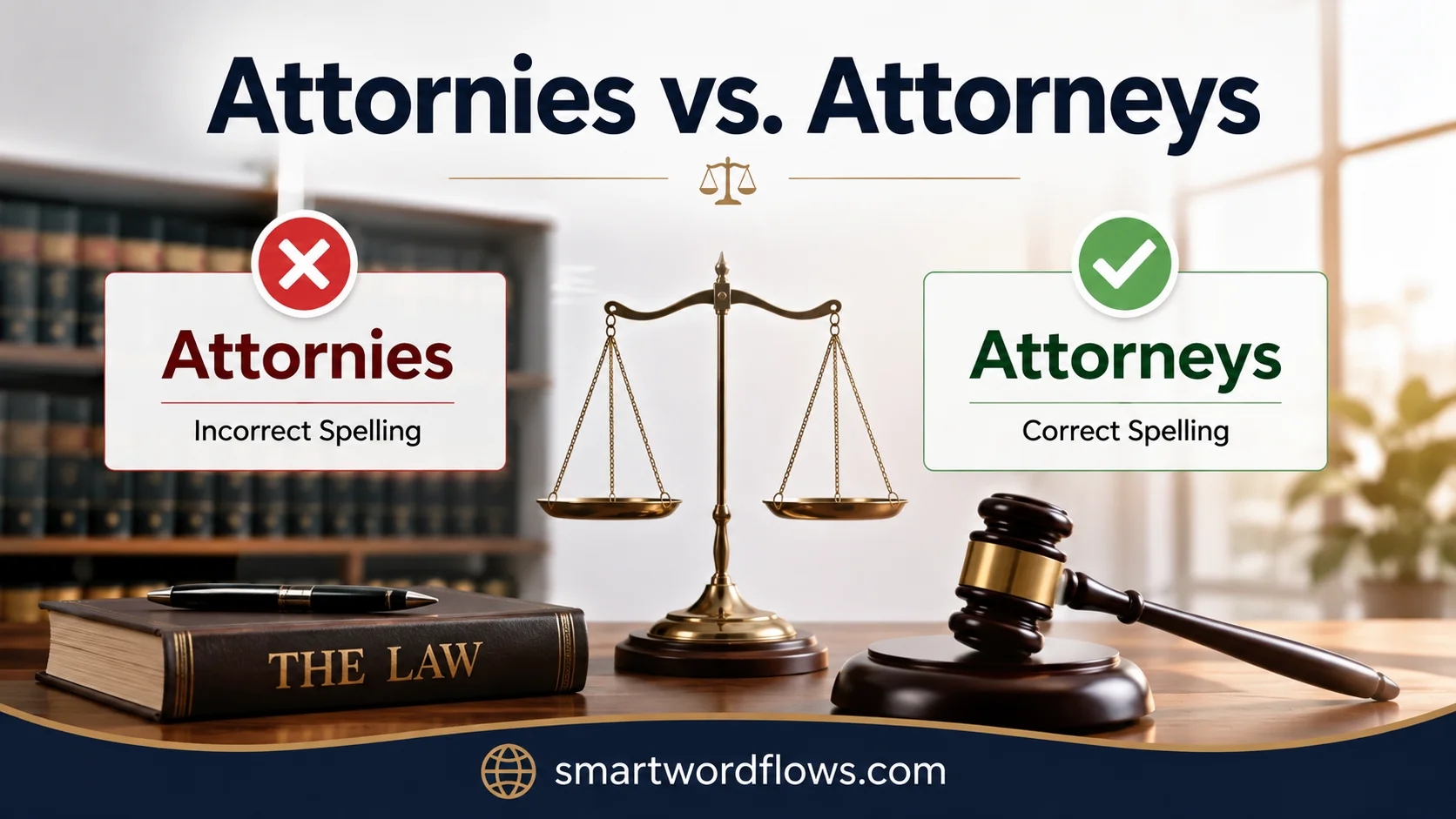

Attornies vs. Attorneys is a common spelling question in American English, especially when writing about legal professionals. The correct plural form is attorneys, while attornies is considered incorrect. An attorney is a person legally appointed to act on another person’s behalf. Although words like city change to cities, the word attorney keeps its -y when pluralized, forming attorneys. Knowing this simple rule helps you avoid spelling mistakes in professional writing.
In legal writing, business communication, and formal documents, always use attorneys when referring to more than one attorney. You may also see the word frequently in court cases, law firms, legal articles, and academic writing. Remember the pattern: one attorney, two attorneys. Using the correct spelling makes your writing look polished and improves clarity. Once you understand this plural noun rule, it becomes much easier to recognize and avoid the common mistake of writing attornies.
Quick Answer
Attorneys is the correct plural of attorney.
Attornies is a misspelling.
The spelling rule is straightforward:
- Attorney = one
- Attorneys = more than one
- Attorney’s = something belonging to one attorney
- Attorneys’ = something belonging to multiple attorneys
Why does attorney become attorneys instead of attornies?
Because the word ends in -ey. The letter immediately before y is e, which is a vowel. Words ending in a vowel + y generally form their plural by adding s.
Compare:
- attorney → attorneys
- key → keys
- boy → boys
- day → days
By contrast, many words ending in consonant + y change the y to ies:
- company → companies
- party → parties
- policy → policies
- city → cities
So the easiest rule to remember is:
Vowel + y: add S. Consonant + y: usually change Y to IES.
That’s why attorneys is correct.
Comparison Overview
| Word or phrase | Correct? | Meaning or use |
| attorney | Yes | Singular noun |
| attorneys | Yes | Plural noun |
| attornies | No | Common misspelling |
| attorney’s | Yes | Singular possessive |
| attorneys’ | Yes | Plural possessive |
| attorney general | Yes | Singular title |
| attorneys general | Yes | Plural title |
| attorney-at-law | Yes | Singular compound noun |
| attorneys-at-law | Yes | Plural compound noun |
The most important distinction is simple: attorneys describes two or more attorneys. It doesn’t represent a different type of lawyer.
Main Differences Between Attornies vs. Attorneys
The difference between attornies and attorneys isn’t a difference in meaning, pronunciation, or legal status. It’s a difference between a correct spelling and a misspelling.
Attorneys Is the Correct Plural
Attorneys is the standard plural form of attorney.
For example:
- “The company hired three attorneys.”
- “Several attorneys attended the hearing.”
- “The attorneys reviewed the agreement.”
- “Two attorneys represented the parties.”
In each sentence, attorneys refers to more than one attorney.
Attornies Is Not the Standard Plural
Attornies isn’t the accepted plural spelling of attorney.
You might encounter it online, in informal writing, or in documents containing typing errors. Its appearance doesn’t make it a legitimate alternative spelling.
The mistake usually happens because writers remember a real English pattern:
- city → cities
- company → companies
- family → families
They then apply that pattern to attorney:
- attorney → attornies
That reasoning looks plausible. The spelling rule, however, doesn’t work that way here.
The Difference Comes From the Letter Before Y
Look closely at the final two letters:
attorne + y
The y follows the vowel e.
That matters because English commonly treats vowel + y differently from consonant + y when forming plurals.
So:
attorne-y → attorne-ys → attorneys
Not:
attorn-ey → attorn-ies
That tiny distinction solves the entire spelling problem.
Why Is “Attorneys” the Correct Spelling?
English pluralization isn’t perfectly consistent, but this particular rule is useful.
When a noun ends in consonant + y, the plural often replaces y with ies.
For example:
- baby → babies
- country → countries
- library → libraries
- activity → activities
The letter immediately before y is a consonant in each case.
Now look at words ending in vowel + y:
- boy → boys
- key → keys
- toy → toys
- day → days
- journey → journeys
- attorney → attorneys
Here, the letter immediately before y is a vowel.
The Rule in Action
| Singular | Letter before Y | Plural |
| company | n | companies |
| party | t | parties |
| city | t | cities |
| baby | b | babies |
| boy | o | boys |
| key | e | keys |
| toy | o | toys |
| attorney | e | attorneys |
This is why attorney belongs with key, boy, and toy, not with city or company.
A Simple Way to Remember It
When you’re unsure, don’t stare at the whole word. Look at the two letters at the end.
If you see:
vowel + y → usually add s
If you see:
consonant + y → usually change y to ies
For attorney, you see ey.
Therefore:
attorney → attorneys
That’s the spelling you want.
What Does “Attorney” Mean?
An attorney is commonly used in American English to mean a lawyer. The word can also refer more broadly to someone authorized to act for another person in certain legal or formal matters.
That broader meaning explains phrases such as power of attorney, where an individual gives another person authority to act on their behalf.
The plural attorneys simply refers to more than one person who is an attorney.
For example:
“The attorneys met before the hearing.”
Here, attorneys refers to multiple lawyers.
The legal context doesn’t change the spelling. Whether you’re talking about criminal defense attorneys, corporate attorneys, tax attorneys, or attorneys handling estate matters, the plural remains attorneys.
How to Use “Attorney” and “Attorneys” Correctly
Knowing the spelling is one thing. Using the singular and plural forms correctly is another.
Singular: Attorney
Use attorney when you’re talking about one person.
Examples:
- “The attorney called the client.”
- “She hired an attorney.”
- “The attorney reviewed the contract.”
- “I spoke with an attorney yesterday.”
Notice the use of an before attorney. The word begins with a vowel sound, so an attorney is correct.
Plural: Attorneys
Use attorneys when you’re talking about two or more people.
Examples:
- “The attorneys discussed the settlement.”
- “Several attorneys attended the conference.”
- “The firm employs dozens of attorneys.”
- “The attorneys reviewed the evidence.”
The plural doesn’t require an apostrophe.
This is important because attorneys and attorney’s perform completely different jobs.
Attorney vs. Attorneys: Singular and Plural
The basic distinction is easy:
| Number | Correct form | Example |
| One | attorney | “One attorney reviewed the case.” |
| Two or more | attorneys | “Three attorneys reviewed the case.” |
You can think of the s as the marker that tells the reader you’re talking about more than one.
Incorrect
“The company has five attornies.”
Correct
“The company has five attorneys.”
Incorrect
“Several attornies signed the document.”
Correct
“Several attorneys signed the document.”
The difference is only one letter, but that letter matters.
Attorney’s vs. Attorneys’: Understanding the Apostrophe
The apostrophe creates another common source of confusion.
Attorney’s, attorneys, and attorneys’ aren’t interchangeable.
Each form has a different grammatical function.
Attorney’s: Singular Possessive
Attorney’s usually means something belongs to or is associated with one attorney.
Examples:
- “The attorney’s office is downtown.”
- “The attorney’s opinion was important.”
- “I found the attorney’s business card.”
- “The attorney’s client arrived early.”
Think:
one attorney + possession = attorney’s
Attorneys: Simple Plural
Attorneys means more than one attorney.
Examples:
- “The attorneys met privately.”
- “Several attorneys attended.”
- “The attorneys exchanged documents.”
There’s no apostrophe because you’re simply making the noun plural.
Attorneys’: Plural Possessive
Attorneys’ indicates possession by multiple attorneys.
Examples:
- “The attorneys’ offices are on different floors.”
- “The attorneys’ arguments differed.”
- “The attorneys’ schedules conflicted.”
Here’s the easiest comparison:
| Form | Meaning | Example |
| attorney | One attorney | The attorney arrived. |
| attorneys | More than one | The attorneys arrived. |
| attorney’s | Belonging to one | The attorney’s file |
| attorneys’ | Belonging to several | The attorneys’ files |
A Quick Test
If you’re trying to make attorney plural, don’t add an apostrophe.
Use:
attorneys
If you’re showing possession, ask how many attorneys own or relate to the thing.
- One → attorney’s
- More than one → attorneys’
That simple test prevents a surprising number of punctuation mistakes.
Attorney General vs. Attorneys General
Here’s where English gets a little more interesting.
The plural of attorney general is attorneys general, not attorney generals.
Why?
Because attorney is the main noun. General modifies it.
So the plural marker goes on attorney:
attorney general → attorneys general
This follows the same basic principle used in other compounds where the main noun appears before a modifier.
Examples
- “The attorney general issued a statement.”
- “Several attorneys general joined the lawsuit.”
- “The state attorney general announced the investigation.”
- “The attorneys general discussed the issue.”
This form is well established in American English.
Why “Attorney Generals” Sounds Wrong
A common assumption is that the last word should receive the plural ending:
attorney general → attorney generals
But general isn’t the noun being pluralized in this title. Attorney is.
Therefore:
One attorney general
Two attorneys general
This is an excellent example of why English compounds sometimes require you to identify the grammatical core rather than simply add -s to the final word.
Attorney-at-Law vs. Attorneys-at-Law
Another related form is attorney-at-law.
This term generally refers to a lawyer who is licensed to practice law.
The plural is:
attorneys-at-law
Notice where the plural marker goes.
It attaches to attorney:
- attorney-at-law
- attorneys-at-law
Not:
- attorney-at-laws
For example:
“The firm employs several attorneys-at-law.”
The same idea appears in other compound expressions. The principal noun carries the plural marker while the remaining words retain their original form.
Common Misspellings of “Attorneys”
The most important misspelling to recognize is attornies.
However, writers can make several other spelling errors when typing the word quickly.
Attornies
Incorrect: attornies
Correct: attorneys
This is the most common conceptual error because writers apply the wrong -y plural rule.
Attornys
Incorrect: attornys
Correct: attorneys
This version simply drops the e before adding s.
Attorneys
Correct: attorneys
This is the form to use in standard English writing.
If you’re editing a legal website or proofreading professional documents, it’s worth searching specifically for attornies. Spell-check software may catch obvious errors, but targeted proofreading catches mistakes that automated tools can miss.
Read More: Steer vs Stear: Spelling Mistake, Meaning, and Correct Usage
Why Do People Write “Attornies”?
The mistake makes sense once you understand the pattern behind it.
English contains many familiar nouns that end in consonant + y:
- company → companies
- policy → policies
- party → parties
- agency → agencies
- industry → industries
After seeing this pattern repeatedly, it’s easy to assume that every noun ending in y behaves the same way.
It doesn’t.
The letter immediately before y changes the rule.
Consider this pair:
company → companies
The final sequence is ny. The n is a consonant.
Now consider:
attorney → attorneys
The final sequence is ey. The e is a vowel.
That single letter separates the two patterns.
A Useful Comparison
Imagine the plural rule as a fork in the road:
Word ending in -y
→ Consonant + y → usually -ies
→ Vowel + y → usually -s
Once you identify which road attorney belongs to, the spelling becomes easy.
Real-World Examples: Attornies vs. Attorneys
Seeing the difference in context makes the rule easier to remember.
| Incorrect | Correct |
| The company hired two attornies. | The company hired two attorneys. |
| Several attornies attended the hearing. | Several attorneys attended the hearing. |
| The attornies reviewed the contract. | The attorneys reviewed the contract. |
| Three attornies represented the clients. | Three attorneys represented the clients. |
| The firm employs experienced attornies. | The firm employs experienced attorneys. |
Here are more natural examples using the correct form:
- “The attorneys reached an agreement.”
- “Several attorneys specialize in corporate law.”
- “The attorneys reviewed the proposed settlement.”
- “Two attorneys represented the defendant.”
- “The company consulted its attorneys before signing.”
- “The attorneys prepared separate arguments.”
The pattern stays the same regardless of the legal specialty.
Case Study: Why the Wrong Rule Creates the Wrong Word
Consider a writer preparing this sentence:
“The law firm has twenty experienced attornies.”
The writer knows that company becomes companies and party becomes parties. They apply that same pattern to attorney.
The problem isn’t that the writer doesn’t understand plurals. The problem is that they applied the consonant + y rule to a word ending in vowel + y.
Now make one small correction:
“The law firm has twenty experienced attorneys.”
The sentence immediately looks professional.
This is a useful lesson beyond this one word. English spelling rules often depend on the letters immediately surrounding a word ending rather than the final letter alone.
Attornies vs. Attorneys in Professional Writing
Spelling becomes especially important in professional contexts.
A misspelled word on a casual text message may go unnoticed. A misspelled professional title on a law firm’s website can create a very different impression.
Correct spelling matters in:
- Legal websites
- Contracts
- Court-related correspondence
- Business letters
- Resumes
- Job applications
- Academic papers
- Press releases
- Professional directories
- Marketing materials
- Company profiles
- Legal research
If a website repeatedly uses attornies, readers may question the quality of the content even when the underlying information is accurate.
That doesn’t mean one spelling mistake proves anything about someone’s legal ability. It simply shows why proofreading matters when you’re communicating professionally.
“Attorney” vs. “Lawyer”: Are They the Same?
In everyday American English, attorney and lawyer are often used interchangeably.
For example:
- “I need to speak with an attorney.”
- “I need to speak with a lawyer.”
In many ordinary situations, both sentences communicate essentially the same idea.
However, the terms can have different technical or historical uses depending on the legal system and context. Attorney can also describe someone authorized to act for another person, which is why the phrase power of attorney has a broader meaning than simply “power of a lawyer.”
For everyday US writing, though, you can generally understand attorney as a common term for a lawyer.
The plural distinction remains unchanged:
- one attorney → attorneys
- one lawyer → lawyers
A Simple Memory Trick for Attorneys
If attornies keeps tempting you, use one of these shortcuts.
Compare Attorney With Key
You already know:
key → keys
Not:
key → keies
Now apply the same ending pattern:
attorney → attorneys
Both words have a vowel immediately before y.
Look at “EY”
When you see ey at the end of attorney, remember:
EY takes S.
So:
attorne + y + s = attorneys
Use the One-Two Test
Say it to yourself:
One attorney. Two attorneys.
This is perhaps the simplest memory aid of all.
Facts About the Word “Attorney”
A few useful facts help put the spelling question into context:
- Attorney is a noun.
- Attorneys is its standard plural form.
- Attornies is a misspelling.
- The word can commonly refer to a lawyer in American English.
- Attorney general becomes attorneys general in the plural.
- Attorney-at-law becomes attorneys-at-law.
- Attorney’s is generally singular possessive.
- Attorneys’ is plural possessive.
- The spelling attorneys follows the vowel + y plural pattern.
Merriam-Webster’s dictionary treatment of attorney supports attorneys as the plural form.
Quick Reference: Attorney Pluralization Cheat Sheet
| Form | Correct? | Explanation | Example |
| attorney | Yes | Singular | One attorney |
| attorneys | Yes | Plural | Three attorneys |
| attornies | No | Misspelling | Don’t use it |
| attorney’s | Yes | Singular possessive | The attorney’s office |
| attorneys’ | Yes | Plural possessive | The attorneys’ offices |
| attorney general | Yes | Singular title | The attorney general spoke |
| attorneys general | Yes | Plural title | The attorneys general met |
| attorney-at-law | Yes | Singular compound | An attorney-at-law |
| attorneys-at-law | Yes | Plural compound | Several attorneys-at-law |
FAQs :
1. Is “Attornies” a correct word?
No. Attornies is considered an incorrect spelling. The correct plural form of attorney is attorneys.
2. What is the plural of attorney?
The plural of attorney is attorneys. For example: “The two attorneys discussed the case.”
3. Why is “attorneys” spelled with -eys?
Unlike words such as city → cities, attorney keeps its original ending when pluralized. You simply add -s to form attorneys.
4. When should I use “attorneys”?
Use attorneys whenever you’re referring to more than one legal professional, especially in legal writing, business documents, court cases, and professional communication.
5. How can I remember the correct spelling?
Remember the simple pattern: one attorney → two attorneys. The ending stays -ey, making it easy to avoid the common spelling attornies.
Conclusion :
Attorneys is the correct and standard plural form of attorney, while attornies is a common spelling mistake. Remembering “one attorney, two attorneys” will help you use the correct spelling confidently in legal, academic, and professional writing.