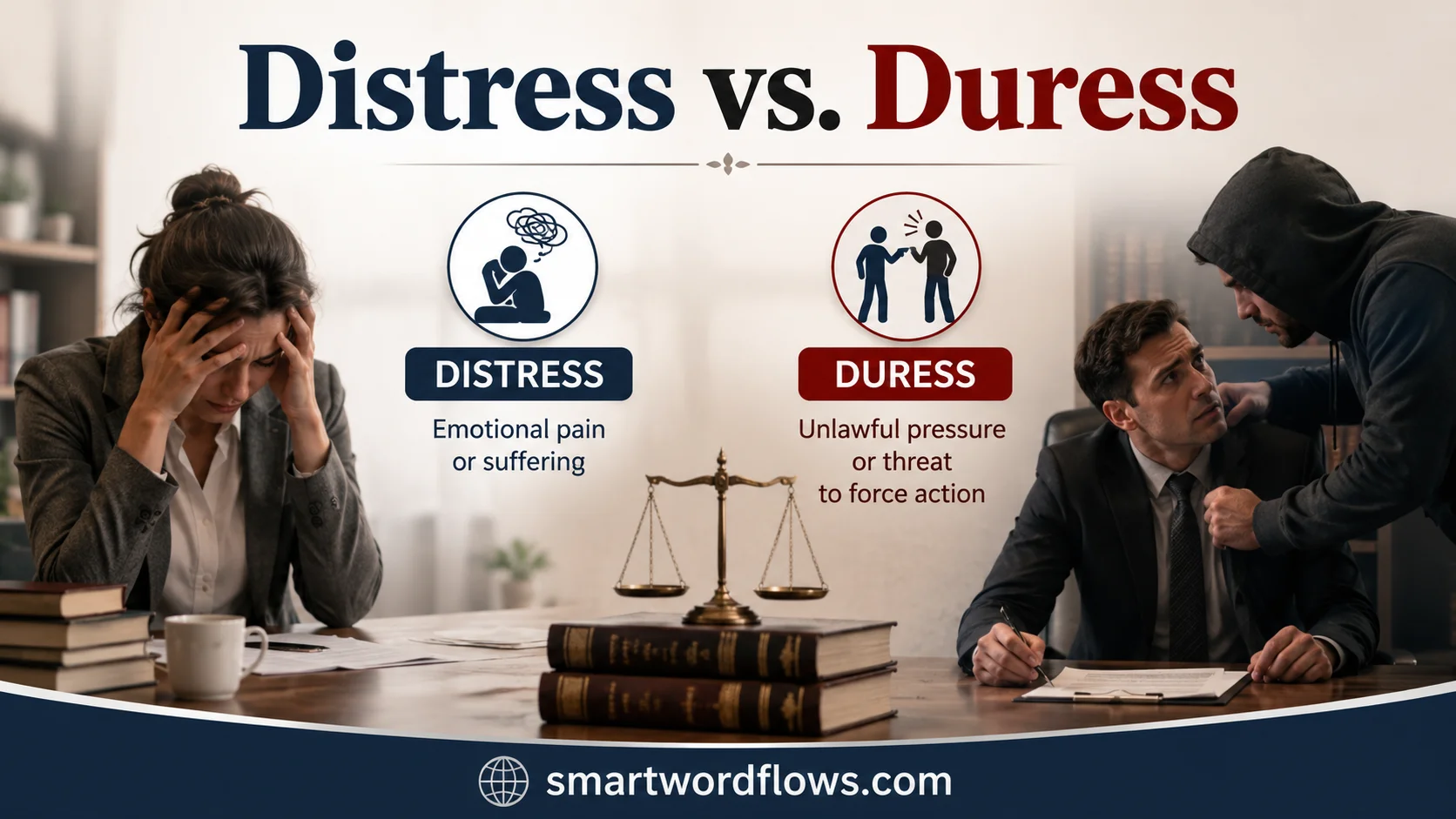

Distress vs. Duress can be confusing because both words relate to difficult situations, but their meanings are different. Distress describes a state of emotional, mental, or physical suffering, often caused by stress, fear, loss, pain, or hardship. You might experience distress after losing a job, facing financial problems, receiving sad news, or dealing with an accident. Understanding this meaning helps you use distress correctly in everyday conversations, academic writing, professional communication, and discussions about emotional or physical well-being.
Duress, on the other hand, refers to force, threats, pressure, or coercion that makes someone do something against their will. This word commonly appears in legal, business, and contractual contexts. For example, someone may sign an agreement under duress because another person threatens or intimidates them. The easiest way to remember the difference is simple: distress describes suffering, while duress describes forced action. Knowing this distinction can help you avoid vocabulary mistakes and communicate your meaning clearly and confidently.
Quick Answer
The simplest way to distinguish distress vs. duress is this:
Distress means suffering or serious trouble. Duress means coercion or forced action.
For example:
- Distress: “The accident caused her severe emotional distress.”
- Duress: “He signed the contract under duress.”
In the first sentence, distress describes the suffering she experienced.
In the second, duress describes the coercive circumstances that affected his decision.
The easiest memory trick
Think of it this way:
Distress = suffering.
Duress = coercion.
If you’re describing someone who is anxious, suffering, grieving, struggling, or in serious trouble, distress will usually fit.
If you’re describing someone being forced to act because of threats or improper coercive pressure, duress is the better word.
Comparison Overview
| Feature | Distress | Duress |
| Basic meaning | Suffering, anxiety, hardship, or trouble | Coercion, compulsion, or forced action |
| Main focus | The person’s condition or suffering | The pressure imposed on the person |
| Common contexts | Emotional, physical, financial, emergency situations | Legal, contractual, coercive situations |
| Common phrase | “In distress” | “Under duress” |
| Can describe emotion? | Yes | Usually not in the same sense |
| Can describe financial problems? | Yes | Sometimes, particularly as economic duress |
| Usually involves coercion? | No | Yes |
| Common legal meaning | Can have specialized meanings, including property seizure | Coercion that may affect contracts or criminal liability |
| Example | “She was in distress.” | “She acted under duress.” |
The distinction is subtle enough to confuse people but clear enough to learn quickly.
Distress describes what someone is going through. Duress describes coercive pressure that influences what someone does.
Main Differences Between Distress vs. Duress
The biggest difference between distress vs. duress lies in what each word identifies.
Distress focuses on suffering. Duress focuses on compulsion.
Imagine someone receives a frightening threat.
The threat may cause the person distress because it creates fear and anxiety. If the threat also forces that person to sign a document or perform an action, the coercive situation may constitute duress, depending on the circumstances and applicable law.
So the two concepts can appear in the same situation without meaning the same thing.
Distress describes a condition
You might experience distress after:
- A serious accident
- The death of someone close to you
- A frightening event
- Financial problems
- A medical emergency
- A natural disaster
- Severe workplace difficulties
- A traumatic experience
Nothing in the word distress requires another person to force you to do something.
Duress describes coercive pressure
Duress generally involves someone using unlawful threats or coercive behavior to make another person do something they otherwise wouldn’t do. In US legal terminology, the precise requirements vary according to the legal context and jurisdiction.
For example:
“She was under emotional distress after the accident.”
This describes suffering.
“She signed the agreement under duress.”
This describes a potentially coercive circumstance affecting her decision.
That one-word difference can completely change the meaning of a sentence.
What Does Distress Mean?
Distress is a noun and a verb with several established meanings.
In everyday English, the word most often describes serious emotional, physical, or practical suffering.
Distress as a noun
When used as a noun, distress can describe a state of severe discomfort, anxiety, pain, hardship, or trouble.
Examples include:
- “The news caused considerable distress.”
- “The passengers were in distress.”
- “The family experienced financial distress.”
- “The accident caused emotional distress.”
- “The child appeared to be in physical distress.”
Notice what all these sentences have in common.
They describe a difficult condition, not necessarily coercion.
Distress as a verb
Distress can also function as a verb.
It means to cause someone emotional or physical suffering, worry, or pain.
For example:
“The news distressed her.”
Here, distressed means the news caused her significant emotional suffering.
Another example:
“It distressed him to see his friend struggling.”
The word identifies the emotional effect of the situation.
Distress can describe different types of suffering
The word isn’t limited to emotional problems.
Common forms include:
Emotional distress
Emotional distress refers to mental suffering resulting from an event, condition, or series of events. In US tort law, emotional distress can also form part of claims involving intentional or negligent infliction of emotional distress.
Financial distress
A person, household, or business can experience financial distress when serious financial problems threaten its ability to meet obligations.
For example:
“The company entered financial distress after losing its largest customer.”
The company isn’t necessarily being coerced. It’s struggling financially.
Physical distress
Physical distress describes serious physical difficulty or discomfort.
For example:
“The patient showed signs of respiratory distress.”
Distress during emergencies
You may also see distress in emergency communication:
“The vessel sent a distress signal.”
Here, the signal communicates that the vessel needs urgent assistance.
What Does Duress Mean?
Duress refers to coercion, compulsion, or improper pressure that causes someone to act against their free will.
The term is particularly important in law.
Cornell’s Legal Information Institute defines duress as a situation involving unlawful threats or coercive behavior that causes someone to perform an act they otherwise wouldn’t perform. In contract law, duress can make a contract voidable.
Duress in ordinary language
Although duress has a strong legal flavor, it can also appear in broader writing.
For example:
“The workers claimed they accepted the conditions under duress.”
The phrase suggests that the workers didn’t make the decision freely.
Still, duress is not simply a fancy synonym for stress.
That’s an important distinction.
If your boss gives you a difficult assignment, you might feel stressed.
If someone threatens you and uses that threat to force you to sign an agreement, the situation may involve duress.
The phrase “under duress”
One of the most common constructions is:
under duress
Examples:
- “He signed under duress.”
- “She claimed that she acted under duress.”
- “The agreement was allegedly entered into under duress.”
- “The defendant argued that he acted under duress.”
This phrase has a strong association with coercion and legal proceedings.
Distress vs. Duress in Legal Contexts
Legal usage makes the difference between these words especially important.
Duress is a recognized legal concept. Distress can also appear in law, but its legal meanings vary considerably by context.
Duress in contract law
A contract generally depends on voluntary agreement.
When one party uses improper coercion to force another party into an agreement, the affected party may raise duress.
Cornell’s Legal Information Institute explains that duress can render a contract voidable.
Consider this hypothetical example:
A supplier threatens to unlawfully destroy a small business’s property unless the owner signs a highly unfavorable contract immediately.
The owner may later argue that the agreement resulted from duress.
The key issue isn’t simply that the contract was unpleasant.
The issue is whether improper coercive pressure undermined genuine free choice.
Economic duress
Duress doesn’t always involve someone physically threatening another person.
US legal sources also recognize the concept of economic duress, sometimes called business compulsion. It can arise when improper conduct creates severe economic pressure that prevents someone from exercising genuine free choice in a commercial agreement.
A simplified example might look like this:
A company uses improper pressure to threaten termination of an existing contractual relationship unless the other party accepts significantly different terms.
Whether that conduct legally establishes economic duress depends on the facts and applicable law.
That’s why legal discussions should avoid treating every difficult business negotiation as duress.
Duress in criminal law
Duress can also arise as an affirmative defense in criminal law.
At a general level, a defendant may argue that another person’s coercion or threat forced them to commit an otherwise criminal act. Legal requirements vary, but the defense generally involves serious coercive circumstances rather than ordinary pressure.
For example:
A person claims that another individual threatened them with serious harm unless they participated in a crime.
The relevant legal question isn’t simply whether the defendant felt frightened.
A court may examine the nature and immediacy of the threat, the defendant’s options, and other requirements established by the applicable law.
That makes “duress” a much more precise word than “stress.”
Distress in Legal Language
While duress is strongly associated with coercion, distress also has specialized legal meanings.
One important historical legal meaning involves distress or distraint, which refers to the seizure of personal property to satisfy a demand, traditionally including unpaid rent or other debts.
Historically, landlords and other parties could use forms of distress to seize property in certain circumstances.
Modern US law regulates these practices through statutes, and the rules vary by jurisdiction.
So don’t assume that distress always means emotional suffering when you encounter it in a legal document.
The surrounding context matters.
Emotional distress in law
Legal writing also frequently uses emotional distress.
It refers to mental suffering associated with an event, occurrence, pattern of events, or condition. Depending on the jurisdiction and circumstances, emotional distress can become relevant to tort claims and damages.
This gives you another useful distinction:
Emotional distress = suffering.
Duress = coercion.
They can occur together, but they’re not interchangeable legal concepts.
Distress vs. Duress Examples
The fastest way to understand distress vs. duress is to compare them in realistic sentences.
Example: An accident
“The accident caused significant emotional distress.”
Correct.
The sentence describes suffering caused by the accident.
Using duress wouldn’t make sense unless the accident somehow involved coercive circumstances.
Example: A forced agreement
“He signed the agreement under duress.”
Correct.
The sentence indicates that coercive pressure affected his decision.
Example: Financial problems
“The company is experiencing severe financial distress.”
Correct.
The company is struggling financially.
Example: A threat
“She agreed to the demand under duress.”
Correct if the facts support coercion.
The phrase indicates that she didn’t make the decision freely.
Example: A stressful deadline
“I’m under a lot of stress because of the deadline.”
Correct.
Using duress here would normally exaggerate the situation and change its meaning.
Example: A frightening situation
“The passengers were in distress.”
This describes their condition.
If another person forced them to take an action through threats, you could potentially discuss duress as well.
Distress vs. Duress: Common Phrases
Learning common word combinations can make the distinction much easier.
Common phrases with distress
You will frequently see:
- emotional distress
- financial distress
- physical distress
- severe distress
- considerable distress
- in distress
- cause distress
- distress signal
- distressed person
- distressing situation
Examples:
“The family suffered considerable emotional distress.”
“The vessel transmitted a distress signal.”
“The business remains in financial distress.”
Common phrases with duress
You will commonly encounter:
- under duress
- act under duress
- sign under duress
- consent under duress
- claim duress
- allege duress
- economic duress
- duress defense
Examples:
“The defendant claimed that he acted under duress.”
“She alleged that the contract was signed under duress.”
“The company raised economic duress as part of its argument.”
These collocations provide a useful shortcut.
When you naturally want to write “under ___,” the established phrase is usually “under duress,” not “under distress.”
Distress vs. Duress vs. Stress vs. Pressure
The confusion doesn’t stop with two words.
Stress and pressure can also overlap with distress and duress.
Understanding all four terms gives you a much cleaner vocabulary map.
| Word | Meaning | Example |
| Stress | Mental or physical strain | “The workload caused stress.” |
| Distress | Serious suffering or trouble | “The accident caused emotional distress.” |
| Pressure | A demand or influence pushing someone toward an action | “She felt pressure to accept the offer.” |
| Duress | Coercive pressure that compels action | “He signed under duress.” |
Stress
Stress is broad.
You can experience stress because of:
- Work
- School
- Money
- Relationships
- Deadlines
- Major life changes
Stress doesn’t necessarily involve coercion.
Pressure
Pressure sits somewhere between ordinary influence and coercion.
A manager might pressure an employee to finish a project. A family member might pressure someone to attend an event.
That doesn’t automatically mean duress.
Distress
Distress generally signals a more serious degree of suffering.
You can experience stress without reaching severe distress.
Duress
Duress introduces another element: coercive compulsion.
That’s the crucial dividing line.
Common Mistakes When Using Distress and Duress
Mistake: Treating duress as a synonym for stress
Incorrect in most ordinary contexts:
“I’m under duress because I have too much work.”
Better:
“I’m under a lot of stress because I have too much work.”
The second sentence accurately describes ordinary strain.
Mistake: Using distress when you mean coercion
Consider:
“He signed the contract in distress.”
This could mean he was emotionally upset when he signed it.
If the intended meaning is that someone forced him to sign, write:
“He signed the contract under duress.”
The second sentence communicates coercion.
Mistake: Assuming every threat creates legal duress
This is especially important in legal writing.
Not every unpleasant demand, threat, negotiation tactic, or difficult choice automatically establishes duress.
Legal definitions and tests differ by jurisdiction and context. Cornell’s legal materials illustrate how duress can involve specific requirements concerning unlawful threats, coercion, free will, and reasonable alternatives.
So avoid writing:
“Any threat automatically constitutes duress.”
That’s far too broad.
Mistake: Assuming distress only refers to emotions
Distress can describe financial trouble, physical problems, emergency situations, and specialized legal concepts.
For example:
“The company is in financial distress.”
That’s perfectly normal English.
Case Study: One Situation, Two Different Words
Consider a fictional business owner named Maya.
A supplier threatens to terminate an essential existing business relationship unless Maya signs a new agreement immediately. The pressure becomes severe enough that Maya claims she had no reasonable way to protect her business.
There are two different concepts you could describe.
Maya’s emotional response
Maya may experience:
- Anxiety
- Fear
- Sleeplessness
- Emotional suffering
- Financial worry
Those reactions can be described as distress.
The coercive circumstances
If the supplier’s conduct meets the applicable legal requirements for coercion, Maya might argue that she entered the new agreement under economic duress.
The distinction is clean:
Maya’s suffering = distress.
The coercive pressure affecting her decision = duress.
That example shows why the words can appear in discussions about the same event without being synonyms.
Can Distress and Duress Overlap?
Yes, but they still mean different things.
Imagine someone threatens another person.
The victim may feel distress because the threat causes fear and anxiety.
At the same time, the threat may create duress if it improperly compels the victim to take an action.
Think of the relationship like this:
Coercive pressure → possible duress → emotional suffering may result in distress
But the chain isn’t automatic.
Someone can experience distress without duress.
Someone can face a legally significant coercive situation without the writer’s main point being emotional distress.
The words identify different aspects of an experience.
Why Do Distress and Duress Sound So Similar?
The similarity isn’t accidental.
Both words have long histories involving ideas of hardship, restraint, pressure, and coercion.
The history of distress
Distress entered English in the late 13th century through Old French destresse. Its deeper history connects it to Latin districtus and distringere, associated with restraint, pressure, hindrance, and compulsion. The meaning later developed toward anguish, grief, pain, and physical or mental suffering.
The history of duress
Duress entered English in the early 14th century from Old French duresse, related to Latin duritia, meaning hardness. By the early 15th century, it had developed the sense of coercion or compulsion and acquired its legal sense involving physical constraint or threatened constraint.
So the words share a conceptual neighborhood.
Their modern meanings nevertheless took different paths.
Distress moved strongly toward suffering and hardship.
Duress moved toward coercion and compulsion.
That’s why their spellings may look like linguistic cousins while their modern uses remain distinct.
Grammar and Word Forms
Knowing how each word behaves grammatically helps prevent awkward sentences.
Distress
Distress can function as both a noun and a verb.
Noun:
“The accident caused distress.”
Verb:
“The news distressed her.”
You can also use related forms:
- distress
- distressed
- distressing
Examples:
“He looked distressed.”
“It was a distressing experience.”
Duress
Duress is normally used as a noun.
The most familiar structure is:
under duress
Examples:
“He acted under duress.”
“She signed under duress.”
Don’t casually create forms such as duressed when standard English gives you clearer alternatives.
Instead, use phrases such as:
- “acted under duress”
- “was subjected to coercion”
- “was forced to act”
- “claimed duress”
How to Choose Between Distress and Duress
When you’re unsure, ask one simple question:
Am I describing suffering or coercion?
Choose “distress” when you’re describing:
- Anxiety
- Pain
- Emotional suffering
- Physical difficulty
- Hardship
- Financial problems
- Emergency conditions
- Serious trouble
Example:
“The family experienced severe emotional distress.”
Choose “duress” when you’re describing:
- Coercion
- Compulsion
- Threats
- Forced decisions
- Lack of meaningful free choice
- Certain contract disputes
- Certain criminal defenses
Example:
“The defendant claimed that he acted under duress.”
Choose “stress” for ordinary strain
Example:
“The project deadline is causing a lot of stress.”
Choose “pressure” for influence or demands
Example:
“The employee felt pressure to accept the offer.”
This four-word distinction can solve most everyday usage questions.
Read More: Attornies vs. Attorneys: Which Spelling Is Correct?
A Simple Memory Trick for Distress vs. Duress
Here’s the shortcut worth remembering:
Distress hurts. Duress compels.
Or use this two-question test.
Question one: Is someone suffering?
→ Distress
Question two: Is someone being coerced into doing something?
→ Duress
For example:
“The disaster left thousands in distress.”
Suffering is the focus.
“He signed the document under duress.”
Coercion is the focus.
Once you recognize that difference, the words stop looking like interchangeable twins.
Distress vs. Duress: Quick Reference Table
| If you mean… | Use… | Example |
| Emotional suffering | Distress | “The event caused emotional distress.” |
| Financial hardship | Distress | “The company is in financial distress.” |
| Physical suffering | Distress | “The patient showed signs of distress.” |
| An emergency | Distress | “The ship sent a distress signal.” |
| Coercion | Duress | “He acted under duress.” |
| A forced contract | Duress | “She signed under duress.” |
| Coercive economic pressure | Duress | “The company alleged economic duress.” |
| Ordinary workload strain | Stress | “The deadline caused stress.” |
| General influence | Pressure | “He felt pressure to agree.” |
Frequently Asked Questions About Distress vs. Duress
What is the difference between distress and duress?
Distress means suffering, hardship, anxiety, or serious trouble. Duress means coercive pressure or compulsion that forces someone to act against their free will.
Is duress the same as stress?
No.
Stress refers broadly to mental or physical strain. Duress involves coercion or compulsion, especially in legal contexts.
Having a stressful day doesn’t normally mean you’re under duress.
Is emotional distress the same as duress?
No.
Emotional distress describes mental suffering. Duress describes coercive circumstances.
A person could experience emotional distress because someone subjected them to duress, but the concepts remain different.
What does “under duress” mean?
Under duress means acting while subject to coercive pressure or compulsion.
For example:
“He signed the agreement under duress.”
The phrase suggests that his decision wasn’t genuinely voluntary because of the coercive circumstances.
Can you use “under distress”?
Usually, that’s not the standard expression when you mean suffering.
English commonly uses:
in distress
For example:
“The passengers were in distress.”
By contrast, English commonly uses:
under duress
For example:
“The defendant claimed he acted under duress.”
Can distress and duress describe the same situation?
They can describe different aspects of the same situation.
A threat can cause someone distress while simultaneously creating circumstances that may constitute duress.
The words aren’t synonyms, though.
What is economic duress?
Economic duress refers to coercive economic pressure that can undermine someone’s free choice in entering a commercial agreement. The precise legal requirements depend on the applicable law.
What is a synonym for distress?
Depending on context, useful alternatives include:
- Suffering
- Anguish
- Hardship
- Anxiety
- Pain
- Trouble
- Misery
The best synonym depends on the sentence.
What is a synonym for duress?
Depending on context, possible alternatives include:
- Coercion
- Compulsion
- Constraint
- Force
- Pressure
In legal writing, however, these terms aren’t necessarily interchangeable. A legal term should be replaced only when the substitute preserves the intended meaning.
FAQs :
1. What is the difference between distress and duress?
Distress means emotional, mental, or physical suffering, while duress means being forced or pressured to do something against your will.
2. What does distress mean in a sentence?
Distress describes a state of suffering or discomfort. For example: “The news caused her great distress.”
3. What does duress mean in a sentence?
Duress refers to pressure, threats, or force. For example: “He signed the contract under duress.”
4. Is “under distress” correct?
Usually, no. The standard expression is “in distress” when describing someone who is suffering. “Under duress” is used when someone is being forced or threatened.
5. How can I easily remember distress vs. duress?
Remember that distress = suffering, while duress = forced action. If someone is experiencing pain or emotional hardship, use distress. If someone is being threatened or coerced, use duress.
Conclusion :
Although distress and duress look and sound similar, they have clearly different meanings. Distress describes suffering, discomfort, or emotional pain, while duress involves force, threats, or coercion. Remembering this simple distinction will help you choose the correct word in everyday conversations, professional writing, and legal contexts.