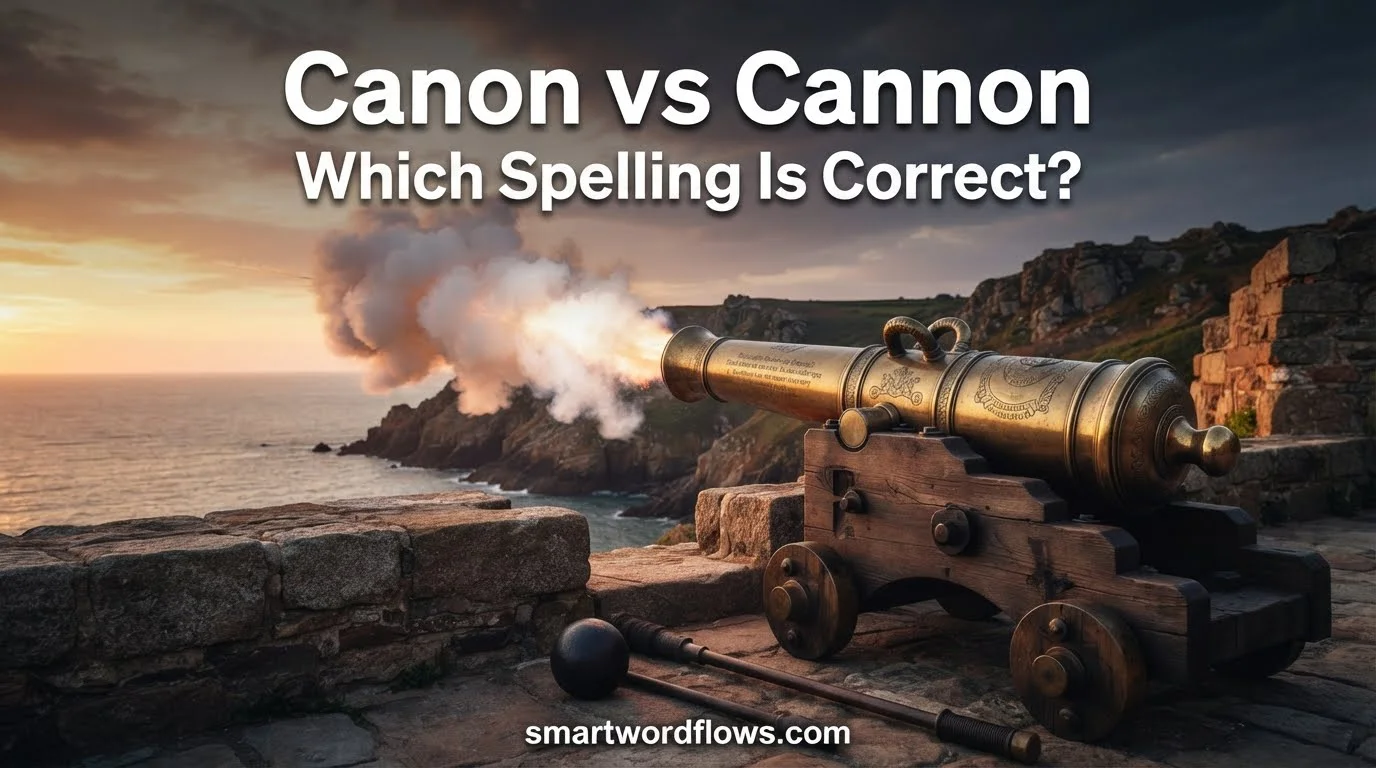

Canon vs Cannon: Which Spelling Is Correct? is a common question because these words have an almost identical look and are pronounced exactly the same, yet their meanings differ completely.
In the English language, canon and cannon differ by one letter, but their meanings are worlds apart. Many writers make spelling mistakes and mistakenly add an extra n, which can change the meaning of a sentence. When discussing an official movie storyline, for example, someone may accidentally use cannon when referring to an established fictional story. This difference between canon and cannon matters in books, movies, religion, photography, and military history, where correct spelling keeps writing clear and accurate.
Canon can describe an accepted collection of works, a recognized rule or standard, official story continuity, or religious texts. The word also appears in the Canon imaging brand, especially in photography, while cannon means a large gun or artillery weapon associated with military subjects and military history. Once you understand these definitions, the distinction becomes easy to connect with the spelling. From my experience, a simple guide with practical examples works better than memorizing a complicated rule: use canon for accepted works, storyline, or a standard, and cannon for artillery. These words appear frequently in academic writing, online discussions, fandom communities, and everyday communication, so understanding their usage can build confidence. To remember the difference, focus on the extra n in cannon: the longer spelling belongs to the large gun, while canon relates to accepted works, official story continuity, or a recognized standard. These simple memory tricks help you use each word correctly. Their origins, pronunciation, and different uses may seem confusing, but the common mistakes become easier to avoid when you practice the simple ways each word belongs in a sentence. Canon and cannon may sound very similar, but they have different meanings and each has its own role.
Quick Answer
Both canon and cannon are correct English words. They simply mean different things.
- Canon means an accepted collection of works, a recognized rule or standard, or something officially established within a particular field.
- Canon also describes material officially accepted as part of a fictional universe, such as a movie, novel, comic, or video game’s established storyline.
- Canon can refer to recognized religious texts or church rules.
- Canon is also the proper name of the Japanese imaging company Canon, known for cameras, lenses, printers, and related products.
- Cannon means a large gun, especially an artillery weapon used historically or in military contexts.
- Canon has one n in the middle.
- Cannon has two n’s.
For example:
That character’s origin is part of the official canon.
But:
The museum displays an old naval cannon.
So, canon vs cannon isn’t a choice between a correct and incorrect spelling. It is a choice between two different words.
Comparison Overview
The easiest way to understand canon vs cannon is to place their meanings side by side.
| Feature | Canon | Cannon |
| Spelling | Canon | Cannon |
| Main meaning | Accepted collection, rule, standard, or established material | Large gun or artillery weapon |
| Common fields | Literature, religion, entertainment, standards, photography | Military history, warfare, artillery, naval history |
| Fictional meaning | Officially established story material | Not normally used for fictional continuity |
| Brand use | Canon is an imaging company | Not normally a brand in this context |
| Number of middle n’s | One | Two |
| Example | The story is part of the official canon. | The ship carried several cannons. |
The spelling difference is tiny, but the semantic difference is substantial.
Think of canon as something that has been accepted, established, or recognized. Think of cannon as a powerful weapon.
That distinction covers most everyday uses.
Main Differences Between Canon vs Cannon
The central difference between canon vs cannon lies in what each word describes. Although their spellings overlap, their meanings developed in separate directions.
Canon Refers to Accepted Works, Rules, or Standards
The word canon often refers to a body of material that a particular group recognizes as authoritative, important, or officially accepted.
For example, people may talk about the literary canon when discussing books and authors widely regarded as significant within literary study.
You may also see phrases such as:
- literary canon
- biblical canon
- artistic canon
- canon of literature
- canon of works
- established canon
The exact meaning depends on the subject. However, the underlying idea involves recognition, acceptance, or an established body of material.
Cannon Refers to a Large Gun
A cannon is a large gun designed to fire a projectile. The word commonly appears in discussions of military history, artillery, ships, fortifications, and historical warfare.
For example:
The fort still contains an eighteenth-century cannon.
Here, cannon has nothing to do with books, rules, or fictional storylines. It refers to a weapon.
That extra n is therefore more than a spelling detail. It identifies an entirely different word.
What Does Canon Mean?
Canon has several established meanings. While these meanings may seem unrelated at first, they share the broad idea of something recognized, accepted, or established.
Canon as a Collection of Accepted Works
One of the most familiar meanings appears in literature.
A canon can refer to a body of works regarded as important or authoritative within a particular literary tradition.
For example, discussions of English literature may refer to Shakespeare, Jane Austen, Charles Dickens, and other major writers when discussing works that have traditionally occupied an important place in the literary canon.
The term doesn’t necessarily mean that every reader or scholar agrees on exactly which works belong. Literary canons can change as scholarship, education, and cultural priorities evolve.
For example:
The university course explores how the literary canon has changed over time.
In this sentence, canon means a recognized body of literature.
Canon in Fiction and Entertainment
Modern entertainment has given canon another extremely common meaning.
When fans say something is canon, they usually mean that the information or event officially belongs to the established story of a fictional universe.
This usage appears across:
- Movies
- Television shows
- Novels
- Comics
- Manga
- Video games
- Animated series
- Shared fictional universes
Suppose a character reveals that they have a brother in an officially released episode. If later stories recognize that relationship, fans may describe the brother as canon.
By contrast, a fan-created story might not belong to the official canon.
For example:
The new episode confirms that the character’s childhood friend is canon.
Another common expression is non-canon, which describes material that doesn’t form part of the officially established continuity.
Canon vs Non-Canon
The distinction becomes especially useful in large fictional universes.
| Term | Meaning |
| Canon | Officially established story material |
| Non-canon | Material outside the official continuity |
| Fan fiction | Stories created by fans rather than official creators |
| Canon event | An event officially established within the story |
This is why canon appears frequently in entertainment discussions.
If someone writes cannon instead, the sentence technically refers to a gun rather than official story material.
Canon as a Rule or Standard
Historically, canon can also refer to a rule, principle, or standard.
This meaning appears in formal and specialized writing.
For example:
The principle became an important canon of legal interpretation.
In this sense, canon describes an accepted principle or rule within a particular system.
The word can therefore move beyond literature and entertainment. Its meaning depends heavily on the surrounding context.
Canon in Religion
Canon also has an important religious meaning.
In religious studies, a canon can refer to the collection of texts recognized as authoritative within a particular religious tradition.
For example, people may discuss the biblical canon when referring to the books recognized as part of the Bible within a particular tradition.
The word can also refer to church rules or regulations in historical and ecclesiastical contexts.
Because different religious traditions recognize different collections of texts, the phrase religious canon requires attention to the specific tradition being discussed.
Canon as a Brand Name
There is another very common use of Canon that has nothing to do with literature or religion.
Canon is the name of a major Japanese imaging company. The company is particularly well known for cameras, lenses, printers, and other imaging products.
Here, capitalization matters:
- canon → common noun
- Canon → proper name or brand
For example:
She bought a Canon camera for photography.
The capital C identifies the company or its products.
That makes context especially important. The sentence The photographer uses a canon could have a completely different meaning depending on what the writer intended.
What Does Cannon Mean?
Cannon is a noun that primarily refers to a large gun or artillery weapon.
The word has a long history connected with warfare and military technology.
Cannon as a Large Gun
A cannon is designed to launch a projectile using explosive force.
Historically, cannons appeared in different forms and sizes. Some were mounted on ships, while others served on land.
For example:
The soldiers positioned the cannon near the fortress.
The word clearly refers to a weapon in this context.
Cannon in Military History
Cannons played a major role in the development of warfare.
Historical cannons were used in:
- Fortifications
- Siege warfare
- Naval battles
- Field artillery
- Coastal defenses
- Battlefield operations
Large naval vessels once carried numerous cannons. Fortresses also used artillery to defend strategic positions.
The exact design and role of a cannon varied considerably by period and location.
Cannon in Modern Usage
Although modern militaries use highly developed artillery systems, cannon remains a useful word.
You’ll encounter it in:
- Military history books
- Museum descriptions
- Historical documentaries
- Battlefield accounts
- Naval history
- Reenactment discussions
- Technical descriptions of artillery
For example:
The museum restored a cannon recovered from the historic battlefield.
Here, cannon is clearly the correct spelling.
Canon vs Cannon: Spelling Difference
The simplest visible difference is the number of n’s.
Canon
C-A-N-O-N
Cannon
C-A-N-N-O-N
The extra n in cannon creates a different word.
This is one reason proofreading matters. A spell-checker may not always catch the problem because both words are legitimate English words.
If you write:
The movie’s cannon is officially recognized.
The sentence isn’t necessarily grammatically wrong. It simply means something very different from what you probably intended.
If you’re talking about a movie’s established storyline, you need:
The movie’s canon is officially recognized.
Read More:Exercise vs Exorcise: Which Word Is Correct?
Canon vs Cannon Pronunciation
Pronunciation can contribute to the confusion because the two words sound very similar in many varieties of American English.
Both words generally have two syllables.
Their pronunciation isn’t identical in every dialect or speaking style, but the difference may be subtle enough that listeners rely on context.
That’s particularly important in conversations about entertainment.
Someone might say canon while discussing a movie. If you’re only hearing the word without seeing it written, the meaning comes from the surrounding sentence.
Writing removes that ambiguity.
Once you see canon and cannon, the extra n immediately separates the meanings.
Canon vs Cannon in Sentences
Examples make the difference much easier to remember.
Examples Using Canon
- The novel is considered part of the literary canon.
- That episode is officially part of the show’s canon.
- Scholars continue to debate the boundaries of the literary canon.
- The religious tradition has its own established canon.
- She uses a Canon camera for professional photography.
- The author created several rules that became part of the fictional canon.
Examples Using Cannon
- The museum displays a historic cannon.
- The old fort contains several cannons.
- The naval vessel carried heavy cannons.
- The documentary examines the development of battlefield cannons.
- The cannon was restored before the museum reopened.
- Visitors can see an artillery cannon near the entrance.
Notice how the surrounding nouns and verbs provide strong clues.
Words such as literary, fictional, episode, religious, story, author, and camera often point toward canon.
Words such as artillery, battlefield, naval, weapon, firing, fort, and gun point toward cannon.
Common Mistakes With Canon and Cannon
The confusion usually comes from one of three situations.
Using Cannon When You Mean Canon
This mistake often appears in entertainment writing.
For example:
The character isn’t cannon.
The intended word is:
The character isn’t canon.
The first version suggests a weapon. The second means the character isn’t officially part of the established story.
This error is especially common because cannon is a perfectly valid spelling. A standard spell-checker may therefore fail to identify the intended meaning.
Using Canon When You Mean Cannon
The opposite mistake happens when discussing weapons.
Incorrect for the intended meaning:
The soldiers fired the canon.
Correct:
The soldiers fired the cannon.
The second n matters because the sentence describes a weapon.
Confusing Canon With the Canon Brand
Capitalization creates another possible source of confusion.
Consider:
He bought a Canon lens.
Here, Canon is a proper name.
But:
The novel belongs to the literary canon.
Here, canon is a common noun and should normally remain lowercase.
The meaning and capitalization work together.
Canon vs Cannon in Different Contexts
Context provides one of the fastest ways to choose the correct spelling.
| Context | Correct Word | Example |
| Literature | canon | The novel became part of the literary canon. |
| Movies | canon | That scene is part of the official canon. |
| Television | canon | The relationship is now canon. |
| Comics | canon | The publisher confirmed the character’s canon history. |
| Religion | canon | Scholars study the biblical canon. |
| Rules or principles | canon | The principle became an accepted canon. |
| Photography brand | Canon | She uses a Canon camera. |
| Military history | cannon | The fort contained several cannons. |
| Naval warfare | cannon | The ship carried heavy cannons. |
| Artillery | cannon | The museum displays an old artillery cannon. |
This table captures the practical difference most writers need.
Canon vs Cannon: Why Context Matters
English contains many word pairs that sound similar but carry different meanings. Canon and cannon provide a particularly clear example.
Imagine someone says:
That event is not part of the cannon.
If you’re discussing a fictional universe, the meaning becomes awkward because cannon refers to a weapon.
Now change one letter:
That event is not part of the canon.
The meaning immediately becomes clear.
The same thing happens in historical writing.
The fort’s canon was damaged.
That sentence sounds as if the writer is discussing an accepted rule or collection.
Change it to:
The fort’s cannon was damaged.
Now the sentence makes sense in a military setting.
The surrounding context helps readers understand your intended meaning, but correct spelling prevents unnecessary friction.
Case Study: Canon in a Fictional Universe
Consider a fictional television series with ten episodes.
In episode seven, the writers reveal that the main character has an older sister. The show’s creators later confirm that this information belongs to the official storyline.
A fan might write:
The older sister is now part of the show’s canon.
That is correct.
Writing cannon would suggest an artillery weapon and completely miss the intended meaning.
The same distinction applies to phrases such as:
- canon character
- canon relationship
- canon event
- canon storyline
- canon backstory
- canon ending
These all relate to officially established fictional material.
Case Study: Cannon in Military History
Now imagine a museum displaying a large historic artillery piece.
A museum description might say:
This cannon was used in coastal defense during the nineteenth century.
Here, cannon is the only appropriate choice because the object is a weapon.
Calling it a canon would change the meaning completely.
This example shows why the extra n deserves attention. It isn’t decorative. It distinguishes two separate words.
How to Remember Canon vs Cannon
A simple memory trick can save you from this spelling trap.
Canon = Accepted or Official
Think:
Canon → books, rules, stories, religion, standards
If you’re discussing something officially recognized or established, canon is usually the word you need.
For example:
The event is part of the official canon.
Cannon = Weapon
Think:
Cannon → gun
The extra n can help you remember the longer spelling for the weapon.
For example:
The cannon fired across the battlefield.
Another useful trick is visual association. Cannon looks longer and heavier than canon, which can remind you of a large weapon.
It isn’t a grammatical rule. It’s simply a memory aid.
Canon vs Cannon: Which One Should You Use?
Use canon when you’re discussing an accepted body of works, rules, standards, religious texts, or officially established fictional material.
Choose Canon with a capital C when you’re referring to the imaging company or its products.
Use cannon when you’re talking about a large gun or artillery weapon.
A quick decision guide makes the distinction even easier:
- Talking about literature? Use canon.
- Talking about a fictional universe? Use canon.
- Talking about official story continuity? Use canon.
- Talking about religious texts? Use canon.
- Talking about established rules or principles? Use canon.
- Talking about Canon cameras or printers? Use Canon.
- Talking about artillery? Use cannon.
- Talking about a historic gun? Use cannon.
- Talking about naval weapons? Use cannon.
FAQs
Is “canon” or “cannon” the correct spelling?
Both canon and cannon are correct words, but they have different meanings. Canon can refer to accepted works, rules, standards, or official story continuity. Cannon means a large gun or artillery weapon.
What is the difference between canon and cannon?
The main difference is their meaning and spelling. Canon has one n in the middle, while cannon has two. Canon relates to accepted works or standards, whereas cannon refers to artillery.
Is canon used for movies and books?
Yes. Canon is commonly used when discussing the official or accepted events, characters, and stories within books, movies, television series, and other fictional works.
How can I remember canon vs cannon?
A simple memory trick is to associate the extra n in cannon with a large gun. Canon with one “n” refers to accepted works, rules, or official story continuity.
Are canon and cannon pronounced the same?
Yes. Canon and cannon are pronounced the same in standard English, even though they have different spellings and meanings.
Conclusion
Understanding canon vs cannon is important because these two words sound the same but have completely different meanings. Canon refers to an accepted collection of works, a recognized standard, religious texts, or official story continuity in fictional worlds. Cannon, with an extra n, refers to a large gun or artillery weapon. This simple spelling difference can prevent confusion in academic writing, movie discussions, books, fandom communities, photography, and military history. Remembering the extra n in cannon can make the distinction easier. When you mean an accepted story, collection, or standard, choose canon. When you mean artillery, choose cannon. Using the correct word makes your writing clearer and more accurate.




1 thought on “Canon vs Cannon: Which Spelling Is Correct?”