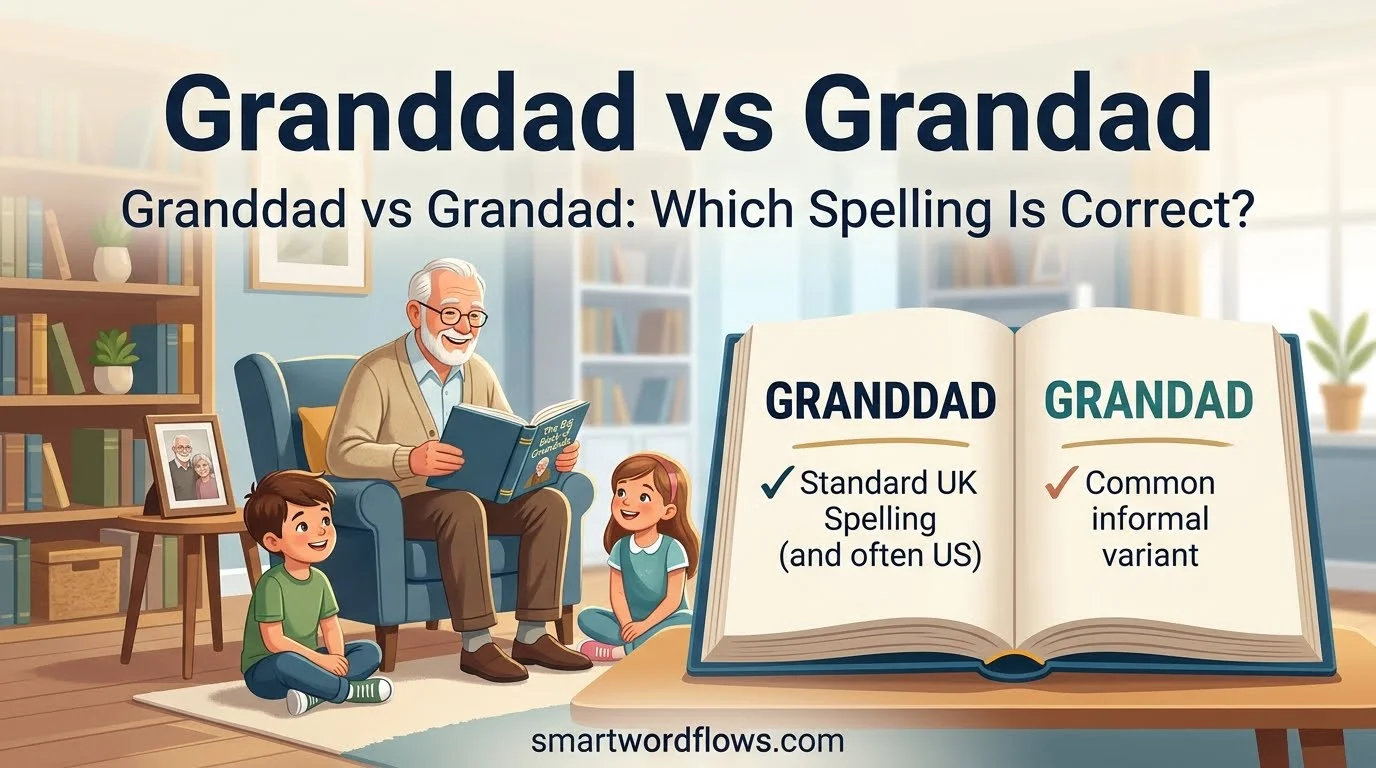

Granddad vs Grandad: Which Spelling Is Correct? Both spellings are correct, and each refers to your grandfather, a beloved family member. When writing a family story, birthday message, or school assignment, you may wonder which form to choose. The main spelling difference is easy to remember: granddad has a double d, while grandad has a single d. Both are accepted forms of the same word in English, with the same meaning, grammar, usage, and basic function. Neither is automatically a wrong version or a misspelling. These spellings are commonly seen, widely accepted, and familiar in everyday English, although regional usage and spelling preferences can sometimes cause confusion.
Your choice may depend on British English, American English, and other English varieties. Granddad can feel more traditional, particularly in older writing or some formal writing, while grandad may appear more common in casual writing and modern English. You can encounter both spellings in children’s books, family messages, social media posts, personal writing, informal speech, family speech, and everyday conversations. Their pronunciation and word meaning generally remain the same, so the visible difference comes from the letters rather than a change in meaning. Understanding these spelling patterns makes word comparison easier and helps you select the preferred spelling style for your audience.
A simple rule can help when preparing a formal document, personal message, birthday card, article, or guide: choose one form and use it consistently. Both spellings are accepted in standard English, and your word choice should suit your writing style and audience. If you’re unsure, remember that the straightforward answer is that neither spelling changes the meaning of the word. This knowledge can build confidence, improve clarity, and prevent unnecessary spelling doubt. By understanding the differences, common usage, and appropriate form for your audience, you can use either spelling naturally in written English and written communication.
Quick Answer
Granddad and grandad are both correct spellings of the informal word for grandfather. They share the same meaning and are generally pronounced the same way.
- Granddad: A common spelling in American English, though it also appears in British English.
- Grandad: Particularly familiar in British English and also used in other English-speaking regions.
- Meaning: Both words refer to your grandfather or the father of one of your parents.
- Pronunciation: Both generally have the same pronunciation.
- Formality: Both are informal and affectionate alternatives to grandfather.
Quick tip: If you’re writing for an American audience, granddad is a familiar choice. For a British audience, grandad is equally familiar. When in doubt, follow your family’s preferred spelling or the style used by your publication.
Comparison Overview
Although granddad and grandad differ by just one letter, their spelling preferences can vary by region and writing style. Dictionaries recognize both forms as informal words for a grandfather. Oxford Learner’s Dictionaries specifically notes that granddad is especially associated with North American English.
| Feature | Granddad | Grandad |
| Correct spelling | Yes | Yes |
| Meaning | Grandfather | Grandfather |
| Part of speech | Noun | Noun |
| Style | Informal, affectionate | Informal, affectionate |
| Regional association | Especially familiar in North American English | Particularly familiar in British English |
| Pronunciation | Generally /ˈɡræn.dæd/ | Generally /ˈɡræn.dæd/ |
| Number of letters | Eight | Seven |
| Plural | Granddads | Grandads |
| Possessive form | Granddad’s | Grandad’s |
| Suitable for everyday writing | Yes | Yes |
The most important point is that neither spelling changes the word’s basic meaning. You can use either one when talking about your father’s father or your mother’s father.
For example:
- My granddad taught me how to ride a bicycle.
- My grandad taught me how to ride a bicycle.
Both sentences are grammatically correct. The choice depends on your preferred spelling, regional conventions, and the context in which you’re writing.
Main Differences Between Granddad vs Grandad
Granddad Meaning and Usage
Granddad is an informal noun that means grandfather. People commonly use it when speaking about a grandfather in everyday conversation, writing family stories, or expressing affection for an older family member.
The word sounds familiar and personal. Instead of using the more formal term grandfather, you might say granddad when telling a friend about a weekend visit or describing a childhood memory.
Consider this example:
“My granddad used to take me fishing every Saturday morning.”
The sentence feels conversational and personal. It tells the reader about a family relationship without sounding formal or distant.
You can use granddad in several situations:
- Family conversations: “My granddad is coming over for dinner tonight.”
- Personal stories: “Granddad taught me how to fix an old radio.”
- Birthday messages: “Happy birthday to the best granddad in the world!”
- Family histories: “My granddad moved to California when he was young.”
- Informal writing: “We spent the afternoon listening to my granddad’s stories.”
In North American English, granddad is a familiar form. Oxford Learner’s Dictionaries identifies it as a variant of grandad that is especially common in North American usage.
However, the spelling isn’t limited to the United States or Canada. British writers and speakers also use granddad. The important distinction is regional preference, not a strict geographical boundary.
Grandad Meaning and Usage
Grandad also means grandfather and serves the same purpose as granddad. It is an informal family term used in everyday speech, personal writing, and affectionate conversations.
The spelling is particularly familiar in British English. Cambridge Dictionary lists grandad as an informal noun and recognizes granddad as an alternative spelling.
For example:
“My grandad always tells the funniest stories at family gatherings.”
Here, grandad refers to the speaker’s grandfather. The sentence doesn’t carry a different meaning from the version using granddad.
You’ll often encounter grandad in contexts such as:
- British family conversations: “We’re visiting Grandad this weekend.”
- Personal memories: “My grandad showed me how to grow tomatoes.”
- Cards and greetings: “Happy Father’s Day to a wonderful grandad!”
- Family biographies: “Her grandad worked in a local factory.”
- Informal storytelling: “Grandad sat by the window and watched the rain.”
The spelling also appears in published writing and online content. It isn’t an incorrect or shortened version that writers should automatically replace with granddad.
One useful detail is that grandad can also appear as a familiar or joking form of address for an older man who isn’t actually someone’s grandfather. The intended meaning depends on the context.
For example, someone might jokingly call an older man “Grandad” while teasing him about an old-fashioned habit. This use is informal and can sound disrespectful if the relationship doesn’t support that kind of humor.
Spelling Difference: One D or Two?
The visible difference between these words is simple: granddad contains two d’s at the end, while grandad contains one.
| Word | Spelling pattern | Letter count |
| Granddad | Grand + dad | 8 |
| Grandad | Grand + ad | 7 |
Both forms are established English spellings. The extra d in granddad doesn’t create a new meaning or change the word’s grammatical function.
Why do two forms exist? English often develops spelling variations through regional preferences, historical usage, and differences in how words become established in everyday speech. In this case, dictionaries recognize both forms rather than treating one as a mistake.
It’s best not to assume that a word with an extra letter is more correct. English spelling doesn’t follow one universal rule that makes longer forms more accurate.
For instance, color and colour are both correct, although regional conventions determine which one is preferred. The same general principle applies here: use the form that suits your audience and remain consistent.
Remember: If you see grandad in a British article or granddad in an American one, you don’t need to correct it merely because you prefer the other spelling.
Are Granddad and Grandad Pronounced the Same?
Yes. In standard English, granddad and grandad are generally pronounced alike.
Both commonly use the pronunciation /ˈɡræn.dæd/, with the stress on the first syllable. Cambridge and Oxford provide matching pronunciation information for these forms.
The pronunciation has two syllables:
- The first syllable sounds like grand.
- The second syllable sounds like dad.
The extra written d in granddad doesn’t usually create an additional sound. That’s why the words can sound identical even when their spellings differ.
For example, if someone says, “My granddad is visiting,” you generally can’t tell from the pronunciation alone whether that person would write granddad or grandad.
This similarity explains why people sometimes hesitate when writing the word. They hear the same sound but encounter two accepted spellings.
If you’re learning English, focus on the meaning and the spelling convention used in your preferred variety of English. You don’t need to learn a separate pronunciation for each form.
Read More: Counselor vs Councilor: Which Spelling Is Correct?
Granddad vs Grandad in American and British English
Regional spelling preferences are one of the main reasons these words cause confusion. English varies across countries, and familiar family terms are no exception.
Still, it’s important to distinguish a common regional preference from an exclusive spelling rule. Both granddad and grandad appear in dictionaries, and neither belongs exclusively to one country.
Which Spelling Is More Common in American English?
For American readers, granddad is a familiar and suitable choice. Oxford Learner’s Dictionaries identifies this spelling as especially common in North American English.
You can use it in American blog posts, personal letters, family biographies, and everyday messages.
For example:
- “My granddad lives in a small town in Ohio.”
- “Every summer, we visit our granddad in Florida.”
- “My granddad taught me to appreciate old books.”
- “I bought a new fishing rod for my granddad.”
Each sentence uses the spelling naturally.
However, American English doesn’t prohibit grandad. You may encounter that version in family correspondence, books, or writing influenced by British English.
If you’re writing for a US audience, choose granddad when it aligns with your preferred style. There’s no need to change the spelling of a person’s chosen family title simply to match a general regional preference.
Which Spelling Is More Common in British English?
In British English, grandad is a familiar spelling for grandfather. Cambridge Dictionary labels the word informal and records granddad as an alternative.
British writers regularly use grandad in personal stories, children’s writing, family messages, and everyday communication.
Here are a few examples:
- “My grandad lives near the coast.”
- “We had Sunday lunch with Grandad.”
- “Her grandad taught her how to bake bread.”
- “I called my grandad to wish him a happy birthday.”
The spelling fits naturally into these sentences because it functions as an ordinary noun.
Nevertheless, granddad is also acceptable in British English. You shouldn’t mark it as an error simply because grandad is familiar to British readers.
For British publications, the practical approach is to follow the publication’s house style. If no style guide applies, choose the spelling that feels natural for the intended audience and use it consistently.
What About Australian and Other English Varieties?
English-speaking countries don’t always follow identical spelling conventions. Australia, New Zealand, Canada, and other English-speaking communities may show different preferences depending on family habits, local usage, and publishing conventions.
Both grandad and granddad are recognizable English forms. However, it’s best to avoid making precise claims about which spelling dominates every country without reliable regional usage data.
If you’re writing for an international audience, either form can communicate the intended meaning. A little context makes the relationship clear.
For example:
“My grandad is visiting us during the school holidays.”
Most English readers will understand that sentence regardless of the spelling they personally prefer.
For professional content, check the spelling conventions used by your publisher or target market. For personal writing, your family’s established preference may matter more than regional tendencies.
Granddad vs Grandad Example Sentences
Examples make the difference easier to understand. Since the two spellings share the same meaning, you can often replace one with the other without changing the sentence’s basic message.
Examples Using Granddad
Here are some original sentences showing how granddad works in everyday English.
- Family visits: “My granddad comes over for dinner every Friday.”
- Childhood memories: “My granddad taught me how to ride a bicycle.”
- Hobbies: “Granddad spends most mornings working in his garden.”
- Family history: “My granddad grew up on a farm in the Midwest.”
- Celebrations: “We bought a special cake for our granddad’s birthday.”
- Gifts: “I made a photo album for my granddad.”
- Advice: “Whenever I have a problem, I ask my granddad for advice.”
Notice how granddad acts as the subject or object of a sentence. It can also appear in a possessive phrase, such as granddad’s birthday.
The spelling doesn’t restrict the word to a particular type of sentence. You can use it wherever the meaning fits.
Examples Using Grandad
The following sentences demonstrate the same uses with grandad.
- Family visits: “My grandad comes over for dinner every Friday.”
- Childhood memories: “My grandad taught me how to ride a bicycle.”
- Hobbies: “Grandad spends most mornings working in his garden.”
- Family history: “My grandad grew up on a farm in the Midwest.”
- Celebrations: “We bought a special cake for our grandad’s birthday.”
- Gifts: “I made a photo album for my grandad.”
- Advice: “Whenever I have a problem, I ask my grandad for advice.”
These sentences remain grammatically correct. The only change is the spelling of the family term.
This is a useful way to check your understanding: if replacing granddad with grandad doesn’t change the intended meaning, you’re dealing with two spelling variants rather than two separate words with different definitions.
Using Granddad or Grandad in Questions and Possessive Forms
Both spellings work in questions, negative sentences, and possessive constructions. The same basic grammar rules apply to each form.
| Purpose | Using granddad | Using grandad |
| Question | Is your granddad coming? | Is your grandad coming? |
| Negative sentence | My granddad isn’t home yet. | My grandad isn’t home yet. |
| Possession | My granddad’s car is blue. | My grandad’s car is blue. |
| Plural | Both granddads attended. | Both grandads attended. |
| Direct address | Thank you, Granddad! | Thank you, Grandad! |
Pay attention to the apostrophe in the possessive examples. The form granddad’s indicates that something belongs to one granddad. The same rule applies to grandad’s.
When you mean more than one grandfather, use granddads or grandads. Neither plural requires an apostrophe.
For example:
- Correct: “My two granddads live nearby.”
- Correct: “My two grandads live nearby.”
- Incorrect for a simple plural: “My two granddad’s live nearby.”
The final example incorrectly uses an apostrophe to form a plural. Apostrophes generally indicate possession or contractions, not ordinary plural forms.
Granddad vs Grandad vs Grandfather
Although these three words refer to the same family relationship, they differ slightly in tone and typical use.
Grandfather is the standard, more formal term. Granddad and grandad are informal alternatives that often sound warmer or more conversational. Cambridge Dictionary identifies grandfather as the father of a person’s mother or father and lists informal alternatives.
| Word | Meaning | Tone | Common context |
| Grandfather | The father of your mother or father | Neutral or formal | Official documents, biographies, formal writing |
| Granddad | Grandfather | Informal and affectionate | Family conversations, stories, personal messages |
| Grandad | Grandfather | Informal and affectionate | Family conversations, stories, personal messages |
| Grandpa | Grandfather | Informal and affectionate | Everyday conversation and family use |
When Should You Use Grandfather?
Choose grandfather when you want a neutral term that suits a wide range of audiences.
For example:
“My grandfather served in the military before starting his own business.”
This wording works well in a biography, family history, school assignment, or formal article.
The word also helps when you need to clarify a family relationship. In a historical account, for instance, maternal grandfather means the father of someone’s mother, while paternal grandfather means the father of someone’s father.
These terms provide more detail than granddad or grandad usually would.
When Should You Use Granddad or Grandad?
Choose either informal spelling when the tone is personal, warm, or conversational.
For example:
“Grandad always saved the last piece of apple pie for me.”
This sentence sounds like a personal memory. Using granddad instead would preserve the same meaning and tone.
You might also choose one form because it’s the name your family uses. Some families prefer Grandad, while others use Granddad, Grandpa, Papa, or another familiar title.
There’s no universal rule requiring every family to use the same name. In personal writing, respecting someone’s preferred title often matters more than following a broad regional trend.
Is Granddad or Grandad More Appropriate for Formal Writing?
Neither granddad nor grandad is usually the best choice for highly formal writing. Both are informal nouns, so grandfather is often the safer option for academic, professional, or official contexts.
However, the right choice depends on the document’s purpose.
Consider these examples:
- Academic writing: “The research examines how the participant’s grandfather influenced his education.”
- Family memoir: “My granddad taught me the value of hard work.”
- Personal letter: “I hope you and Grandad enjoy your holiday.”
- Official family record: “The child’s maternal grandfather was born in 1948.”
Each example suits its context. Formal writing benefits from precise, neutral language, while personal writing can use familiar family terms.
You don’t need to avoid granddad or grandad in every professional setting. A magazine feature, interview, or personal essay may use either spelling naturally. The important thing is to match the tone to your readers and purpose.
Should Granddad and Grandad Be Capitalized?
Both words follow the same capitalization rules as other English nouns. Capitalize the word when it functions as a name or title, but generally use lowercase when it describes a family relationship.
The difference becomes clearer when you compare sentences.
| Usage | Example | Why |
| General reference | My granddad lives nearby. | Lowercase because it describes a relationship. |
| General reference | I called my grandad yesterday. | Lowercase for the same reason. |
| Direct address | Thanks for helping me, Granddad. | Capitalized because it’s used as a name. |
| Direct address | Good morning, Grandad! | Capitalized because you’re addressing him directly. |
| Possessive, general reference | My granddad’s garden looks beautiful. | Lowercase because it describes the relationship. |
| Possessive, used as a name | Grandad’s garden looks beautiful. | Capitalized when Grandad functions as his name. |
Context matters more than the spelling itself.
For example, consider these two sentences:
- “My granddad made breakfast.”
- “Granddad made breakfast.”
The first sentence describes the person through a family relationship. In the second, Granddad functions as a familiar name or title.
Capitalization practices can vary slightly with house style and family preference. Still, the distinction between a general noun and a name provides a reliable starting point.
Common Mistakes to Avoid When Using Granddad and Grandad
Even though both spellings are correct, a few mistakes can make your writing less clear.
Assuming One Spelling Is Incorrect
The most common misunderstanding is believing that grandad is always wrong because granddad contains an extra letter.
That isn’t true. Major dictionaries recognize both forms. Oxford specifically identifies granddad as an alternative spelling associated especially with North American English.
Incorrect assumption: “Grandad is a spelling mistake.”
Better understanding: Both grandad and granddad are accepted spellings of the same informal noun.
Confusing Regional Preference With a Grammar Rule
A spelling may be more familiar in one region without being forbidden elsewhere.
For example, a British publication might prefer grandad, while an American publication might favor granddad. These preferences don’t mean the alternative spelling is grammatically incorrect.
When writing for a particular publication, follow its style guide. When writing for yourself, choose a form that feels natural and use it consistently.
Switching Spellings Without a Reason
Imagine writing a short family story that begins with “My granddad loved fishing” and later says “My grandad taught me to swim.”
The meaning remains clear, but the change may look accidental.
A better approach is to select one spelling and maintain it throughout the article. Consistency makes your writing look polished and helps readers focus on the story rather than the spelling.
There is one exception: when quoting someone or reproducing an original document, preserve the spelling used in the source unless your editorial rules require otherwise.
Misusing Apostrophes
Another mistake involves plural and possessive forms.
Use granddads or grandads for the plural. Use granddad’s or grandad’s when showing singular possession.
Examples:
- Plural: Both granddads attended the graduation.
- Possessive: My granddad’s watch is an antique.
- Plural: The two grandads arrived together.
- Possessive: My grandad’s stories always make us laugh.
Remember that granddads’ and grandads’ can indicate possession by multiple granddads. For example, “The granddads’ seats were near the front.”
How to Choose Between Granddad and Grandad
Choosing the right spelling doesn’t require a complicated rule. A few practical checks will help you decide.
- Consider your audience. For North American readers, granddad is a familiar choice. For British readers, grandad is a familiar choice.
- Follow your family’s preference. If your family consistently writes Grandad, there’s no need to change it to Granddad.
- Check your publication’s style guide. Editors may prefer one spelling to maintain consistency.
- Match the tone. Both forms suit informal writing, while grandfather is often better for formal contexts.
- Stay consistent. Choose one form for your own narrative and use it throughout.
Here’s a practical example.
Suppose you’re writing a blog post for an American audience about childhood memories. You might choose granddad and use that spelling in the title, headings, and examples. If you’re writing a British family memoir, grandad may feel more natural.
Neither decision changes the underlying meaning.
Ultimately, the best spelling is the one that fits your audience, context, and preferred style.
Frequently Asked Questions
Is granddad or grandad correct?
Both spellings are correct. They mean the same thing and refer informally to a grandfather. The difference is primarily a matter of spelling preference and regional usage.
Is grandad British or American?
Grandad is particularly familiar in British English, although Americans also use it. It isn’t exclusive to Britain, and it isn’t incorrect in American writing.
Is granddad more common in American English?
Granddad is especially associated with North American English, according to Oxford Learner’s Dictionaries. However, that regional association doesn’t establish an exact usage percentage or mean that every American prefers it.
Do granddad and grandad mean the same thing?
Yes. Both words refer to a person’s grandfather, the father of their mother or father. Neither spelling indicates a different family relationship.
Are granddad and grandad pronounced the same?
Yes. Both are generally pronounced /ˈɡræn.dæd/, with the stress on the first syllable. The additional written d in granddad doesn’t normally change the pronunciation.
Is grandad a misspelling of granddad?
No. Grandad is an accepted spelling in its own right. Dictionaries recognize it as an informal word for grandfather, with granddad listed as an alternative.
What is the plural of granddad and grandad?
The usual plurals are granddads and grandads, respectively.
For example, “Both granddads attended the wedding” and “Both grandads attended the wedding” are correct.
Don’t add an apostrophe when forming these ordinary plurals.
Is grandfather more formal than granddad or grandad?
Generally, yes. Grandfather is the neutral term that suits formal and informal contexts. Granddad and grandad are informal alternatives, making them especially suitable for conversations, family stories, and personal messages.
Conclusion
The difference between granddad vs grandad comes down to spelling preference rather than meaning. Both forms are correct, both refer to a grandfather, and both generally share the same pronunciation. Granddad is especially familiar in North American English, while grandad is particularly familiar in British English.
When choosing between them, consider your audience, family preference, and writing style. If you’re writing formally, grandfather may be more appropriate. Otherwise, either spelling works well. Choose the version that fits your context and use it consistently. There’s no need to treat one accepted spelling as a mistake simply because another is more familiar to you.



2 thoughts on “Granddad vs Grandad: Which Spelling Is Correct?”