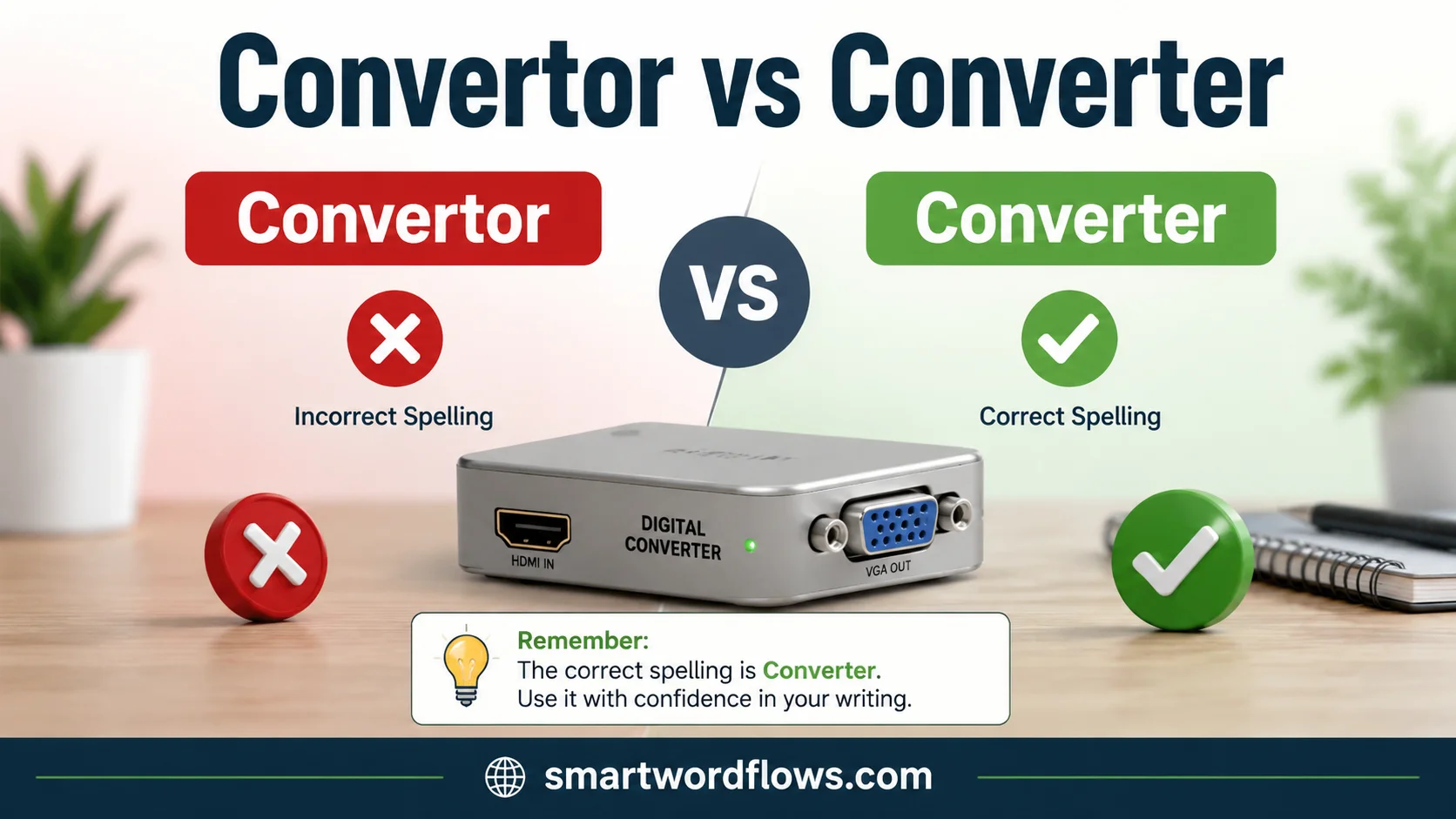

Convertor vs Converter: Which Spelling Is Correct? The clear answer is that Converter is the standard spelling and preferred spelling in modern English. Convertor is a less common variant sometimes found in technical texts and older sources. Both words can have the same meaning, but modern usage, English usage, and spelling trends strongly favor Converter. For English learners, writers, and students, choosing the correct spelling helps avoid confusion and improves writing confidence.
In technology, electronics, engineering, and technical writing, Converter is widely used for a device, tool, or system that can convert one form into another. The same spelling is preferred in academic writing, business communication, professional writing, websites, emails, and online content. Using one spelling throughout a document improves spelling consistency, content readability, and reader understanding. When unsure, check trusted dictionaries or a reliable reference source before publishing.
Quick Answer
Converter is the correct and standard spelling used in modern English.
A converter is a person, device, machine, or software tool that changes something from one form into another. Examples include a currency converter, PDF converter, video converter, and catalytic converter.
Convertor is a rare spelling variation that has the same basic meaning. However, it is not commonly used in modern writing and may look incorrect or outdated to many readers.
| Spelling | Correctness | Common Usage | Example |
| Converter | Standard spelling | Very common | “I used an online currency converter.” |
| Convertor | Rare variant | Uncommon | “The old document used the word convertor.” |
If you are writing for a general audience, business, education, or technology, choose converter.
Comparison Overview
The confusion between convertor vs converter mainly comes from the similarity between the two spellings. Both words come from the verb convert, which means to change something from one state, system, format, or purpose into another.
The difference is not about meaning. It is about usage, familiarity, and modern language preferences.
| Feature | Converter | Convertor |
| Root word | Convert | Convert |
| Ending | -er | -or |
| Meaning | Something that converts | Something that converts |
| Modern acceptance | Preferred | Rarely used |
| Common in technology | Yes | Almost never |
| Common in dictionaries | Primary entry | Usually a variant |
| Recommended for writing | Yes | No |
The reason converter dominates modern English is simple: English often uses the -er ending to describe a person or thing that performs an action.
Examples:
- Teach → Teacher
- Drive → Driver
- Print → Printer
- Scan → Scanner
- Convert → Converter
The pattern feels natural to English speakers. When they hear the word converter, they immediately recognize it as something that performs a conversion.
On the other hand, English also has many words ending in -or, such as:
- Actor
- Creator
- Translator
- Generator
- Calculator
Because both endings exist, some people naturally wonder whether convertor should also be acceptable. Although the spelling appears occasionally, modern usage strongly favors converter.
Meaning Difference Between Convertor and Converter
The biggest point of confusion is whether convertor and converter have different meanings.
They do not.
Both words refer to something that converts.
A converter can be:
- A machine that changes energy.
- A software program that changes file formats.
- A tool that changes measurements.
- A person who changes something into a different form.
A convertor, when used, generally refers to the same thing.
For example:
Converter:
“This image converter changes PNG files into JPEG format.”
A convertor would technically communicate the same idea, but most readers would expect the word converter instead.
The difference is similar to choosing between a common road and a rarely used side street. Both may reach the same destination, but one is easier and more familiar for everyone.
Spelling Difference Between Convertor and Converter
The only visible difference is the final letters:
- Convert + er = Converter
- Convert + or = Convertor
This small change creates confusion because both endings appear in English.
The suffix -er usually identifies a person or object that performs an action.
Examples:
| Verb | Person or Object |
| Mix | Mixer |
| Blend | Blender |
| Calculate | Calculator |
| Convert | Converter |
The suffix -or also creates nouns, but it often appears in words influenced by Latin origins or specific historical patterns.
Examples:
| Word | Meaning |
| Creator | Someone who creates |
| Operator | Someone who operates |
| Generator | Something that generates |
Because English developed from many languages, spelling patterns are not always perfectly predictable. That is why both endings can exist, even when one becomes more popular.
Usage Difference Between Convertor and Converter
The biggest practical difference is how often people use each spelling.
Converter appears everywhere:
- Technology websites
- Software applications
- Engineering documents
- Educational resources
- Product descriptions
- Everyday conversations
Examples:
- PDF converter
- Video converter
- Currency converter
- Unit converter
- Voltage converter
- Catalytic converter
The word convertor, however, appears much less frequently. Many readers may pause when they see it because it does not match the spelling they usually encounter.
For professional communication, familiarity matters. A familiar word creates a smoother reading experience.
Why Is Converter the Preferred Spelling?
The popularity of converter is not accidental. Several factors have helped it become the standard form.
English Usually Prefers Action-Based Nouns Ending in -er
English speakers naturally create words with -er when describing something that performs an action.
For example:
- A device that cools is a cooler.
- A device that heats is a heater.
- A device that filters is a filter.
- A device that converts is a converter.
This pattern makes converter feel natural.
Technology Made Converter More Common
Modern technology has played a major role in making converter the dominant spelling.
People regularly search for:
- Online converter tools
- Video converters
- File converters
- Currency converters
- Image converters
Software companies and websites typically choose converter because users already recognize the term.
For example, someone searching online is far more likely to type:
“Free PDF converter”
rather than:
“Free PDF convertor”
The first phrase matches common language patterns.
Professional Writing Uses Converter
Technical fields rely heavily on consistent terminology. Engineers, programmers, educators, and businesses generally use converter.
Examples include:
- Analog-to-digital converter (ADC)
- Digital-to-analog converter (DAC)
- Power converter
- Frequency converter
- Catalytic converter
These established terms reinforce the spelling across industries.
What Does Converter Mean?
A converter is anything that changes one form of something into another.
The conversion may involve:
- Data
- Energy
- Measurements
- Currency
- Language
- Physical materials
- Beliefs or ideas
The word has both technical and general meanings.
Converter Meaning in Technology
In technology, a converter usually refers to software or hardware that changes information from one format into another.
Examples:
File Converter
A file converter changes one file type into another.
Examples:
- Word document to PDF
- JPG image to PNG
- MP4 video to another format
A person may use a file converter when a program cannot open a certain file type.
Data Converter
A data converter changes information so different systems can understand it.
For example:
A company moving information from an old database to a new platform may use a data conversion tool.
Digital Converter
A digital converter changes signals between different forms.
A common example is an analog-to-digital converter, which allows devices like smartphones and computers to process real-world signals.
Converter Meaning in Electronics
In electronics, a converter is a device that changes electrical properties.
Common examples include:
- Voltage converter
- Power converter
- Signal converter
A voltage converter allows electrical devices designed for one voltage system to work safely with another.
For example:
A traveler from the United States visiting a country with a different electrical standard may need a voltage converter for certain appliances.
Read More: Maintained vs Maintenanced: Differences Explained
Converter Meaning in Automotive Industry
One of the most familiar uses of the word is catalytic converter.
A catalytic converter is a vehicle component that reduces harmful emissions from engine exhaust.
It converts harmful gases into less damaging substances before they leave the vehicle.
Common pollutants it helps reduce include:
- Carbon monoxide
- Nitrogen oxides
- Hydrocarbons
This is one reason the word converter appears frequently in environmental and automotive discussions.
What Does Convertor Mean?
The word convertor has the same basic meaning as converter. It describes something that changes one thing into another form. However, unlike converter, the spelling convertor is rarely used in modern English.
You may occasionally find convertor in older texts, regional writing, or specific references. Some dictionaries recognize it as a variant spelling, but it does not have the same level of acceptance or popularity as converter.
Think of it like an old-fashioned spelling that still exists but has been replaced by a more common version. Language changes over time, and some words become the preferred choice because they are used more often by writers, businesses, and professionals.
For most situations, choosing converter is the safest option.
Why Is Convertor Less Common?
The main reason convertor is less common comes down to language habits.
English speakers usually prefer words that follow familiar patterns. Since many tools and devices that perform actions use the -er ending, people naturally recognize converter as the correct form.
For example:
- A device that prints is a printer.
- A machine that scans is a scanner.
- A tool that filters is a filter.
- A tool that converts is a converter.
The word convertor does not sound wrong because English does contain many words ending in -or. However, it does not match the spelling pattern that became dominant for this particular word.
Examples of Words Ending in -or
English has many valid -or words:
- Creator
- Generator
- Operator
- Translator
- Accelerator
This pattern may lead some people to believe convertor should be equally common. However, word popularity is not always based on strict rules. Usage, history, and industry standards often decide which form survives.
Examples of Convertor Usage
Although uncommon, convertor can still appear in some contexts.
Examples:
- “The old manual referred to the device as a convertor.”
- “Some historical documents use the term convertor instead of converter.”
In modern writing, these examples would usually be changed to:
- “The old manual referred to the device as a converter.”
- “Some historical documents use the term converter.”
The meaning remains clear, but converter sounds more natural to most readers.
Common Types of Converters
The word converter appears in many industries because conversion happens everywhere. From digital files to electricity, converters help systems communicate, adapt, and function properly.
Digital Converter
A digital converter changes digital information from one format into another.
Common examples include:
- Video converter
- Audio converter
- Image converter
- File converter
- Document converter
For example, if someone receives a file that their computer cannot open, a converter can change it into a compatible format.
Common Digital Converter Examples
| Type of Converter | Purpose | Example |
| PDF Converter | Changes documents into PDF files | Word to PDF |
| Video Converter | Changes video formats | MP4 to AVI |
| Image Converter | Changes image formats | PNG to JPG |
| Audio Converter | Changes audio files | WAV to MP3 |
Digital converters are especially useful because different programs often use different file formats.
A photographer, for example, may convert images from RAW files into JPEG files before sharing them online. A business may convert documents into PDFs to preserve formatting.
Electrical Converter
An electrical converter changes electrical energy from one form to another.
These devices play an important role in modern technology because electronic systems often require specific power conditions.
Examples include:
- Voltage converters
- Power converters
- Current converters
- Frequency converters
Real-Life Example
Imagine buying an electronic device from another country. The device may require a different voltage than the electrical system in your home provides.
A voltage converter can adjust the electricity so the device can operate properly.
Without the converter, the equipment may not work or could become damaged.
Currency Converter
A currency converter calculates the value of one currency compared with another.
People use currency converters for:
- International travel
- Online shopping
- Business transactions
- Financial planning
For example:
Someone traveling from the United States to Europe may use a currency converter to understand how many euros they can receive for their dollars.
Currency values change constantly because exchange rates move based on global economic conditions.
Measurement Converter
A measurement converter changes one unit into another.
Common examples include:
- Miles to kilometers
- Pounds to kilograms
- Fahrenheit to Celsius
- Inches to centimeters
These converters are helpful because different countries use different measurement systems.
For example:
A recipe written in cups and ounces may need conversion when someone follows it in a country that uses grams and milliliters.
Language Converter
A language converter changes text from one language into another.
Examples include:
- English to Spanish conversion
- Japanese to English conversion
- French to German conversion
Although people often call these tools translators, some digital platforms use the term converter because they transform information from one language system into another.
Common Mistakes When Using Convertor and Converter
Even though converter is the preferred spelling, people still confuse these two words. Understanding the common mistakes can help you avoid them.
Using Convertor in Professional Writing
One common mistake is using convertor in formal writing.
Example:
“This PDF convertor can merge multiple files.”
Better:
“This PDF converter can merge multiple files.”
The first sentence is understandable, but the second one looks more professional because it uses the standard spelling.
When writing:
- Business documents
- Articles
- Reports
- Product descriptions
- Technical guides
use converter.
Confusing Spelling Because of Pronunciation
Another reason people make this mistake is pronunciation.
Both words sound almost identical:
- Converter
- Convertor
When people hear the word spoken, they cannot identify the spelling difference. They have to rely on familiarity and written examples.
This happens with many English words.
For example:
- Their / there / they’re
- Affect / effect
- Stationary / stationery
Sound alone does not always reveal the correct spelling.
Assuming Both Forms Are Equally Common
A frequent misunderstanding is believing that if two spellings exist, both are equally acceptable.
English does not always work that way.
Some words have multiple forms, but one becomes the standard choice because millions of people use it regularly.
Examples:
- Email is preferred over e-mail in many modern contexts.
- Website is preferred over web site.
- Converter is preferred over convertor.
The less common form may not be completely incorrect, but it is usually not the best choice.
Converter vs Convertor Examples in Real Sentences
Seeing the words in context makes the difference easier to understand.
| Less Common Usage | Preferred Usage |
| I downloaded a video convertor. | I downloaded a video converter. |
| This currency convertor gives accurate results. | This currency converter gives accurate results. |
| The power convertor stopped working. | The power converter stopped working. |
| I need a file convertor for this document. | I need a file converter for this document. |
The meaning stays the same, but the preferred versions sound more natural.
Everyday Examples With Converter
Here are examples of how converter appears in real communication:
Technology:
“I used an online converter to change the file format.”
Travel:
“Check the currency converter before exchanging money.”
Automotive:
“The mechanic inspected the catalytic converter.”
Engineering:
“The power converter controls the energy supply.”
These phrases are widely recognized because converter has become the accepted term across many industries.
Is Convertor Ever Correct?
Yes, convertor can exist as a spelling variant, but it is rarely the best choice.
Using convertor is not usually a serious grammar mistake because readers can understand the meaning. However, it may appear unusual or outdated.
There are a few situations where you might see it:
- Historical documents
- Older publications
- Specific product names
- Regional spelling preferences
For example, if a company officially names a product “Power Convertor,” changing the spelling may not be appropriate because it is part of the brand name.
Outside of those cases, converter remains the recommended spelling.
Converter vs Convertor: Which One Should You Use?
For almost every modern writing situation, choose:
Converter
It is:
- More common
- More recognizable
- Preferred by professionals
- Widely used in technology
- Accepted internationally
Use converter when writing:
- Blog posts
- Emails
- Academic papers
- Software descriptions
- Technical articles
- Business content
Avoid convertor unless you have a specific reason to use it.
A simple writing rule can help:
If the word describes a tool, device, or software that changes something, write converter.
Synonyms and Related Words for Converter
Depending on the situation, several words can describe something similar to a converter. However, they are not always exact replacements.
| Related Word | Meaning | Example |
| Adapter | A device that allows compatibility | Travel adapter |
| Transformer | A device that changes electrical voltage | Electrical transformer |
| Translator | Changes language or meaning | Language translator |
| Processor | Handles or modifies information | Data processor |
| Modifier | Changes characteristics | Image modifier |
| Changer | Something that creates change | Game changer |
The best word depends on what kind of conversion happens.
For example:
- A voltage converter and a voltage transformer may have similar purposes, but they are not always identical devices.
- A translator changes language, while a converter may change formats.
Choosing the right term improves clarity.
FAQs:
1. Is Converter or Convertor the correct spelling?
Converter is the standard spelling and preferred form in modern English. Convertor is a less common variant.
2. What does Converter mean?
A Converter is a device, tool, or system that can convert one form into another. It is widely used in technology, electronics, and engineering.
3. Is Convertor wrong?
Convertor is not necessarily wrong, but it is less common. It may appear in technical texts, specialized sources, or an official name.
4. Which spelling should I use in professional writing?
Use Converter in professional writing, academic writing, business communication, websites, and online content because it is more widely accepted.
5. How can I confirm the correct spelling?
Check trusted dictionaries or a reliable reference source when you are unsure. This helps maintain spelling consistency and accurate English usage.
Conclusion
Converter is the safer and more widely accepted spelling in modern English. Although Convertor can appear in some technical or specialized contexts, most writers, students, and English learners should use Converter for clear and professional communication.