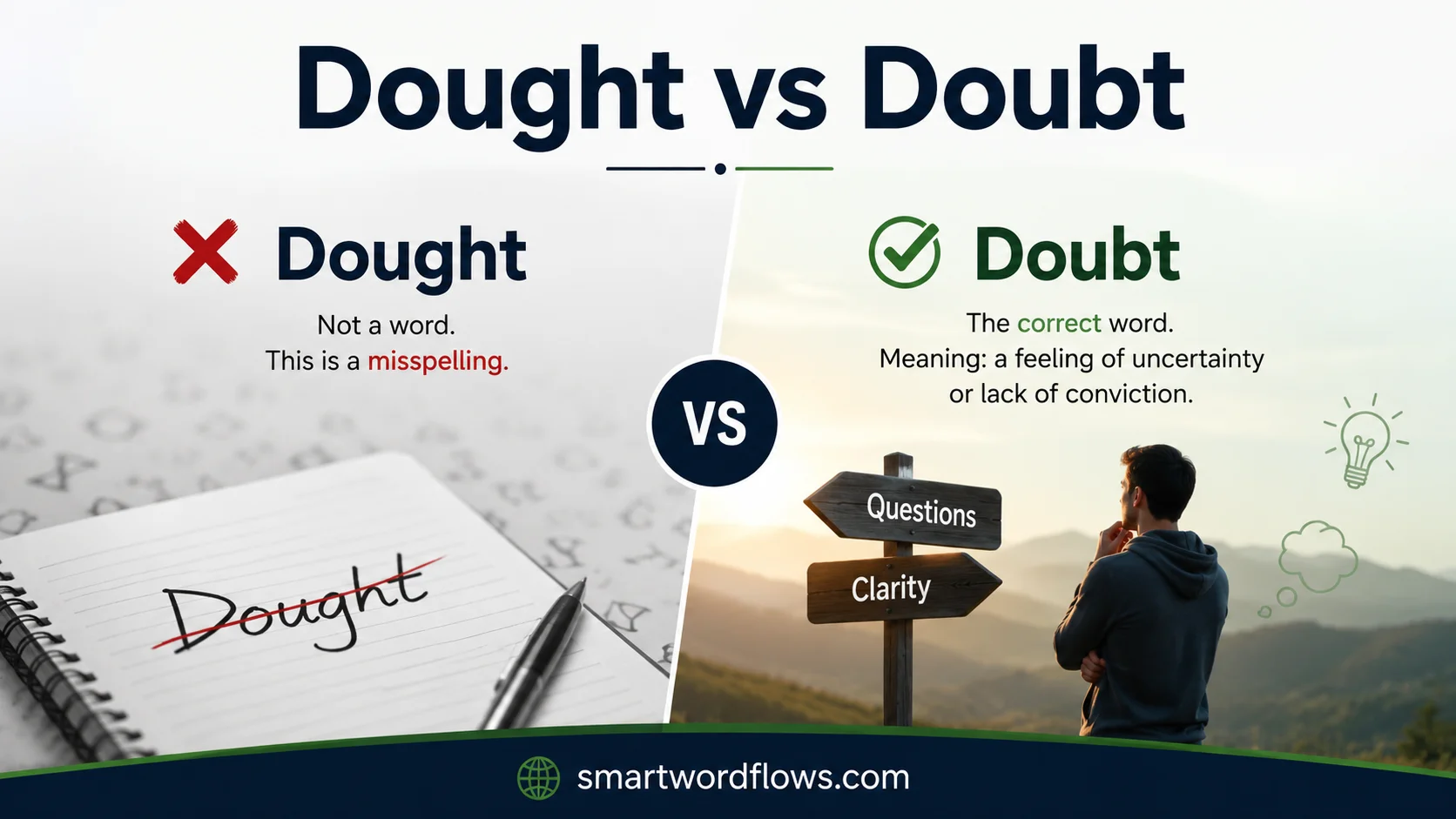

Dought vs Doubt often confuses English learners, writers, and native speakers because both words look similar. In modern English, doubt is the correct spelling, while dought is usually a misspelling or typo. This difference matters in writing, emails, texts, essays, and professional communication because correct spelling improves clarity, meaning, and reader trust. The silent letter in doubt can also make its pronunciation confusing for learners.
The confusion becomes easier to understand through English spelling patterns. Words such as thought, bought, and brought may make dought seem believable, but doubt remains the standard word in American English and British English. Learning its correct usage, clear meaning, and real examples helps avoid spelling mistakes and English vocabulary errors. Simple memory tricks, grammar rules, and regular practice can help learners use doubt confidently in daily writing.
Quick Answer
Doubt is the correct spelling used in modern English. It means a feeling of uncertainty, hesitation, or lack of confidence about something.
Dought is not used in modern standard English. It is an old, obsolete spelling that appeared in historical forms of English but is no longer considered correct for everyday writing.
Correct example:
- I doubt that he will arrive on time.
- Without a doubt, she is one of the best players on the team.
Incorrect example:
- I dought that he will arrive on time.
If you are writing an email, essay, article, report, or message, always choose doubt.
Comparison Overview
Understanding the difference between dought vs doubt becomes easier when you compare their meanings, usage, and modern relevance.
| Feature | Dought | Doubt |
| Modern English usage | Not commonly used | Widely used |
| Correct spelling today | No | Yes |
| Meaning | Historical/obsolete form | Feeling of uncertainty or questioning |
| Word type | Old English form | Noun and verb |
| Used in daily communication | No | Yes |
| Common in formal writing | No | Yes |
| Pronunciation | Not used in modern speech | Usually pronounced as “dout” |
| Silent letter | Not relevant in modern use | The “b” is silent |
The biggest difference is simple: doubt belongs to modern English, while dought belongs to the history of the language.
Main Differences Between Dought vs Doubt
The confusion between dought and doubt mainly comes from spelling patterns and pronunciation. English contains many silent letters, and the word doubt is a perfect example.
Meaning Difference Between Dought and Doubt
The word doubt describes uncertainty. When you doubt something, you are not completely convinced that it is true, possible, or reliable.
For example:
- I doubt the weather will improve today.
- She had doubts about accepting the job offer.
- There is no doubt that practice improves skills.
The word dought, however, does not carry a meaning in modern English. It may appear in old texts because English spelling changed significantly over centuries.
Modern readers usually encounter dought only when studying historical language, old manuscripts, or the development of English vocabulary.
Usage Difference Between Dought and Doubt
The word doubt has many practical uses.
You can use it as:
- A noun
- A verb
- Part of common expressions
Examples:
As a noun:
- His doubt about the plan was understandable.
- The evidence removed all doubt.
As a verb:
- I doubt his explanation.
- Many people doubt whether the project will succeed.
The word dought does not function in normal modern sentences.
What Does Doubt Mean?
Doubt means a feeling of uncertainty or a lack of belief in something.
When you have doubt, your mind questions whether something is correct, possible, or trustworthy.
For example, imagine you are preparing for an important exam. You studied for weeks, but you still wonder whether you will perform well. That feeling of uncertainty is doubt.
Doubt does not always mean negativity. Sometimes doubt encourages people to investigate, ask questions, and find better answers.
A scientist, for example, does not simply accept every claim. Healthy doubt encourages research and discovery.
Definition of Doubt
According to standard English usage:
Doubt (noun): A feeling of uncertainty or lack of confidence.
Doubt (verb): To question the truth, reliability, or possibility of something.
Examples of Doubt in Sentences
- I have no doubt that you will succeed.
- The manager doubted the accuracy of the report.
- She expressed doubt about the results.
- There is little doubt that technology has changed communication.
Why Is the B Silent in Doubt?
One of the biggest reasons people confuse dought vs doubt is the silent b in the word doubt.
The word looks like it should sound like:
- “doubt” with a pronounced b
However, English pronunciation does not work that way. The correct pronunciation sounds like:
doubt → /daʊt/
The b remains silent.
The Historical Reason Behind the Silent B
The silent b was added because of the influence of Latin.
The English word doubt came through Old French from the Latin word dubitare, meaning “to hesitate” or “to question.”
During the Renaissance period, scholars tried to make English spelling reflect Latin origins. Because of this, the letter b was added back into the spelling.
However, English speakers had already changed the pronunciation, so the b stayed silent.
This pattern appears in other words too:
| Word | Silent Letter |
| Doubt | b |
| Debt | b |
| Subtle | b |
| Thumb | b |
| Climb | b |
Is “Dought” a Real Word?
Yes, dought has existed historically, but it is not considered a normal modern English word.
Languages constantly change. Words that were common hundreds of years ago can disappear or transform over time.
In older forms of English, dought appeared as a spelling connected with meanings related to ability, strength, or worth. However, modern English speakers no longer use it in everyday communication.
Where You Might See Dought
You may find dought in:
- Medieval texts
- Historical documents
- Old English studies
- Discussions about language evolution
For example, someone studying the works of medieval writers may encounter unusual spellings that are no longer used today.
However, using dought in a modern essay or email would likely be considered a spelling mistake.
How to Use Doubt Correctly
The word doubt is flexible because it works as both a noun and a verb.
Doubt as a Noun
When used as a noun, doubt refers to uncertainty or hesitation.
Examples:
- Her doubt disappeared after seeing the evidence.
- The decision created doubt among employees.
- There was no doubt about his commitment.
Common noun patterns include:
- doubt about something
- doubt in something
- doubt that something is true
Examples:
- I have doubts about this strategy.
- There is no doubt that education matters.
Read More: Shute vs Chute Differences and Correct Usage
Doubt as a Verb
As a verb, doubt means to question or not believe something.
Examples:
- I doubt his story.
- They doubted the plan would work.
- Nobody doubts her talent.
A useful pattern is:
Subject + doubt + object
Examples:
- Many people doubt the prediction.
- Scientists doubt the accuracy of the claim.
Common Mistakes With Dought and Doubt
Many English learners and even native speakers make spelling mistakes because words do not always sound the way they look.
Here are common errors:
| Incorrect Sentence | Correct Sentence |
| I have no dought about it. | I have no doubt about it. |
| Without dought, she is talented. | Without doubt, she is talented. |
| I dought his explanation. | I doubt his explanation. |
| There is no dought that he worked hard. | There is no doubt that he worked hard. |
A simple rule can help:
If you are expressing uncertainty, always use doubt.
Common Expressions With Doubt
The word doubt appears in many common English phrases. Learning these expressions can improve your writing and speaking skills.
Without a Doubt
Meaning: Definitely or certainly.
Example:
- She is without a doubt the most experienced person on the team.
No Doubt
Meaning: A strong belief that something is true.
Example:
- He will no doubt finish the project soon.
Beyond Doubt
Meaning: Completely certain.
Example:
- The evidence proved his innocence beyond doubt.
Benefit of the Doubt
Meaning: Choosing to believe someone despite uncertainty.
Example:
- I will give him the benefit of the doubt because he explained the situation.
Cast Doubt On
Meaning: To make something seem uncertain.
Example:
- The new information cast doubt on the original report.
Why People Confuse Dought and Doubt
Several factors create confusion between these two spellings.
Silent Letters
English contains many words where letters do not match pronunciation.
Examples:
- Knife
- Honest
- Doubt
- Island
Because the b in doubt is silent, some people create incorrect spellings based on sound.
Similar-Looking Words
The spelling dought looks believable because English has many words ending with similar patterns.
For example:
- Thought
- Bought
- Fought
These words contain “ought,” which may make dought appear correct.
However, spelling patterns do not always follow predictable rules in English.
Typing Errors
Digital communication creates another problem. Autocorrect may sometimes accept unusual words, and fast typing can lead to mistakes.
Before submitting professional writing, always review words that look unusual.
Memory Trick to Remember Doubt
A simple way to remember the correct spelling:
Doubt has a silent B because the word has a hidden history.
Think of the phrase:
“Don’t doubt the silent B.”
This reminds you that the letter exists in spelling even though you cannot hear it.
Another trick:
- Doubt = uncertainty
- Both contain the letter B
- Believe and doubt both involve what your mind accepts as true
Doubt vs Similar Words
The meaning of doubt becomes clearer when compared with similar words.
| Word | Meaning | Example |
| Doubt | Feeling uncertain | I doubt the result. |
| Suspicion | Belief something may be wrong | She had suspicion about the message. |
| Uncertainty | Lack of knowledge or confidence | There is uncertainty about the future. |
| Hesitation | Pause before making a decision | He showed hesitation before answering. |
| Disbelief | Refusal to accept something as true | She reacted with disbelief. |
| Skepticism | Questioning whether something is reliable | Healthy skepticism improves research. |
Although these words overlap, they are not always interchangeable.
Case Study: How Small Spelling Errors Affect Communication
Imagine a student submitting an essay with the sentence:
“Without dought, climate change is an important issue.”
The reader understands the meaning, but the spelling mistake reduces the writer’s credibility.
Correct version:
“Without doubt, climate change is an important issue.”
In professional settings, small mistakes can influence how people view your attention to detail. A single incorrect word may distract readers from your main message.
FAQs:
1. Is “dought” a correct English word?
No. Dought is generally a misspelling or typo. The correct modern English spelling is doubt.
2. What is the correct spelling: dought or doubt?
The correct spelling is doubt. It is the standard word used in both American English and British English.
3. Why do people confuse dought and doubt?
People often confuse them because English has irregular spelling patterns, silent letters, and words such as thought, bought, and brought.
4. How can I remember the spelling of doubt?
A simple way is to remember that doubt contains a silent b. Regular reading and writing practice can also help you remember the correct spelling.
5. Can I use dought in formal writing?
No. Avoid dought in professional writing, academic work, emails, and other formal contexts. Use doubt instead.
Conclusion
Understanding Dought vs Doubt is simple once you remember that doubt is the correct modern English spelling. Although dought may look believable because of similar English words and spelling patterns, it should be avoided in everyday and formal writing. Learning the correct spelling, pronunciation, and usage of doubt can improve your English writing and help prevent common spelling mistakes.