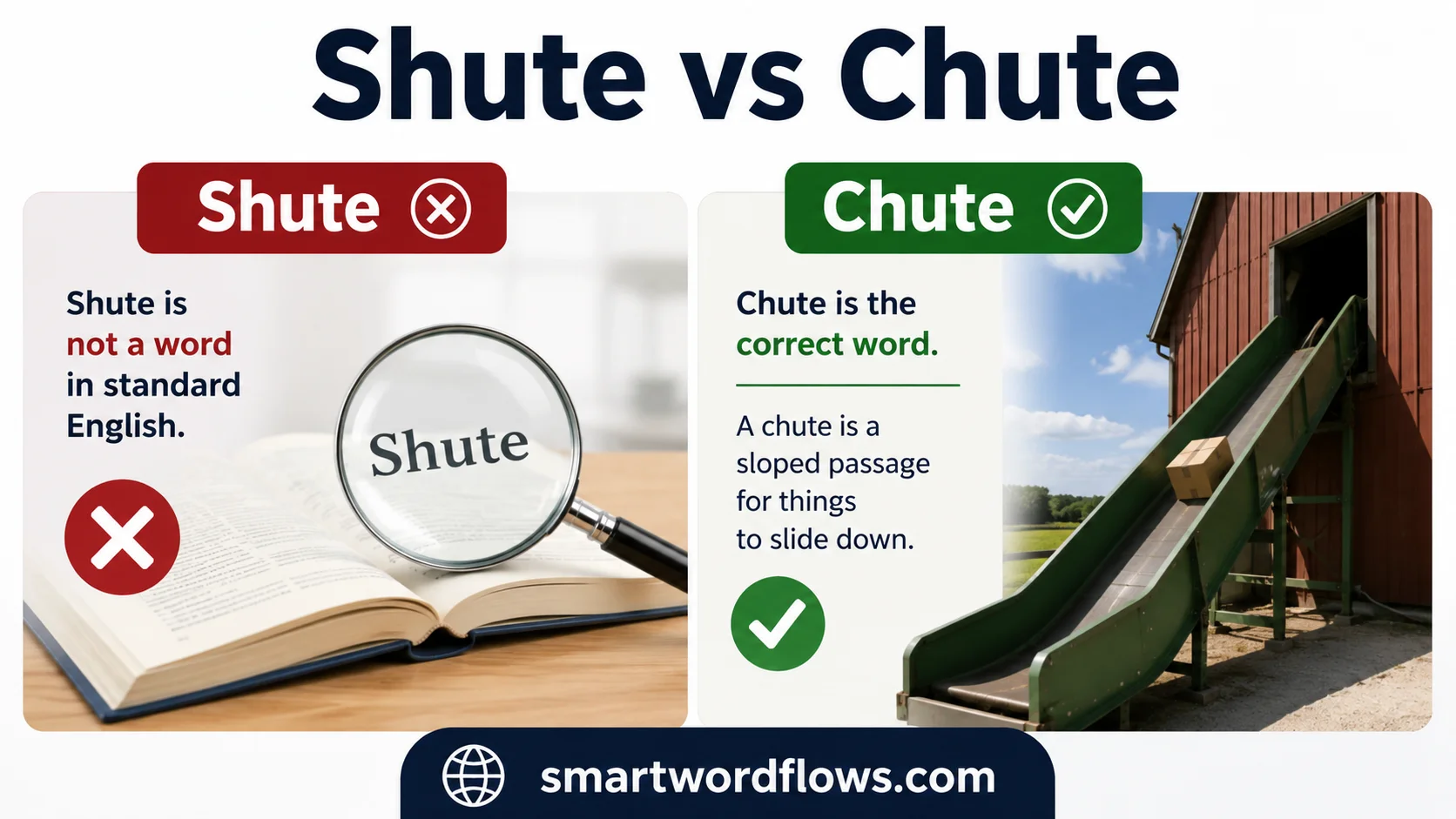

Shute vs Chute Differences and Correct Usage can confuse English speakers, learners, and native speakers because both words have the same sound and pronunciation. In standard English, chute is the correct word, while shute is usually an incorrect spelling or spelling mistake. A chute means a sloping channel, tube, or narrow passage used for movement. Common examples include a garbage chute, construction chute, and parachute system.
The chute definition becomes clearer when we look at its real-life applications. A chute can move objects, people, or items from one place to another through a channel or system. It is also important not to confuse chute with chalet or château. A chalet is a wooden mountain house or vacation home, while a château is a large French castle, manor, or country estate. These terms have French origins and different meanings.
Quick Answer
Use chute when you mean a slide, passage, channel, or steep downward path. Use Shute mainly when it is part of a name or when you are referring to a rare historical or variant spelling. In modern usage, chute is the word most readers expect.
Comparison Overview
Here is the simplest way to see the difference.
| Word | Modern status | Core meaning | Common use |
| chute | Standard English word | A sloping passage, slide, or channel; also related to descent and parachute | Laundry chute, garbage chute, animal chute, ski chute |
| Shute | Much less common | A less common spelling of chute or a surname | Family names, proper nouns, rare variant spelling |
Merriam-Webster lists shute as a “less common spelling of chute,” while major dictionaries define chute as a passage or channel used for sliding or moving things downward. Oxford and Cambridge also connect chute to descent, sliding, and the parachute family of words.
Main Differences Between Shute vs Chute
Meaning
Chute is the word you want when you mean a narrow, sloping structure that carries things, people, or animals downward. Dictionaries describe it as an inclined channel, trough, shaft, or passage. Some sources also include the sense of a waterfall, steep descent, or water slide, which shows how strongly the word is tied to the idea of downward movement.
Shute, by contrast, is not the normal modern word for that structure. Merriam-Webster marks it as a less common spelling of chute, and it is also used as a surname. That means most readers will expect chute, not shute, unless the context is a proper name.
Spelling
The spelling difference is small, but the impact is big. Chute begins with ch, which matches the standard dictionary entry for the structure. Shute begins with sh, which often makes writers assume it should work the same way. In practice, that usually leads to an error. The spelling that belongs in normal English writing is chute.
Pronunciation
This is where the confusion gets worse. Chute is pronounced like shoot. Collins gives the pronunciation as /ʃuːt/, and Cambridge shows the same sound pattern. Because shute is pronounced the same way in most contexts, sound alone does not help you choose the correct spelling.
That is why spelling knowledge matters here. If you hear the word in conversation, your ear will not tell you whether to write chute or Shute. You have to know the meaning and the context.
Usage
In modern writing, chute appears in everyday phrases like laundry chute, garbage chute, cattle chute, and emergency chute. It also appears in idioms and specialized terms such as out of the chute and chute man. Those are real dictionary-backed uses, which shows how active the word is in English.
Shute appears far less often. When it does show up, it is usually as a surname or a rare spelling variant, not the main word people use to describe a chute. That is why writing shute for a garbage disposal shaft or a slide is usually the wrong choice.
What Does Chute Mean?
A chute is a narrow, sloping passage or channel that helps things move from a higher point to a lower one. The word covers a lot of real-world uses, but the idea stays the same: controlled downward movement. Dictionaries define it that way across multiple sources, including entries for water slides, steep slopes, passages, and vertical troughs.
That is why chute works so well in practical settings. It solves a simple problem: how to move objects or people safely and quickly without carrying them by hand. You see the word in homes, apartment buildings, farms, factories, mines, sports, and amusement parks.
Common Types of Chutes
Laundry chute
A laundry chute lets people drop clothes from an upper floor into a laundry area below. The point is convenience. Instead of carrying clothes down stairs, the chute handles the downward path for you.
Garbage chute
A garbage chute gives building residents a direct way to send trash to a lower collection area. It is a common feature in apartment buildings and large facilities.
Cattle chute or animal chute
On farms and ranches, a chute helps guide animals into a controlled space. Merriam-Webster even lists chute man for someone who tends these systems. That specialized usage shows that chute is not only about household slides. It also belongs to industrial and agricultural life.
Ski chute
In skiing, a chute is a narrow, steep run or channel down a mountain. The word fits because the path is tight and the descent is fast.
Water chute
Older and historical sources also use chute for water-related descents, including waterfalls and water slides. Oxford’s historical evidence shows the term has been around since at least the early 19th century in this sense.
What Does Shute Mean?
Shute is not the normal everyday word for a slide or passage. Merriam-Webster identifies it as a less common spelling of chute, and it also appears as a surname. That means most of the time you should think of Shute as a name, not a standard noun for a downward channel.
As a surname, Shute has a real family-history background. Ancestry describes it as an English name linked to places in Devon and traces it to Middle English shute and Old English roots meaning a projecting piece of land. That is a very different story from the modern industrial or household meaning of chute.
Why People Get Confused
The confusion is easy to understand. The words sound alike. They are short. They look similar enough that a quick glance can fool you. On top of that, English has plenty of homophones, so writers often rely on sound when they really need to rely on meaning and spelling.
A good example is this: you may hear someone say “trash chute” and think the spelling could be “shute” because the sound is identical. But dictionary usage does not support that in normal modern writing. The accepted spelling is chute.
Origin and History of Chute
The word chute comes from French. Oxford Learner’s Dictionaries traces it to French chute, meaning “fall,” and links that to older French and Latin roots. That origin makes perfect sense because the word is built around the idea of descending or dropping downward.
Oxford’s historical record also shows that English has used chute for a long time. The noun sense appears in the early 19th century, and the shortened form developed within English, influenced by parachute. Merriam-Webster’s entry for parachute confirms the French root too, showing para- plus chute meaning “fall.” The first known use of parachute dates to 1784.
That history matters because it explains why chute is not just random spelling. It is tied to a real word family. Once you see the family connection, the spelling feels more logical.
Origin and History of Shute
Shute has a different background. As a surname, it can trace back to English place names and older regional forms. Ancestry notes Devon-linked origins and Old English roots for a projecting piece of land. That makes Shute a proper noun with its own history rather than a standard substitute for chute.
That is an important point for careful writers. A surname can be correct in a name line and incorrect in a sentence about a slide or channel. Context decides the spelling.
Real-World Examples of Chute
Here are some natural, correct uses of chute in modern English:
- The hotel had a laundry chute on every floor.
- Workers dropped the bags into the garbage chute.
- The ranch used a cattle chute to guide the animals safely.
- Skiers moved through a narrow chute between the rocks.
- The emergency chute let passengers exit quickly.
These examples show the word at work in everyday life. The pattern is consistent: chute means a guided downward path or passage.
Real-World Examples of Shute
Now compare that with Shute, which is usually correct only in proper-name contexts:
- The article mentioned the Shute family history.
- Shute appeared as the author’s surname.
- The building does not use a shute; it uses a chute.
That last sentence is the key lesson in plain English. If you are talking about the structure, use chute. If you are talking about a person or a family name, Shute may be right.
Also Read This: Icycle vs Icicle Differences and Correct Usage
Why Chute Is the Safer Choice in Most Writing
If you are unsure, choose chute. That is the safer spelling for general English because it is the standard dictionary form for the object or passage. Readers, editors, and search engines will all understand it immediately.
This matters even more in professional writing. A single wrong letter can make a phrase look unpolished. For example, “garbage shute” may look like a typo even if the reader understands what you mean. “Garbage chute” looks clean and correct.
A Practical Case Study
Imagine you are writing a property listing for an apartment building. One line says the building has a trash shute on every floor. The sentence is understandable, but it looks off to a native speaker because the accepted form is trash chute. A buyer or tenant may not say anything, but the mistake still weakens the writing.
Now change the line to trash chute. The meaning stays the same. The sentence now matches dictionary usage and reads like it was written by someone who knows the language well. That is the difference a correct word choice can make.
Here is another one. A ranch safety guide says workers should stand clear of the animal shute. Again, the intended meaning is obvious, but the form is wrong in standard English. Animal chute is the correct expression.
Common Mistakes to Avoid
Using Shute as the Default Spelling
This is the biggest mistake. Many people pick shute because they hear the sound and guess the spelling. That guess is usually wrong in modern usage.
Confusing Sound with Meaning
Sound can trick you here. Both words can sound like “shoot,” but only one is the normal noun for the structure. The spelling has to match the role the word plays in the sentence.
Ignoring Proper-Name Context
If Shute appears in a person’s name or a family history, it may be completely correct. The mistake happens when writers use that same spelling for a chute structure. Context is everything.
Easy Memory Tips
A simple way to remember the difference is this:
- Chute = a channel, slide, or downward passage.
- Shute = usually a name or a rare spelling.
Another trick: think of chute as related to parachute, which also carries the idea of falling. That connection comes from the same French root meaning “fall.”
FAQs:
1. Is “shute” or “chute” correct?
Chute is the correct spelling in standard English. Shute is usually an incorrect spelling, except when used as a surname or proper noun.
2. What does “chute” mean?
A chute is a sloping channel, tube, or passage used to move objects, people, or materials from one place to another.
3. Why do people confuse shute and chute?
They are often confused because shute and chute have the same pronunciation, even though their spelling and standard usage are different.
4. What is the difference between a chute and a chalet?
A chute is a passage or channel for movement, while a chalet is traditionally a wooden mountain house or vacation home.
5. What is the difference between a chalet and a château?
A chalet is generally a mountain house or vacation home, while a château is a large French castle, manor, or country estate.
Conclusion:
Understanding Shute vs Chute Differences and Correct Usage is simple once you remember that chute is the standard English spelling for a channel, tube, or passage. Shute is normally a spelling mistake unless it is used as a surname or proper noun. Keeping these meanings separate can help you avoid common spelling mistakes and use the correct word confidently in everyday and professional writing.