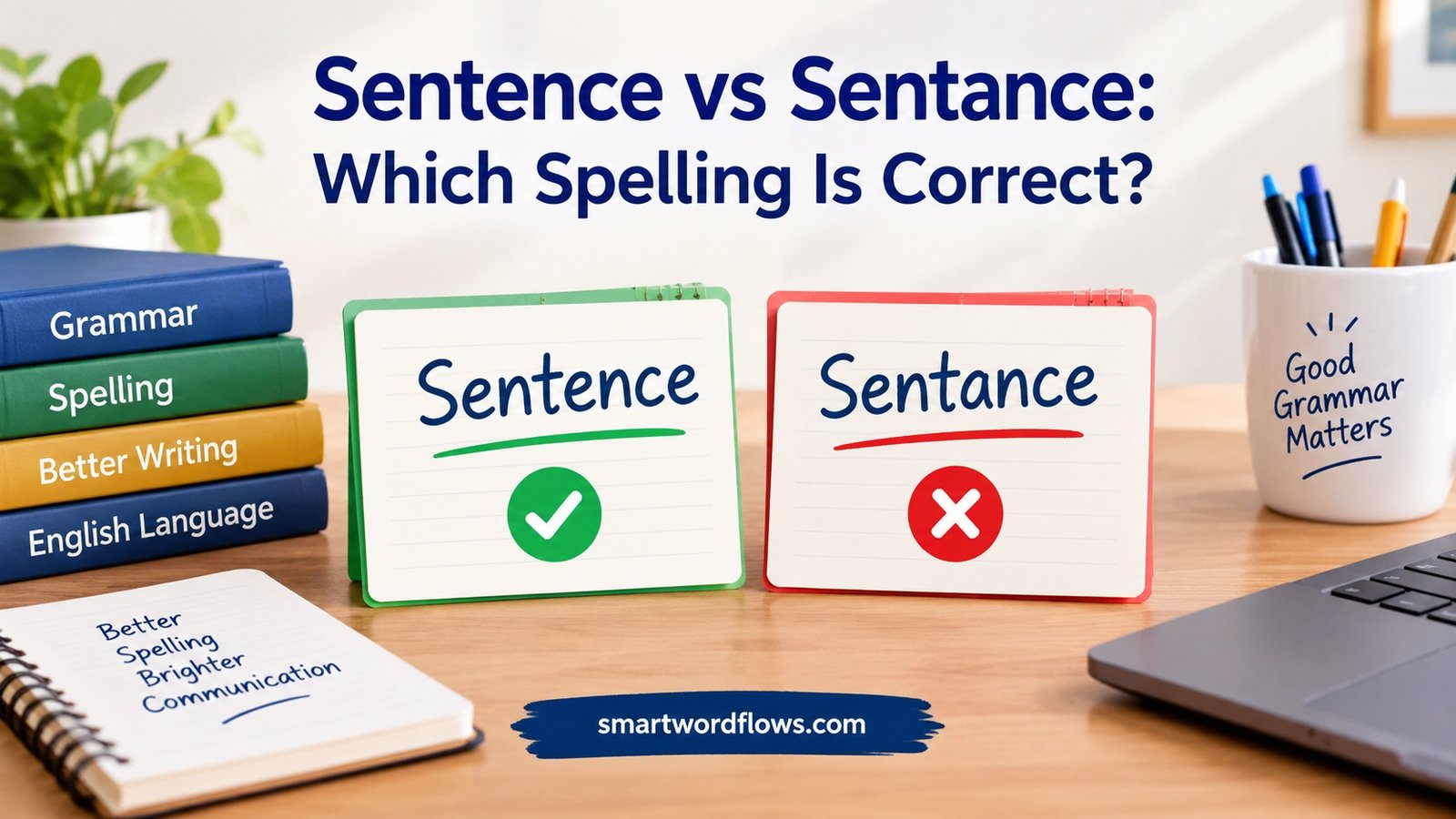

Sentence vs Sentance: Which Spelling Is Correct? has a clear answer: sentence is correct, while sentance is a common misspelling in English. The difference is simple but important because the wrong form can appear in school assignments, emails, blog posts, and professional documents. In English grammar, this confusion often comes from how the words sound similar when spoken. Dictionaries, grammar experts, and style guides identify sentence as the correct word in American English and British English. From my experience with writing skills and communication, learning this correct spelling quickly builds writing confidence and prevents an avoidable spelling mistake.
The meaning of sentence becomes clearer when you look at its everyday use in grammar. A sentence is a group of words that gives a complete statement, question, command, or exclamation. The word also has related uses in legal contexts, where a court can give a punishment, while the verb means to officially impose that punishment. Its spelling stays the same regardless of its meaning or grammatical role. Writers, English learners, and native speakers can still make this common error because the unstressed middle syllable sounds different in natural speech. This English pronunciation may make the letter a in Sentance seem reasonable, but the letter e belongs in the correct form.
A useful basic rule is to focus on the written spelling rather than the middle sound. The spelling patterns remain consistent in academic writing, professional communication, and everyday English writing, so the same form works in every setting. Common examples and real-life examples make learning easier, while simple memory tricks can help you eliminate repeated spelling mistakes. Once you recognize the common error, you can improve grammar accuracy and produce more accurate writing that looks polished, professional, and natural. Paying attention to the correct spelling is therefore a practical habit that makes the wrong spelling easier to notice and avoid.
Quick Answer: Sentence or Sentance?
Sentence is the correct spelling.
Sentance is a common misspelling and isn’t the standard English spelling.
The correct word is:
sentence
It contains an e after the t:
s-e-n-t-e-n-c-e
For example:
- I wrote a complete sentence.
- This sentence needs a comma.
- The judge gave him a five-year sentence.
The incorrect spelling looks like this:
- ❌ I wrote a complete sentance.
- ❌ The teacher corrected my sentance.
- ❌ He received a prison sentance.
Each example should use sentence instead.
So, if you’re deciding between sentence vs sentance, choose sentence every time in standard US English.
Comparison Overview
The easiest way to understand the difference is to compare the two spellings directly.
| Word | Correct Spelling? | Meaning | Standard Usage |
| Sentence | Yes | A grammatical unit expressing a thought; also a legal judgment or punishment | Standard English |
| Sentance | No | No standard meaning as a variant of sentence | Common misspelling |
The key distinction is simple: sentence is a real standard English word, while sentance is an incorrect spelling of that word.
This isn’t a case like color and colour, where both spellings are accepted in different varieties of English. It’s also not like authorization and authorisation, where regional spelling conventions determine which form you’ll normally see.
With sentence vs sentance, there’s no standard US English spelling choice to make. Sentence is the correct form.
Main Differences Between Sentence vs Sentance
The difference between sentence vs sentance comes down primarily to spelling and standard usage. However, understanding why the error happens can make the correct spelling easier to remember.
Sentence Is the Correct Spelling
Sentence is the standard spelling used in English.
It can refer to a grammatical construction:
The dog chased the ball.
That entire group of words forms a sentence.
It can also refer to a legal judgment:
The court imposed a ten-year sentence.
The same spelling works in both contexts.
Sentance Is a Misspelling
Sentance isn’t the accepted spelling of the word.
You may encounter it in informal writing, online comments, student assignments, social media posts, or other places where someone has made a spelling mistake. Its appearance doesn’t make it an alternative spelling.
Think of it as a typo rather than a different version of sentence.
The Spelling Difference Is One Letter
The two forms differ by only one letter:
- sentence → correct
- sentance → incorrect
The important section is:
- sentence → …tence…
- sentance → …tance…
That middle e matters.
A useful way to see the spelling is:
SENT + ENCE = SENTENCE
The incorrect version changes that middle e to a.
Their Meanings Aren’t Different
You shouldn’t treat sentence and sentance as two words with different meanings.
There is no standard distinction such as:
- one for American English
- one for British English
- one for formal writing
- one for informal writing
Instead, sentence carries the meaning. Sentance simply represents a spelling error.
What Does Sentence Mean?
The word sentence has more than one established meaning. Its grammatical and legal uses are especially common.
Sentence as a Group of Words
In grammar, a sentence is a linguistic unit that expresses a complete thought or proposition.
For example:
The children played outside.
This sentence tells you who performed the action and what they did.
A sentence can be very short:
Stop.
Or it can contain several clauses:
Although the rain continued throughout the afternoon, the children stayed outside because they wanted to finish their game.
Both are sentences, even though their structures are very different.
The important point isn’t simply length. A sentence needs to function as a complete grammatical unit in its context.
Sentence in Grammar
When people talk about writing, they often use sentence to describe the basic units that make up paragraphs and larger pieces of communication.
A strong sentence can:
- express an idea
- describe an action
- ask a question
- give an instruction
- show emotion
- connect ideas
- provide information
For example:
Maria finished her assignment before dinner.
The sentence communicates a complete idea.
Types of Sentences
English commonly divides sentences into four types based on their purpose.
Declarative Sentence
A declarative sentence makes a statement.
The library closes at six.
It normally ends with a period.
Interrogative Sentence
An interrogative sentence asks a question.
When does the library close?
It normally ends with a question mark.
Imperative Sentence
An imperative sentence gives a command, request, or instruction.
Please close the door.
The subject you is often understood rather than directly stated.
Exclamatory Sentence
An exclamatory sentence expresses strong emotion.
What an amazing performance!
It normally ends with an exclamation point.
These four categories demonstrate how broadly the word sentence functions in grammar.
Sentence as a Legal Term
The word sentence also has an important legal meaning.
In criminal law, a sentence generally refers to the punishment or legal disposition imposed by a court after a person has been convicted.
For example:
The judge imposed a five-year prison sentence.
Here, sentence has nothing to do with punctuation or grammar.
Depending on the legal system and circumstances, a sentence can involve forms of punishment or supervision such as:
- imprisonment
- probation
- fines
- community-based penalties
- other court-ordered consequences
The exact meaning and available penalties depend on the jurisdiction.
This creates an interesting contrast. The same word can describe something as small as a grammatical unit and something as serious as a criminal punishment.
Sentence in Grammar vs Law
| Context | Meaning | Example |
| Grammar | A group of words expressing a complete thought | She opened the window. |
| Writing | A unit of written communication | This sentence needs revision. |
| Law | A court-imposed punishment or legal judgment | The court imposed a sentence. |
Context tells you which meaning applies.
What Does Sentance Mean?
Sentance is not the standard spelling of the word sentence.
If someone writes:
Please read the last sentance.
The intended word is almost certainly sentence.
The corrected version is:
Please read the last sentence.
Likewise:
❌ The judge announced the sentance.
should become:
✅ The judge announced the sentence.
You might see sentance online because people make spelling mistakes. Search engines, spell-checkers, grammar tools, and autocorrect systems may also encounter the form. None of that makes it a standard alternative spelling.
Why Is Sentance Incorrect?
The mistake usually becomes easier to understand when you consider the relationship between pronunciation and spelling.
English spelling doesn’t always provide a perfect visual representation of pronunciation. A word can sound one way while its written form follows a historical spelling pattern.
That’s one reason learners sometimes write sentance instead of sentence.
The Correct Spelling Pattern
The correct spelling is:
S-E-N-T-E-N-C-E
Pay particular attention to the letters after t.
The word contains:
…t-e-n-c-e
Not:
…t-a-n-c-e
This small distinction makes the difference between the correct word and a misspelling.
Why Pronunciation Causes Confusion
When you pronounce sentence, the unstressed vowel sounds can be less obvious than they look in writing.
That can make the spelling harder to recall, particularly for people who are learning English or writing quickly.
Consider this simple principle:
Sound can help you pronounce a word, but spelling determines how you write it.
That distinction matters because English contains many words whose spelling isn’t immediately obvious from their pronunciation.
How to Remember the Spelling of Sentence
A good spelling trick should be quick enough to use when you’re writing.
Here are several ways to remember sentence.
Remember the Middle E
Focus on:
SENT-E-NCE
The middle e separates the correct spelling from the common mistake.
When you’re unsure, pause and mentally check:
sent-e-nce
Connect Sentence With Ten
The word sentence contains the sequence ten:
sen + ten + ce
This isn’t a formal spelling rule. It’s simply a useful memory aid.
If sentance feels tempting, remember that the correct form has an e in that middle position.
Use the Word in Context
Instead of memorizing the spelling in isolation, write several natural examples:
- I wrote one sentence.
- The paragraph contains five sentences.
- Please finish the sentence.
- That sentence is too long.
- The court announced the sentence.
Repeated exposure makes the correct spelling more familiar.
Sentence vs Sentance: Common Mistakes
The most obvious mistake is replacing the middle e with a.
Mistake: Sentance
❌ She wrote an interesting sentance.
Correction: Sentence
✅ She wrote an interesting sentence.
The same correction applies in every context.
Mistake: Sentances
Some writers also carry the error into the plural:
❌ The paragraph contains three sentances.
The correct plural is:
✅ The paragraph contains three sentences.
Notice that the ending changes from -ce to -ces when the word becomes plural.
Mistake: Confusing Spelling With Pronunciation
A writer might hear the word and try to reproduce its sound letter by letter.
That approach can lead to sentance.
Instead, learn the written form as a complete word. Once you’ve seen sentence often enough, the spelling becomes much easier to recognize.
Read More:Sence vs Sense: Which Spelling Is Correct?
Sentence vs Sentance in Different Contexts
The correct spelling stays the same regardless of context.
Sentence in Academic Writing
Academic writing frequently discusses sentences, paragraphs, clauses, and grammatical structure.
For example:
Each sentence should communicate its main idea clearly.
A teacher might also write:
Revise the second sentence for clarity.
In academic work, spelling accuracy matters because repeated mistakes can distract readers and weaken the presentation of otherwise strong ideas.
Sentence in Everyday Communication
You’ll encounter the word sentence constantly in ordinary conversation and writing.
Examples include:
Can you finish that sentence?
I don’t understand the last sentence.
That sentence sounds awkward.
Please read the first sentence again.
Because the word appears so often, learning its correct spelling pays off quickly.
Sentence in Legal Writing
Legal writing uses sentence in a specialized sense.
For example:
The defendant received a three-year sentence.
Here, the word refers to a legal punishment or disposition rather than a grammatical construction.
The spelling remains exactly the same.
Examples of Sentence vs Sentance
Seeing the difference in real sentences makes the rule easier to remember.
| Incorrect | Correct |
| I wrote a long sentance. | I wrote a long sentence. |
| Read the final sentance. | Read the final sentence. |
| The paragraph has six sentances. | The paragraph has six sentences. |
| Please complete the sentance. | Please complete the sentence. |
| The judge announced the sentance. | The judge announced the sentence. |
The pattern stays consistent. Sentence is correct in every example.
Example Sentences Using Sentence
Here are some natural examples showing different meanings and contexts.
Grammar Examples
The first sentence introduces the main idea.
This sentence contains an independent clause.
Please rewrite the final sentence.
The paragraph begins with a strong sentence.
That sentence needs better punctuation.
Everyday Examples
I couldn’t understand the last sentence.
She repeated the sentence slowly.
He deleted the first sentence from the email.
Can you read that sentence aloud?
Legal Examples
The judge announced the sentence after the hearing.
The defendant received a prison sentence.
The court reduced the sentence on appeal.
These examples show why context matters when interpreting the word. Its spelling doesn’t change.
Sentence vs Sentance: A Simple Case Study
Imagine a student writing an essay about climate change.
The student writes:
Climate change affects every sentance in the paragraph.
The teacher marks the spelling error.
The student then writes:
Climate change affects every sentence in the paragraph.
The second version uses the correct spelling.
Now imagine the same student encounters the word in a legal article:
The defendant received a five-year sentence.
The meaning has changed, but the spelling hasn’t.
This illustrates an important rule:
Different meanings do not automatically create different spellings.
The word remains sentence whether you’re discussing grammar or law.
Why Correct Spelling Matters
A single spelling mistake rarely destroys an entire piece of writing. However, frequent mistakes can affect how readers perceive the text.
Correct spelling helps your writing appear:
- polished
- clear
- credible
- professional
- easier to read
This becomes particularly important in academic assignments, resumes, business communication, websites, reports, and formal documents.
For example, compare:
Please review the final sentance before submission.
with:
Please review the final sentence before submission.
The second version immediately looks cleaner because it uses the standard spelling.
Sentence vs Sentance: Grammar and Spelling Test
Test yourself before moving on.
Choose the Correct Spelling
The teacher asked me to rewrite the final ________.
A. sentance
B. sentence
Answer: B. sentence
The paragraph contains four complete ________.
A. sentences
B. sentances
Answer: A. sentences
The judge announced the prison ________.
A. sentance
B. sentence
Answer: B. sentence
Please read the first ________ carefully.
A. sentence
B. sentance
Answer: A. sentence
If you consistently choose sentence, you’ve got the spelling down.
Sentence vs Sentance: A Quick Visual Reminder
A simple spelling pattern can help:
Correct:
S E N T E N C E
Incorrect:
S E N T A N C E
The important letter is the E after T.
Remember:
Sentence has an E in the middle.
That tiny visual cue can prevent the mistake.
Is Sentence Singular or Plural?
Sentence is singular.
The plural form is sentences.
| Singular | Plural |
| sentence | sentences |
Examples:
This sentence is clear.
These sentences are clear.
The plural ending is -s, but because sentence already ends in e, the resulting spelling becomes sentences.
A common mistake is writing sentances, which carries the original spelling error into the plural.
How Do You Spell Sentence Correctly?
The correct spelling is:
S-E-N-T-E-N-C-E
A useful breakdown is:
sent + ence = sentence
Avoid changing the middle e to a.
If you’re writing quickly, it may help to pause briefly whenever you notice yourself thinking about the spelling. One second of checking can save you from repeating the same error throughout a document.
How Do You Pronounce Sentence?
In standard US English, sentence is pronounced with two syllables.
sentence (ˈsɛn.təns)
The pronunciation can help explain why some writers struggle with the spelling. The middle vowel isn’t pronounced as clearly as the written e might suggest.
That’s a useful reminder that pronunciation and spelling don’t always line up perfectly in English.
Is Sentance a Word?
Sentance isn’t the standard English spelling for the word meaning a grammatical unit or legal punishment.
You may find the form in user-generated content, informal writing, or spelling-error databases. Its existence in those contexts doesn’t make it an accepted spelling.
For standard US English, use sentence.
Is Sentence the Same in American and British English?
Yes. Sentence is the standard spelling in both American and British English.
This point is worth emphasizing because English contains many regional spelling differences.
For example:
- American English: color
- British English: colour
But sentence doesn’t follow that pattern.
You don’t need to choose between sentence and sentance based on your location. Sentence is the correct spelling.
Common Words Related to Sentence
Understanding related words can strengthen your vocabulary and spelling awareness.
Sentences
The plural of sentence is sentences.
The article contains several short sentences.
Sentence Structure
Sentence structure describes how words, phrases, and clauses combine within a sentence.
For example, writers may discuss simple, compound, complex, and compound-complex sentence structures.
Sentence Fragment
A sentence fragment looks like part of a sentence but doesn’t function as a complete sentence in standard usage.
For example:
Because she was tired.
This leaves the reader waiting for the rest of the thought.
Sentence Case
Sentence case is a capitalization style in which the first word of a sentence is capitalized while most other words remain lowercase unless they require capitalization for another reason.
For example:
This is written in sentence case.
These related terms all use the same correct spelling: sentence.
Frequently Asked Questions About Sentence vs Sentance
Is sentence or sentance correct?
Sentence is correct. Sentance is a misspelling.
Is sentance a word?
Sentance isn’t the standard English spelling of the word sentence. It generally appears as a spelling error.
How do you spell sentence correctly?
Spell it:
S-E-N-T-E-N-C-E
The middle e is important.
Why do people spell sentence as sentance?
The mistake likely comes from the relationship between pronunciation and spelling. The unstressed sounds in sentence can make the written e less obvious when someone tries to spell the word from sound.
What is the plural of sentence?
The plural is sentences.
For example:
The teacher asked us to write five sentences.
What does sentence mean in grammar?
In grammar, a sentence is a linguistic unit that communicates a complete thought or proposition and follows the grammatical conventions of the language.
What does sentence mean in law?
In legal contexts, a sentence generally refers to a punishment or legal disposition imposed by a court following a conviction.
Is sentance an alternative American spelling?
No. Sentance isn’t an accepted American English variant of sentence.
Is sentence spelled differently in British English?
No. Sentence is also the standard spelling in British English.
How can I remember sentence vs sentance?
Remember the middle e:
sent-e-nce
If you see sentance, change the a to e.
conclusion
When choosing between sentence vs sentance, there’s a straightforward answer: sentence is the correct spelling.
The word has several established meanings. In grammar, a sentence expresses a complete thought or functions as a grammatical unit. In law, a sentence refers to a court-imposed punishment or legal disposition. Despite these different meanings, the spelling stays the same.
Sentance is simply a common misspelling. It doesn’t represent a separate American or British spelling, and it doesn’t have a different meaning that you need to learn.
The easiest way to remember the correct form is to focus on the middle e:
S-E-N-T-E-N-C-E
So, whenever you’re unsure, choose sentence. That small spelling detail can make your academic writing, professional communication, and everyday messages much cleaner and more polished.




1 thought on “Sentence vs Sentance: Which Spelling Is Correct?”