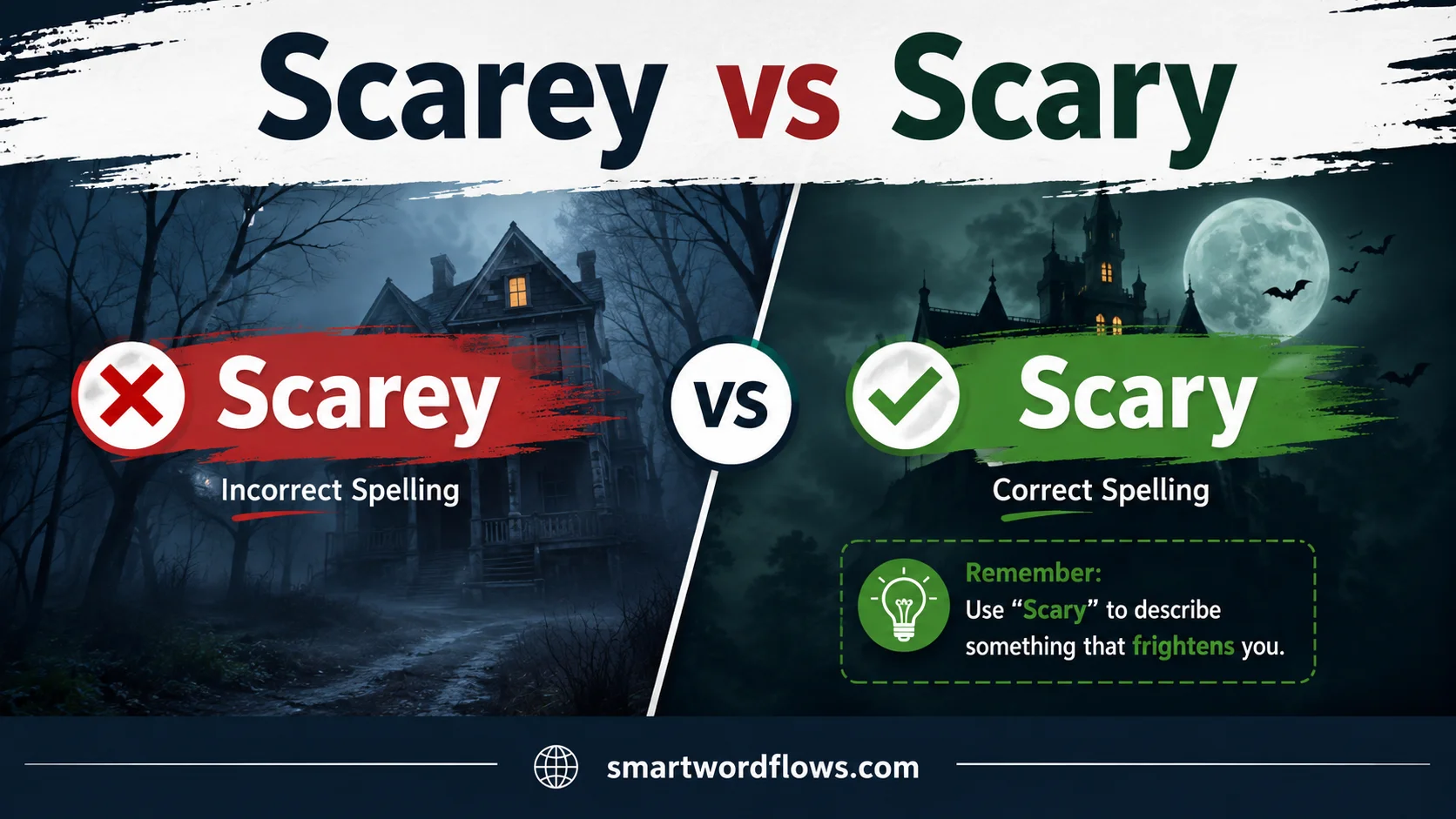

If you’ve ever been confused by Scarey vs Scary, you’re not alone. Both forms look believable, but scary is the standard spelling in modern US English. The word describes something that causes fear, worry, or alarm, while scarey is generally treated as a variant spelling with much less everyday use. Understanding this difference can help you avoid common spelling mistakes and choose the correct word with confidence.
The confusion often comes from the spelling of scare, which naturally makes scarey seem correct. However, scary is the preferred form in contemporary writing, including school assignments, professional emails, blogs, and casual messages. In this guide, you’ll learn about their meaning, spelling, pronunciation, grammar, and usage, along with practical examples to make the difference easy to remember.
Quick Answer
Scary is the standard and preferred spelling in US English.
Scarey is recorded as a variant spelling in some dictionaries. Merriam-Webster lists scarey as a variant of scary, while Cambridge identifies scarey as a UK variant. Therefore, it isn’t accurate to say that scarey has no existence in English. However, scary is the spelling you should normally choose in American English.
The simple answer
| Word | Status | Meaning | Best choice in US English |
| Scary | Standard spelling | Causing fear or alarm | Yes |
| Scarey | Recorded variant | Same basic meaning | Usually no |
| Scared | Different adjective | Experiencing fear | Yes, when appropriate |
| Scare | Verb or noun | To frighten or a frightening event | Yes, when appropriate |
So if you’re deciding between “That movie was scary” and “That movie was scarey,” choose:
That movie was scary.
That form is natural, standard, and appropriate for general US writing.
Comparison Overview
The easiest way to understand scarey vs scary is to compare how dictionaries and modern writers treat the two spellings.
| Feature | Scary | Scarey |
| Standard US spelling | Yes | No |
| Meaning | Causing fear | Causing fear |
| Dictionary recognition | Yes | Yes, as a variant |
| Common in modern US writing | Very common | Uncommon |
| Common recommendation for US English | Preferred | Not preferred |
| UK variant status | Used | Recorded as a variant |
| Part of speech | Adjective | Adjective |
| Comparative form | Scarier | Rarely used |
| Superlative form | Scariest | Rarely used |
| Related verb | Scare | Scare |
Merriam-Webster records scarey as a variant of scary. Cambridge also provides evidence for scarey as a UK variant. That distinction matters because dictionary status and preferred modern usage aren’t always identical.
In practical terms, “scary” is the spelling to remember.
Main Differences Between Scarey vs Scary
The biggest difference isn’t meaning. Both forms refer to something that causes fear or makes someone feel frightened.
The important difference involves standard usage and regional preference.
1. Scary is the standard US spelling
When American readers see the word scary, nothing looks unusual. It appears regularly in books, news articles, entertainment writing, everyday conversations, and professional content.
For example:
- The movie was scary.
- That was a scary experience.
- The storm became scary after midnight.
- She heard a scary noise outside.
These sentences use the spelling most readers expect.
2. Scarey is a recognized variant
The situation becomes more interesting with scarey.
Merriam-Webster lists scarey as a variant spelling of scary. Cambridge lists it as a UK variant. Collins also records the form.
That means the statement “scarey isn’t a word” is too absolute.
A better explanation is:
“Scarey is a recognized variant spelling, but scary is the standard choice for contemporary US English.”
That wording gives readers useful information without oversimplifying English spelling.
3. Scary is much safer for formal writing
If you’re writing for an American audience, scary is almost always the better choice.
Use it in:
- School assignments
- College papers
- Professional communication
- Business websites
- Articles and blog posts
- Marketing copy
- Reports
- Applications
- General online writing
Unless you’re deliberately preserving a regional spelling or quoting an original source, there’s little reason to choose “scarey” over “scary.”
What Does “Scary” Mean?
Scary is an adjective that describes something that causes fear, fright, worry, or uneasiness.
Cambridge Dictionary defines scary as “frightening.”
You can use the word for physical danger, fictional horror, disturbing behavior, unexpected situations, or even emotional experiences.
For example:
- The haunted house was scary.
- Driving through the storm was scary.
- The sudden crash was scary.
- That horror story was incredibly scary.
- Starting a new job can feel scary at first.
Notice something important here. Scary doesn’t always mean terrifying.
A situation can be mildly scary, somewhat scary, extremely scary, or completely terrifying. The word covers a broad range of fear.
Scary can describe many things
You might describe these as scary:
- A horror movie
- A dangerous animal
- A dark alley
- A strange sound
- A serious accident
- A threatening person
- A difficult situation
- An unexpected experience
- A frightening dream
- A sudden medical emergency
The context determines the intensity.
What Does “Scarey” Mean?
Scarey has essentially the same basic meaning as scary. It functions as an adjective that describes something frightening or capable of causing fear.
The important distinction involves spelling preference rather than meaning.
Merriam-Webster’s dictionary entry for scarey identifies it as a variant of scary. You can view the entry here:
Cambridge provides additional evidence by listing scarey as a UK variant associated with scary:
This evidence gives us a more accurate picture than simply labeling scarey a spelling error.
Why should US writers still choose “scary”?
Because standard usage matters.
A dictionary can recognize a variant without recommending it as the best choice for every audience. English contains many regional spellings and historical variants that remain understandable but aren’t equally common.
For contemporary American writing, scary is the clear practical choice.
Why Do People Confuse Scarey and Scary?
The confusion makes perfect sense when you look at the base word.
The word scare is spelled:
S-C-A-R-E
That makes many writers naturally expect:
S-C-A-R-E-Y
The spelling scarey looks visually connected to scare. Unfortunately, English spelling doesn’t always behave as neatly as that.
The established standard form is:
S-C-A-R-Y
This means you need to remember the spelling rather than simply adding -y to scare.
Think of it this way
Scare → Scary
Not:
Scare → Scarey
That tiny spelling difference causes a surprising amount of confusion.
Scare + Y = Scary: Understanding the Spelling
One useful way to remember scary is to treat it as its own established adjective rather than trying to construct it mechanically.
The standard spelling is:
scary
It contains no e before the final y.
The same spelling pattern appears when you use related forms:
- Scary
- Scarier
- Scariest
Examples
This movie is scary.
The second movie is scarier.
That was the scariest scene in the entire film.
The spelling changes naturally as the adjective becomes comparative or superlative.
A simple memory trick works well:
SCARY = SCARE without the final E + Y
This isn’t a universal spelling rule for every English word. It’s simply a useful way to remember this particular word.
Scary vs Scared: Don’t Mix Them Up
One of the most important distinctions is scary vs scared.
These words relate to fear. However, they describe different sides of the experience.
Scary means “causing fear”
Something scary creates fear in someone.
The abandoned house looked scary.
The house causes the feeling.
Scared means “feeling fear”
Someone who experiences fear feels scared.
I was scared when I entered the abandoned house.
The person experiences the feeling.
A simple formula
Scary → causes fear
Scared → feels fear
Consider this example:
The thunderstorm was scary, so the children became scared.
The storm is scary because it causes fear. The children are scared because they experience that fear.
That’s an easy distinction to remember.
Scary vs Scare: How Are They Different?
Scare and scary come from the same word family. However, they perform different grammatical jobs.
Scare as a verb
As a verb, scare means to frighten someone.
The loud noise scared me.
Here, scared tells us what the noise did.
Scare as a noun
As a noun, scare can refer to a frightening experience or sudden feeling of fear.
The unexpected noise gave everyone a scare.
Scary as an adjective
As an adjective, scary describes something that causes fear.
The unexpected noise was scary.
These three sentences describe a similar event while using different grammatical structures.
| Word | Function | Example |
| Scare | Verb | The noise scared me. |
| Scare | Noun | The noise gave me a scare. |
| Scary | Adjective | The noise was scary. |
| Scared | Adjective | I was scared by the noise. |
Scarey vs Scary Examples in Real Sentences
Seeing the difference in context makes the answer much easier to remember.
| Less suitable for standard US English | Preferred form |
| That was a scarey movie. | That was a scary movie. |
| The house looked scarey at night. | The house looked scary at night. |
| It was a scarey situation. | It was a scary situation. |
| The story became scarey near the end. | The story became scary near the end. |
| That dog looks scarey. | That dog looks scary. |
Again, “less suitable” doesn’t mean “nonexistent.” The word scarey has dictionary recognition as a variant. The table simply shows the spelling that works best for ordinary US English.
More examples with “scary”
- The abandoned theater looked scary after sunset.
- That was a scary moment for everyone involved.
- The horror movie wasn’t scary enough for me.
- Walking home alone through the empty streets felt scary.
- The sudden change in weather became genuinely scary.
Common Mistakes With Scarey and Scary
Understanding the common errors can help you avoid them.
Mistake 1: Assuming “scarey” must be the standard spelling
The base word scare can make scarey seem logical. However, standard US English uses scary.
Mistake 2: Saying “scarey” is never a real word
This claim ignores dictionary evidence.
Major dictionaries record scarey as a variant. Therefore, the more accurate explanation recognizes its existence while still recommending scary for US usage.
Mistake 3: Confusing scary with scared
Don’t write:
I was scary during the movie.
That sentence means you caused fear.
Instead, write:
I was scared during the movie.
The movie itself might be:
The movie was scary.
Mistake 4: Using “scare” instead of “scary”
Compare these sentences:
The movie was scary.
The movie scared me.
Both are correct. However, they use different grammatical structures.
Is “Scarey” Correct in British English?
This question deserves a careful answer because English spelling can vary between regions.
Scarey is recorded as a UK variant of scary by Cambridge Dictionary. Collins also recognizes the variant spelling.
That doesn’t mean British writers must use scarey. In fact, scary remains a familiar and widely recognized spelling.
Regional variants can survive for many reasons. Some come from historical usage while others reflect differences in spelling traditions or editorial preferences.
Therefore, it’s better to avoid a rigid statement such as:
“Scarey is British English and scary is American English.”
That oversimplifies the evidence.
A more accurate statement is:
Scary is the standard spelling you can confidently use across modern English. Scarey is a recorded variant that appears in some British English contexts and dictionaries.
Read This: Stared vs. Starred: How to Use Each Word Correctly
Is “Scarey” a Misspelling?
The best answer is sometimes, depending on context.
If an American writer intends to use standard contemporary US English, scarey would normally be treated as a nonstandard or unwanted spelling choice.
However, dictionary evidence prevents us from saying that scarey is always an outright misspelling.
Think about it like regional vocabulary. A word can exist in a language while still being unusual for a particular audience.
Practical rule
If you’re writing for:
An American audience → use “scary.”
A general international audience → “scary” is still the safest choice.
A source that intentionally uses “scarey” → preserve the original spelling when quoting it.
That approach gives you accuracy without unnecessary confusion.
How Do You Spell Scary Correctly?
The correct standard spelling is:
S-C-A-R-Y
Not:
S-C-A-R-E-Y
A quick memory trick can make the difference stick:
Scare loses the final E before becoming scary.
Try remembering these three forms together:
- Scary
- Scarier
- Scariest
Example sentence
The first scene was scary, but the ending was even scarier.
That sentence reinforces both the spelling and the comparative form.
Pronunciation of Scary and Scarey
Spelling becomes especially confusing when two forms sound similar.
Scary is generally pronounced with the first syllable sounding like “scare” followed by a short final sound.
The pronunciation doesn’t necessarily help you decide whether to write scary or scarey because the variant spelling is associated with the same basic word.
That’s why visual memory is more useful here.
When you hear the word, remember:
scary
rather than trying to spell it exactly as the base word scare looks.
For formal writing, spelling should follow the standard written form rather than an intuitive pronunciation-based construction.
Comparative and Superlative Forms of Scary
The adjective scary has two common forms for comparing levels of fear.
Scary
Use scary for the basic description.
That movie is scary.
Scarier
Use scarier when comparing two things.
The second movie was scarier than the first.
Scariest
Use scariest when something ranks highest among several things.
That was the scariest scene in the movie.
| Degree | Form | Example |
| Positive | Scary | The story is scary. |
| Comparative | Scarier | This story is scarier. |
| Superlative | Scariest | This is the scariest story. |
Notice that the e doesn’t return in either scarier or scariest.
Scary Synonyms You Can Use
Sometimes scary isn’t specific enough. Choosing a more precise synonym can make your writing stronger.
Frightening
Frightening works well when something genuinely causes fear.
The sudden explosion was frightening.
Creepy
Creepy often describes something strange, unsettling, or uncomfortable rather than openly terrifying.
There was something creepy about the empty house.
Spooky
Spooky often fits ghosts, Halloween, mysterious places, and playful horror.
The old cemetery looked spooky beneath the moonlight.
Terrifying
Terrifying describes a much stronger level of fear.
The experience was absolutely terrifying.
Horrifying
Horrifying usually suggests something deeply disturbing or shocking.
The documentary revealed a horrifying reality.
Alarming
Alarming works especially well when something creates concern about danger or possible harm.
The sudden drop in temperature was alarming.
The best synonym depends on how strong the fear is and why it exists.
Scary in Different Contexts
The word scary has a surprisingly broad range.
Movies and entertainment
That horror movie was scary without relying on constant jump scares.
Here, scary describes the emotional effect of the movie.
Real-life situations
Driving through flooded roads became scary after the water rose quickly.
The word describes a dangerous experience.
People and behavior
His sudden aggressive reaction was scary.
In this case, the behavior creates fear.
Places
The abandoned building looked scary after dark.
The environment creates an unsettling impression.
Personal experiences
Moving to a new city alone felt scary at first.
Here, the word describes an emotional experience rather than physical horror.
This flexibility explains why scary remains such a useful everyday adjective.
When Should You Use “Scary” Instead of “Scarey”?
For most readers, the answer is simple: choose scary.
Use scary when you’re writing:
- School assignments
- College essays
- Professional emails
- Business content
- Website copy
- Blog articles
- News-style writing
- Social media posts
- Formal documents
- General US English
You can encounter scarey in dictionaries or regional writing. However, using the standard form scary avoids distracting readers who expect conventional American spelling.
When clarity is the goal, the familiar spelling wins.
A Practical Case Study: Choosing the Right Form
Imagine that three writers describe the same horror movie.
Writer A
The movie was scarey, especially during the final scene.
The sentence is understandable. However, a US editor would normally change scarey to scary.
Writer B
The movie was scary, especially during the final scene.
This version uses the standard US spelling and requires no explanation.
Writer C
The movie scared me, especially during the final scene.
This sentence is also correct. However, it changes the grammatical focus.
Writer B describes the movie’s quality.
Writer C describes the writer’s emotional reaction.
That distinction shows why spelling and grammar should be considered together.
Quick Scarey vs Scary Cheat Sheet
Keep this reference handy when you’re unsure.
| Question | Answer |
| Which spelling is standard in US English? | Scary |
| What does scary mean? | Causing fear or fright |
| Is scary an adjective? | Yes |
| Is scarey recognized by dictionaries? | Yes, as a variant |
| Should US writers normally use scarey? | No |
| What is the comparative form? | Scarier |
| What is the superlative form? | Scariest |
| What is the related verb? | Scare |
| What describes a person experiencing fear? | Scared |
| What spelling is safest for general readers? | Scary |
Test Yourself: Scarey or Scary?
Try completing these sentences before checking the answers.
- That abandoned house looks incredibly _____ at night.
- I felt _____ when I heard footsteps upstairs.
- The thunderstorm was becoming _____.
- The loud crash _____ everyone in the room.
- That was the _____ part of the entire story.
- The second movie was much _____ than the original.
- The strange behavior was genuinely _____.
Answers
- scary
- scared
- scary
- scared
- scariest
- scarier
- scary
The exercise highlights an important point: scary, scared, and scare belong to the same word family, but they don’t perform the same grammatical role.
FAQs:
1. Is Scary or Scarey correct?
Scary is the standard and preferred spelling in modern US English. Use scary in most everyday, academic, and professional writing.
2. Is Scarey a misspelling?
Not completely. Scarey appears as a variant spelling in some dictionaries, but it’s much less common than scary. In standard writing, scary is the safer choice.
3. What does Scary mean?
Scary is an adjective that describes something that causes fear, alarm, or worry. For example: “That movie was very scary.”
4. Why do people spell Scary as Scarey?
The confusion usually comes from the word scare. Because scare contains an “e,” people may naturally assume that scarey is the correct form.
5. How can I remember the correct spelling?
A simple way to remember it is to connect scary with scare, but drop the final “e” before adding -y. This gives you scary, the preferred spelling.
Conclusion:
When comparing Scarey vs Scary, scary is the standard spelling you should normally use. Although scarey can appear as a variant, it’s far less common in contemporary English. Choosing scary will make your writing clearer, more natural, and appropriate for most situations.