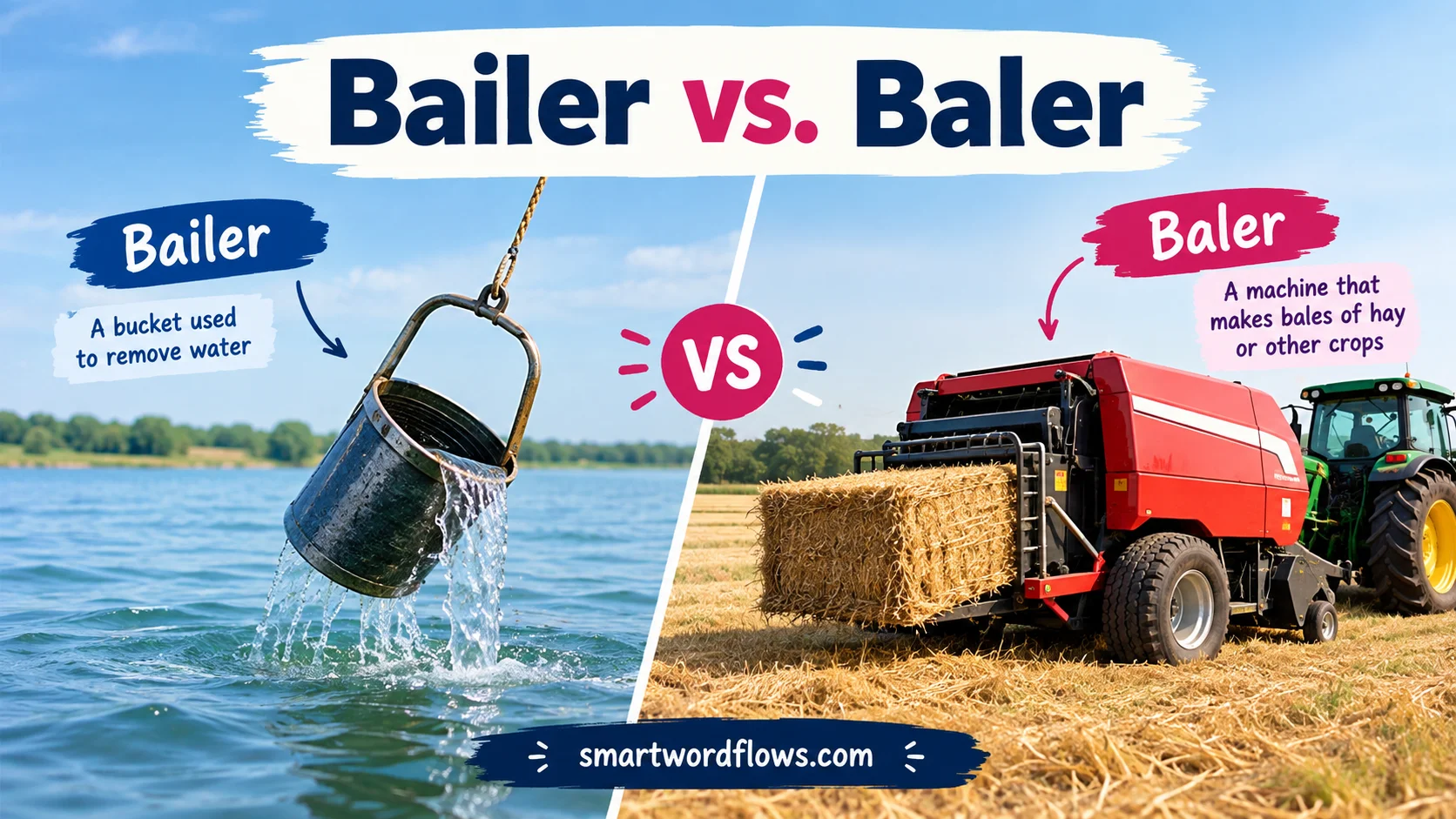

Bailer vs. Baler can be confusing because these words look and sound very similar, but they have completely different meanings and uses. A bailer is a person or tool used to remove water from a boat, container, or other space. In a legal context, it can also describe someone who provides bail. Understanding this difference is important when writing about boating, law, groundwater, or everyday situations where choosing the correct word matters.
A baler, on the other hand, is a machine designed to compress materials such as hay, straw, paper, cardboard, plastic, and recyclables into compact bundles called bales. Although bailer and baler have similar pronunciation, their functions, contexts, and meanings are not interchangeable. Knowing how each term is used can help you avoid common spelling mistakes and communicate more clearly, especially when discussing farming equipment, recycling, agriculture, or technical subjects.
Quick Answer
The difference between bailer and baler comes down to their root words and meanings.
- Bailer comes from bail and commonly refers to something used to remove water or another liquid.
- Baler comes from bale and usually refers to a machine or person that compresses material into a bale.
- A bailer might help empty water from a boat.
- A baler might compress hay into rectangular or round bales.
- Both spellings are correct, but they aren’t interchangeable.
A simple way to remember them is:
Bail → bailer → removes liquid
Bale → baler → makes bales
For example, these sentences use the words correctly:
“The sailor used a bailer to remove water from the boat.”
“The farmer used a baler to compress the freshly cut hay.”
The words differ by only one letter, yet they describe entirely different actions.
Comparison Overview
| Feature | Bailer | Baler |
| Root word | Bail | Bale |
| Related verb | Bail | Bale |
| Main meaning | A person or device that bails | A person or machine that makes bales |
| Common physical use | Removing water or liquid | Compressing material |
| Common settings | Boats, wells, liquid-removal equipment | Farms, recycling facilities, industrial sites |
| Common materials | Water and other liquids | Hay, straw, paper, cardboard, plastics, cotton |
| Example | “The bailer removed water from the boat.” | “The baler compressed the hay.” |
| Memory clue | Bail = remove water | Bale = bundle material |
The easiest distinction is functional. A bailer takes liquid away, while a baler turns loose material into compact bundles.
However, bailer has another legitimate meaning in legal language. That meaning comes from the legal sense of bail, rather than the physical act of removing water.
What Does “Bailer” Mean?
Bailer is a noun derived from the verb bail. In its physical sense, it describes a container, tool, or device used to remove water or another liquid from a place where the liquid isn’t wanted.
The word appears in several practical settings. Boating is one of the clearest examples. If water collects inside a small boat, a person might use a bailer to scoop that water out.
The same basic idea applies elsewhere. A bailer can refer to equipment used to remove liquid from a well, tank, excavation, or other confined space, depending on the industry and context.
Bailer as a Tool
The physical meaning of bailer relates directly to the verb bail, which can mean to remove water from a boat or other vessel.
For instance, imagine a small fishing boat taking on water during rough weather. A person could use a handheld container to scoop water overboard. That container can be called a bailer.
The tool doesn’t need to have a complicated design. In simple situations, a bucket or specially designed scoop can perform the job.
Common contexts include:
- Boating: removing water from inside a boat.
- Wells: removing water or other fluids.
- Industrial work: extracting liquid from particular spaces or equipment.
- Excavation: removing accumulated water in certain circumstances.
- Marine applications: handling unwanted water inside vessels.
The exact design varies according to the job. A small recreational boat might use a basic handheld bailer, while industrial equipment can use specialized devices designed for particular fluid-removal tasks.
Bailer in Legal Context
Bailer can also have a legal meaning connected with bail.
In this context, a bailer is a person who provides or arranges bail for someone who has been arrested or detained. The exact terminology and legal responsibilities can vary between jurisdictions.
This meaning should not be confused with bailor, a separate legal term associated with the person who delivers property to another party in a bailment relationship.
That distinction matters because English has several closely related legal words that look and sound similar.
| Term | Basic meaning |
| Bail | Money, security, or an arrangement connected with releasing an accused person while awaiting further proceedings |
| Bailer | A person who provides or arranges bail in contexts where this term is used |
| Bailor | A person who delivers property to another party under a bailment |
| Bale | A compact bundle of material |
| Baler | A person or machine that makes bales |
The legal meaning of bailer is less likely to appear in everyday conversation than its physical meaning. Context therefore plays an important role.
What Does “Baler” Mean?
A baler is a person or, more commonly, a machine that compresses and binds loose material into bales.
The word comes from the verb bale. To bale something means to gather and compress it into a bale.
You’ll most often encounter baler in agriculture, recycling, waste management, and industrial processing.
A farm baler, for example, gathers cut hay or straw and compresses it into a manageable package. Instead of handling loose material spread across a field, farmers can collect it into dense bales that are easier to move and store.
Baler in Agriculture
Agriculture provides one of the clearest examples of the word baler.
After crops such as hay or straw are cut and dried sufficiently, farmers can use specialized equipment to collect and compress the material. The machine forms the material into a defined shape and secures it so the resulting bale remains together.
Agricultural balers commonly produce round or rectangular bales, depending on the machine and intended use.
Baling offers several practical advantages:
- Easier transportation: Compact bales are easier to move than loose crop material.
- Simpler storage: Uniform shapes make stacking and organizing material easier.
- Efficient handling: Machinery can move many bales with less manual labor.
- Better organization: Baling turns scattered material into manageable units.
- Commercial value: Farmers can package certain forage and crop residues for sale.
Different balers serve different purposes. A round baler creates cylindrical bales, while a square or rectangular baler produces more uniform blocks.
The choice depends on factors such as the crop, storage method, transportation requirements, available equipment, and farm operation.
Baler in Recycling and Industry
The word baler isn’t limited to agriculture.
Recycling facilities and businesses often use industrial balers to compress materials such as cardboard, paper, plastic, textile waste, and other recyclable materials.
A recycling baler can dramatically reduce the volume occupied by loose material. This makes handling and transportation more efficient.
For example, a large retail store can accumulate significant quantities of cardboard from incoming shipments. Instead of sending loose cardboard to a recycling facility, workers can feed it into a baler. The machine compresses the cardboard into dense bundles that are easier to store and transport.
This is the same basic concept used in agricultural baling, even though the materials and equipment differ.
Baler always connects to the idea of making a bale.
Main Differences Between Bailer vs. Baler
The most important difference between bailer vs. baler is the action represented by each word.
Bailer comes from bail. Baler comes from bale. The different vowels aren’t merely spelling variations. They signal different root words and meanings.
Meaning
A bailer generally refers to something or someone associated with bailing.
When bail means removing water, a bailer is a tool or container used for that purpose. In legal contexts, bailer can refer to someone associated with providing bail.
A baler, by contrast, refers to something or someone associated with baling.
That means compressing material into bales.
Function
The functions couldn’t be more different.
A bailer removes liquid.
A baler compresses material.
Think of the distinction as two opposite physical tasks:
Bailer → takes unwanted water away
Baler → gathers loose material into a compact bundle
Context
You’ll usually encounter bailer in contexts involving water, liquids, boats, wells, or certain legal situations.
You’ll usually see baler in contexts involving farming, recycling, waste management, and manufacturing.
The surrounding words often reveal which spelling you need.
For example:
- boat + water + remove → bailer
- hay + field + compress → baler
- cardboard + recycling + compress → baler
- well + water + remove → bailer
Spelling
The spelling difference becomes much easier when you identify the root word.
Bail + er = bailer
Bale + er = baler
The final e in bale doesn’t appear in baler because standard English word formation removes the silent e before the suffix -er in this case.
The same pattern appears in many English words:
- bake → baker
- make → maker
- drive → driver
- bale → baler
That makes baler a natural derivative of bale.
Bailer vs. Baler Word Origins and Word Formation
English often creates nouns by adding -er to a verb. The resulting word can describe a person or thing that performs the action.
That’s exactly what’s happening here.
Bail → Bailer
The verb bail has several meanings, including removing water from a boat.
Add -er, and you get bailer, meaning something or someone that performs that action.
The relationship is straightforward:
bail → bailing → bailer
Bale → Baler
The verb bale means to gather and compress something into a bale.
Add -er, and you get baler.
The relationship looks like this:
bale → baling → baler
The key isn’t memorizing two isolated spellings. Instead, remember the base verbs.
If you’re talking about baling hay, the equipment is a baler.
If you’re talking about bailing water, the tool is a bailer.
That root-word approach makes the spelling much harder to forget.
How to Use “Bailer” in a Sentence
Here are natural examples showing the physical and legal uses of bailer.
- The sailor kept a small bailer aboard the boat in case water collected inside.
- After the storm, she used a plastic bailer to remove water from the fishing boat.
- The crew carried a sturdy bailer because the vessel occasionally took on water.
- The bailer helped remove standing water from the confined area during the operation.
- The defendant’s family member acted as a bailer under the applicable legal arrangement.
The first four examples focus on the liquid-removal meaning. The fifth illustrates the legal meaning, which depends on the terminology used in the relevant jurisdiction.
How to Use “Baler” in a Sentence
These examples show how baler works in agricultural and industrial contexts.
- The farmer used a baler to turn the dried hay into compact round bales.
- The new baler allowed the farm crew to collect straw much more efficiently.
- The recycling center uses a hydraulic baler to compress large amounts of cardboard.
- Workers loaded the compressed material after the baler formed it into dense bundles.
- The contractor purchased an industrial baler to reduce the volume of recyclable waste.
Notice the common thread. In every example, the baler creates a bale or compact bundle.
Bailer vs. Baler Examples in Context
Seeing the two words side by side makes their difference much clearer.
| Sentence | Correct Word | Explanation |
| The sailor used a ___ to remove water. | Bailer | The tool removes liquid. |
| The farmer used a ___ to compress hay. | Baler | The machine makes hay bales. |
| The crew kept a ___ aboard the small boat. | Bailer | It helps remove water. |
| The farm bought a new ___ for straw. | Baler | It compresses straw into bales. |
| The recycling facility installed a cardboard ___. | Baler | It compresses cardboard. |
| The worker used a ___ to scoop water. | Bailer | The action involves bailing water. |
The mistake usually happens when writers remember the sound but forget the underlying meaning.
That’s why pronunciation alone isn’t a reliable spelling guide here.
Bailer, Baler, Bail, Bale, and Bailor: Related Words
These words belong to different word families, even though several of them sound similar.
Bail
Bail can function as a noun or verb.
As a verb in a boating context, it can mean to remove water from a boat.
Example:
“They had to bail water from the boat.”
In legal contexts, bail relates to the release of an accused person while a case proceeds, subject to applicable conditions.
Bailer
Bailer derives from bail.
It can refer to a tool used to remove liquid. It can also have a legal meaning involving a person who provides or arranges bail in contexts where that term is used.
Bale
Bale refers to a compact bundle of material. It can also function as a verb meaning to gather or compress material into a bale.
Example:
“The machine will bale the dried grass.”
Baler
Baler derives from bale.
It usually refers to a machine that compresses material into bales.
Bailor
Bailor is a distinct legal term.
A bailor is generally the person who delivers personal property to another party under a bailment arrangement. That meaning has nothing to do with a machine that compresses hay.
Read This: Coaches vs. Coach’s: Difference and Usage Explained
Common Mistakes With Bailer and Baler
Using “Bailer” for Farm Equipment
One of the most common errors is writing bailer when referring to a machine that makes hay bales.
The correct word is baler.
Incorrect: “The farmer bought a new bailer.”
Correct: “The farmer bought a new baler.”
The second sentence clearly identifies equipment used for baling.
Using “Baler” for Water Removal
The reverse mistake happens when someone writes baler for a tool that removes water.
Incorrect: “Keep a baler in the boat.”
Correct: “Keep a bailer in the boat.”
Here, the intended action is bailing water, so bailer is the appropriate word.
Confusing “Bailer” With “Bailor”
Legal vocabulary creates another potential spelling trap.
Bailer and bailor may look similar, but they don’t mean the same thing.
- Bailer: can refer to someone who provides or arranges bail, depending on the legal terminology being used.
- Bailor: a party who delivers property to another party under a bailment.
If you’re writing legal material, always check the terminology used by the relevant jurisdiction or legal source.
Choosing the Word Based Only on Pronunciation
Bailer and baler can sound alike or nearly alike in ordinary speech.
That similarity makes the spelling difficult if you rely only on pronunciation.
Instead, identify the action first.
Ask yourself:
Is something removing liquid?
Use bailer.
Is something making a bale?
Use baler.
This method works far better than trying to hear the difference.
Easy Ways to Remember Bailer vs. Baler
The fastest memory trick is to connect each word to its base verb.
Bailer → Bail
Think:
Bail water → bailer
A bailer can help remove water from a boat.
Baler → Bale
Think:
Bale hay → baler
A baler creates bales from hay or other materials.
Another useful association is visual:
BAILER → WATER → REMOVE
BALER → HAY → BUNDLE
You can also remember that a bale is a physical bundle. Therefore, equipment that creates one is a baler.
The extra i in bailer points you toward bail, while the spelling of baler mirrors bale.
Is “Bailer” or “Baler” Correct?
Both “bailer” and “baler” are correct words. The correct choice depends on what you’re describing.
Use bailer when the meaning involves bailing, particularly removing water or another liquid.
Use baler when the meaning involves baling, particularly compressing material into bales.
Neither spelling is a general alternative for the other.
Consider these examples:
- Boat + water: bailer
- Well + liquid: bailer
- Hay + farm machinery: baler
- Straw + farm machinery: baler
- Cardboard + recycling machine: baler
The context does most of the work.
When Should You Use “Bailer”?
Use bailer when you’re describing a person, container, tool, or device associated with bailing.
The physical meaning appears especially naturally in situations involving water removal.
Examples include:
- A boat taking on water
- A small vessel that needs manual drainage
- A device used to remove liquid from a particular space
- Certain well or industrial applications
- Some legal contexts involving bail
The crucial question is simple:
What action is taking place?
If something is bailing, bailer is the logical noun.
When Should You Use “Baler”?
Use baler when you’re describing a person or machine that bales material.
Agricultural contexts are particularly common. A baler can process hay, straw, forage, cotton, or other suitable crop material.
Industrial balers can handle materials such as:
- Cardboard
- Paper
- Plastic
- Textile materials
- Recyclable waste
- Other materials suitable for compression and bundling
If the equipment compresses loose material into a bale, baler is the correct term.
Bailer vs. Baler in Professional and Technical Writing
Technical writing demands extra precision because a single letter can change the meaning of an equipment description.
Imagine an agricultural equipment manual that calls a hay baler a bailer. A reader might understand the intended meaning from context, but the terminology remains incorrect.
The same problem can appear in boating documentation.
If a safety guide tells someone to locate a baler when it means a water-removal tool, the wording could create genuine confusion.
For professional writing, identify the underlying operation before choosing the noun.
| If the equipment… | Use |
| Removes water from a boat | Bailer |
| Removes liquid | Bailer |
| Compresses hay | Baler |
| Compresses straw | Baler |
| Compresses cardboard | Baler |
| Compresses recyclable materials | Baler |
This distinction becomes especially valuable in equipment manuals, agricultural articles, safety instructions, technical reports, product descriptions, and educational materials.
A Practical Case Study: Farm vs. Boat
Consider two completely different situations.
Situation One: A Farm
A farmer cuts and dries a field of hay. The loose material needs gathering and compression before storage.
The farmer uses a baler.
Why?
Because the machine bales the hay.
The resulting product is a bale of hay.
Situation Two: A Fishing Boat
A fishing boat takes on water during rough conditions. The crew needs to remove the water from inside the vessel.
They use a bailer.
Why?
Because they are bailing water.
The two situations demonstrate the entire distinction without relying on spelling memorization alone.
Bale produces a bale. Bail removes water.
Why the Difference Matters
At first glance, bailer vs. baler may seem like a tiny spelling issue. In practice, the difference carries real meaning.
Precise vocabulary helps readers understand what equipment does and what action you’re describing.
This matters particularly in specialized fields because technical readers often interpret terminology literally.
For example, these phrases communicate very different functions:
- Boat bailer: associated with removing water.
- Hay baler: associated with compressing hay.
- Cardboard baler: associated with compressing cardboard.
- Well bailer: associated with removing fluid.
- Legal bailer: associated with bail in contexts where the term is used.
The surrounding noun often gives you an immediate clue about which spelling belongs.
Faqs :
1. What is the difference between a bailer and a baler?
A bailer is a person or tool used to remove water, while a baler is a machine that compresses materials such as hay, straw, paper, or cardboard into bales.
2. Is a bailer a farming machine?
Usually, no. A bailer is generally associated with removing water from boats or containers. A baler is the farming machine used to compress hay and straw into manageable bundles.
3. What does a baler do?
A baler compresses loose materials into compact bales. Farmers commonly use balers for hay and straw, while recycling facilities may use them for paper, cardboard, and plastic.
4. Are bailer and baler pronounced the same?
In most varieties of English, bailer and baler have the same or nearly the same pronunciation. Their spelling and meaning, however, are different.
5. How can I remember bailer vs. baler?
Think of bailer as something connected with bail or removing water, while baler is connected with making bales. This simple association can help you choose the correct spelling.
Conclusion :
Although bailer and baler look and sound alike, they describe different things. A bailer relates mainly to removing water, providing bail, or collecting samples, whereas a baler is equipment used to compress materials into bales. Remembering their specific meanings and contexts makes it much easier to avoid spelling mistakes. Whether you’re writing about farming, boating, recycling, or legal matters, using the right term will make your writing clearer and more accurate.