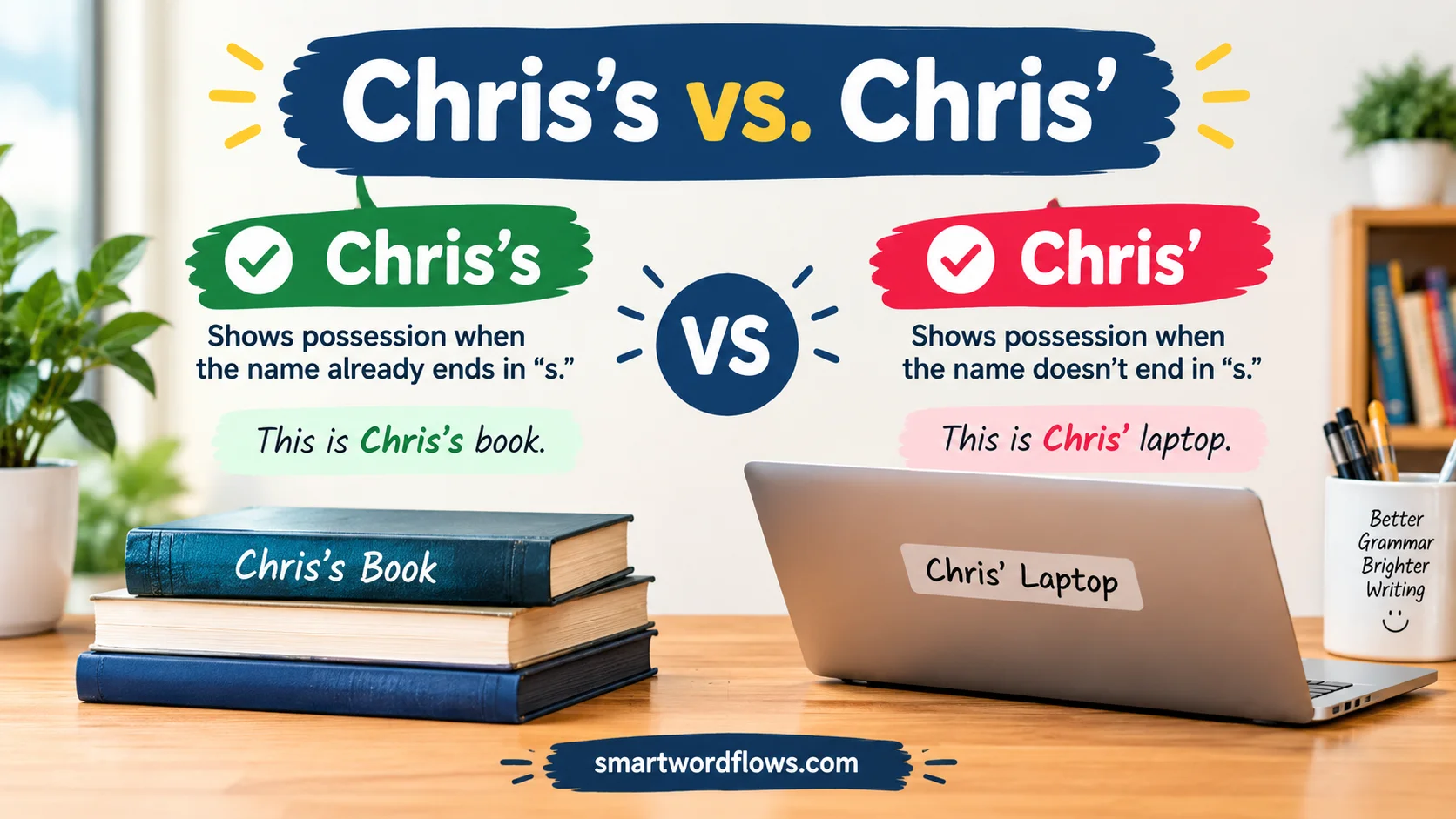

Chris’s vs. Chris’ often confuses writers because both forms can express possession. The main difference comes from apostrophe rules for singular names ending in “s.” In most modern English writing, Chris’s is the standard form, while Chris’ may be accepted by some style guides.
Knowing the correct possessive form helps you avoid mistakes in emails, essays, stories, and professional writing. For a singular name like Chris, adding ’s clearly shows ownership or association. However, certain writing styles prefer only an apostrophe after names ending in “s.” Understanding these conventions makes your writing more accurate and consistent.
Quick Answer
Chris’s and Chris’ can both function as possessive forms of the singular name Chris. However, they don’t represent two different meanings.
For example:
- Chris’s car is parked outside.
- Chris’ car is parked outside.
Both sentences indicate that the car belongs to or is associated with one person named Chris.
The difference comes from style conventions.
Many major writing systems use Chris’s because they apply the general rule that a singular noun takes ’s to form its possessive, even when the noun already ends in s. Other style systems, notably AP style, traditionally use Chris’ for many singular proper names ending in s.
| Form | Function | Main point |
| Chris’s | Singular possessive | Adds ’s to Chris |
| Chris’ | Singular possessive | Adds only an apostrophe |
| Chrises | Plural | Refers to more than one person named Chris |
| Chrises’ | Plural possessive | Shows possession by multiple people named Chris |
So, if no specific style guide applies, Chris’s is a clear general choice because it follows the common singular possessive pattern. If your employer, school, publisher, or publication follows a particular style guide, follow that guide consistently.
Comparison Overview
At first glance, Chris’s vs. Chris’ looks like a tiny punctuation question. In practice, it illustrates a broader issue in English grammar: grammar rules and style rules aren’t always identical.
Grammar tells you what a construction does. Style guides often tell you which acceptable construction an organization prefers.
Chris’s vs. Chris’ at a Glance
| Question | Chris’s | Chris’ |
| Shows singular possession? | Yes | Yes |
| Refers to one Chris? | Yes | Yes |
| Adds an apostrophe? | Yes | Yes |
| Adds another s? | Yes | No |
| Used in formal writing? | Yes | Yes, depending on style |
| Accepted by established style conventions? | Yes | Yes |
| Meaning changes? | No | No |
| Best choice without a specified style? | Usually Chris’s | Use when your chosen style calls for it |
Consider this example:
Chris’s presentation impressed the entire team.
The possessive construction tells readers that the presentation belongs to, came from, or is associated with Chris.
Now compare:
Chris’ presentation impressed the entire team.
The meaning remains the same. The punctuation changes because the writer follows a different possessive convention.
That distinction matters. Chris’ isn’t automatically a grammatical mistake, just as Chris’s isn’t automatically wrong because the name ends in s.
Main Differences Between Chris’s vs. Chris’
The most important difference between Chris’s and Chris’ isn’t meaning. It’s style and formation.
Chris’s Adds ’s
The form Chris’s follows the common rule for forming the possessive of a singular noun.
The pattern looks like this:
Chris + ’s = Chris’s
Examples include:
- Chris’s phone
- Chris’s desk
- Chris’s brother
- Chris’s opinion
- Chris’s project
The construction makes the possessive relationship immediately visible.
Chris’ Adds Only an Apostrophe
The form Chris’ keeps the final s already present in the name and adds only an apostrophe.
The pattern becomes:
Chris + ’ = Chris’
Examples include:
- Chris’ phone
- Chris’ desk
- Chris’ brother
- Chris’ opinion
- Chris’ project
This convention doesn’t turn Chris into a plural noun. It simply represents a different editorial approach to singular possessives ending in s.
The Meaning Stays the Same
This point deserves emphasis because it causes much of the confusion.
Chris’s doesn’t mean something different from Chris’.
If you write:
I borrowed Chris’s laptop.
you mean the same basic thing as:
I borrowed Chris’ laptop.
The distinction is primarily which possessive style you’re following.
What Does “Chris’s” Mean?
Chris’s is the possessive form of the singular proper name Chris under a convention that forms singular possessives with ’s.
A possessive shows a relationship between one noun and another. That relationship often involves ownership, but it can also indicate connection, authorship, responsibility, origin, or association.
For example:
- Chris’s car — the car belongs to Chris.
- Chris’s idea — Chris developed or expressed the idea.
- Chris’s office — the office is associated with Chris.
- Chris’s decision — Chris made the decision.
- Chris’s birthday — the birthday belongs to Chris in the sense of marking their birth.
The word after the possessive doesn’t have to be a physical object.
That’s an important point because people sometimes learn possession as simply “something belongs to someone.” English uses possessives much more broadly.
Examples of Chris’s
- Chris’s new laptop has a larger screen than the previous model.
- Everyone agreed that Chris’s explanation made the difficult topic easier to understand.
- The manager reviewed Chris’s proposal before approving the project.
- Chris’s favorite restaurant recently changed its menu.
- We found Chris’s keys underneath the stack of papers.
These examples all involve one person named Chris.
What Does “Chris’” Mean?
Chris’ serves the same basic possessive function when a style convention permits an apostrophe without an additional s.
For example:
Chris’ car needs repairs.
The sentence identifies Chris as the person associated with the car.
Likewise:
Chris’ opinion changed after the discussion.
The sentence doesn’t indicate that several people named Chris share an opinion. It simply uses an apostrophe-only possessive style.
Examples of Chris’
- Chris’ presentation starts at nine o’clock tomorrow morning.
- The team discussed Chris’ recommendations during the meeting.
- We left Chris’ package near the front door.
- Chris’ office is located on the second floor.
- The committee considered Chris’ proposal before making its final decision.
Again, the possessive meaning remains unchanged.
The Main Grammar Rule Behind Chris’s
The traditional rule for a singular possessive generally adds ’s, even when the singular noun ends in s.
For example:
- the boss’s office
- the class’s schedule
- the glass’s edge
- Chris’s book
The important distinction is that Chris is singular.
The spelling ends in s, but that doesn’t make the person plural.
This is where many writers stumble. They see the final s and instinctively think an apostrophe alone must follow. That logic works for many plural nouns ending in s, but it doesn’t automatically apply to singular names.
Singular Possessive
One Chris → Chris’s
Chris’s notebook is on the table.
Plural Possessive
Multiple Chrises → Chrises’
The Chrises’ offices are next to each other.
Those forms serve completely different grammatical purposes.
Why Does Chris’s Look Different From Chris’?
English has accumulated several conventions for handling names that end in s. Over time, publishers, newspapers, academic institutions, and style organizations have developed rules that don’t always match one another.
That’s why you’ll encounter both forms in polished writing.
The disagreement isn’t necessarily evidence that writers don’t understand grammar. Often, they’re simply following different editorial standards.
For example, one publication might write:
James’s book
while another might write:
James’ book
Both forms can be found in reputable writing because style guides differ in how they handle singular proper names ending in s.
The same principle applies to Chris’s vs. Chris’.
What Major Style Guides Say About Chris’s vs. Chris’
When accuracy matters, don’t rely on a random rule you remember from school. Check the style guide required for the document.
Chicago Style
The Chicago Manual of Style generally forms the possessive of a singular proper name ending in s by adding ’s.
That means a Chicago-style treatment would generally favor:
Chris’s
The same pattern applies to many other singular names ending in s.
Examples include:
- James’s
- Charles’s
- Lucas’s
- Chris’s
Chicago’s approach follows the broader idea that a singular noun forms its possessive with ’s, rather than treating the final s as though it automatically makes the noun plural.
MLA Style
MLA style also generally uses ’s with singular proper nouns ending in s.
Therefore, under the standard rule, you would write:
Chris’s argument was persuasive.
This approach keeps the singular possessive formation consistent.
APA Style
APA style generally follows the singular possessive ’s construction for names ending in s.
For example:
Chris’s findings support the study’s conclusion.
Academic writers should still check the latest institutional or publication requirements because organizations sometimes adopt house rules alongside a formal style guide.
AP Style
AP style takes a different approach for many singular proper names ending in s.
AP style traditionally favors adding only an apostrophe:
Chris’
So a news organization following AP style may write:
Chris’ statement addressed the controversy.
This difference explains why readers may see Chris’ frequently in journalism while encountering Chris’s in academic or book publishing.
Why Style Consistency Matters
Imagine an article that uses:
- Chris’s report
- James’ statement
- Charles’s office
- Lucas’ project
If no reason explains those differences, the punctuation looks inconsistent.
A better approach is simple:
Choose the applicable style and follow it throughout the document.
Chris’s vs. Chris’: Side-by-Side Examples
| Meaning | ’s Style | Apostrophe-Only Style |
| Car belonging to Chris | Chris’s car | Chris’ car |
| Opinion expressed by Chris | Chris’s opinion | Chris’ opinion |
| Office associated with Chris | Chris’s office | Chris’ office |
| Book written by Chris | Chris’s book | Chris’ book |
| Decision made by Chris | Chris’s decision | Chris’ decision |
The important thing to notice is that the underlying meaning doesn’t change.
Only the preferred possessive construction changes.
Examples of Chris’s in Different Contexts
The possessive form can describe many kinds of relationships.
Ownership
Chris’s bicycle was outside the house.
Here, the bicycle belongs to Chris.
Authorship
Chris’s article appeared in the magazine last month.
Here, Chris wrote the article.
Responsibility
Chris’s decision affected the entire department.
The possessive connects Chris with the decision.
Association
Chris’s office is beside the conference room.
The office is associated with Chris.
Personal Characteristics
Chris’s patience helped calm the frustrated customer.
The possessive identifies a quality associated with Chris.
This broader use explains why possessive constructions appear so often in everyday English.
Examples of Chris’ in Different Contexts
The apostrophe-only version works in the same grammatical contexts when the chosen style permits it.
Ownership
Chris’ bicycle was outside the house.
Authorship
Chris’ article appeared in the magazine last month.
Responsibility
Chris’ decision affected the entire department.
Association
Chris’ office is beside the conference room.
Personal Characteristics
Chris’ patience helped calm the frustrated customer.
The meaning remains essentially identical to the Chris’s versions.
Chris’s vs. Chris’: Pronunciation
Pronunciation creates another layer of confusion.
When many speakers say the possessive form Chris’s, the possessive ending adds an additional syllable. The exact vowel quality varies by accent, but the possessive commonly has a sound comparable to the ending heard in words such as buses.
This matters because some writers assume that if they don’t clearly hear an additional syllable, they shouldn’t write ’s.
That’s not a reliable rule.
Spelling conventions don’t always mirror pronunciation perfectly.
The pronunciation question can also become complicated because proper names vary by speaker and dialect. Style guides generally focus on written consistency, not on forcing every writer to pronounce the possessive in exactly the same way.
Singular Possessive vs. Plural Possessive
This is perhaps the most useful distinction to learn.
One Chris
When you’re talking about one person:
Chris’s car
or, under an apostrophe-only convention:
Chris’ car
Several People Named Chris
The plural of Chris is normally Chrises when you genuinely need to refer to multiple people with that name.
For example:
Three Chrises attended the conference.
Now the noun is plural.
To make that plural possessive, add an apostrophe after the plural s:
The Chrises’ schedules conflicted.
So:
| Form | Meaning |
| Chris | One person |
| Chris’s | Possessive form of one Chris |
| Chris’ | Alternative possessive form of one Chris |
| Chrises | More than one person named Chris |
| Chrises’ | Possessive form of multiple Chrises |
This distinction prevents a common punctuation mistake.
Read This: Studder vs Stutter: Difference Explained and Usage
Common Mistakes With Chris’s vs. Chris’
Treating Chris’ as Automatically Plural
Some writers see the apostrophe after s and assume Chris’ means multiple people.
It doesn’t.
The context determines whether Chris refers to one person. In Chris’ car, the name remains singular.
Assuming Chris’s Is Wrong Because Chris Ends in S
This is another widespread misconception.
The final s doesn’t prohibit another s from appearing in a singular possessive.
Under many style conventions:
Chris → Chris’s
is completely standard.
Mixing Style Guides
A document can lose polish when it switches between possessive systems without a reason.
If you choose Chris’s, don’t randomly use Chris’ later unless a particular rule genuinely requires the change.
Using an Apostrophe to Make Chris Plural
Avoid writing:
Chris’s attended the meeting.
That form doesn’t correctly create the plural.
If you mean several people named Chris, use:
Several Chrises attended the meeting.
The apostrophe has no role in ordinary pluralization.
Confusing Possession With Contraction
An apostrophe can show possession or represent omitted letters.
For example:
Chris’s car
uses an apostrophe in a possessive construction.
By contrast, a contraction such as:
Chris’s going home
can potentially be interpreted as Chris is going home.
Context usually makes the meaning clear, but the two grammatical functions are different.
Is Chris’s or Chris’ More Correct?
There isn’t one answer that works for every writing situation.
If you’re asking which form follows the general singular possessive rule, Chris’s has a strong grammatical basis.
If you’re writing according to a style system that specifically prefers Chris’, then Chris’ is the correct choice for that publication or context.
Think of it like driving on a road with two accepted lane markings. The destination doesn’t change. The governing rules determine which lane you should use.
A Practical Rule
If a style guide applies:
Follow the style guide.
If no style guide applies:
Chris’s is a sensible general choice.
If you’re editing an existing publication:
Match the publication’s established style.
That last point matters more than many writers realize. Consistency often matters more than personal preference.
Is “Chris’s” Grammatically Correct?
Yes.
Under the common singular possessive rule, Chris’s is grammatically correct.
The logic is straightforward:
Chris is singular.
’s forms the possessive.
Therefore:
Chris’s
Examples:
- Chris’s car
- Chris’s house
- Chris’s answer
- Chris’s team
- Chris’s responsibility
The fact that the name ends in s doesn’t automatically change its grammatical number.
Is “Chris’” Grammatically Correct?
Yes, when the applicable style convention permits or requires it.
The form Chris’ appears in professional journalism, publishing, organizational communications, and other established writing contexts.
However, don’t turn that fact into a universal rule.
A writer following a style guide that requires Chris’s shouldn’t switch to Chris’ simply because the latter looks cleaner.
The right question isn’t:
“Which one looks better?”
Instead, ask:
“Which style does this document follow?”
That question usually settles the issue.
When Should You Use Chris’s?
Use Chris’s when your chosen style follows the general singular possessive pattern.
It’s particularly useful when:
- You’re following Chicago style.
- You’re following MLA style.
- You’re following APA style.
- Your employer’s style guide uses ’s.
- Your publisher requires the traditional singular possessive construction.
- No specific style guide applies and you want a clear general default.
For example:
Chris’s research produced several useful findings.
The form clearly identifies Chris as a singular possessive noun.
When Should You Use Chris’?
Use Chris’ when the style governing your writing prefers an apostrophe-only construction for singular proper names ending in s.
This can include:
- AP-style journalism
- Publications with an apostrophe-only house style
- Editorial systems that explicitly prescribe the shorter form
- Existing documents where consistency requires matching the established convention
For example:
Chris’ comments appeared in the morning edition.
The construction is appropriate when it matches the publication’s style.
How to Make Chris Possessive in Different Contexts
Understanding the relationship between the nouns makes possessive constructions much easier.
Objects
Chris’s phone is charging.
or:
Chris’ phone is charging.
Ideas and Opinions
Chris’s opinion changed after the discussion.
or:
Chris’ opinion changed after the discussion.
Places
Chris’s office is downstairs.
or:
Chris’ office is downstairs.
Work and Projects
Chris’s project received additional funding.
or:
Chris’ project received additional funding.
Time
English can also use possessives in time expressions:
Chris’s two-week vacation begins Monday.
Here, the possessive doesn’t necessarily mean Chris owns “two weeks.” Instead, the construction helps identify the vacation associated with Chris.
What About James, Charles, Lucas, and Ross?
The same question appears with many names ending in s.
| Name | ’s approach | Apostrophe-only approach |
| Chris | Chris’s | Chris’ |
| James | James’s | James’ |
| Charles | Charles’s | Charles’ |
| Lucas | Lucas’s | Lucas’ |
| Ross | Ross’s | Ross’ |
The important lesson isn’t that every name ending in s has one universally correct spelling.
Instead, the governing style determines the preferred form.
That consistency becomes especially important in longer articles, books, academic papers, and professional documents.
What About Biblical, Classical, or Historical Names Ending in S?
Some names and traditional expressions have special conventions.
Writers often encounter forms such as:
- Jesus’ teachings
- Moses’ law
- Socrates’ philosophy
These examples can make the rules seem contradictory.
However, don’t assume that a convention used with an established historical or biblical name automatically applies to every modern name ending in s.
Modern singular names such as Chris should be handled according to the relevant style guide.
This distinction prevents writers from creating a broad rule based on a narrow exception or established tradition.
A Simple Decision Guide for Chris’s vs. Chris’
When you’re unsure, work through these questions.
Is Chris Singular?
If you’re talking about one person named Chris, you’re dealing with a singular possessive.
Does Your Writing Have a Required Style?
If you’re writing for a school, newspaper, company, journal, or publisher, check its style requirements.
Does That Style Prefer ’s?
If yes, write:
Chris’s
Does That Style Prefer an Apostrophe Only?
If yes, write:
Chris’
Is There No Required Style?
When you have complete freedom, Chris’s provides a straightforward general default.
Quick Checklist
Before submitting your writing, check:
- Is Chris one person?
- Am I showing possession or association?
- Does my publication use a particular style guide?
- Have I used the same possessive convention consistently?
- Am I accidentally treating a plural as singular?
These five questions solve most Chris’s vs. Chris’ problems.
Chris’s vs. Chris’: Quick Reference Table
| Situation | Recommended form |
| One Chris, general singular possessive | Chris’s |
| Style requiring apostrophe-only possessives | Chris’ |
| Chicago-style writing | Chris’s |
| MLA-style writing | Chris’s |
| APA-style writing | Chris’s |
| AP-style writing | Chris’ |
| Multiple people named Chris | Chrises |
| Possession by multiple people named Chris | Chrises’ |
| No specified style | Chris’s is a practical default |
Style guides can change over time, so professional writers should consult the current edition of the required guide rather than relying on an old classroom rule.
Case Study: Choosing the Right Form in Three Situations
Imagine three writers describing the same person.
Academic Paper
A graduate student writes:
Chris’s findings support the original hypothesis.
The student follows an academic style that uses ’s for singular possessives.
Best choice: Chris’s
Newspaper Article
A journalist writes:
Chris’ statement came shortly after the announcement.
The publication follows AP style.
Best choice: Chris’
Personal Blog
A blogger isn’t required to follow a formal editorial manual.
Chris’s new business has grown quickly.
Using Chris’s gives the writer a clear and widely recognized singular possessive form.
Best choice: Chris’s
The key lesson is simple: the context determines the preferred form.
FAQs :
1. Is Chris’s or Chris’ correct?
Chris’s is generally the preferred possessive form for the singular name Chris. However, Chris’ is also accepted by some style guides.
2. Should I write Chris’s car or Chris’ car?
Write Chris’s car in most modern English writing. It clearly shows that the car belongs to Chris.
3. Why do people use Chris’ instead of Chris’s?
Some traditional style guides recommend adding only an apostrophe to names ending in s, which is why you may see Chris’.
4. How do you pronounce Chris’s?
Chris’s is usually pronounced with an extra “iz” sound, similar to “Chris-iz,” depending on the sentence and pronunciation style.
5. Is Chris’s more common in everyday writing?
Yes. Chris’s is widely used in everyday, academic, and professional English because it follows the common possessive rule for singular names.
Conclusion :
Choosing between Chris’s and Chris’ becomes much easier once you understand the possessive rule. For most writing, Chris’s is the safest and clearest choice for showing possession with the singular name Chris. Chris’ can still be correct when a particular style guide prefers it. The key is to follow one consistent style throughout your writing.