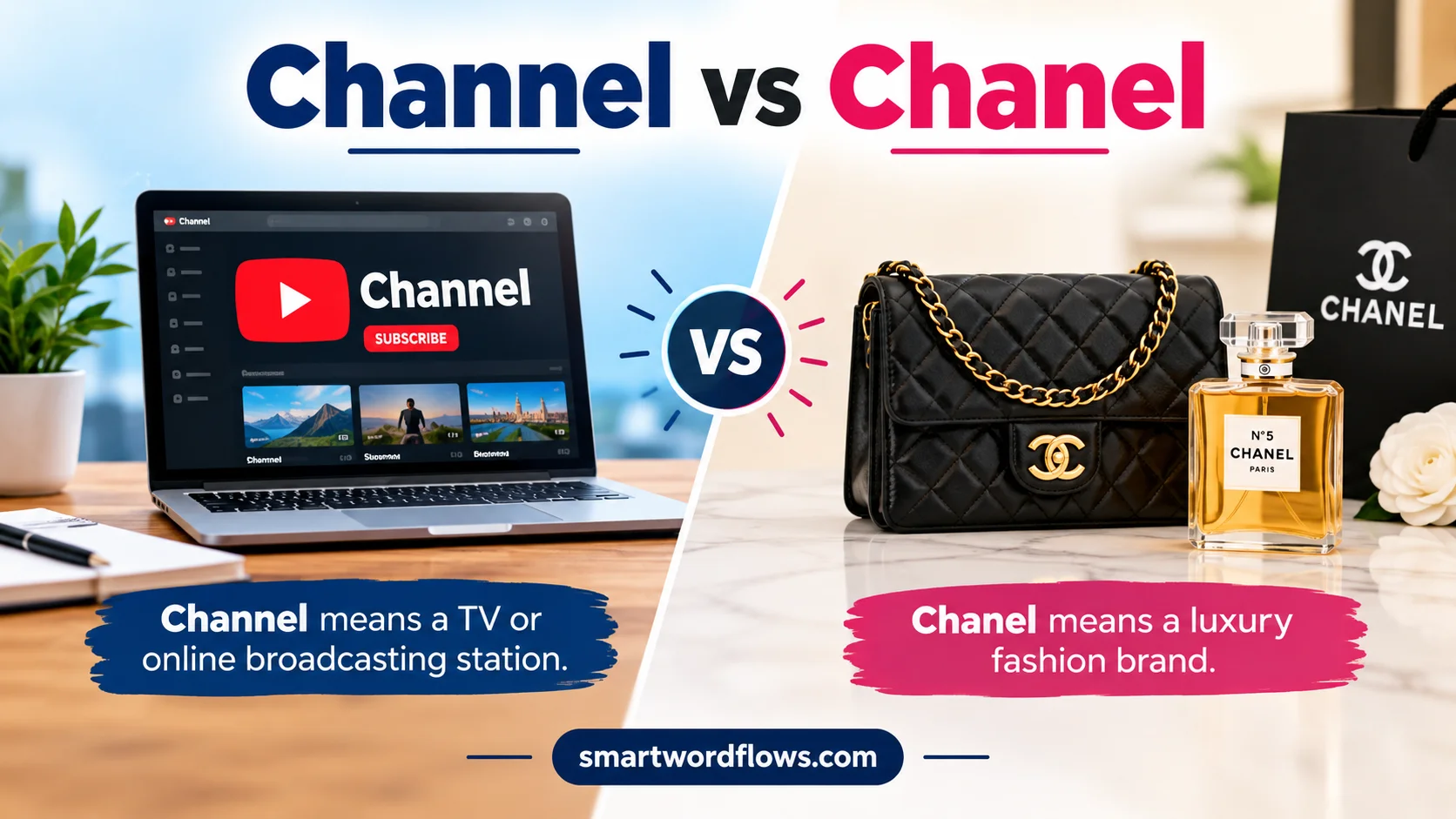

Channel vs Chanel can be confusing because these words look and sound almost identical, yet they have completely different meanings. Channel is the correct everyday English word for a pathway, waterway, TV station, communication method, or digital marketing channel used to reach an audience. Chanel, on the other hand, is a proper noun associated with the famous French luxury fashion house founded by Coco Chanel. Knowing this simple difference can help you avoid spelling mistakes and choose the right word with confidence.
In writing, channel works in many contexts, from describing a river’s deeper course to discussing communication, media, and online marketing strategies. A business may use social media, email, search engines, or paid advertising as different marketing channels to connect with customers. Chanel should only be used when referring to the fashion brand or its founder. Although the spelling differs by just one letter, the meaning changes completely, making context the key to using each term correctly.
Quick Answer
Channel and Chanel are different words with different meanings.
Channel is an English noun and verb. As a noun, it can mean a television station, communication method, physical passage, waterway, or route. As a verb, it can mean to direct something toward a particular purpose.
Chanel is a proper name. It commonly refers to Gabrielle Chanel, the French fashion designer, or CHANEL, the luxury fashion house associated with her name. CHANEL states that Gabrielle Chanel opened her first hat boutique at 21 Rue Cambon in Paris in 1910.
| Word | Meaning | Grammar | Example |
| Channel | A route, medium, station, passage, or means of directing something | Noun / Verb | “Change the television channel.” |
| Chanel | A person’s surname or the name of a luxury fashion house | Proper noun | “She wore a Chanel jacket.” |
The simplest rule is this: use “channel” for a route, medium, station, or means of directing something. Use “Chanel” for the person or fashion brand.
Comparison Overview
Although channel vs Chanel may look like a minor spelling issue, the distinction involves meaning, grammar, capitalization, pronunciation, and context.
| Feature | Channel | Chanel |
| Word type | Common English word | Proper noun |
| Main meanings | Route, medium, station, passage, method | Surname and luxury fashion brand |
| Common fields | Television, communication, geography, marketing, technology | Fashion, beauty, fragrance, jewelry, watches |
| Capitalization | Usually lowercase | Capitalized |
| Pronunciation | /ˈtʃæn.əl/ | /ʃəˈnel/ |
| Verb use | Yes | No, when referring to the brand or surname |
| Plural form | Channels | Usually unchanged when used as a brand name |
| Example | “The river has a narrow channel.” | “She bought a Chanel fragrance.” |
The pronunciation difference is especially useful because the words aren’t pronounced alike in standard English. Cambridge gives channel as /ˈtʃæn.əl/ and Chanel as /ʃəˈnel/ in US English.
Main Differences Between Channel vs Chanel
The clearest way to understand Channel vs Chanel is to examine what each word actually does in a sentence.
Channel Refers to a Route, Medium, or Passage
The word channel carries the broad idea of something providing a route or pathway.
That pathway can be physical, such as a water channel. It can also be abstract, such as a communication channel. In television, a channel provides a route through which programming reaches viewers.
For example:
- “The boat entered the narrow channel.”
- “Email remains an important communication channel.”
- “Which channel is showing the game?”
- “The company uses several marketing channels.”
- “She created a new YouTube channel.”
Cambridge Dictionary lists broadcasting, communication, and physical meanings among the uses of channel.
Chanel Refers to a Name
Chanel works differently because it identifies a person or a brand.
The name can refer to Gabrielle Chanel, whose fashion career became the foundation of the House of CHANEL. It can also refer to the luxury company itself and its products.
CHANEL’s own historical records state that Gabrielle Chanel opened her first independent millinery shop at 21 Rue Cambon in 1910. The company later expanded into couture, fragrance, beauty, jewelry, watches, and other areas of luxury.
For example:
- “She wore a Chanel dress.”
- “He gave her a Chanel fragrance.”
- “Gabrielle Chanel changed women’s fashion.”
- “The CHANEL boutique displayed the latest collection.”
So, while channel describes something, Chanel identifies someone or something by name.
What Does “Channel” Mean?
Channel has several established meanings in English. Its central idea involves a route, passage, medium, or method through which something moves or communicates.
Channel as a Television or Radio Station
One of the most familiar uses of channel appears in broadcasting.
A television or radio channel provides programming to an audience. You might switch channels, watch a particular channel, or refer to a channel by its number or name.
Examples include:
- “Please change the channel.”
- “Which channel is broadcasting the match?”
- “The news channel reported the latest developments.”
- “I watched the documentary on a science channel.”
- “The television automatically switched to another channel.”
This usage remains common in everyday American English, even as streaming platforms have changed how people consume television.
Channel as a Communication Method
Channel can also describe a method used to communicate information.
For example, a business might use email, telephone calls, social media, or face-to-face meetings as different communication channels.
Consider the sentence:
“Email is our main communication channel.”
Here, channel doesn’t mean a television station. Instead, it means a means or route through which information travels.
You might also encounter expressions such as:
- communication channel
- marketing channel
- sales channel
- distribution channel
- digital channel
- customer service channel
The meaning changes with the context, but the underlying idea remains similar: something provides a pathway for information, products, services, or interaction.
Channel as a Physical Passage
A channel can also describe a physical route, particularly one through which water flows.
For example:
- “The river flows through a deep channel.”
- “The boat stayed inside the marked channel.”
- “The storm changed the shape of the river channel.”
This sense appears frequently in geography, engineering, environmental science, and navigation.
Channel as a Verb
Channel also works as a verb.
As a verb, it means to direct something toward a particular place, purpose, or activity.
You can channel:
- energy
- creativity
- anger
- resources
- attention
- effort
- emotions
- money
For example:
“She channeled her frustration into writing.”
The sentence means that she directed her frustration toward a productive activity.
Another example makes the idea even clearer:
“The organization channeled its resources into education.”
Here, the organization directed its available resources toward education.
This verb form creates one of the most useful distinctions between channel and Chanel. Channel can function as both a noun and a verb, while Chanel remains a proper name when referring to the designer or brand.
What Does “Chanel” Mean?
Chanel is a proper name rather than an ordinary English word.
Most commonly, it refers to Gabrielle Chanel or the luxury fashion house that carries her surname.
Gabrielle Chanel opened her first independent millinery shop in Paris in 1910. According to CHANEL’s official history, she later opened a boutique in Deauville in 1912 and established her first couture house in Biarritz in 1915.
The name became associated with a much broader luxury business over time.
CHANEL’s historical material records several important milestones, including the launch of CHANEL N°5 in 1921, the introduction of makeup in 1924, the creation of the little black dress in 1926, and the launch of the 2.55 handbag in 1955.
That background matters for spelling because it makes one thing clear: Chanel isn’t an alternative spelling of channel.
Chanel as a Person’s Surname
When discussing Gabrielle Chanel, Chanel functions as a surname.
For example:
- “Chanel was a major figure in twentieth-century fashion.”
- “Gabrielle Chanel founded the fashion house.”
- “The designs of Chanel influenced modern clothing.”
Because it is a person’s name, it receives a capital letter.
Chanel as a Brand Name
Chanel also refers to the fashion house and its products.
The company operates across several luxury categories, including fashion, fragrance and beauty, watches, and fine jewelry.
Examples include:
- “She bought a Chanel handbag.”
- “He recognized the Chanel logo.”
- “The store sells Chanel beauty products.”
- “She received a Chanel fragrance as a gift.”
When referring specifically to the company’s official styling, you may see CHANEL written in all capital letters. In ordinary prose, Chanel is also commonly used as the proper-name form.
Channel vs Chanel Pronunciation
Pronunciation provides another strong clue when distinguishing these words.
Cambridge Dictionary gives the US pronunciation of channel as /ˈtʃæn.əl/. The first sound is the familiar ch sound found in words such as chair and cheese.
Cambridge gives the US pronunciation of Chanel as /ʃəˈnel/. The word begins with a sh sound and places the main stress on the second syllable.
So the two words differ in both sound and spelling.
A useful pronunciation comparison is:
| Word | US IPA | Stress |
| channel | /ˈtʃæn.əl/ | First syllable |
| Chanel | /ʃəˈnel/ | Second syllable |
This distinction can help you catch an error before you write it.
Channel as a Noun
When channel appears as a noun, its exact meaning depends heavily on context.
Consider these examples:
Television:
“Turn to another channel.”
Communication:
“We need a better communication channel.”
Water:
“The boat moved through the narrow channel.”
Business:
“Online sales have become an important distribution channel.”
Social media:
“The company launched a new YouTube channel.”
These meanings aren’t random. Each one involves some kind of pathway, route, or medium.
That’s the central concept worth remembering.
Channel as a Verb
As a verb, channel usually means to direct something toward a particular destination or purpose.
For instance:
“He channeled his energy into training.”
The person doesn’t literally pour energy through a pipe. Instead, the verb describes deliberate direction.
Common constructions include:
- channel energy into something
- channel creativity into something
- channel resources toward something
- channel attention toward something
- channel emotions into something
- channel funds into a project
The verb often appears in contexts involving personal development, business strategy, creativity, and emotional expression.
For example, a writer might channel personal experiences into a novel, while a company might channel additional funds into research.
Chanel as a Proper Noun
Unlike channel, Chanel doesn’t normally function as a general-purpose English noun or verb.
It identifies a particular person or brand.
That distinction affects capitalization, grammar, and sentence structure.
For example:
“She bought a Chanel bag.”
Here, Chanel identifies the brand associated with the product.
By contrast:
“She switched to another channel.”
Here, channel describes a television station or broadcasting outlet.
The two sentences look deceptively similar, yet their meanings have nothing to do with each other.
Read More: Less Than vs Less Then: Difference and Usage
Channel vs Chanel Examples
The fastest way to master Channel vs Chanel is to see the words in natural sentences.
Correct Examples With Channel
- “Which channel is showing the baseball game tonight?”
- “The company opened a new communication channel for customers.”
- “The boat entered the main shipping channel.”
- “She started a cooking channel on YouTube.”
- “He channeled his disappointment into a new project.”
Correct Examples With Chanel
- “She wore a Chanel jacket to the event.”
- “The Chanel fragrance came in an elegant bottle.”
- “Gabrielle Chanel became an influential fashion designer.”
- “The store displayed several Chanel handbags.”
- “The Chanel fashion house has a long history.”
Notice how channel works naturally with concepts such as television, communication, waterways, and online media. Chanel, meanwhile, appears in references to a person, company, or product.
Channel vs Chanel in Different Contexts
Context often tells you which spelling you need before you even think about the definition.
| Context | Correct Word | Example |
| Television | Channel | “Change the channel.” |
| Radio | Channel | “Tune into another channel.” |
| YouTube | Channel | “Her channel focuses on cooking.” |
| Communication | Channel | “Use another communication channel.” |
| Marketing | Channel | “Social media is a useful marketing channel.” |
| Waterway | Channel | “The ship entered the channel.” |
| Directing emotions | Channel | “He channeled his anger into exercise.” |
| Fashion brand | Chanel | “She bought a Chanel handbag.” |
| Fragrance | Chanel | “Chanel makes several well-known fragrances.” |
| Designer surname | Chanel | “Gabrielle Chanel transformed fashion.” |
The pattern is remarkably consistent.
If you’re describing a medium, route, passage, or method, choose channel. If you’re naming Gabrielle Chanel or the luxury brand, choose Chanel.
Common Mistakes With Channel and Chanel
Because the spellings differ by only one letter, mistakes are easy to make.
Writing “Chanel” When You Mean “Channel”
Incorrect:
“I watched that Chanel last night.”
Correct:
“I watched that channel last night.”
The first sentence makes it sound as though someone watched the fashion brand itself. The second correctly identifies a television station or broadcasting outlet.
Writing “Channel” When You Mean “Chanel”
Incorrect:
“She bought a Channel perfume.”
Correct:
“She bought a Chanel perfume.”
A perfume associated with the luxury fashion house takes the proper name Chanel.
Forgetting to Capitalize Chanel
Incorrect:
“She bought a chanel handbag.”
Correct:
“She bought a Chanel handbag.”
When Chanel refers to the person or brand, it functions as a proper name and therefore requires capitalization.
Assuming Similar Spelling Means Similar Meaning
English contains many words that resemble one another without sharing the same meaning.
Channel and Chanel are a good example.
The extra n in channel matters. So does the different pronunciation. Treating the two spellings as interchangeable creates an actual vocabulary error rather than a minor stylistic preference.
Channel vs Chanel: How to Remember the Difference
A simple memory trick can save you from repeatedly checking the spelling.
Remember “Channel” as a Route
Think about a channel as something that lets something travel.
Information travels through a communication channel.
Television programming travels through a TV channel.
Water moves through a water channel.
A creator distributes content through an online channel.
The verb follows the same basic idea because you can channel something toward a chosen purpose.
Remember “Chanel” as a Name
Think of Chanel as a person’s name.
Gabrielle Chanel → CHANEL fashion house → Chanel products.
That connection makes the spelling much easier to recall.
A useful shortcut is:
Channel = pathway. Chanel = name.
If you’re talking about something that carries, directs, or provides a route, you almost certainly need channel.
If you’re talking about fashion, Gabrielle Chanel, or the luxury brand, you need Chanel.
Is “Channel” Ever a Proper Name?
Yes. Channel can appear within proper names.
For example, a company, television network, organization, geographic feature, or publication may include the word Channel as part of its official name.
The important point is that capitalization comes from the specific proper name rather than from the word channel itself.
Compare:
- “The television channel showed a documentary.”
- “The company launched its News Channel.”
In the first sentence, channel functions as an ordinary noun. In the second, the words may form part of a specific name and therefore receive capitalization according to that name’s official styling.
Is “Chanel” Ever Used as a Common Noun?
In standard usage, Chanel should not replace the common noun channel.
You shouldn’t write:
“Which Chanel is the news on?”
when you mean a television station.
The correct sentence is:
“Which channel is the news on?”
Likewise, you shouldn’t write Chanel when describing a communication method, waterway, or online platform.
The brand name remains a proper name.
Channel vs Chanel in Professional and Academic Writing
Accuracy matters even more in professional writing because a single spelling error can undermine an otherwise polished sentence.
In marketing, for example, channel commonly refers to a route through which a company reaches customers.
You might write:
“The company expanded its digital marketing channels.”
In communications research, channel can describe the medium through which information moves.
In geography, channel can describe a physical passage or watercourse.
In business, it can refer to sales or distribution routes.
Meanwhile, Chanel appears when the subject concerns the fashion house, its founder, products, or history.
For example:
“Chanel remains an influential name in luxury fashion.”
Both words belong in formal writing, but they belong in different semantic lanes.
A Practical Case Study: Choosing Channel or Chanel
Imagine someone writing this sentence:
“The company promoted its new perfume through a social media Chanel.”
At first glance, the sentence might seem reasonable. However, the final word is incorrect.
The company isn’t promoting its perfume through the luxury fashion brand. It is using a social media channel.
The corrected sentence is:
“The company promoted its new perfume through a social media channel.”
Now consider a different sentence:
“She bought a new Channel fragrance.”
Here, the context concerns a fragrance brand. The correct spelling is:
“She bought a new Chanel fragrance.”
This demonstrates why context matters so much. You don’t choose between the words simply because they look similar. You choose based on what the sentence means.
Channel vs Chanel: A Simple Decision Test
When you’re unsure which spelling to use, ask yourself one question:
Am I talking about a route or a name?
If you’re talking about a route, medium, station, passage, or way of directing something, choose channel.
If you’re referring to Gabrielle Chanel or the luxury fashion brand, choose Chanel.
Choose “Channel” If You Mean:
- a television station
- a radio station
- a communication method
- a marketing route
- a sales route
- a distribution method
- a water passage
- an online content outlet
- a way to direct energy or emotions
Choose “Chanel” If You Mean:
- Gabrielle “Coco” Chanel
- the CHANEL fashion house
- Chanel fashion
- Chanel fragrances
- Chanel beauty products
- Chanel handbags
- Chanel watches
- Chanel jewelry
This quick test handles most everyday cases without requiring a dictionary.
Facts About Chanel That Help Explain the Proper Name
The history behind Chanel also makes the spelling easier to remember.
CHANEL’s official history records these major milestones:
| Year | Chanel milestone |
| 1910 | Gabrielle Chanel opened her first independent millinery shop at 21 Rue Cambon in Paris. |
| 1912 | She opened her first boutique in Deauville. |
| 1915 | She opened her first couture house in Biarritz. |
| 1918 | She established her couture house at 31 Rue Cambon in Paris. |
| 1921 | CHANEL N°5 was launched. |
| 1924 | Gabrielle Chanel launched her first makeup collection and founded Société des Parfums CHANEL. |
| 1926 | She created the little black dress. |
| 1955 | The 2.55 quilted handbag was launched. |
These dates come from CHANEL’s own historical and corporate materials.
The history also explains why Chanel appears so often in discussions of fashion, beauty, fragrance, and luxury.
CHANEL’s current haute couture information notes that Gabrielle Chanel opened her couture house in 1915, while the house’s couture activity remains centered at 31 Rue Cambon in Paris.
Common Phrases With Channel
Learning common combinations can help you recognize channel instantly.
Communication
- communication channel
- official channel
- private channel
- communication channels
- customer service channel
Media
- television channel
- radio channel
- news channel
- YouTube channel
- sports channel
Business
- sales channel
- marketing channel
- distribution channel
- digital channel
- retail channel
Physical Geography
- river channel
- shipping channel
- water channel
- navigation channel
These expressions all use channel because they describe some kind of route, medium, or passage.
Common Phrases With Chanel
By contrast, Chanel commonly appears alongside words connected with luxury products and the fashion house.
Examples include:
- Chanel handbag
- Chanel fragrance
- Chanel perfume
- Chanel makeup
- Chanel fashion
- Chanel jewelry
- Chanel watches
- Chanel boutique
- Chanel collection
- Gabrielle Chanel
These combinations make the distinction especially easy to spot.
If the word sits beside handbag, perfume, fashion, fragrance, or Gabrielle, you’re almost certainly looking at Chanel.
Channel vs Chanel: Which One Should You Use?
Use channel when you mean a route, medium, passage, station, or method of directing something.
Use Chanel when you mean Gabrielle Chanel or the luxury fashion house and brand named after her.
Here’s the rule worth remembering:
Channel is a pathway. Chanel is a name.
That single distinction covers nearly every common usage.
If you need a television station, choose channel.
If you need a communication method, choose channel.
If you’re describing a river passage, choose channel.
If you’re talking about directing your energy toward something, choose channel.
If you’re discussing the French fashion house, choose Chanel.
If you’re referring to Gabrielle Chanel, choose Chanel.
If you’re naming a Chanel fragrance or handbag, choose Chanel.
FAQs :
1. What is the difference between Channel and Chanel?
Channel means a pathway, waterway, communication method, TV station, or marketing platform. Chanel refers to the famous French luxury fashion brand founded by Coco Chanel.
2. Is Channel or Chanel the correct spelling?
Both spellings are correct, but they have different meanings. Use channel for communication, waterways, media, or marketing. Use Chanel when referring to the fashion brand.
3. Is Chanel a person or a brand?
Chanel can refer to both the luxury fashion brand and its founder, Coco Chanel. The meaning depends on the context.
4. Can Channel and Chanel be used interchangeably?
No. Channel and Chanel aren’t interchangeable because they represent completely different meanings and uses.
5. What is a channel in digital marketing?
A digital marketing channel is a platform or method businesses use to reach their target audience, such as search engines, social media, email, or paid advertising.
Conclusion :
Understanding Channel vs Chanel is simple once you remember their meanings. Channel relates to pathways, communication, media, waterways, and marketing, while Chanel refers to the well-known luxury fashion brand or its founder, Coco Chanel. Although the words differ by only one letter, using the correct spelling keeps your writing clear and professional.