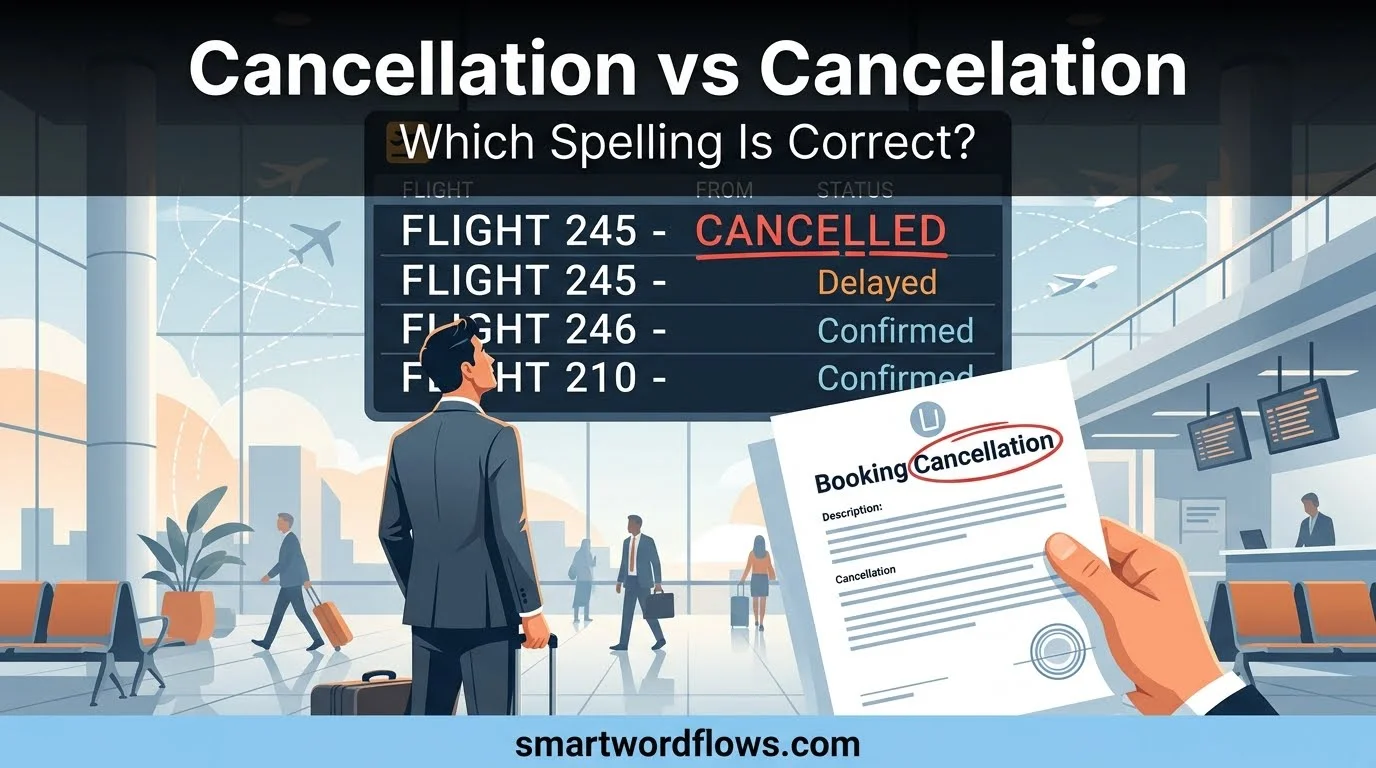

Cancellation vs Cancelation: Which Spelling Is Correct? Learn why cancellation is preferred and how to choose the right spelling for your writing.
The cancellation vs cancelation debate is a common English spelling question that causes confusion in everyday writing, emails, articles, and formal documents. Both versions exist, but cancellation is the preferred spelling in American English and British English. Although cancelation is a valid variant, it is less common, making cancellation the safest choice for professional writing and formal communication. The difference between cancelation and cancellation lies in their spelling: the verb cancel ends with a single l, while cancellation uses a double l before the suffix -ation.
This spelling pattern can create doubt, especially because related word forms follow different regional patterns. For example, American English generally uses canceled and canceling, while British English often favors cancelled and cancelling. These spelling variations reflect established language conventions, not random choices. In professional communication, including business emails, reports, academic work, and online content, choosing the correct spelling helps maintain clear communication and writing accuracy. Editorial style, style guides, and audience expectations may also influence spelling decisions, so consistency matters. If you’re unsure when to use cancellation, make it your default unless an organization’s or publication’s specific spelling rules require otherwise. Following this simple spelling guide can help you avoid mistakes, improve your writing skills, and communicate with greater confidence.
Quick Answer
Cancellation is the preferred spelling in American English and the most familiar form in everyday and professional writing. Cancelation is also a legitimate spelling, but it is much less common.
Both words are nouns that mean the act of canceling something or the state of something being canceled. They have the same meaning and pronunciation.
- Cancellation: The standard and widely preferred spelling.
- Cancelation: An accepted but less common spelling.
- American English: Use cancellation for general writing.
- British English: Cancellation is also the usual spelling.
- Best practical choice: Write cancellation unless a specific style guide, official name, or established document requires the alternative.
Example: “The cancellation of the concert disappointed thousands of fans.”
You could also write, “The cancelation of the concert disappointed thousands of fans.” The meaning remains the same, but the first version follows the more widely used spelling.
Comparison Overview
The following table summarizes the main differences between cancellation and cancelation.
| Feature | Cancellation | Cancelation |
| Spelling status | Correct | Correct |
| Meaning | The act of canceling something | The act of canceling something |
| Part of speech | Noun | Noun |
| Number of Ls in the word | Two consecutive Ls | One L |
| American English usage | Strongly preferred | Less common |
| British English usage | Standard and widely preferred | Less common |
| Pronunciation | Same | Same |
| Formal writing | Recommended default | Acceptable, but less familiar |
| Plural form | Cancellations | Cancelations |
| Best general-purpose choice | Yes | Usually not necessary |
The most important point is that the difference is spelling frequency, not meaning. You don’t need to use one word for business and the other for everyday conversation. Both can describe the same action.
For example, a company might issue a cancellation notice for a delayed shipment. A writer using cancelation notice would communicate the same basic information, although the double-L version is more familiar to most readers.
Main Differences Between Cancellation vs Cancelation
Although the two spellings share the same meaning, a few practical details explain why cancellation is usually the better choice. The most important differences involve spelling conventions, frequency, word formation, and the expectations of your readers.
Cancellation vs Cancelation: Spelling and Meaning
The word cancellation refers to the act of stopping something that was planned, arranged, or previously agreed upon. It can also describe the ending of an agreement or the removal of something’s validity.
The word cancelation expresses the same idea. The only visible difference is the extra L in cancellation.
The Oxford Advanced Learner’s Dictionary identifies cancellation as a noun and notes cancelation as a US English variant. Its examples include cancellation fees, canceled ferry services, and the cancellation of contracts.
Oxford Learner’s Dictionaries
Consider these examples:
- Cancellation: The cancellation of our reservation cost us a small fee.
- Cancelation: The cancelation of our reservation cost us a small fee.
Both sentences communicate the same information. Neither spelling changes the grammatical role of the word.
The noun can describe several related situations:
- Stopping a planned event: The cancellation of the festival disappointed local families.
- Ending a service: I requested the cancellation of my streaming subscription.
- Ending an agreement: Both parties agreed to the cancellation of the contract.
- Removing an appointment: The clinic notified patients about the cancellation of their appointments.
- Invalidating a document or arrangement: The cancellation of the permit ended the authorization it provided.
In each case, cancellation names the action or result rather than the person performing it.
Why Is Cancellation More Common Than Cancelation?
The spelling cancellation remains common because English spelling conventions don’t always apply uniformly to every word derived from the same base.
The verb cancel creates a particularly confusing example. American English usually drops the second L in canceled and canceling. However, the standard noun retains both Ls: cancellation.
That difference can catch writers off guard. If you already know that Americans write canceled, you might reasonably assume that cancelation follows the same pattern. English doesn’t always reward that kind of logical guesswork.
According to cancellation remains more common in American English than cancelation, despite the American preference for one L in certain verb forms.
Dictionary.com
Here is the pattern to remember:
| Word | Common American English spelling | Common British English spelling |
| Base verb | Cancel | Cancel |
| Present-tense form | Cancels | Cancels |
| Past tense | Canceled | Cancelled |
| Present participle | Canceling | Cancelling |
| Noun | Cancellation | Cancellation |
| Plural noun | Cancellations | Cancellations |
This table shows the usual regional preferences, not an absolute ban on alternative spellings. You may encounter cancelled in American writing and canceled in British writing.
The noun cancellation, however, remains the familiar choice in both varieties.
Is Cancellation or Cancelation Correct in American English?
Both forms are recognized, but cancellation is the better default for American English.
If you’re writing a college assignment, a customer service email, a company policy, or a blog post, the double-L spelling is the safer option. It’s widely familiar and follows established usage.
For example:
- Your flight cancellation notice has arrived.
- The company announced the cancellation of its annual conference.
- Please review our cancellation policy before booking.
- We received your request for subscription cancellation.
Each sentence sounds natural with cancellation.
When might you use cancelation instead? You could retain it when quoting a source, reproducing an official document, or following a specific organization’s spelling conventions. If a company’s official policy uses that spelling, preserving it in an exact quotation makes sense.
However, there’s rarely a practical advantage to choosing the less common variant in ordinary writing. Readers may understand it perfectly, but some spell-checkers and editors may flag it or suggest the more familiar form.
For everyday American English, keep the choice simple: use cancellation unless you have a clear reason to do otherwise.
Cancellation vs Cancelation in British English
British English also favors cancellation. The double-L spelling isn’t limited to American English, even though American spelling conventions often remove a final L in certain verb forms.
For instance, a British newspaper might report that a concert was cancelled and then discuss the resulting cancellation. An American publication might write that the concert was canceled but still use cancellation in the next sentence.
Notice how the regional difference affects the verb but usually not the noun.
Here are examples in both varieties:
| American English | British English |
| The airline canceled the flight. | The airline cancelled the flight. |
| We are canceling the booking. | We are cancelling the booking. |
| The cancellation surprised everyone. | The cancellation surprised everyone. |
| Several cancellations occurred overnight. | Several cancellations occurred overnight. |
The same noun spelling works naturally in both versions.
This distinction matters when you’re editing content for an international audience. You don’t need to change cancellation to cancelation to make a sentence sound American. Instead, apply regional preferences consistently to words that actually vary.
Cancellation vs Cancelation: Pronunciation
Another useful fact is that cancellation and cancelation have the same pronunciation in ordinary English.
The Oxford Advanced Learner’s Dictionary gives the pronunciation as /ˌkænsəˈleɪʃn/. The main stress falls on the syllable containing the long A sound in lay.
Oxford Learner’s Dictionaries
You can think of the word as having four spoken syllables:
- can
- suh
- LAY
- shun
The spelling difference doesn’t introduce an extra syllable or change the sound of the word. Both forms are pronounced alike.
For example, if someone says, “We received notice of the cancellation,” you cannot determine from the sound alone whether the speaker would write cancellation or cancelation.
This makes the distinction purely orthographic in normal use. You need to recognize the conventional spelling rather than rely on pronunciation.
Cancellation vs Cancelation: Grammar and Word Forms
Understanding how cancel changes form will help you avoid other spelling mistakes. The verb and its related noun don’t follow one perfectly uniform spelling pattern.
The base verb is cancel. You use it when describing the action of stopping something.
- I need to cancel my appointment.
- Please cancel the order before it ships.
- We may cancel the event if attendance remains low.
When you describe a completed action in American English, you usually write canceled. British English typically uses cancelled.
- American: The manager canceled the meeting.
- British: The manager cancelled the meeting.
For an ongoing action, American English usually uses canceling, while British English commonly uses cancelling.
- American: We are canceling the reservation.
- British: We are cancelling the reservation.
The noun is different. In ordinary writing, both varieties generally use cancellation.
The following distinctions are worth learning:
| Word | Part of speech | Example |
| Cancel | Verb | I need to cancel my appointment. |
| Cancels | Verb | The airline cancels flights during severe weather. |
| Canceled | Past-tense verb or participle | The airline canceled the flight. |
| Cancelled | Past-tense verb or participle | The airline cancelled the flight. |
| Canceling | Present participle | She is canceling her membership. |
| Cancelling | Present participle | She is cancelling her membership. |
| Cancellation | Noun | The cancellation caused confusion. |
| Cancellations | Plural noun | Several cancellations affected the schedule. |
| Cancelation | Less common noun variant | The cancelation surprised the customers. |
| Cancelations | Plural of the less common variant | The report listed several cancelations. |
Why does the noun keep two Ls? Because established English spelling doesn’t require every related word to follow the same consonant pattern. Cancellation has its own conventional spelling, which writers should learn as a complete word.
Don’t assume that removing one L from canceled automatically produces the preferred spelling of every related form.
Cancellation vs Cancelation in Everyday Writing
The spelling you choose can affect how polished and consistent your writing looks. Although both forms communicate the same meaning, cancellation is the more practical choice in most real-world situations.
Let’s look at common examples.
Travel and transportation
Airlines, hotels, and travel agencies regularly use the word cancellation when discussing changes to bookings or services.
- The airline announced the cancellation of three flights because of severe weather.
- Passengers should review the cancellation policy before purchasing tickets.
- We received a full refund after the cancellation of our hotel reservation.
Subscriptions and online services
Subscription providers use the term when customers end recurring services or memberships.
- You can request cancellation of your subscription through your account settings.
- The company confirmed the cancellation of my membership.
- Please read the cancellation terms before starting your free trial.
Business and contracts
In professional communication, cancellation often describes the termination of an agreement or a scheduled commitment.
- Both parties agreed to the cancellation of the contract.
- The supplier sent written confirmation of the order cancellation.
- Our cancellation policy requires customers to provide 48 hours’ notice.
Appointments and events
The word also appears in everyday scheduling.
- I received a cancellation notice from the dentist.
- The event organizer announced the cancellation of Saturday’s concert.
- A last-minute cancellation allowed another patient to book the appointment.
Across these examples, cancellation works as a noun that identifies the action, decision, or result. It fits naturally into formal documents, casual messages, and public announcements.
Read More:Summarize vs Summarise: Which Spelling Is Correct?
Cancellation vs Cancelation: Examples in Sentences
Examples make spelling rules easier to remember. The following sentences show how both forms work in context.
Examples Using Cancellation
Here are ten sentences featuring the standard spelling cancellation.
- The cancellation of the flight forced us to change our travel plans.
- Please submit your cancellation request at least 24 hours before the appointment.
- The company announced the cancellation of its annual conference.
- I received an email confirming the cancellation of my subscription.
- The hotel explained its cancellation policy before accepting the reservation.
- Heavy snowfall caused the cancellation of several school activities.
- We requested the cancellation of the order before shipment.
- The contract allows cancellation under specific circumstances.
- A last-minute cancellation opened a place on the waiting list.
- Customers can check the terms of cancellation on the company’s website.
Notice how the noun works across different contexts. It can describe a decision, an administrative process, a contractual action, or an unexpected change.
In each sentence, the double-L spelling is the conventional choice.
Examples Using Cancelation
Although less common, cancelation can also appear as a noun.
- The cancelation of the appointment surprised the client.
- We received a notice about the cancelation of our reservation.
- The company processed the cancelation of the membership.
- A weather warning led to the cancelation of the outdoor event.
- The customer requested cancelation of the order before dispatch.
These sentences demonstrate the same grammatical usage as the examples above. The spelling changes, but the meaning remains intact.
However, if you’re preparing a document for publication or writing for a broad American audience, cancellation will generally be the more familiar option.
Cancellation vs Cancelation: Side-by-Side Examples
Compare the paired sentences below to see how little the spelling difference affects meaning.
| Cancellation | Cancelation |
| The cancellation was announced yesterday. | The cancelation was announced yesterday. |
| We received a cancellation notice. | We received a cancelation notice. |
| The cancellation fee is $25. | The cancelation fee is $25. |
| The airline confirmed the cancellation. | The airline confirmed the cancelation. |
| Please read the cancellation policy. | Please read the cancelation policy. |
Every pair communicates essentially the same message. The double-L spelling is simply the more conventional choice.
Common Mistakes to Avoid With Cancellation vs Cancelation
Even experienced writers can stumble over this word because its spelling doesn’t always match their expectations. These are the mistakes worth watching for.
Assuming Cancelation Is Always a Misspelling
The single-L form isn’t simply an accidental typo. It is recognized as an alternative spelling in some dictionaries, including Oxford’s American English entry for cancellation.
Oxford Learner’s Dictionaries
Still, recognition doesn’t mean both spellings appear equally often. When you want the most familiar form, choose cancellation.
Confusing Cancellation With Canceled
These words serve different grammatical purposes.
- Canceled describes an action that has already happened: “The airline canceled our flight.”
- Cancellation names the action or result: “The cancellation disrupted our plans.”
You wouldn’t normally write, “The canceled of the flight disrupted our plans.” The noun is necessary in that sentence.
Assuming American English Always Uses One L
American English often favors one L in canceled and canceling. However, cancellation retains two Ls as the standard noun spelling.
The lesson is simple: learn the conventional spelling of each form instead of applying one rule mechanically.
Switching Spellings Within the Same Document
Using cancellation in one paragraph and cancelation in another can make your work look inconsistent.
Although both forms are recognized, switching between them without a reason may distract readers. Pick the preferred form at the beginning and use it throughout the document.
For business writing, educational content, and website articles, cancellation is generally the easiest choice.
How to Remember the Correct Spelling of Cancellation
If you frequently hesitate between cancellation and cancelation, a simple memory trick can help.
Remember the phrase “cancellation notice.” This familiar combination uses the double-L spelling, making it easier to recall the standard form.
You can also use these practical techniques:
- Memorize the noun separately: Learn cancellation as a complete word rather than deriving it from canceled.
- Connect it with common phrases: Practice writing cancellation fee, cancellation policy, and cancellation notice.
- Use a spell-checker: Most writing tools can flag unfamiliar variants or suggest a preferred spelling.
- Follow your style guide: If your employer or publisher specifies a particular form, apply it consistently.
- Review related words: Remember that canceled and canceling commonly use one L in American English, while cancellation uses two.
For example, write this sentence a few times: “Please review the cancellation policy before confirming your reservation.”
Because the phrase appears in travel bookings, subscriptions, appointments, and contracts, it’s useful to remember as a complete unit.
Which Spelling Should You Use: Cancellation or Cancelation?
For most writing situations, choose cancellation.
It is the standard, widely preferred form in American English and the usual spelling in British English. The alternative cancelation is recognized, but it appears less often.
Your choice becomes easier when you consider the purpose of your writing.
| Writing situation | Recommended spelling |
| School assignments | Cancellation |
| Professional emails | Cancellation |
| Blog posts and articles | Cancellation |
| Business policies | Cancellation |
| Travel and booking notices | Cancellation |
| Legal or contractual documents | Cancellation, unless an established source specifies otherwise |
| Exact quotations | Preserve the original spelling |
| Documents governed by a house style | Follow the specified style |
Consistency matters most when a document contains many related terms. A company policy, for instance, should use the same spelling in its headings, instructions, and customer notices.
If you’re editing an existing document, don’t change official names or direct quotations simply to make them match your preference. Otherwise, standardizing on cancellation is a sensible editorial decision.
Frequently Asked Questions
Is cancellation or cancelation correct?
Both spellings are recognized. However, cancellation is the standard and more widely used form, making it the better choice for most writing.
Why does cancellation have two Ls?
The double-L spelling reflects the established spelling of the noun. Although American English commonly uses canceled and canceling, it generally retains both Ls in cancellation.
Is cancelation wrong in American English?
No. Cancelation is an accepted alternative spelling in American English, but it is much less common than cancellation. For everyday and professional writing, the double-L form is preferable.
Is cancellation spelled differently in British English?
No. Cancellation is the usual spelling in British English as well as American English. The regional difference appears more clearly in related verb forms, such as canceled in American English and cancelled in British English.
What is the plural of cancellation?
The standard plural is cancellations.
For example: “The airline announced several cancellations because of the storm.”
The less common variant cancelation has the plural cancelations.
Do cancellation and cancelation have different meanings?
No. Both nouns describe the act of canceling something or the resulting state. The distinction is spelling and usage frequency, not meaning.
Should I write cancellation fee or cancelation fee?
Use cancellation fee in most situations. This is the more familiar spelling in customer agreements, booking policies, and business communication.
For example: “A $20 cancellation fee applies to reservations changed within 24 hours of arrival.”
Is cancellation one word or two?
Cancellation is one word. It doesn’t require a space or hyphen.
The same applies to cancelation. Both forms are single-word nouns.
Is cancellation a noun or a verb?
Cancellation is a noun. The verb is cancel.
For example, “I will cancel my appointment” uses the verb, while “The cancellation surprised me” uses the noun.
Which spelling is best for SEO content?
Use cancellation as your main spelling when writing for a general English-speaking audience. It is the more familiar form and fits common search phrases such as cancellation policy, flight cancellation, and cancellation fee.
You can mention cancelation naturally when explaining the spelling difference. There’s no need to repeat either variant excessively or force both into every heading.
Conclusion
When comparing cancellation vs cancelation, the main difference is spelling frequency rather than meaning. Both forms are recognized, but cancellation, with two Ls, is the standard and more widely preferred spelling in American English. It is also the usual form in British English.
The confusion often comes from related words such as canceled and canceling, which commonly use one L in American English. However, the noun follows its established spelling pattern.For schoolwork, professional emails, website articles, business policies, and everyday communication, choose cancellation. Remember that spelling, consistency, and context all matter when you want your writing to look polished and clear.




1 thought on “Cancellation vs Cancelation: Which Spelling Is Correct?”