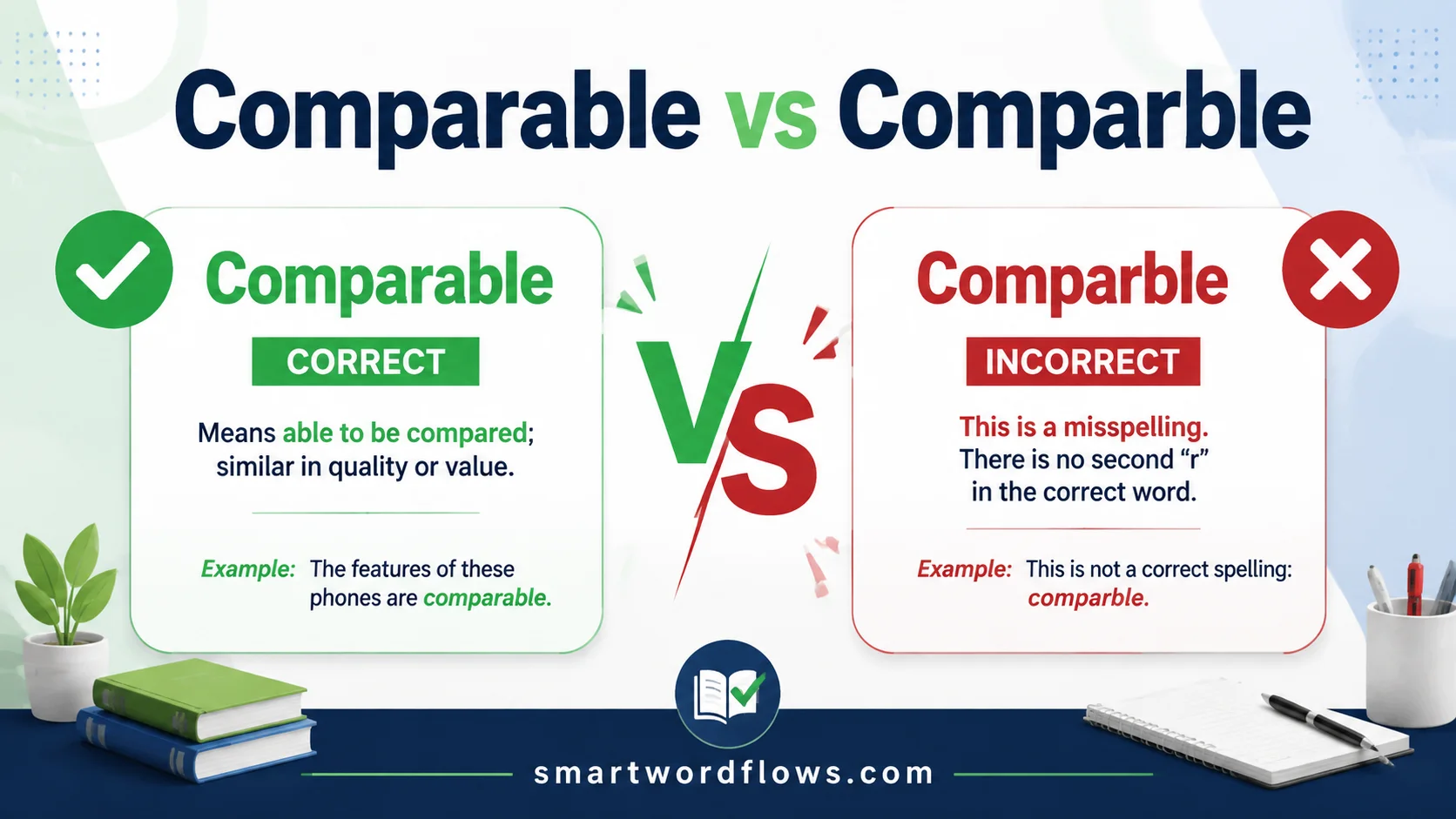

Comparable vs. Comparble: Which Spelling Is Correct? The correct spelling is comparable, while comprable is an incorrect misspelling. Both words may sound almost identical when spoken quickly, which causes confusion among writers. English pronunciation can soften vowel sounds, making people accidentally leave out the second a. However, comparable is the standard English word in modern writing. Remembering this small spelling difference can help you avoid a common spelling mistake in emails, essays, and professional writing.
The word comparable is useful when two things can be compared in a meaningful way. It commonly appears in business reports, academic papers, real estate listings, and professional documents. Even fluent English speakers may type comprable by accident when writing quickly. Dictionaries and style guides recognize comparable as the accepted form. Simple memory techniques, practical examples, and comparison tables can help you confidently use the correct spelling and avoid confusing comprable vs. comparable in everyday conversations.
Quick Answer
Comparable is the correct spelling.
Comparble is incorrect and should not be used in formal or informal writing.
| Word | Correct Spelling | Meaning |
| Comparable | Yes | Similar enough to be compared with something else |
| Comparble | No | A misspelling caused by removing the second “a” |
The easiest way to remember the correct spelling is to connect it with the root word compare:
Compare + able = Comparable
The word keeps the “a” from compare before adding the suffix -able.
Examples:
- The two laptops have comparable performance levels.
- Her experience is comparable to that of senior professionals.
- The two products have comparble features.
Comparison Overview
Although comparable and comparble look almost identical, they do not have the same status in English. One is a recognized adjective while the other is simply a spelling error.
| Feature | Comparable | Comparble |
| Correct English word | Yes | No |
| Appears in dictionaries | Yes | No |
| Used in professional writing | Yes | No |
| Based on the word “compare” | Yes | Incorrect form |
| Meaning | Able to be compared | No official meaning |
The confusion usually happens because people pronounce the word quickly. When spoken naturally, the second “a” sound in comparable can become less noticeable. As a result, writers sometimes spell the word the way they hear it.
However, spelling depends on the structure and history of a word, not only its pronunciation. English often keeps letters that are connected to the original word.
For example:
- Compare → Comparable
- Prepare → Prepar-able (not commonly used but follows the pattern)
- Repair → Repairable
The same spelling principle appears in many English words where a base word combines with a suffix.
Main Differences Between Comparable vs. Comparble
The biggest difference between comparable and comparble is simple: one is correct English and the other is not.
Comparable Is a Real English Word
Comparable is an adjective that describes something similar enough to another thing that people can compare them.
It does not always mean two things are exactly the same. Instead, it means they share enough qualities, features, or characteristics to make a comparison meaningful.
For example:
“The two smartphones have comparable battery life.”
This sentence does not mean both phones are identical. It means their battery performance is close enough to evaluate side by side.
Comparable can describe:
- Quality
- Price
- Size
- Performance
- Value
- Skills
- Results
- Features
Examples:
- The company offers salaries comparable to industry standards.
- Her writing skills are comparable to experienced authors.
- These two restaurants provide comparable dining experiences.
Comparble Is a Spelling Mistake
Comparble does not appear as a standard English word. It has no accepted definition in dictionaries.
The mistake happens because people often drop the second “a” while writing quickly.
Correct:
Comparable
Incorrect:
Comparble
A useful trick is to slow down and identify the root word:
Compare → Comparable
If you remember the original word, the spelling becomes much easier.
What Does Comparable Mean?
The word comparable means “similar enough to be compared.”
It comes from the verb compare, which means to examine two or more things to identify similarities and differences.
When something is comparable, it has qualities that allow people to make a fair evaluation.
For example:
- Two cars may be comparable because they have similar prices, features, and performance.
- Two athletes may be comparable because they have similar records and achievements.
- Two businesses may be comparable because they operate in the same market.
The key idea is that comparable things have a meaningful connection.
Definition of Comparable
According to standard English usage, comparable means:
Similar in quality, amount, importance, or characteristics so that a comparison can be made.
The word is commonly used when people analyze similarities between objects, ideas, or situations.
Comparable Meaning in Different Contexts
The meaning of comparable changes slightly depending on the situation.
Comparable in Business and Finance
In business, comparable is often used when evaluating companies, investments, and market performance.
For example, analysts may study comparable companies to estimate the value of a business.
A real estate professional might compare similar homes in the same neighborhood. These properties are called comparables because they provide a reference point for pricing.
Examples:
- The company’s revenue growth is comparable to its competitors.
- Analysts reviewed comparable businesses before estimating the company’s value.
Comparable in Technology
Technology companies frequently compare products based on:
- Speed
- Features
- Battery life
- Price
- User experience
Example:
“This smartphone offers performance comparable to premium models.”
This means the phone performs similarly to higher-end devices.
Comparable in Everyday Conversations
People use comparable in normal conversations too.
Examples:
- My workload this month is comparable to last month’s workload.
- Her dedication is comparable to that of professional athletes.
- The new restaurant offers quality comparable to expensive hotels.
Why Is Comparable the Correct Spelling?
The spelling of comparable comes from the combination of the word compare and the suffix -able.
The suffix -able means “capable of” or “able to be.”
Examples:
- Enjoy → Enjoyable
- Read → Readable
- Comfort → Comfortable
- Compare → Comparable
When “-able” joins with “compare,” the word keeps the important letters from its original form.
Compare + able = Comparable
Removing the “a” creates an incorrect spelling because it breaks the connection with the original word.
Why People Write Comparble Instead
There are several reasons people accidentally write comparble:
- They rely only on pronunciation.
- They type quickly without proofreading.
- They forget the original word structure.
- They assume the spelling follows the sound.
English has many words where spelling does not perfectly match pronunciation. That is why remembering word families is often more effective than memorizing isolated words.
For example:
- Prepare → Preparation
- Compare → Comparison
- Compare → Comparable
The related words help reinforce the correct spelling pattern.
Common Mistakes When Using Comparable
Even after learning the correct spelling, people sometimes misuse the word.
Mistake: Thinking Comparable Means Exactly Equal
Comparable does not mean identical.
Incorrect:
“These two products are comparable because they are exactly the same.”
Better:
“These two products are comparable because they offer similar features.”
Comparable means similar enough for evaluation, not completely identical.
Mistake: Confusing Comparable With Compatible
These words sound similar but have different meanings.
| Word | Meaning | Example |
| Comparable | Similar enough to compare | These cars have comparable features. |
| Compatible | Able to work together | This software is compatible with my computer. |
A phone and a charger can be compatible, but two phones can be comparable.
Mistake: Using Comparable Without a Clear Reference
Comparable usually works best when you explain what something is being compared with.
Less clear:
“This product is comparable.”
Better:
“This product is comparable to leading brands in the market.”
The second sentence gives the reader a clear comparison point.
How to Use Comparable Correctly in Sentences
Understanding the definition of comparable is helpful, but knowing how to use it naturally makes your writing stronger. The word usually appears when you want to show that two things share important similarities.
You can use comparable in professional writing, casual conversations, academic discussions, and product descriptions. The meaning stays consistent, but the context changes how the comparison works.
Professional Examples of Comparable
In workplaces, comparable often appears when discussing performance, salaries, skills, results, or business measurements.
Examples:
- The company provides benefits comparable to other leading organizations.
- Her leadership abilities are comparable to those of experienced managers.
- The new software delivers results comparable to more expensive solutions.
- This year’s sales numbers are comparable to last year’s performance.
In these examples, comparable helps create a fair comparison without claiming that two things are exactly identical.
Academic Examples of Comparable
Students and researchers often use comparable when analyzing studies, theories, historical events, or data.
Examples:
- The two research studies produced comparable results.
- These historical events have comparable social impacts.
- The researchers selected groups with comparable characteristics.
- The experiment produced outcomes comparable to previous studies.
In academic writing, comparable creates a logical connection between two subjects.
Everyday Examples of Comparable
You can also use comparable in normal conversations.
Examples:
- This restaurant offers quality comparable to expensive dining places.
- My new phone has a camera comparable to professional equipment.
- Her excitement was comparable to winning a major award.
- The two movies have stories with comparable themes.
The word adds precision because it explains that something is similar in a specific way.
Read More: Realist vs Realest Correct Usage
Comparable vs Similar: What Is the Difference?
Many people use comparable and similar as if they mean exactly the same thing. Although they overlap, they have different purposes.
Similar is a broader word. It simply means that two things share some qualities.
Comparable is more specific. It suggests that two things are similar enough that someone can evaluate them against each other.
| Word | Meaning | Example |
| Similar | Having some qualities in common | The two shirts have similar designs. |
| Comparable | Similar enough for direct comparison | The two shirts have comparable prices and quality. |
Consider this example:
“A bicycle and a motorcycle are similar because both provide transportation.”
However:
“Two motorcycles from different brands are comparable because they can be measured by speed, price, fuel efficiency, and features.”
The first example shows a general connection. The second involves a practical evaluation.
When to Use Similar Instead of Comparable
Use similar when you only want to mention a resemblance.
Examples:
- The two paintings have similar colors.
- Their opinions are similar.
- The houses have similar designs.
Use comparable when you want to analyze or measure differences.
Examples:
- The two houses have comparable market values.
- The athletes have comparable career achievements.
- The products have comparable performance levels.
A simple way to remember the difference:
Similar = alike in some ways
Comparable = alike enough to measure or evaluate
Comparable in Business and Market Analysis
The word comparable has a special role in business because companies constantly compare performance, pricing, and value.
One of the most common uses is the term comparable companies analysis, often called “comps.”
This method helps investors and analysts estimate the value of a company by comparing it with similar businesses.
For example:
A technology company may be compared with other technology companies that have:
- Similar revenue levels
- Similar customers
- Similar market conditions
- Similar growth patterns
These businesses are considered comparable because they provide useful reference points.
Comparable Sales in Real Estate
Real estate professionals frequently use the term comparable sales or comps.
A comparable property usually shares characteristics such as:
- Location
- Size
- Number of bedrooms
- Property condition
- Recent sale history
For example:
A three-bedroom house sold recently in the same neighborhood can help determine the value of another three-bedroom house nearby.
The properties are not identical, but they are comparable.
Comparable in Salary Discussions
The word also appears in employment and compensation discussions.
Companies often review comparable salaries to determine whether their pay rates match industry standards.
Example:
“The company adjusted salaries to remain comparable with competitors.”
This means the salaries are similar to what other companies offer for similar roles.
Comparable in Technology and Product Comparisons
Technology websites, reviewers, and customers use comparable frequently when evaluating products.
When someone says a device has comparable performance, they usually mean it performs close to another product in a measurable way.
Important comparison areas include:
| Category | Example of Comparison |
| Speed | Processing power compared with another device |
| Price | Cost compared with competitors |
| Features | Available tools and functions |
| Battery life | Hours of usage compared with similar products |
| Quality | Materials and overall experience |
Example:
“This affordable laptop offers performance comparable to premium models.”
The sentence does not claim the laptop is identical to expensive models. It means the performance is close enough to make a reasonable comparison.
Comparable Synonyms and Alternative Words
Sometimes using the same word repeatedly can make writing feel dull. Depending on the context, you can replace comparable with other words.
| Alternative Word | Meaning | Best Used For |
| Similar | Sharing qualities | General comparisons |
| Equivalent | Equal in value or function | Technical or professional writing |
| Analogous | Similar in a particular way | Academic discussions |
| Matching | Having the same features | Products and designs |
| Related | Connected in some way | Ideas and concepts |
| Alike | Very similar | Casual writing |
| Corresponding | Having a similar relationship | Formal writing |
Comparable vs Equivalent
These two words are often confused.
Comparable means two things can be compared because they share qualities.
Equivalent means two things have the same value, function, or meaning.
Examples:
- These two phones have comparable camera quality.
- These two measurements are equivalent.
Two phones can be comparable without being equivalent.
Comparable vs Analogous
Analogous is a more advanced word used when two things share a similar pattern or purpose.
Example:
- The human brain and a computer are sometimes described as analogous systems.
They are not the same, but they share certain similarities.
How to Remember the Correct Spelling of Comparable
Spelling mistakes become easier to avoid when you understand the word’s structure.
The best memory trick for comparable is:
Remember the root word first.
Compare → Comparable
The word does not lose the “a” when the suffix -able is added.
Another useful method is to break the word into parts:
Com + par + able
This helps your brain recognize the complete spelling pattern.
Simple Spelling Reminder
Think:
“If I can compare something, it becomes comparable.”
The connection between these two words makes the spelling easier to remember.
Comparable vs Comparble: A Final Spelling Check
Before submitting an article, email, assignment, or report, check whether you wrote:
Comparable
Comparble
A quick proofreading habit can prevent simple spelling errors from affecting the quality of your writing.
Professional communication depends on small details. Correct spelling shows attention, accuracy, and confidence.
FAQs:
1. Is comparable the correct spelling?
Yes, comparable is the correct English spelling. Comprable is an incorrect misspelling.
2. Why do people spell comparable as comprable?
People often leave out the second a because the word can sound almost identical when spoken quickly.
3. What does comparable mean?
Comparable means that two or more things are similar enough to be compared meaningfully.
4. Is comprable a real English word?
No. Comprable is not a standard English word. It is a common spelling error.
5. How can I remember the spelling of comparable?
Remember the second a in comparable. Breaking the word into parts and practicing it in sentences can also help.
Conclusion
The correct spelling is comparable, not comprable. Although both forms may sound similar in quick speech, comprable is a common spelling mistake and is not a standard English word. Remember the second a in comparable, especially when writing emails, essays, business documents, or professional content. With regular practice and simple memory techniques, you can easily remember the correct spelling and use comparable confidently.