
When writing, many people hesitate between moment and momment, especially when typing quickly or trusting memory. The correct spelling is moment, while momment is a spelling error. This common confusion can create a visible mistake in clean writing. The meaning of moment usually describes a short period of time, a specific point in time, or an important event. Remember that moment has no extra “m.” Using the correct form helps English learners and native speakers write accurately and confidently in different contexts.
The word moment also appears in scientific terminology, where its meaning connects with motion and physical quantities. Linear momentum describes the amount of motion along a rectilinear path, while angular momentum relates to rotational motion. Other examples include Dipole Moment, moment of Inertia, Scalar quantity, and Magnetic Moment. In ordinary English, moment refers mainly to time, but scientific usage can describe physical concepts. Checking pronunciation, examples, and standard English dictionaries can help writers remember the correct usage.
Quick Answer
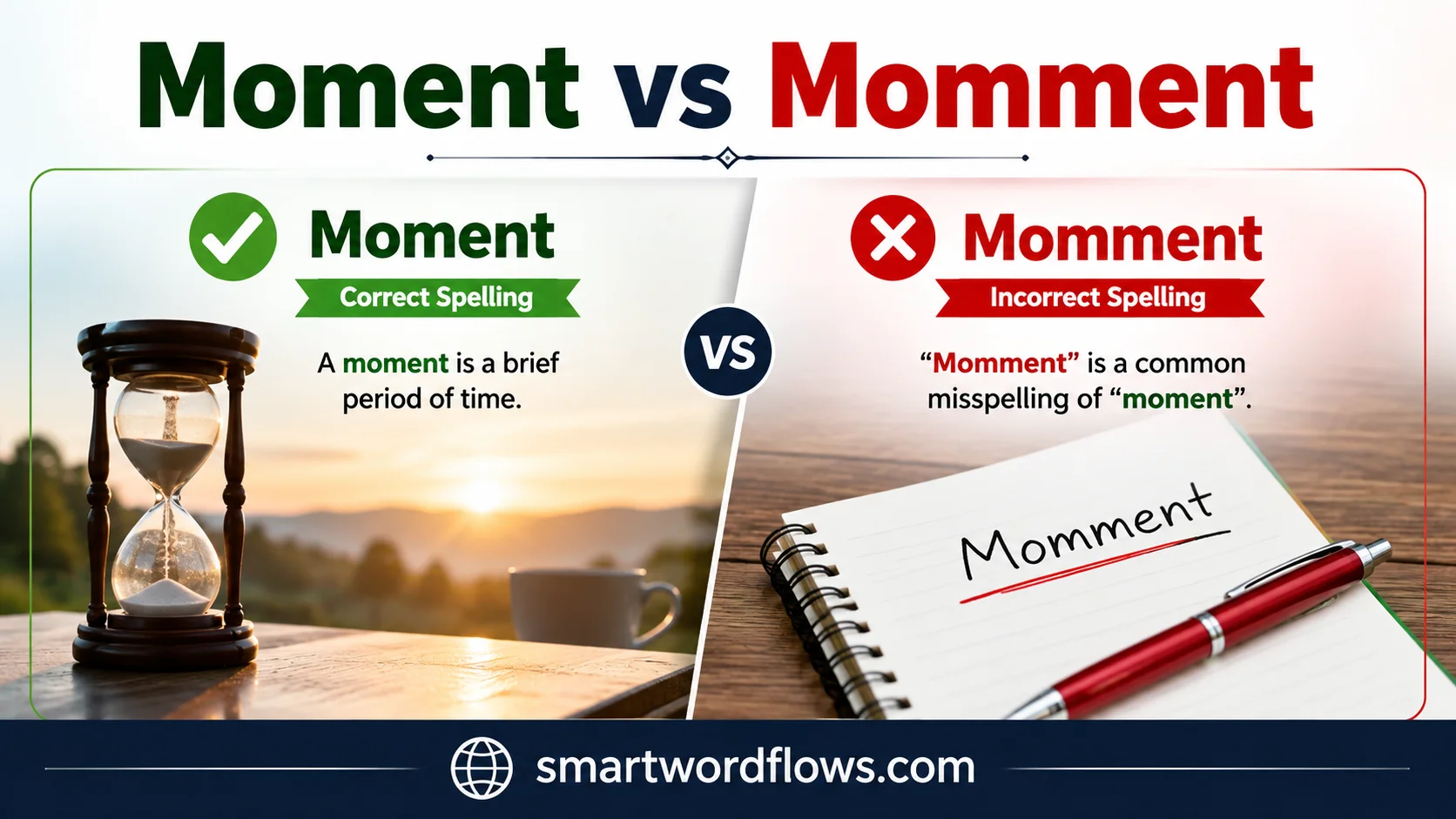
The correct spelling is moment.
Momment is an incorrect spelling of moment. It isn’t a standard English word with its own meaning or grammatical function.
| Word | Correct Spelling? | Meaning | Example |
| Moment | Yes | A short period, point in time, occasion, or significant time | Please wait a moment. |
| Momment | No | No standard English meaning | Please wait a momment. |
Oxford lists moment as a noun meaning, among other things, “a very short period of time” and an exact point in time.
So if you’re wondering “moment or momment?”, choose moment every time in standard English.
Correct: I’ll be there in a moment.
Incorrect: I’ll be there in a momment.
There’s no special context in which momment becomes the correct spelling. If you’re writing an email, essay, article, text message, résumé, or business report, use moment.
Comparison Overview
The moment vs momment distinction is straightforward once you separate spelling from meaning.
| Feature | Moment | Momment |
| Standard English word | Yes | No |
| Correct spelling | Yes | No |
| Common noun | Yes | No |
| Refers to a short period | Yes | No |
| Refers to a point in time | Yes | No |
| Can describe an important occasion | Yes | No |
| Used in common expressions | Yes | No |
| Suitable for formal writing | Yes | No |
| Pronunciation | /ˈmoʊ.mənt/ in American English | — |
| Example | Wait a moment. | Wait a momment. |
The important point is that this isn’t a conventional word-versus-word comparison like affect vs effect. There isn’t a meaning difference to memorize.
Instead, you’re dealing with one correct word and one misspelling.
Cambridge defines moment as a very short period of time and also as a particular time or occasion. Its American English entry gives the same core uses.
Main Differences Between Moment vs Momment
The biggest difference between moment vs momment is simple: one belongs to standard English and the other doesn’t.
Moment Is the Correct Spelling
Moment contains six letters:
M-O-M-E-N-T
Notice the spelling carefully. There is only one m immediately before ent.
Examples:
- Give me a moment to finish this.
- That was an unforgettable moment.
- She arrived at the perfect moment.
- I’ll call you in a moment.
- At that moment, everything changed.
The word works naturally in casual conversation as well as formal writing.
Momment Is a Misspelling
Momment adds an unnecessary second m:
M-O-M-M-E-N-T
That extra letter doesn’t create a new word. It simply turns the correct spelling into an error.
For example:
- I need a momment to think.
- I need a moment to think.
- It was a beautiful momment.
- It was a beautiful moment.
- Wait a momment, please.
- Wait a moment, please.
A spelling mistake doesn’t become correct simply because readers can understand what you meant.
What Does Moment Mean?
The word moment is more versatile than it first appears.
In everyday English, it commonly refers to a short period of time or a particular point in time. It can also describe an important occasion or opportunity.
Oxford identifies several major uses, including a very short period, an exact point in time, and a particular occasion or suitable time for doing something.
Let’s look at each meaning separately.
Moment as a Short Period of Time
The most familiar meaning describes a brief amount of time.
You don’t usually use moment to give an exact duration. Instead, the word communicates that something won’t take long.
For example:
- Please wait a moment.
- I’ll be back in a moment.
- She paused for a moment.
- He thought for a moment before answering.
- Can you spare a moment?
When someone says “Give me a moment,” they usually aren’t promising exactly 30 seconds or 90 seconds. They’re asking for a short amount of time.
That’s an important distinction.
A second and a minute are precise units of time. A moment is generally flexible and contextual.
Moment as a Specific Point in Time
Sometimes moment doesn’t describe a stretch of time at all.
Instead, it identifies a particular point when something happens.
Consider:
At that moment, the phone rang.
The sentence doesn’t mean the phone rang for a long period. It points to one specific instant in the sequence of events.
Other examples include:
- At that moment, I realized my mistake.
- She knew the truth from that moment on.
- The power went out at the worst possible moment.
- At that very moment, the door opened.
This use is especially common when storytelling requires a precise turning point.
Moment as an Important Occasion
A moment can also be an event or experience that carries emotional or personal significance.
For example:
- Graduation was one of the happiest moments of her life.
- Winning the championship was a proud moment.
- That conversation became a memorable moment for both of them.
- The announcement created a tense moment in the meeting.
Here, moment doesn’t simply measure time. It highlights meaning.
That’s why English speakers often describe something as a special moment, historic moment, proud moment, or defining moment.
Cambridge describes a defining moment as an important point or event that changes a situation in a significant way.
Moment as an Opportunity
Another useful meaning appears when moment describes the right or wrong time to do something.
For example:
- I’m waiting for the right moment to ask.
- This isn’t a good moment to discuss money.
- She chose the perfect moment to announce the news.
- Have I caught you at a bad moment?
Here, moment is close to opportunity or suitable time.
Oxford specifically includes this sense as a particular occasion or a good time for doing something.
What Does Momment Mean?
In standard English, momment has no established meaning.
It’s simply a misspelling of moment.
You might encounter momment in:
- Social media posts
- Informal messages
- Comments
- Unedited websites
- User-generated content
- Fast typing
Seeing the spelling online doesn’t make it correct.
The internet contains countless typos. Search engines can index them, social platforms can display them, and people can repeat them. None of that changes the standard spelling.
A useful rule is:
If you mean a brief period or point in time, write “moment,” not “momment.”
Examples of the Error
Consider these sentences:
Give me a momment.
That was the best momment of my life.
She stopped for a momment.
At that momment, everyone became silent.
Each sentence should use moment instead.
Correct Versions
Give me a moment.
That was the best moment of my life.
She stopped for a moment.
At that moment, everyone became silent.
The correction doesn’t change the meaning. It simply restores the standard spelling.
Why Do People Spell Moment as Momment?
The mistake has a few plausible causes, although there isn’t a formal rule that explains every individual misspelling.
Double-Consonant Patterns Can Cause Confusion
English contains many familiar words with doubled consonants:
- common
- summer
- hammer
- grammar
- comment
- manner
- address
Because double letters are common in English, a writer may incorrectly assume that moment follows a similar pattern.
It doesn’t.
The correct spelling remains:
moment
Not:
momment
Pronunciation Can Mislead Writers
American English pronunciation of moment is commonly represented as /ˈmoʊ.mənt/. Cambridge gives that pronunciation in its American English entry.
The word contains two audible m sounds across its syllables:
mo-mənt
That sound pattern can make the spelling feel as though it might contain mm in the middle. But pronunciation doesn’t tell you exactly how many letters to write.
English is full of these little traps.
Fast Typing Creates Small Errors
Typing quickly can also produce accidental doubled letters.
You might intend to write:
I’ll be there in a moment.
Your fingers might produce:
I’ll be there in a momment.
That’s a typo, not a new spelling variant.
The same thing happens with many everyday words. The best fix is simple: pause when a word looks unfamiliar and check its spelling.
How to Use Moment Correctly in a Sentence
Understanding the definition is useful. Knowing how the word behaves in real sentences is even better.
Using Moment for a Short Wait
Use a moment when asking someone to wait briefly.
Examples:
- Please wait a moment.
- Just a moment, please.
- I’ll be with you in a moment.
- Give me a moment to check the details.
- Can you hold on for a moment?
These phrases are extremely common in everyday English.
Using Moment for a Particular Time
Use moment when pointing to a specific point in an event.
Examples:
- At that moment, she understood everything.
- The lights went out at the exact moment we arrived.
- From that moment on, things changed.
- I knew something was wrong at that moment.
This use works especially well in narratives.
Using Moment for a Memorable Experience
Use moment to emphasize an event’s emotional importance.
Examples:
- It was a proud moment for her family.
- That was a beautiful moment.
- The ceremony created a memorable moment.
- Winning the final match was the team’s greatest moment.
Here, the word carries emotional weight rather than simply measuring time.
Using Moment for the Right Opportunity
Use moment when you’re talking about timing.
Examples:
- Wait for the right moment.
- This isn’t the right moment to complain.
- He chose a quiet moment to speak.
- She found the perfect moment to apologize.
The surrounding adjective often reveals this meaning.
Words such as right, wrong, perfect, bad, good, quiet, critical, and appropriate frequently appear with this use.
Common Expressions With Moment
One reason moment appears so often in English is its role in fixed expressions.
At the Moment
At the moment means now or currently.
Examples:
- I’m busy at the moment.
- She’s not available at the moment.
- We’re working on the problem at the moment.
Cambridge lists at the moment as meaning “now.”
In a Moment
In a moment usually means very soon or after a short time.
Examples:
- I’ll be ready in a moment.
- The doctor will see you in a moment.
- I’ll call you back in a moment.
For a Moment
For a moment means for a short period.
Examples:
- She closed her eyes for a moment.
- For a moment, I thought I was lost.
- He stood quietly for a moment.
Just a Moment
Just a moment is a polite way to ask someone to wait.
Example:
Just a moment, please. I’ll check your reservation.
It can also express sudden realization:
Wait a moment—that isn’t my bag.
Oxford includes this use among its examples of moment.
The Moment
The moment can mean as soon as when followed by a clause.
Examples:
- Call me the moment you arrive.
- I knew the moment she walked in.
- The moment he heard the news, he called his parents.
This is different from at the moment, which means currently.
That small difference matters.
For the Moment
For the moment means for now.
Example:
For the moment, we’ll keep the existing schedule.
Cambridge explains this expression as something being done now even though the situation may change later.
On the Spur of the Moment
This expression means doing something suddenly and without planning.
Example:
We decided to take a road trip on the spur of the moment.
It’s a useful phrase when describing spontaneous decisions.
At a Moment’s Notice
This means with very little warning.
Example:
The crew must be ready to leave at a moment’s notice.
Oxford includes this expression in its American English entry for moment.
Moment vs Minute vs Second vs Instant
The moment vs momment issue is simple. However, another question often follows: how does moment differ from words such as minute, second, and instant?
These words overlap, but they aren’t interchangeable in every sentence.
| Word | Main Idea | Precision | Example |
| Moment | Short period or point in time | Low | Wait a moment. |
| Second | Exact unit of time | High | Wait ten seconds. |
| Minute | Exact unit of time or short period | High when literal | Wait five minutes. |
| Instant | Extremely brief point or period | Usually low | It happened in an instant. |
Moment vs Second
A second is an exact unit of time.
A moment isn’t normally exact.
So:
Wait ten seconds.
gives a measurable duration.
Meanwhile:
Wait a moment.
simply asks for a short delay.
Moment vs Minute
A minute can mean exactly 60 seconds. It can also be used informally to describe a short period.
A moment is generally less precise.
Compare:
- I’ll be back in two minutes.
- I’ll be back in a moment.
The first gives you a measurable timeframe. The second doesn’t.
Moment vs Instant
Instant often suggests something extremely brief.
For example:
The glass shattered in an instant.
Moment can describe a broader range of situations:
She paused for a moment.
The two words can overlap, but moment has more everyday uses involving occasions, opportunities, and significance.
Read More: Faring vs Fairing: What’s the Difference?
Moment vs Momment: Common Mistakes to Avoid
Once you know the correct spelling, a few related mistakes are worth watching.
Mistake: Writing Momment
This is the central error.
It was a special momment.
It was a special moment.
Mistake: Treating Moment as an Exact Unit
Don’t assume a moment always has a fixed number of seconds.
If exact timing matters, use seconds or minutes.
Mistake: Confusing “At the Moment” and “The Moment”
These expressions have different meanings.
At the moment = now.
I’m studying at the moment.
The moment = as soon as.
Call me the moment you arrive.
That distinction is easy to overlook.
Mistake: Confusing Moment With Momentum
The words look related because they are historically connected, but they have different modern meanings.
Moment commonly refers to a short period, point in time, or significant occasion.
Momentum has technical meanings in physics and broader figurative uses involving movement or progress.
Don’t substitute one for the other.
Moment in Technical and Scientific Writing
The everyday meaning of moment isn’t the whole story.
The word also has established technical meanings in disciplines such as physics, mechanics, statistics, and mathematics.
Moment in Physics
In mechanics, a moment describes the turning effect produced by a force about a point or axis.
For example, pushing a door near its hinges produces less turning effect than pushing the same door near its handle.
That’s why the distance from the pivot matters.
This technical sense is entirely legitimate, but it has nothing to do with the spelling momment.
Moment in Statistics
In statistics, moments describe numerical characteristics of a probability distribution.
For example, moments can help describe features such as:
- Central tendency
- Variability
- Skewness
- Kurtosis
The technical terminology gets more specialized, but the spelling remains exactly the same:
moment
Never momment.
Why This Matters
The technical uses demonstrate an important point: moment is a well-established English term with a broad range of meanings.
Momment, by contrast, doesn’t gain legitimacy simply because someone uses it in a technical-looking sentence.
The History of the Word “Moment”
The spelling becomes easier to appreciate when you look at the word’s history.
Oxford traces moment to Late Middle English through Latin momentum, from movere, meaning “to move.”
That history is useful because the modern word carries several related ideas.
It can describe a point or brief span of time. It can also describe significance, influence, or importance in more formal contexts.
Cambridge, for example, records of great moment as a formal expression meaning very important.
So moment isn’t merely a word for “a few seconds.”
It’s a flexible noun that has developed several connected meanings over centuries.
Case Study: Choosing the Right Meaning of “Moment”
Imagine a manager says:
“Can I have a moment?”
The manager probably wants a short amount of time or a brief conversation.
Now imagine the same manager says:
“This is a defining moment for the company.”
The meaning has changed.
The second sentence refers to an important event or turning point rather than a short wait.
Now consider:
“At that moment, the server went offline.”
Here, moment points to a particular time.
Three sentences. Three shades of meaning.
Yet the spelling never changes.
Moment remains moment.
This flexibility is one reason the word appears so frequently across everyday speech, journalism, business writing, literature, and technical fields.
Moment vs Momment Examples: Correct and Incorrect
Side-by-side examples make the spelling rule almost impossible to forget.
| Incorrect | Correct | Explanation |
| Wait a momment. | Wait a moment. | Momment is misspelled. |
| Give me a momment to think. | Give me a moment to think. | Use moment for a short period. |
| That was a special momment. | That was a special moment. | Moment can describe an important occasion. |
| At that momment, she cried. | At that moment, she cried. | Use moment for a point in time. |
| I’ll return in a momment. | I’ll return in a moment. | The correct spelling has one middle m. |
| It was the proudest momment of his career. | It was the proudest moment of his career. | Moment is the standard noun. |
| She paused for a momment. | She paused for a moment. | The phrase requires moment. |
| The momment had finally arrived. | The moment had finally arrived. | Moment can describe an anticipated occasion. |
How to Remember the Spelling of Moment
You don’t need a complicated mnemonic.
Just remember the word as:
MO + MENT = MOMENT
There isn’t an extra m between mo and ment.
A useful visual check is:
moment
momment
Think of it this way:
One moment needs one middle M.
That’s enough.
If you’re writing quickly and the word suddenly looks strange, spell it mentally:
M-O-M-E-N-T
You’ll spot the unnecessary extra m immediately.
Pronunciation of Moment
In American English, moment is pronounced approximately:
MOH-mənt
Cambridge gives the American pronunciation as /ˈmoʊ.mənt/.
The pronunciation has two syllables:
mo + ment
The second syllable contains a reduced vowel sound in ordinary speech.
This matters because pronunciation can sometimes influence spelling mistakes. You may hear the repeated m sounds and unconsciously imagine an extra letter.
However, pronunciation and spelling aren’t mirror images.
English doesn’t work that neatly.
The correct written form remains:
moment
Why Correct Spelling Matters
A single spelling mistake won’t ruin your writing.
Still, repeated errors can make otherwise strong content look careless.
Imagine reading this sentence in a business email:
“This is an important momment for our company.”
You understand it instantly. Yet the error catches your eye.
Now compare:
“This is an important moment for our company.”
The second version reads smoothly because the spelling doesn’t interrupt the sentence.
Correct spelling helps with:
- Professional credibility
- Academic writing
- Reader confidence
- Clear communication
- Editorial quality
- Polished business communication
The point isn’t perfection for perfection’s sake. Good spelling removes unnecessary friction.
Your reader shouldn’t have to mentally repair your words while trying to understand your message.
A Simple Editing Test for Moment vs Momment
When proofreading your writing, search for:
momment
If you find it, replace it with:
moment
This works especially well when editing long documents because the error can hide inside otherwise familiar sentences.
You can also watch for these common patterns:
- a momment → a moment
- the momment → the moment
- this momment → this moment
- one momment → one moment
- every momment → every moment
A quick search can catch every instance.
Practice Quiz: Moment or Momment?
Test yourself before moving on.
Which sentence is correct?
A. Please wait a momment.
B. Please wait a moment.
Answer: B
Which spelling belongs here?
It was one of the happiest _____ of my life.
A. moment
B. momment
Answer: A — moment
Choose the correct sentence
A. At that momment, the door opened.
B. At that moment, the door opened.
Answer: B
Which sentence uses “moment” to describe an important occasion?
A. I’ll return in a moment.
B. Graduation was a proud moment.
Answer: B
In the first sentence, moment means a short period. In the second, it describes a significant occasion.
Which phrase means “currently”?
A. At the moment
B. In a moment
Answer: A
For example:
She’s busy at the moment.
That means she’s busy now.
FAQs:
1. Is “moment” or “momment” correct?
Moment is the correct spelling. Momment is a common spelling error and isn’t accepted in standard English.
2. What does “moment” mean?
Moment can mean a short period of time, a specific point in time, or an important event.
3. Why do people spell “moment” as “momment”?
People often add an extra m because English has many words with double letters. Typing fast or relying on memory can also cause this mistake.
4. Can “moment” be used in science?
Yes. Moment is used in scientific terminology, including Dipole Moment, moment of Inertia, and Magnetic Moment.
5. How can I remember the correct spelling?
Remember that moment has only one “m” after the “o.” Practicing examples and checking dictionaries can help you remember it.
Conclusion:
The difference between moment vs momment is simple: moment is the correct English word, while momment is an incorrect spelling. Moment can describe a short period of time, a specific point in time, or an important event. It also has important uses in science, such as Dipole Moment, moment of Inertia, and Magnetic Moment. If you often confuse these spellings, remember that moment does not contain an extra “m.” Using the correct spelling will make your writing clearer, more accurate, and more professional. With a little practice and attention to spelling, you can confidently use moment correctly every time.