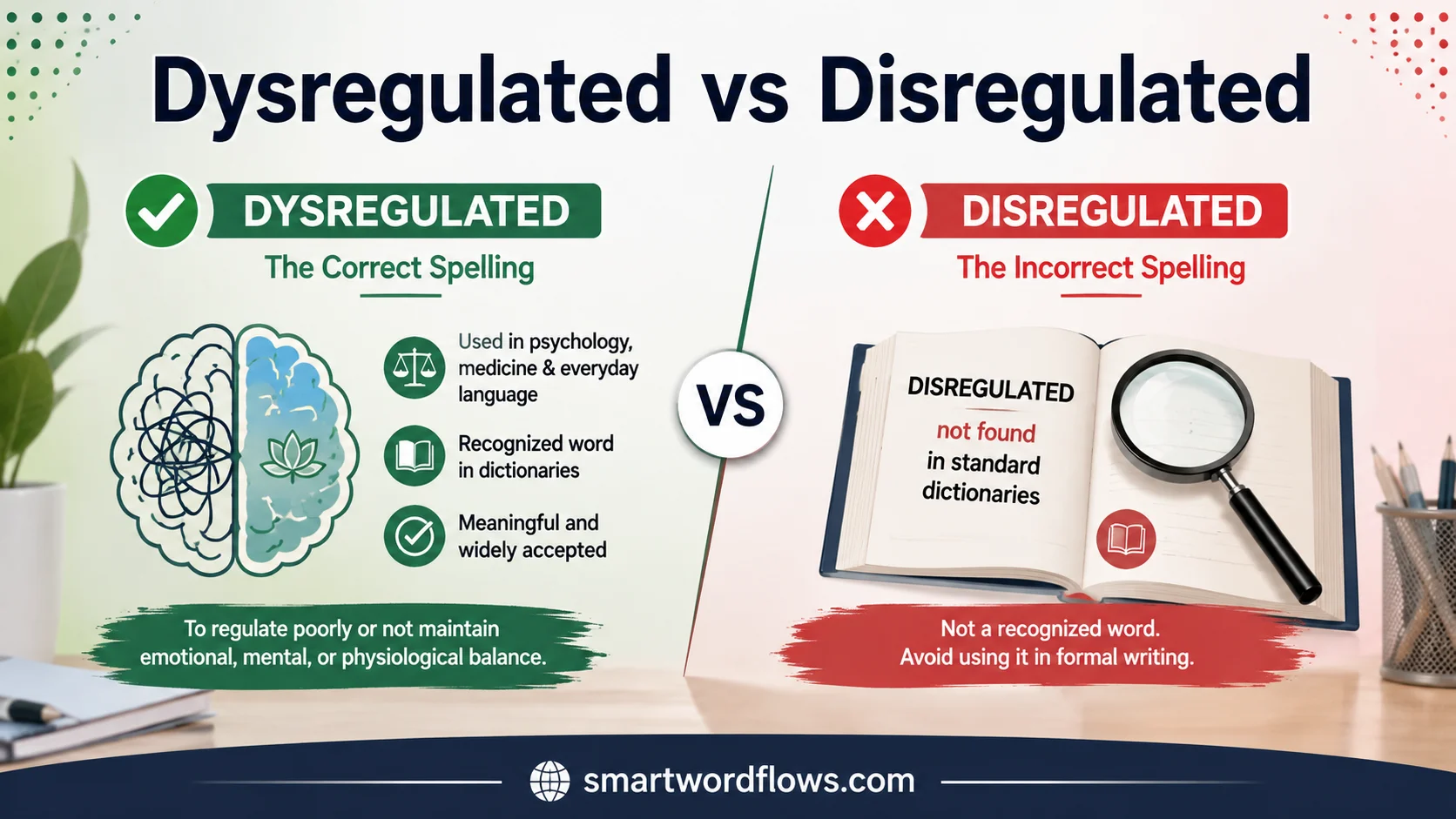

The terms Dysregulated vs Disregulated often confuse writers, students, and even professionals because they look almost identical. However, only dysregulated is the correct and widely accepted spelling in psychology, medicine, and academic writing. Understanding the difference helps you avoid common grammar mistakes and use the right term when discussing emotional regulation, mental health, or nervous system function.
Many people encounter this spelling question while reading about ADHD, autism, anxiety, trauma, or other behavioral disorders. Although disregulated appears occasionally in informal writing, experts, therapists, and researchers overwhelmingly use dysregulated to describe a system that is out of balance or functioning improperly. This guide explains the correct usage, meaning, examples, and the reasons why one spelling is considered standard while the other should generally be avoided.
Quick Answer
Dysregulated is the correct and preferred word in modern English.
Disregulated is uncommon and usually avoided in current medical, psychological, and biological writing.
In practice, use dysregulated for:
- emotional dysregulation
- immune dysregulation
- gene dysregulation
- hormonal dysregulation
- nervous system dysregulation
If you are writing for a general audience, academic audience, or clinical audience, dysregulated is almost always the safer choice.
Comparison Overview
| Feature | Dysregulated | Disregulated |
| Modern usage | Common and accepted | Rare and usually avoided |
| Main meaning | Abnormally or poorly regulated | Older, uncommon, or nonstandard form |
| Common fields | Medicine, psychology, biology, neuroscience | Limited historical or specialized use |
| Reader recognition | High | Low |
| Best choice today | Yes | Usually no |
The big takeaway is simple: dysregulated has become the standard term. Disregulated survives in the wild, but it is not the word most editors, researchers, and readers expect.
Main Differences Between Dysregulated and Disregulated
The difference starts with the prefix.
Dys- usually suggests something abnormal, impaired, or functioning badly. That is why words like dysfunction, dyslexia, and dysregulation feel natural in medical and technical English. The prefix points to a problem in how something works.
Dis- often suggests reversal, separation, or negation. It appears in words like disconnect, disagree, and disorder. While it can sometimes overlap in meaning with other prefixes, it does not fit the modern form of this term as cleanly as dys- does.
That is why dysregulated sounds right to modern readers. It follows the pattern they already know from related terms.
A simple way to think about it
If regulation is the body’s control system, then dysregulated means that system is not working properly. It is not fully broken. It is off balance, noisy, unstable, or misfiring.
That is a useful distinction. It helps explain why the word shows up so often in health writing. Many conditions do not involve total failure. They involve poor control.
What Does Dysregulated Mean?
Dysregulated describes something that is not being regulated properly. The word usually points to a process, system, or response that has gone out of balance.
That could mean:
- emotions that rise too fast or too strongly
- immune activity that becomes too aggressive
- genes that turn on or off at the wrong time
- hormones that drift outside a healthy range
- nervous system responses that are too sensitive or too weak
The word is not limited to one field. It works wherever control, balance, and coordination matter.
Dysregulated in psychology
In psychology, emotional dysregulation often refers to difficulty managing feelings. A person may feel overwhelmed, react quickly, or struggle to calm down after stress.
This does not mean the person is weak or broken. It means the emotional system is not adjusting smoothly. That distinction is important, especially in mental health writing. It keeps the language precise and humane.
Dysregulated in medicine
In medicine, dysregulated often describes a body system that is not responding the way it should.
Examples include:
- immune dysregulation in autoimmune or inflammatory conditions
- hormonal dysregulation in endocrine disorders
- metabolic dysregulation in conditions involving blood sugar or energy balance
The word is useful because it describes imbalance without claiming total failure. That makes it a flexible and accurate term.
Dysregulated in biology
Biology uses the term often because living systems depend on tight control.
For example:
- gene dysregulation can affect how cells behave
- cell signaling dysregulation can disrupt communication between cells
- protein dysregulation can alter growth, repair, or immune response
In these contexts, the word signals a measurable shift from normal control. That is why researchers prefer it.
What Does Disregulated Mean?
Disregulated is much less common in modern English. Some writers use it, and readers may still find it in older or niche material. But in most current writing, it is not the preferred form.
That does not mean it is impossible to find. It just means the word has lost ground to dysregulated. When a term loses standard status, editors usually push writers toward the more widely accepted version.
Why it appears at all
Language does not always move in neat lines. Some terms survive in older books, regional usage, or specialized writing. A word can hang around even after another form becomes dominant.
That seems to be what happened here. The more common modern form became dysregulated, and that is the form most readers now recognize.
Should you use disregulated?
For most writing, no. If you are writing for:
- a blog
- a research summary
- a school paper
- a medical website
- a psychology article
then dysregulated is the better choice.
Using disregulated may look like a typo to many readers.
Why Dysregulated Became the Preferred Term
Language often shifts toward the form that feels more logical, more familiar, or more useful in professional writing. Dysregulated won because it fits the way English usually builds technical terms.
It also aligns with a larger family of words. Readers already know words like dysfunction and dysplasia. So dysregulated feels consistent.
There is also a practical reason. Medical and scientific writing depends on standard terms. Once one form becomes common in journals, textbooks, and professional communication, it tends to win by repetition. Editors, teachers, and clinicians reinforce the same form again and again.
That repeated use matters. It shapes what readers expect and what search engines surface.
When You Should Use Dysregulated
Use dysregulated when you want to describe a system that is not regulating normally.
In mental health writing
Use it in phrases like:
- emotional dysregulated behavior
- mood dysregulation
- stress dysregulation
- behavioral dysregulation
A common example is when someone reacts with unusually intense emotions after a small trigger. The issue is not simply emotion. It is the control pattern around the emotion.
In medical writing
Use it for problems involving the body’s internal balance.
Examples:
- immune dysregulated response
- hormonal dysregulation
- inflammatory dysregulation
- metabolic dysregulation
This word works well because it is specific. It tells the reader that the body is not regulating a process normally.
In biology and research
Use it in scientific writing where control pathways matter.
Examples:
- dysregulated genes
- dysregulated signaling pathways
- dysregulated protein expression
- dysregulated cell-cycle control
These are standard kinds of terms in lab reports and journal articles.
Are There Situations Where Disregulated Is Correct?
This is the tricky part. You may still encounter disregulated in older texts, less edited material, or rare technical usage. That does not automatically make it the best choice today.
The safest rule is this:
- If you are writing for a modern audience, use dysregulated
- If you are reading an older source, disregulated may appear there
- If you are editing content, replace it with dysregulated unless a source clearly requires the older form
That keeps your writing cleaner and more current.
Dysregulated vs. Disregulated Examples
Here are some simple side-by-side examples.
| Incorrect or less preferred | Better modern form |
| The patient showed disregulated emotions. | The patient showed dysregulated emotions. |
| The body had disregulated immune activity. | The body had dysregulated immune activity. |
| The study focused on disregulated gene expression. | The study focused on dysregulated gene expression. |
More examples in context
- Dysregulated emotions can make stress feel harder to manage.
- Dysregulated immune signaling may contribute to chronic inflammation.
- Dysregulated sleep patterns often affect mood, focus, and energy.
- Dysregulated hormones can change appetite, energy, and recovery.
Each sentence sounds natural because the word fits the technical meaning.
Common Mistakes Writers Make
People usually make the same few mistakes with this pair.
Assuming both words mean exactly the same thing
They may overlap in meaning, but they do not carry the same level of modern acceptance. That difference matters.
Choosing the wrong prefix by habit
Many writers see dis- and assume it must be right because it looks familiar. That is where spelling confidence can go sideways fast.
Copying an old source without checking current usage
Older material is helpful, but it is not always the best guide for modern wording. If a term looks suspicious, check how current editors and professionals use it.
Using the less common form in polished writing
A rare word is not automatically wrong. Still, rare words can distract readers. If a simpler, better-known form exists, use it.
Also Read This: Conex or Connex: Differences Explained
What Do Dictionaries and Style Guides Imply?
Most modern references and professional writers favor dysregulated in current usage. That does not mean every dictionary gives a long entry for every form. It means the language community has largely settled on one choice.
For practical writing, this matters more than theoretical debate. Readers want the term they recognize. Editors want the term that fits current usage. Search engines also tend to reward the term people actually type.
So, even when both forms appear in historical records, the modern writer should usually pick dysregulated.
Usage in Scientific and Medical Writing
This is where the distinction becomes especially clear. Researchers and clinicians need precision. They do not want a term that makes readers hesitate.
Why the scientific world likes dysregulated
The word fits systems thinking. It suggests a process that is malfunctioning, overactive, underactive, or poorly timed.
That is ideal for research writing because many biological problems are not all-or-nothing. They are partial failures of control.
Common research phrases
- dysregulated immune response
- dysregulated inflammatory pathways
- dysregulated transcription
- dysregulated gene networks
- dysregulated stress response
These phrases are common because they are concise and accurate.
Case Study: A Psychology Article
Imagine two draft sentences:
Version 1: “The patient displayed disregulated emotions during stress.”
Version 2: “The patient displayed dysregulated emotions during stress.”
The second sentence feels more natural to a modern reader. It also fits the language used in psychology and mental health writing. The first version may make an editor pause, not because it is impossible to understand, but because it sounds less standard.
That is the key issue here. The better word is the one that feels native to the field.
Case Study: A Biology Paper
Now take a research-style example:
Version 1: “The cells showed disregulated signaling after treatment.”
Version 2: “The cells showed dysregulated signaling after treatment.”
The second version sounds like the language of a journal article. It is cleaner, more established, and easier to trust.
This is why one small prefix can matter so much. Scientific readers notice these details immediately.
Related Words You Should Know
Once you understand dysregulated, a few related terms become easier too.
Dysregulation
This is the noun form. It names the condition or process itself.
- Emotional dysregulation
- Immune dysregulation
- Hormonal dysregulation
Regulation
This is the broader idea of control, balance, or management.
Upregulation
This means increasing activity or expression.
Downregulation
This means decreasing activity or expression.
Dysfunction
This means something is not working properly.
Homeostasis
This means the body’s stable internal balance. Dysregulation often disrupts homeostasis.
These words often appear together in biology and health writing, so learning them as a group helps a lot.
Memory Trick to Remember the Difference
Here is a simple way to remember it:
Dys- = trouble with the system.
So when a system is not working right, dysregulated is the word you want.
Another way to think about it:
- regulated means under control
- dysregulated means the control is off
- disregulated is not the form most modern readers expect
That tiny memory hook can save you from a lot of second-guessing.
Quick Quiz
Try these out.
Choose the better word
- The immune system was __________ after the infection.
- She had trouble with __________ emotions during stress.
- The study examined __________ gene expression.
- The less common form in modern writing is __________.
- The accepted modern term is __________.
Answers:
- dysregulated
- dysregulated
- dysregulated
- disregulated
- dysregulated
If you got all five right, you have the core difference down.
Real-World Writing Advice
When you are writing for readers, clarity beats cleverness every time. That is especially true with technical terms.
Use dysregulated when:
- you are writing about medicine or psychology
- you want to sound current and accurate
- you are editing for readability
- you want to match modern professional language
Avoid disregulated unless a historical source, archived text, or very specific editorial reason requires it.
A good rule is this: if a trusted reader might hesitate, choose the form they already know.
FAQs :
1. Which is correct: dysregulated or disregulated?
Dysregulated is the correct and accepted spelling. It is widely used in psychology, medicine, and scientific writing. Disregulated is generally considered a misspelling.
2. What does dysregulated mean?
Dysregulated describes a person, system, or body function that is not working in a normal, balanced, or controlled way. It is commonly used to describe emotional or nervous system regulation.
3. Is disregulated a real word?
Although disregulated may appear in some informal texts, it is not the preferred spelling in professional or academic English. Most experts recommend using dysregulated.
4. Where is the term dysregulated commonly used?
The word dysregulated is frequently used in discussions about ADHD, autism, anxiety, trauma, emotional regulation, behavioral disorders, and certain medical conditions.
5. How can I remember the correct spelling?
Remember that many medical terms use the prefix dys-, which means abnormal or impaired. This makes dysregulated the correct spelling, while disregulated should usually be avoided.
Conclusion :
Understanding the difference between Dysregulated vs Disregulated helps you use accurate and professional language. Dysregulated is the standard spelling recognized by healthcare professionals, psychologists, and academic sources, while disregulated is generally treated as an incorrect variation. Using the correct term improves both your writing and your understanding of topics related to emotional regulation, mental health, and medical science.