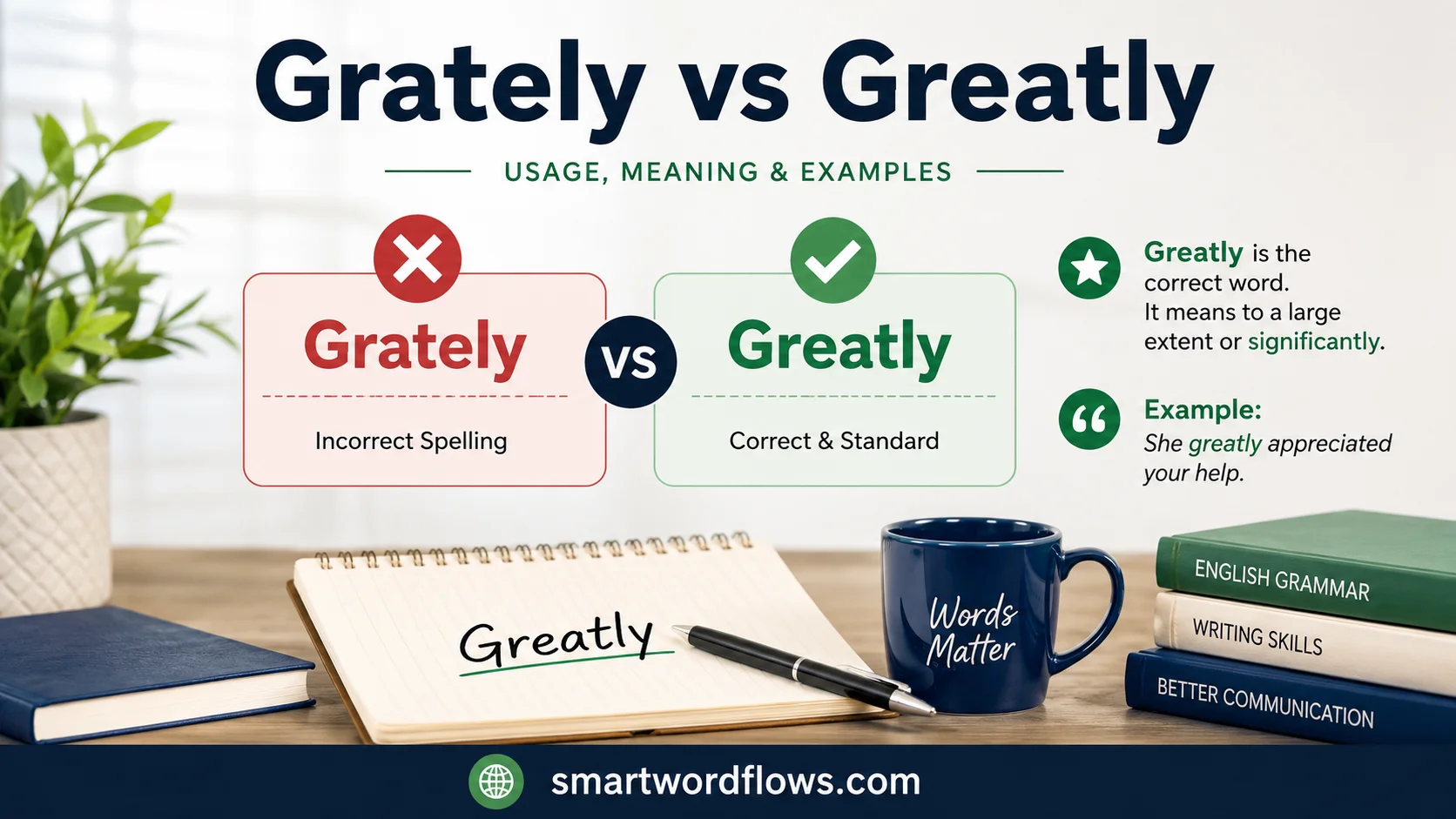

Grately vs Greatly is a common English spelling confusion. While both forms may look similar, only Greatly is correct in standard English. It means to a large extent or degree and is commonly used to describe something that happens significantly or considerably. Grately is an incorrect spelling and should be avoided in formal writing, academic work, emails, and everyday communication. Knowing this simple difference will help you write more confidently.
Many English learners confuse these words because they sound and look quite similar. However, Greatly is the proper word to use whenever you want to express a high degree or significant amount. For example, “Your help is greatly appreciated” is correct. Remembering the correct spelling can prevent common writing mistakes and make your sentences more clear, accurate, and professional.
Quick Answer
Greatly is the correct English word. It is an adverb that means to a large extent, very much, or considerably.
Grately is not a recognized English word. It appears because of a typing mistake, spelling confusion, or misunderstanding of English word formation.
Correct Examples
- I greatly appreciate your help.
- The new policy greatly improved customer satisfaction.
- Her confidence greatly increased after the training.
Incorrect Examples
- I grately appreciate your help.
- The project was grately successful.
- Your advice grately helped me.
If you’re writing in English, always choose “greatly.”
Comparison Overview
| Feature | Grately | Greatly |
| Is it a real English word? | No | Yes |
| Dictionary recognized | No | Yes |
| Part of speech | None | Adverb |
| Correct spelling | No | Yes |
| Used in formal writing | Never | Frequently |
| Used in business communication | No | Yes |
| Used in academic writing | No | Yes |
| Common cause | Typo or misspelling | Correct English usage |
| Meaning | None | To a large degree or considerably |
Key takeaway: If you see grately, treat it as a spelling mistake. Replace it with greatly before publishing or sending your writing.
Main Differences Between Grately vs Greatly
At first glance, grately and greatly appear almost identical. The only visible difference is the placement of a single letter. Despite that small change, their meanings and usage differ completely.
Greatly Is a Valid English Adverb
The word greatly comes from the adjective great with the suffix -ly, which turns many adjectives into adverbs.
Examples include:
- Great → Greatly
- Quick → Quickly
- Easy → Easily
- Slow → Slowly
- Happy → Happily
Because greatly is an adverb, it modifies verbs, adjectives, or other adverbs.
Example:
The software greatly improved productivity.
Here, greatly tells us the extent to which productivity improved.
Grately Is Simply a Misspelling
Unlike greatly, grately has no accepted meaning in modern English.
It does not appear as a standard entry in respected dictionaries, including:
- Merriam-Webster
- Cambridge Dictionary
- Oxford English Dictionary
- Collins Dictionary
If you type grately, most spell-checking tools will automatically suggest greatly.
One Letter Can Affect Your Credibility
Readers often judge professionalism based on spelling accuracy. A small mistake like grately may seem minor, yet it can create a poor first impression.
Imagine receiving these emails.
Correct
We greatly appreciate your continued support.
Incorrect
We grately appreciate your continued support.
The second sentence looks careless, even though the intended meaning is obvious.
Quick Difference Summary
| Point | Greatly | Grately |
| Correct English | ||
| Has meaning | Yes | No |
| Appears in dictionaries | Yes | No |
| Acceptable in exams | Yes | No |
| Professional writing | Yes | Never |
What Does “Greatly” Mean?
The word greatly means to a large extent, very much, considerably, or significantly. It emphasizes the degree or intensity of an action, change, or feeling.
Definition
Greatly (adverb):
To a very large degree or extent.
It answers questions such as:
- How much?
- To what extent?
- How strongly?
Origin of the Word “Greatly”
The word comes from the adjective great, which has existed in English for centuries.
When English speakers add -ly to an adjective, they often create an adverb that describes how an action happens.
Examples include:
| Adjective | Adverb |
| Great | Greatly |
| Slow | Slowly |
| Happy | Happily |
| Quiet | Quietly |
| Careful | Carefully |
This pattern makes greatly both logical and grammatically correct.
Common Meanings of Greatly
Depending on context, greatly can express different shades of meaning.
To a Large Degree
The population greatly increased over the last decade.
Very Much
We greatly admire her dedication.
Considerably
The renovation greatly improved the appearance of the building.
Significantly
Better communication greatly reduced workplace conflicts.
Although the wording changes slightly, the core idea remains the same: something happened to a substantial extent.
Common Contexts Where “Greatly” Appears
You’ll often encounter greatly in professional and formal writing because it sounds precise and polished.
Business
- greatly appreciated
- greatly increased
- greatly reduced
- greatly improved
Example:
Customer satisfaction greatly improved after the redesign.
Academic Writing
Researchers frequently use greatly when discussing measurable results.
Example:
Temperature greatly influenced plant growth.
Professional Emails
Example:
Your assistance is greatly appreciated.
News Reports
Example:
Rising fuel prices greatly affected transportation costs.
Everyday Conversation
People also use greatly in casual speech.
Examples:
- I greatly enjoyed the movie.
- She greatly values honesty.
- We greatly miss our grandparents.
Is “Grately” a Real Word?
The simple answer is no.
Grately is not a standard English word. It has no accepted definition, grammatical function, or official usage in modern English.
Although many people accidentally type grately, dictionaries and grammar guides recognize it only as a misspelling of greatly.
Why Do People Write “Grately”?
Several factors contribute to this common mistake.
Fast Typing
Many spelling errors happen because fingers move faster than the brain.
Example:
Typing
grately
instead of
greatly
takes only one misplaced letter.
Pronunciation Confusion
When spoken quickly, the middle sounds of greatly can blend together.
Some learners hear:
grate-lee
instead of
great-lee
As a result, they write the word based on what they hear.
Lack of Familiarity
English contains many irregular spelling patterns.
Compare these words:
- grateful
- greatly
- graceful
- gratefully
Because several related words share similar beginnings, it’s easy to mix their spellings.
Autocorrect Limitations
Most modern devices catch grately.
However, spell-check doesn’t always activate immediately, especially when:
- typing quickly
- writing offline
- using older software
- entering text into certain forms
That makes proofreading essential.
Is “Grately” Ever Acceptable?
Only in very limited situations, such as:
- quoting someone’s original spelling mistake
- discussing common grammar errors
- teaching English spelling
Otherwise, never use grately in formal or informal writing.
Read More: Dysregulated vs Disregulated: Correct Usage Explained
Grately vs Greatly: Detailed Comparison Table
| Category | Grately | Greatly |
| English word | No | Yes |
| Correct spelling | No | Yes |
| Dictionary listing | No | Yes |
| Part of speech | None | Adverb |
| Meaning | None | To a large extent |
| Grammar status | Incorrect | Correct |
| Used in essays | No | Yes |
| Used in emails | No | Yes |
| Used in reports | No | Yes |
| Suitable for exams | No | Yes |
| Common appearance | Typo | Standard English |
| Recommended usage | Never | Always |
How to Use “Greatly” Correctly
Understanding where greatly belongs in a sentence makes your writing more natural and accurate. Since it is an adverb, its primary job is to modify verbs, adjectives, or sometimes participles by showing the degree or extent of an action or condition.
Using “Greatly” Before a Verb
One of the most common patterns places greatly directly before the main verb.
Examples:
- The updated software greatly improved performance.
- Better planning greatly reduced project delays.
- Regular exercise greatly benefits heart health.
- Honest communication greatly strengthens relationships.
In each example, greatly emphasizes how much the action occurred.
Using “Greatly” After Helping Verbs
When a sentence includes a helping verb such as has, have, had, was, were, is, or will, greatly usually comes after the helping verb and before the main verb.
Examples:
- Customer satisfaction has greatly improved this year.
- The company was greatly affected by supply chain issues.
- Your support will greatly help our team.
- The design has greatly evolved over the past decade.
This structure is common in business reports, news articles, and academic writing because it sounds clear and professional.
Using “Greatly” in Expressions
Some combinations appear so often that they have become standard English expressions.
Common examples include:
- greatly appreciated
- greatly respected
- greatly admired
- greatly valued
- greatly missed
- greatly improved
- greatly increased
- greatly reduced
- greatly influenced
- greatly enhanced
These collocations sound natural because native speakers use them regularly in both formal and everyday communication.
Examples of “Greatly” in Sentences
One of the easiest ways to master greatly is to see it used in real-life situations. The examples below show how the word naturally fits into professional, academic, business, and everyday English.
Professional Examples
Professionals often use greatly to express appreciation, improvement, or significant impact.
- We greatly appreciate your continued support.
- Your feedback greatly helped improve our services.
- The new workflow greatly increased team productivity.
- Employee training greatly reduced workplace errors.
- Your contribution is greatly valued by the organization.
Academic Examples
In academic writing, greatly emphasizes measurable changes or research findings.
- Climate change has greatly affected coastal ecosystems.
- The experiment greatly improved the accuracy of the results.
- Early education greatly influences language development.
- Technology has greatly transformed modern classrooms.
- Sleep quality greatly impacts cognitive performance.
Business Examples
Businesses frequently use greatly in reports, presentations, and client communication.
- Customer satisfaction greatly improved after the website redesign.
- Automation greatly reduced operating costs.
- Sales greatly exceeded expectations during the holiday season.
- The marketing campaign greatly increased brand awareness.
- Better inventory management greatly minimized product shortages.
Everyday Conversation Examples
Although greatly sounds slightly formal, people still use it in everyday speech.
- I greatly enjoyed the concert.
- She greatly admires her grandmother.
- We greatly miss our hometown.
- They greatly benefited from the workshop.
- He greatly regrets his decision.
Email Examples
Business emails often include greatly because it conveys appreciation without sounding exaggerated.
Example 1
Thank you for your quick response. Your assistance is greatly appreciated.
Example 2
We greatly value your partnership and look forward to working with you again.
Example 3
Your suggestions have greatly improved the final proposal.
Why People Misspell “Greatly” as “Grately”
At first glance, grately seems like a reasonable spelling. After all, English contains many words with similar letter patterns. However, several factors explain why this mistake appears so often.
Pronunciation Confusion
Some speakers pronounce greatly so quickly that the t and l blend together. As a result, learners sometimes spell the word exactly as they hear it.
Similar Words
English includes many words that begin with grat- or great-, such as:
- grateful
- gratitude
- grate
- greatly
Because these words resemble one another, it’s easy to confuse their spelling.
Typing Quickly
Typing at high speed increases the chance of dropping or replacing letters. Even experienced writers occasionally type grately before correcting it.
Lack of Proofreading
A single spelling mistake can survive multiple revisions if the writer relies only on their eyes instead of using spell-check or reading the text aloud.
English Spelling Isn’t Always Predictable
English borrows words from many languages, which creates inconsistent spelling patterns. That’s why careful proofreading remains important, even for fluent speakers.
Did You Know? According to studies on writing accuracy, spelling errors are among the most common reasons readers perceive written communication as less professional, even when the overall message is clear.
Common Grammar Mistakes Related to “Greatly”
Confusing grately with greatly is only one of several common mistakes. Here are other errors writers frequently make.
Grately vs Greatly
- We grately appreciate your support.
- We greatly appreciate your support.
Greatful vs Grateful
Many people assume greatful relates to the word great, but the correct spelling comes from grate plus -ful.
- I am greatful.
- I am grateful.
Greatfull vs Grateful
Adding two “l” letters creates another incorrect spelling.
- greatfull
- grateful
Greatly vs Highly
Both words express degree, but they aren’t always interchangeable.
| Greatly | Highly |
| greatly appreciated | highly appreciated (less common) |
| greatly improved | highly improved |
| greatly reduced | highly reduced |
| highly recommended | greatly recommended (less natural) |
| highly qualified | greatly qualified |
Choose the word that native speakers naturally use with a particular expression.
Greatly vs Significantly
Both adverbs describe a large degree of change, but they suit different contexts.
Greatly often sounds more natural in everyday writing.
The update greatly improved performance.
Significantly is common in scientific, statistical, and research writing.
The treatment significantly reduced symptoms.
Words Commonly Used with “Greatly” (Collocations)
A collocation is a pair or group of words that naturally occur together. Learning common collocations helps your English sound more fluent and idiomatic.
| Collocation | Meaning | Example |
| greatly appreciated | sincerely valued | Your help is greatly appreciated. |
| greatly improved | became much better | Sales greatly improved this quarter. |
| greatly reduced | lowered considerably | Costs were greatly reduced. |
| greatly increased | rose substantially | Production greatly increased. |
| greatly affected | influenced strongly | The storm greatly affected travel. |
| greatly influenced | shaped significantly | Her mentor greatly influenced her career. |
| greatly admired | respected deeply | She is greatly admired by her colleagues. |
| greatly benefited | gained major advantages | Students greatly benefited from tutoring. |
| greatly valued | considered important | Your opinion is greatly valued. |
| greatly enhanced | improved noticeably | The update greatly enhanced security. |
| greatly exceeded | surpassed expectations | Profits greatly exceeded forecasts. |
| greatly contributed | played a major role | Volunteers greatly contributed to the project. |
Why Collocations Matter
Native English speakers don’t choose words randomly. Certain combinations simply sound more natural because they appear together frequently.
For example:
- greatly appreciated
- greatly admired
- greatly respected
These phrases appear regularly in books, newspapers, business correspondence, and professional communication.
Synonyms of “Greatly”
Although greatly is versatile, repeating it too often can make your writing feel monotonous. Choosing the right synonym adds variety while keeping your meaning clear.
| Synonym | Meaning | Best Used In | Example |
| significantly | noticeably | Research | Profits significantly increased. |
| considerably | by a large amount | Business | Expenses considerably declined. |
| substantially | to a great extent | Formal writing | Revenue substantially improved. |
| immensely | extremely | Informal and formal | She immensely enjoyed the trip. |
| enormously | very much | Conversation | The update enormously helped productivity. |
| profoundly | deeply | Emotional or academic writing | The experience profoundly changed him. |
| remarkably | unusually | Reports | Results remarkably improved. |
| exceptionally | unusually | Professional writing | The team performed exceptionally well. |
| highly | to a high degree | Recommendations | This book is highly recommended. |
| extensively | widely | Research | The topic has been extensively studied. |
| vastly | by a very large amount | Comparisons | Technology has vastly improved communication. |
| dramatically | suddenly and significantly | News | Prices dramatically increased. |
Choosing the Right Synonym
While these words share similar meanings, they aren’t perfect substitutes.
Compare the following:
- The software greatly improved performance.
- The software significantly improved performance.
- The software dramatically improved performance.
Each sentence is correct, yet the tone changes slightly. Greatly feels balanced and neutral, significantly sounds more analytical, and dramatically suggests a striking change.
When You Should Not Use “Greatly”
Even though greatly is useful, it isn’t always the strongest choice.
When Another Adverb Fits Better
Instead of writing:
The product greatly exceeded expectations.
You could write:
The product far exceeded expectations.
The revised version is shorter and more vivid.
When the Verb Already Implies Intensity
Some verbs naturally express a strong degree of change.
Instead of:
Prices greatly skyrocketed.
Use:
Prices skyrocketed.
Adding greatly becomes redundant because skyrocketed already implies a dramatic increase.
Avoid Overusing “Greatly”
Repeating the same adverb throughout an article weakens your writing.
Instead of this:
- greatly improved
- greatly increased
- greatly helped
- greatly benefited
- greatly influenced
Mix in alternatives such as:
- significantly
- considerably
- substantially
- remarkably
- profoundly
Doing so keeps your writing engaging and varied.
Greatly in Formal vs Informal English
Academic Writing
Researchers often use greatly when discussing findings, experiments, and measurable outcomes.
Example:
Improved nutrition greatly enhanced student performance.
Business Writing
Companies use greatly to express appreciation, describe performance, and explain results.
Examples include:
- greatly appreciated
- greatly valued
- greatly improved
- greatly reduced
Professional Emails
The phrase “greatly appreciated” remains one of the most common expressions in workplace communication because it is polite without sounding overly emotional.
Example:
Your prompt response would be greatly appreciated.
Everyday Speech
People use greatly less often in casual conversation, where simpler words such as really, a lot, or so much may sound more natural.
For example:
Formal:
I greatly enjoyed the event.
Casual:
I really enjoyed the event.
Both are correct. The best choice depends on your audience and the tone you want to create.
Here is the FAQ section and conclusion in a clean, ready-to-use format:
FAQs :
1. Is “Grately” a correct word?
No, Grately is not correct in standard English. The correct spelling is Greatly, which is used to show something happening to a large degree.
2. What does “Greatly” mean?
Greatly means very much, to a large extent, or in a strong way. It is often used to express gratitude, importance, or a high level of impact.
3. Why do people confuse “Grately” and “Greatly”?
People confuse them because the words look and sound similar. Fast typing, autocorrect, and spelling habits can also cause this common mistake.
4. Can I use “Grately” in formal writing?
No, you should not use Grately in formal writing. Always use Greatly because it is the correct and professional spelling.
5. How can I remember the correct spelling?
A simple trick is to connect Greatly with great. Since the word means something large or strong, Greatly is the right form to use.
Conclusion :
The difference between Grately vs Greatly is simple, but it matters. Grately is incorrect, while Greatly is the proper spelling in English. It means to a large extent or degree and is widely used in everyday writing. Once you remember this rule, you can avoid a common mistake and write with more confidence and clarity.