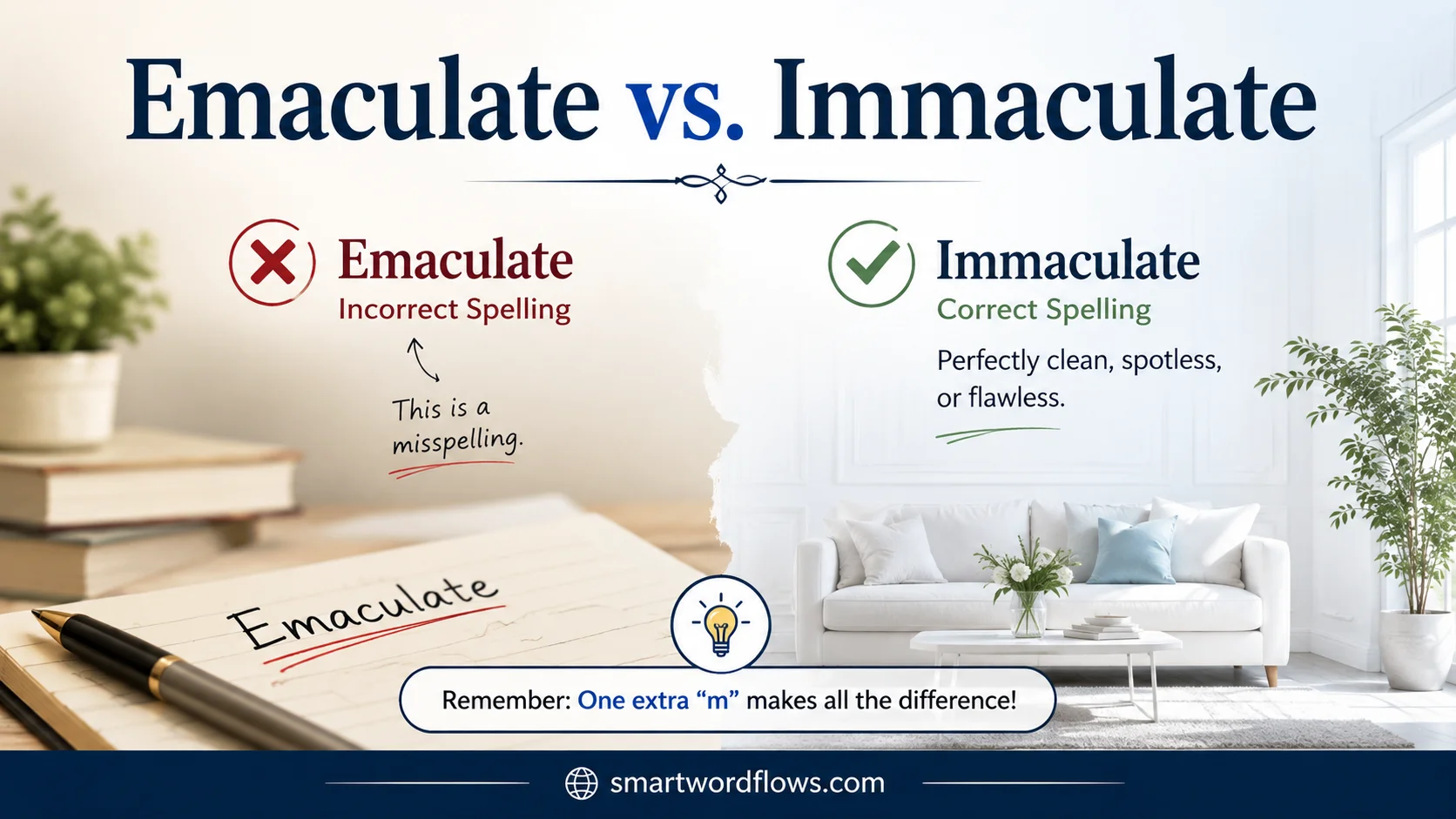

Confused about Emaculate vs. Immaculate? You’re not alone. Many people mix up these similar-sounding words. The correct spelling is immaculate, which means perfectly clean, flawless, or pure. Emaculate is generally considered a spelling mistake rather than a standard English word. Learning this simple difference can help you avoid common spelling mistakes and make your writing clearer and more accurate.
If you’ve ever searched for emaculate meaning or wondered, “Is it immaculate or emaculate?” the answer is straightforward. Immaculate is the word you should use in both formal and casual writing. It can describe something spotless, perfect, or free from faults. Understanding its meaning and correct usage will help you communicate with greater confidence, improve your English writing, and avoid confusion caused by pronunciation or typing errors.
Emaculate vs. Immaculate: Quick Answer
When comparing emaculate vs. immaculate, the answer is straightforward.
| Word | Standard English Spelling? | Meaning |
| Immaculate | Yes | Perfectly clean, spotless, pure, or without flaws |
| Emaculate | No, generally a misspelling | Usually intended to mean immaculate |
If you’re describing something as exceptionally clean or flawless, write immaculate.
Correct Examples
- The hotel room was immaculate.
- He keeps his classic car in immaculate condition.
- She delivered an immaculate performance.
- The white shirt remained immaculate despite the long journey.
Incorrect Example
- The hotel room was emaculate.
The problem with emaculate is simple: it isn’t the standard spelling of the adjective most people intend to use. In ordinary modern English, the correct word is immaculate.
What Does Immaculate Mean?
Immaculate is an adjective with several closely related meanings. At its core, the word describes something that is free from dirt, stains, imperfections, or faults.
However, its exact meaning depends on the context.
The word commonly describes:
- Something extremely clean
- Something spotless
- Something flawless
- Something perfectly maintained
- Something pure or without blemish
Let’s look at each meaning more closely.
Immaculate Meaning: Extremely Clean or Spotless
The most common everyday meaning of immaculate relates to cleanliness.
When you call a room, house, car, or office immaculate, you’re saying it’s exceptionally clean and tidy. You aren’t merely saying that someone wiped the floor or put away a few things. You’re suggesting that the entire space looks almost perfectly maintained.
For example:
The kitchen was immaculate, with every surface clean and every item neatly arranged.
Here, immaculate means extremely clean and orderly.
You might also hear:
- an immaculate house
- an immaculate bedroom
- an immaculate kitchen
- an immaculate bathroom
- an immaculate office
- an immaculate car
Example
Imagine walking into two bedrooms.
The first has clean floors but clothes scattered across the bed and books stacked randomly on the desk.
The second has spotless floors, neatly arranged furniture, clean windows, and everything in its proper place.
You could describe the second room as immaculate.
That’s the difference between simply being clean and appearing immaculate.
Immaculate Meaning: Perfect or Without Flaws
The word can also describe something that is flawless or exceptionally well executed.
In this sense, immaculate doesn’t necessarily have anything to do with physical cleanliness.
For example:
The surgeon’s technique was immaculate.
The team delivered an immaculate performance.
His timing was immaculate throughout the competition.
In these examples, the word suggests an unusually high level of precision or perfection.
This usage is common when describing:
- Performances
- Skills
- Techniques
- Timing
- Execution
- Records
- Work quality
For instance, if a football player makes a series of perfectly timed passes, someone might describe the player’s passing as immaculate.
The idea is similar to saying, “There were no noticeable mistakes.”
Immaculate Meaning: Pure or Without Blemish
Immaculate also carries a more formal meaning associated with purity or freedom from moral or spiritual fault.
This sense appears more often in religious or literary contexts than in casual conversation.
For example:
The painting portrays the figure as immaculate and pure.
In religious language, the word has a particularly important role in the phrase Immaculate Conception, which refers to a specific Catholic doctrine concerning the conception of Mary. It does not refer to the conception of Jesus.
That’s an important distinction because people sometimes misunderstand the phrase.
The adjective itself, however, still carries the broader idea of being without stain or blemish.
Immaculate Meaning: Perfectly Maintained
Another common use describes something that has been kept in excellent condition.
Consider the sentence:
The collector’s 1967 Mustang remains in immaculate condition.
Here, the word suggests more than cleanliness. It implies that the vehicle has been carefully preserved and shows little or no visible deterioration.
You might describe these things as being in immaculate condition:
- Classic cars
- Vintage watches
- Collectible items
- Antique furniture
- Designer clothing
- Historic buildings
- Expensive electronics
The phrase “in immaculate condition” is especially common in product descriptions and collectible markets.
Why Is “Emaculate” Incorrect?
The main reason emaculate causes confusion is that English spelling doesn’t always follow pronunciation perfectly.
When people hear immaculate, they may not immediately recognize that the word begins with “im-.” As a result, they sometimes write what sounds like “emaculate.”
However, the standard spelling is:
I-M-M-A-C-U-L-A-T-E
Not:
E-M-A-C-U-L-A-T-E
The correct word contains two m’s at the beginning:
IMMACULATE
A useful way to remember it is to focus on the opening:
IM + MACULATE
The spelling starts with im, not em.
Correct
The room was immaculate.
Incorrect
The room was emaculate.
If you’re writing for school, work, a website, or a professional audience, always choose immaculate.
Why Do People Spell Immaculate as “Emaculate”?
The emaculate vs. immaculate confusion has several likely causes.
Pronunciation Can Be Misleading
English contains many words whose spelling isn’t obvious from their pronunciation.
When someone hears immaculate without seeing it written, they may mentally reconstruct the spelling incorrectly.
This happens frequently with unfamiliar vocabulary.
For example, someone may know what a word means and pronounce it correctly while still spelling it incorrectly. That’s not unusual. English has plenty of spelling traps.
People Often Spell Words by Sound
A learner who hears the beginning of immaculate may think it sounds closer to “em” than “im.”
That can lead to the incorrect spelling emaculate.
This is especially common when someone has encountered the word in conversation but hasn’t read it frequently.
English Uses Both “Im-” and “Em-”
The prefixes im- and em- appear in many English words.
For example:
- Immature
- Immobile
- Impossible
- Impatient
- Embrace
- Embark
- Empower
- Embrace
Because both patterns exist, it’s easy to assume that emaculate might also be a valid spelling.
In this particular case, however, immaculate is the standard form.
Fast Typing Creates Mistakes
Sometimes the explanation is much simpler: it’s just a typo.
People make spelling errors when they’re:
- Typing quickly
- Writing from memory
- Using autocorrect
- Posting on social media
- Messaging on a phone
- Writing unfamiliar words
A single incorrect letter can quickly spread online. Once people repeatedly see a misspelling, it can start to look legitimate.
That’s why it’s useful to verify unfamiliar words rather than relying solely on what appears in casual online writing.
How to Pronounce Immaculate
The pronunciation of immaculate can vary slightly depending on accent, but an easy approximation is:
im-MAK-yuh-lut
The main stress falls on the “MAK” sound.
The word has four syllables:
im – mac – u – late
In natural speech, however, the final syllables may sound more like “yuh-lut” rather than a fully pronounced “you-late.”
The important point is that the word begins with an “im” sound.
That pronunciation may help reinforce the correct spelling:
IMmaculate
Not:
EMaculate
Still, pronunciation alone isn’t a perfect spelling guide. English pronunciation and spelling often refuse to play by the same rulebook.
How to Spell Immaculate Correctly
The correct spelling is:
I-M-M-A-C-U-L-A-T-E
A simple memory trick is:
Immaculate has two m’s and no mess.
Think of the word’s meaning. If something is immaculate, it’s clean, flawless, or without blemish.
You can also break the spelling into parts:
IM + MACULATE
The most important thing to remember is the beginning:
IMMA…
Not:
EMA…
Quick Spelling Check
If you’re unsure whether to write emaculate or immaculate, ask yourself:
Am I describing something spotless, flawless, or perfectly maintained?
If yes, the word you want is almost certainly:
Immaculate
Immaculate vs. Emaculate: Example Sentences
Seeing the word in real sentences makes the difference easier to remember.
Cleanliness
The hotel room was immaculate when we arrived.
Here, immaculate means extremely clean and tidy.
Personal Appearance
He arrived at the interview in an immaculate suit.
The suit looked exceptionally clean, neat, and well maintained.
Car Condition
The collector keeps his vintage Porsche in immaculate condition.
The car has been carefully preserved and remains in excellent condition.
Performance
The pianist gave an immaculate performance.
The performance was exceptionally precise and seemingly free of mistakes.
Work Quality
Her attention to detail was immaculate.
This suggests an unusually high level of precision and care.
Organization
His desk is always immaculate.
The desk is clean, orderly, and well arranged.
Appearance
The garden looked immaculate after weeks of careful maintenance.
The garden appeared exceptionally neat and well cared for.
Common Phrases With Immaculate
Some combinations with immaculate occur much more naturally than others.
Here are several useful phrases.
| Phrase | Meaning | Example |
| Immaculate condition | Extremely well preserved | The watch is in immaculate condition. |
| Immaculate appearance | Exceptionally neat or flawless appearance | She maintained an immaculate appearance. |
| Immaculate performance | A performance with exceptional execution | The athlete delivered an immaculate performance. |
| Immaculate record | A record without losses, mistakes, or violations | The fighter has an immaculate professional record. |
| Immaculate cleanliness | Extremely high level of cleanliness | The restaurant was known for its immaculate cleanliness. |
| Immaculate conception | A specific Catholic theological doctrine | The Immaculate Conception is a central Catholic doctrine. |
The phrase “immaculate condition” is particularly common.
For example, someone selling a vintage watch might write:
The watch remains in immaculate condition and shows minimal signs of wear.
In that sentence, the word communicates both cleanliness and preservation.
Read This: Emersion vs Immersion: Differences, Meaning, and Correct Usage
Is Immaculate an Adjective?
Yes. Immaculate is an adjective.
An adjective describes or modifies a noun.
For example:
- An immaculate room
- An immaculate car
- An immaculate suit
- An immaculate performance
- An immaculate record
In each case, immaculate tells you something about the noun.
Consider:
The room was immaculate.
Here, immaculate describes the condition of the room.
You can also place it directly before the noun:
We entered an immaculate room.
Both sentence structures are grammatically correct.
Immaculate Synonyms
The best synonym depends on what you mean by immaculate.
Although words such as spotless, pristine, and flawless overlap with immaculate, they aren’t always perfect substitutes.
Synonyms for Immaculate Meaning “Very Clean”
- Spotless
- Pristine
- Clean
- Tidy
- Spick-and-span
Example:
The kitchen was spotless.
This focuses strongly on cleanliness.
Synonyms for Immaculate Meaning “Without Fault”
- Flawless
- Perfect
- Impeccable
- Exemplary
- Unblemished
Example:
She gave a flawless performance.
This focuses on the absence of mistakes.
Synonyms for Immaculate Meaning “Pure”
- Pure
- Untainted
- Unblemished
- Unsullied
These words work better in formal, literary, or religious contexts.
Immaculate vs. Impeccable
The words immaculate and impeccable are close in meaning, but they aren’t identical.
Immaculate often emphasizes cleanliness, purity, or a lack of visible flaws.
Impeccable usually emphasizes exceptionally high standards or faultless quality.
Compare These Examples
His apartment was immaculate.
This means the apartment was extremely clean and orderly.
His manners were impeccable.
This means his behavior was exceptionally polite and proper.
You could sometimes use either word when discussing performance:
She delivered an immaculate performance.
She delivered an impeccable performance.
Both suggest outstanding quality. However, impeccable often sounds more natural when discussing standards, judgment, manners, or conduct.
Immaculate vs. Pristine
Pristine usually suggests something that is fresh, original, untouched, or in excellent condition.
Immaculate emphasizes being spotless, flawless, or free from blemishes.
For example:
The beach remained pristine.
This suggests the beach is clean, natural, and relatively untouched.
The hotel bathroom was immaculate.
This emphasizes exceptional cleanliness.
The two words overlap, but their focus differs.
Simple Difference
- Immaculate: Spotless or flawless
- Pristine: Fresh, untouched, or perfectly preserved
Immaculate vs. Spotless
These two words are often interchangeable when talking about cleanliness.
The house was immaculate.
The house was spotless.
Both sentences suggest the house was extremely clean.
However, immaculate has a broader range of meanings. It can describe performance, appearance, condition, purity, or records.
Spotless tends to focus more directly on cleanliness.
For example:
He has a spotless criminal record.
This means there are no offenses on his record.
You could also say:
The room was spotless.
But saying “The performance was spotless” isn’t as natural as “The performance was immaculate.”
Immaculate vs. Flawless
Flawless means without defects, errors, or imperfections.
Immaculate can mean the same thing, but it also carries stronger associations with cleanliness and purity.
Compare:
She has flawless skin.
This means her skin appears free of imperfections.
Her bedroom is immaculate.
This suggests the room is exceptionally clean and orderly.
You might describe both a performance and a room as immaculate. The word flawless is more directly connected to the absence of defects or mistakes.
The Origin of the Word Immaculate
The history of immaculate helps explain why the word carries meanings related to stains, purity, and perfection.
The word comes through Latin immaculatus, meaning “unspotted” or “undefiled.”
The Latin root connects to the idea of a macula, meaning a spot, stain, or blemish.
That history makes the modern meaning easier to understand.
Think of the word this way:
No macula = no stain or blemish.
Over time, the meaning developed beyond physical stains. Today, immaculate can describe something that is:
- Spotlessly clean
- Free from defects
- Exceptionally maintained
- Pure
- Flawless
The underlying idea remains remarkably consistent: nothing undesirable has marred it.
Is “Emaculate” Ever Correct?
In ordinary modern English, if you mean spotless, flawless, or pure, use immaculate.
The spelling emaculate is generally treated as an error when someone intends to write immaculate.
Therefore, if you’re writing a sentence such as:
The house was emaculate.
Change it to:
The house was immaculate.
The same applies to:
The car is in emaculate condition.
The correct version is:
The car is in immaculate condition.
For everyday writing, there’s no reason to choose emaculate when immaculate is the established standard spelling.
Common Spelling Mistakes With Immaculate
The most common mistake is replacing im- with em-.
Incorrect
Emaculate
Correct
Immaculate
Another common issue involves dropping one of the two opening m’s.
Incorrect
Imaculate
Correct
Immaculate
The correct spelling begins:
IMMA…
That’s two m’s.
Spelling Breakdown
I + M + M + A + C + U + L + A + T + E
A quick visual memory trick:
IMMAculate
If you remember “IMMA”, the rest of the word becomes much easier to reconstruct.
A Simple Case Study: Choosing the Right Word
Imagine you’re writing a review of a luxury hotel.
You want to describe the room. Which sentence sounds correct?
The hotel room was emaculate.
Or:
The hotel room was immaculate.
The second sentence is correct.
Now imagine you want to describe the hotel’s service:
The staff provided impeccable service.
Here, impeccable may be a better choice because you’re emphasizing extremely high standards.
Finally, suppose you’re describing the natural surroundings:
The private beach remained pristine.
Here, pristine works well because you’re emphasizing the untouched, fresh condition of the environment.
This small example shows why understanding related words matters. The goal isn’t simply to find a synonym. It’s to choose the word that fits the exact meaning you want.
Immaculate in Different Contexts
The word becomes easier to understand when you see how its meaning shifts slightly depending on context.
Home and Cleaning
The living room was immaculate.
Meaning: The room was extremely clean and orderly.
Fashion
He appeared in an immaculate tuxedo.
Meaning: The tuxedo looked exceptionally neat and well maintained.
Sports
The goalkeeper produced an immaculate performance.
Meaning: The performance was extremely precise and impressive.
Collectibles
The coin remains in immaculate condition.
Meaning: The coin has been exceptionally well preserved.
Personal Conduct
She maintained an immaculate professional record.
Meaning: Her record remained free from faults or violations.
Religious Context
The Immaculate Conception is a specific Catholic doctrine.
Meaning: The word carries its formal theological sense of purity and freedom from original sin.
Context matters. The same adjective can paint different pictures while retaining its central idea of being free from blemish.
What Is the Opposite of Immaculate?
The opposite of immaculate depends on the context.
When talking about cleanliness, possible opposites include:
- Dirty
- Filthy
- Messy
- Stained
- Untidy
When discussing quality, possible opposites include:
- Flawed
- Imperfect
- Defective
- Faulty
When discussing purity, possible opposites include:
- Tainted
- Polluted
- Stained
- Corrupt
For example:
The room was immaculate.
Opposite:
The room was filthy.
But:
Her performance was immaculate.
Opposite:
Her performance was flawed.
The right antonym depends on what immaculate means in the sentence.
Is Immaculate a Positive Word?
Yes. Immaculate generally has a strongly positive meaning.
When you describe something as immaculate, you’re usually praising its:
- Cleanliness
- Appearance
- Quality
- Condition
- Precision
- Purity
For example:
Your presentation was immaculate.
That’s a compliment.
Your car is immaculate.
That’s also a compliment.
The house looks immaculate.
Again, you’re praising its condition and appearance.
The word can sometimes sound formal or slightly stronger than necessary. If a friend asks whether their room is clean, saying “It’s immaculate” suggests more than ordinary cleanliness.
It’s like saying:
“It looks absolutely spotless.”
Can You Say “Immaculate Condition”?
Yes. “Immaculate condition” is a natural and widely understood phrase.
It usually means that something is in exceptionally good condition, with little evidence of damage, wear, dirt, or deterioration.
Examples include:
- The vintage watch is in immaculate condition.
- The collector purchased a car in immaculate condition.
- The book survived for decades in immaculate condition.
However, context matters when using the phrase in advertising or sales.
For example, a seller might describe a used product as being in immaculate condition. Buyers should still inspect the actual item rather than relying solely on descriptive language.
The phrase is powerful because it sets a very high standard. Immaculate suggests more than simply good or clean.
How to Remember Immaculate
If you regularly confuse emaculate vs. immaculate, use this simple memory trick:
Immaculate has two m’s and no mess.
Think about the meaning and spelling together.
IMMACULATE
- Starts with IM
- Contains MM
- Describes something without stains or flaws
You can also remember the phrase:
“IMMACULATE means no marks.”
The connection isn’t a formal spelling rule, but it gives your brain a useful hook.
Another practical method is to memorize one familiar phrase:
Immaculate condition
Once you recognize that phrase, you’ll start seeing the correct spelling in other contexts.
FAQs:
1. Is “emaculate” a correct English word?
No. Emaculate is generally considered an incorrect spelling. The correct word is immaculate.
2. What does “immaculate” mean?
Immaculate means perfectly clean, spotless, flawless, or free from mistakes and imperfections.
3. Is it “immaculate or emaculate”?
The correct spelling is immaculate. You should use this word when describing something that is exceptionally clean, pure, or perfect.
4. Why do people spell immaculate as emaculate?
People often write emaculate because the two words may sound similar when spoken quickly. Typing mistakes and pronunciation habits can also cause confusion.
5. How can I remember the correct spelling of immaculate?
A simple way to remember it is to focus on the beginning: IM + MACULATE = IMMACULATE. Remembering the “im” at the start can help you avoid the common spelling error.
Conclusion:
The difference between emaculate vs. immaculate is simple once you know the correct spelling. Immaculate is the standard English word used to describe something perfectly clean, flawless, pure, or without imperfections. Emaculate is a common spelling mistake and should be avoided in your writing. By remembering the correct spelling and meaning of immaculate, you can write more clearly, confidently, and accurately.