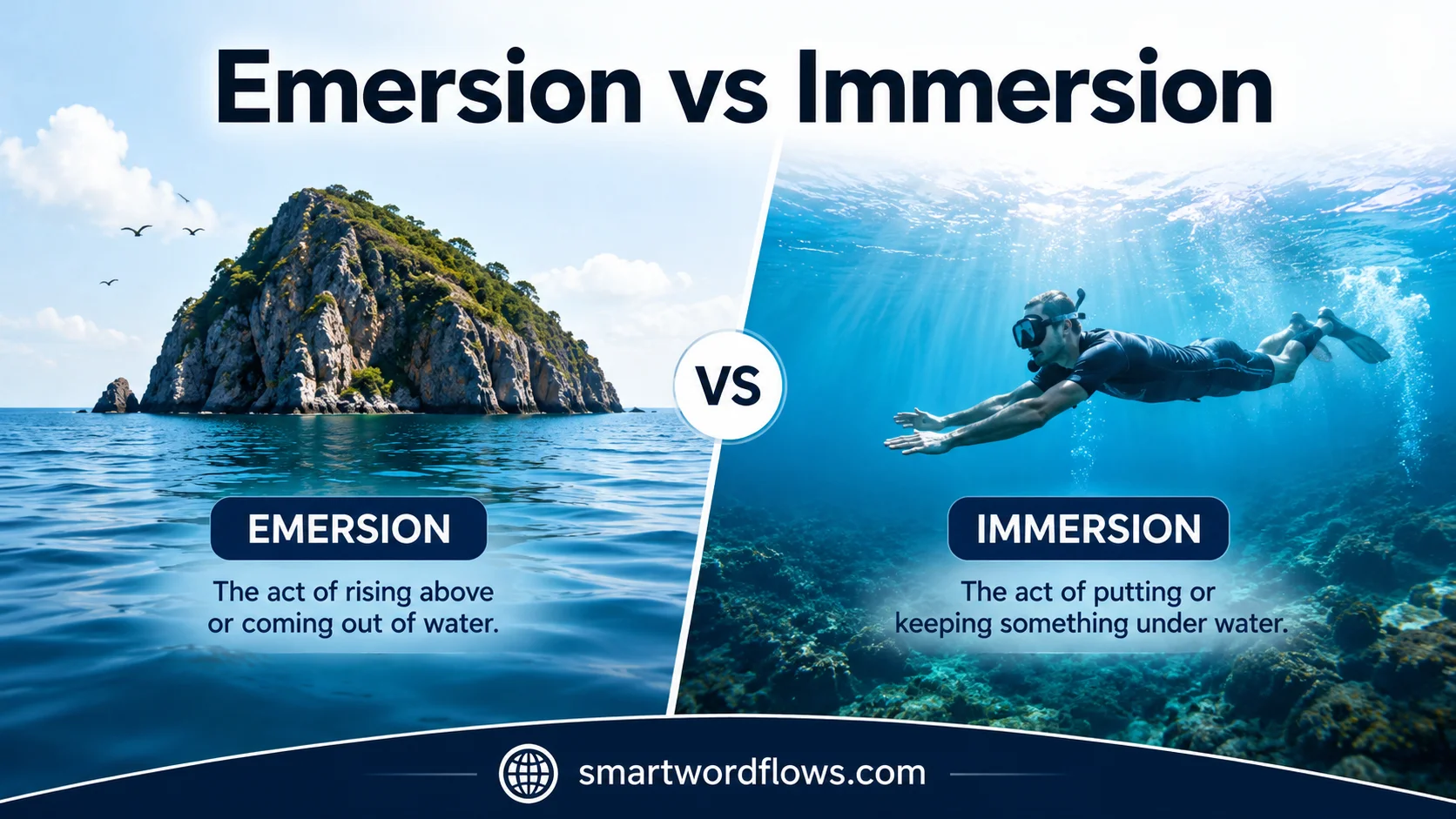

Confused by Emersion vs Immersion? These similar-looking words have opposite meanings. Emersion means coming out or rising from something, while immersion means going deeply into a liquid, activity, or experience.
Understanding the difference between emersion and immersion can help you avoid common mistakes in writing and speaking. This guide explains their meanings with simple examples from astronomy, education, language learning, baptism, marine biology, psychology, virtual reality, and everyday communication.
Emersion vs Immersion: The Quick Difference
Here’s the simplest way to separate the two words:
| Word | Main meaning | Direction or idea | Common examples |
| Immersion | Entering, being placed into, or becoming deeply involved in something | Going in | Water immersion, language immersion, cultural immersion |
| Emersion | Emerging from something or becoming visible after being hidden | Coming out | Emerging from water, astronomical reappearance |
| Emergence | The process of appearing, developing, or becoming known | Coming into view or existence | Emergence of a new trend, idea, or species |
| Submersion | Being completely covered or submerged, especially under water | Going below a surface | Submersion in water, underwater equipment |
A quick memory trick can help:
Immersion = in.
Emersion = emerge.
This isn’t a complete explanation of the words’ origins, but it’s a useful way to remember the practical difference.
If you put your phone into a bowl of water, that’s immersion. If you then pull it out and it becomes visible again, you could describe that movement as emersion in a suitable context.
The key point is that immersion is common and broad, while emersion is uncommon and more specialized.
What Does Immersion Mean?
Immersion is the act of putting something into a substance, especially a liquid, or becoming deeply involved in something.
The word has both a literal meaning and several figurative meanings.
Literal Meaning of Immersion
In its most direct sense, immersion means placing something into a liquid or surrounding environment.
For example:
- The technician tested the device after immersion in water.
- The swimmer practiced underwater immersion techniques.
- The instructions recommend complete immersion of the object for five minutes.
- The scientist studied how the material behaved after prolonged immersion.
Here, the idea is physical. Something enters or becomes surrounded by a liquid.
The word doesn’t always mean that the object must remain completely underwater. The exact meaning depends on the context. In technical writing, immersion often describes placing an object into a liquid for a specific purpose, such as testing, cleaning, cooling, or treatment.
Figurative Meaning of Immersion
Immersion also describes deep involvement or complete engagement.
You don’t have to be physically underwater to experience immersion.
For example:
- She became fully immersed in learning Spanish.
- The novel offers readers an immersive experience.
- He spent the weekend immersed in his research.
- The students learned through cultural immersion.
- Virtual reality can create a strong sense of immersion.
In these examples, immersion means becoming so deeply involved that the activity or environment captures your attention.
Think of it like stepping into a swimming pool. Instead of standing at the edge and dipping in one toe, you enter the water completely. Figurative immersion works in much the same way: you don’t simply participate. You become deeply engaged.
What Does Emersion Mean?
Emersion is a real English word, but it appears far less often than immersion.
It generally refers to the act of emerging from something, especially after being submerged, covered, or hidden.
The concept is essentially movement from a hidden or enclosed state toward visibility.
For example, in a context involving water, emersion can describe something coming out of the water after being submerged.
The word can also appear in technical or scientific writing, particularly when describing an object that becomes visible again after being hidden.
However, most everyday speakers don’t commonly use emersion in ordinary conversation.
Instead, they might say:
- “The diver came out of the water.”
- “The object emerged from the water.”
- “The moon became visible again.”
That’s why emersion can feel unfamiliar even though it’s a legitimate word.
Emersion in Astronomy
One of the clearest specialized uses of emersion appears in astronomy.
Astronomers can use the terms immersion and emersion when describing the disappearance and reappearance of a celestial object during an occultation.
An occultation occurs when one celestial body passes in front of another from the observer’s viewpoint, temporarily hiding it.
For example, suppose the Moon moves in front of a distant star.
- When the star disappears behind the Moon, that event can be described as immersion.
- When the star becomes visible again, that event can be described as emersion.
This gives the two words a very clear relationship:
Immersion → disappearance behind the occulting object
Emersion → reappearance from behind the occulting object
This technical distinction is much more precise than simply saying that the star “appeared” or “disappeared.”
In astronomy, immersion marks the beginning of an occultation for the hidden object, while emersion marks its reappearance.
The exact terminology can vary depending on the astronomical event and context, but the general idea remains the same: immersion involves entering concealment, while emersion involves coming out of it.
Emersion vs Immersion: The Core Difference Explained
The easiest way to understand emersion vs immersion is to imagine a person entering and leaving a swimming pool.
When the person goes underwater, you have the idea of immersion.
When the person rises out of the water, you have the idea of emersion.
The same basic contrast can apply to specialized contexts.
| Situation | Correct concept |
| Something goes into water | Immersion |
| Something is placed into a liquid | Immersion |
| Someone becomes deeply involved in a subject | Immersion |
| A student learns through constant exposure to a language | Immersion |
| A hidden object becomes visible again | Emersion |
| A celestial object reappears after an occultation | Emersion |
| Something simply appears or develops | Usually emergence |
The biggest mistake is assuming that emersion and emergence mean exactly the same thing.
They don’t.
Immersion vs Emersion in Everyday English
When comparing immersion vs emersion, frequency matters.
Immersion has a wide range of everyday uses. You might hear it in classrooms, swimming pools, video games, scientific laboratories, and conversations about travel.
Emersion, by contrast, tends to appear in specialized or technical contexts.
Consider these examples:
Common uses of immersion
- Language immersion
- Cultural immersion
- Immersion education
- Immersive learning
- Water immersion
- Immersion cooling
- Virtual reality immersion
- Immersive gaming
- Immersion in a book or project
Less common uses of emersion
- Scientific descriptions of emerging from water
- Astronomical observations
- Technical descriptions of reappearance after concealment
This difference explains why someone might encounter immersion dozens of times but rarely see emersion.
It doesn’t mean one word is correct and the other is wrong. They simply serve different purposes.
What Is Language Immersion?
Language immersion is one of the most common figurative uses of the word immersion.
In a language immersion environment, learners spend substantial time hearing, speaking, reading, or writing the target language.
Instead of studying vocabulary for thirty minutes and then returning to their normal environment, learners may use the language throughout much of their daily routine.
For example, someone learning French through immersion might:
- Attend classes taught in French.
- Read books and articles in French.
- Speak French with classmates.
- Watch French-language programs.
- Complete assignments in French.
- Interact with native speakers.
The goal is to surround the learner with the language.
That’s why the term immersion fits so well. The learner isn’t merely studying the language from a distance. They’re stepping into an environment where the language becomes part of everyday life.
Example
“The university offers an intensive Spanish immersion program.”
This sentence means students receive extensive exposure to Spanish, often through instruction and interaction conducted primarily in Spanish.
You wouldn’t normally replace immersion with emersion here.
Language emersion is not the standard expression for this idea.
Cultural Immersion Explained
Cultural immersion describes deep engagement with another culture.
Travelers sometimes experience cultural immersion when they spend significant time living within a local community rather than simply visiting tourist attractions.
For example, someone visiting Japan might experience deeper cultural immersion by:
- Staying with a local family.
- Learning everyday customs.
- Using the local language.
- Eating traditional meals.
- Participating in community activities.
- Learning how people work and socialize.
The difference is depth.
A tourist may observe a culture for a few hours. Someone experiencing cultural immersion tries to understand it from within.
This is why you might hear phrases such as:
- “I wanted a more immersive travel experience.”
- “The program provides cultural immersion.”
- “Living with a host family gave me complete cultural immersion.”
Again, immersion is the correct word.
Immersion in Technology and Entertainment
The word immersion has become increasingly common in discussions about technology.
You may hear terms such as:
- Immersive technology
- Immersive gaming
- Immersive media
- Immersive entertainment
- Virtual reality immersion
- Immersive experiences
Here, immersion refers to the feeling of being deeply engaged with a digital environment.
Virtual reality provides a useful example.
When you wear a VR headset, the system can surround your visual field with a simulated environment. Spatial audio and interactive controls can make the experience feel more immediate.
The result is a sense of immersion.
For example:
“The game creates a highly immersive environment that makes players feel part of the virtual world.”
The word immersive is related to immerse and immersion.
It doesn’t mean the player physically enters the game. Instead, the technology creates a strong sense of psychological or sensory involvement.
Emersion vs Emergence: What’s the Difference?
This is where many people get tripped up.
Emersion and emergence look similar, but they’re not interchangeable.
Emersion
Emersion generally refers to coming out of something or becoming visible after being hidden or submerged.
It has a relatively narrow meaning.
Emergence
Emergence has a much broader meaning.
It can describe:
- The act of appearing.
- The process of becoming visible.
- The development of something new.
- The rise of a trend.
- The appearance of a species or organism.
- The arrival of a new idea or technology.
Consider these examples:
“The emergence of artificial intelligence has changed many industries.”
Here, emergence means the rise or development of something.
Now consider:
“The astronomer recorded the star’s emersion after the occultation.”
Here, emersion describes the star becoming visible again after being hidden.
The difference is subtle but important.
| Word | Meaning | Example |
| Emersion | Coming out of concealment or reappearing | The star’s emersion was observed after the occultation. |
| Emergence | Appearing, developing, or becoming prominent | The emergence of new technology changed the industry. |
A Simple Rule
If you’re talking about something appearing or developing in a broad sense, use emergence.
If you’re describing something coming out from a hidden, submerged, or concealed state, emersion may be appropriate.
Immersion vs Submersion: What’s the Difference?
Immersion and submersion overlap, especially when discussing water.
However, they aren’t always interchangeable.
Immersion
Immersion emphasizes the act of placing something into or becoming surrounded by a substance or environment.
It can be literal or figurative.
Examples:
- Immersion in water.
- Immersion in a language.
- Immersion in a culture.
- Immersion in a research project.
Submersion
Submersion usually emphasizes being under the surface, especially when something is completely covered by water or another liquid.
Examples:
- The equipment failed after complete submersion.
- The vehicle was damaged by submersion.
- The diver practiced controlled submersion.
The distinction becomes clearer when you move beyond physical water.
You can be immersed in a book, but you wouldn’t normally say you’re submerged in a book unless you’re deliberately using a metaphor.
Likewise, you can become immersed in a new culture. You wouldn’t normally describe that as cultural submersion.
So:
Immersion has a broader physical and figurative range. Submersion strongly emphasizes being beneath a surface.
Common Mistakes With Emersion and Immersion
The similarity between these words causes predictable errors.
Mistake: Using “Emersion” for Deep Involvement
Incorrect:
“She experienced cultural emersion during her trip.”
Better:
“She experienced cultural immersion during her trip.”
The second sentence is correct because the person became deeply involved in another culture.
Mistake: Using “Emersion” for Language Learning
Incorrect:
“The school offers an English emersion program.”
Correct:
“The school offers an English immersion program.”
Language learning uses immersion because students receive extensive exposure to the language.
Mistake: Using “Immersion” When You Mean Reappearance
Suppose a scientific observation describes a celestial object becoming visible after being hidden.
In that context, emersion may be the precise technical term.
Using immersion would reverse the direction of the event.
Mistake: Assuming “Emersion” Means Any Kind of Emergence
This is another common misunderstanding.
You wouldn’t normally use emersion to describe every situation in which something appears.
For example:
“The emergence of social media transformed communication.”
Here, emergence is the natural choice.
The sentence isn’t about something coming out of water or reappearing after concealment.
Read More: Emersion vs Immersion: Differences, Meaning, and Correct Usage
How to Remember Emersion vs Immersion
If you struggle to remember emersion vs immersion, use this simple mental picture.
Imagine a person standing beside a swimming pool.
Going in
The person jumps into the pool.
Immersion.
Coming out
The person climbs back out.
Emersion.
Now imagine a completely different situation.
A new technology becomes popular.
That’s emergence.
This gives you three useful ideas:
Immersion → in
Emersion → out
Emergence → appearing or developing
The memory trick isn’t a substitute for understanding context, but it works surprisingly well.
Emersion vs Immersion Examples
The best way to master a word distinction is to see it in context.
Examples of “Immersion”
The swimmer practiced controlled immersion in cold water.
The student joined a Spanish immersion program.
Living with a local family provided deep cultural immersion.
The novel offers an immersive reading experience.
The engineer tested the device after prolonged immersion in water.
The virtual reality system creates a strong feeling of immersion.
She became completely immersed in her research.
Notice how the word moves across different contexts. Sometimes it’s physical. Sometimes it’s psychological or educational.
The common thread is entering, being surrounded by, or becoming deeply involved in something.
Examples of “Emersion”
The diver’s emersion from the water marked the end of the exercise.
The astronomer recorded the emersion of the star after the occultation.
The object’s emersion from beneath the surface was clearly visible.
These examples show why emersion is less common.
The situations where it provides a precise meaning are narrower.
Examples of “Emergence”
The emergence of electric vehicles has reshaped the automotive industry.
Scientists observed the emergence of new plant growth in spring.
The emergence of a new market created fresh opportunities.
The company responded quickly to the emergence of a serious competitor.
These sentences describe something appearing, developing, or becoming important.
They don’t describe the technical act of emerging from a submerged or concealed position.
Emersion vs Immersion: Side-by-Side Examples
| Meaning | Correct word | Example |
| Deep involvement in a subject | Immersion | He spent months in total immersion in his research. |
| Learning through constant language exposure | Immersion | The children attend a French immersion school. |
| Being placed into water | Immersion | The equipment requires immersion in a cleaning solution. |
| Deep cultural involvement | Immersion | Her trip gave her meaningful cultural immersion. |
| Reappearing after being hidden | Emersion | The star’s emersion was visible after the occultation. |
| Emerging from water | Emersion | The swimmer’s emersion brought the exercise to an end. |
| A new trend appearing | Emergence | The emergence of AI has changed the workplace. |
| Something becoming established | Emergence | The emergence of new industries created more jobs. |
| Being completely under water | Submersion | The device can withstand temporary submersion. |
A Practical Guide to Choosing the Right Word
When you’re unsure whether to use emersion or immersion, stop and ask what direction or meaning you’re describing.
Choose “immersion” when:
- Something enters a liquid.
- Something becomes surrounded by an environment.
- Someone becomes deeply involved in an activity.
- A learner receives extensive exposure to a language.
- Someone engages deeply with another culture.
- A technology creates a highly engaging experience.
Choose “emersion” when:
- Something emerges from a submerged position.
- Something becomes visible after being hidden.
- You’re describing a specialized astronomical event involving reappearance.
- A technical context specifically calls for the term.
Choose “emergence” when:
- Something appears or develops.
- A trend begins to gain attention.
- A new idea becomes established.
- A species, technology, or movement begins to appear.
- You’re describing the general process of becoming visible or prominent.
Choose “submersion” when:
- Something goes completely below a surface.
- You specifically want to emphasize being underwater or beneath a liquid.
- You’re describing flooding or complete coverage by water.
This four-way comparison eliminates most confusion:
Immersion = going in or becoming deeply involved.
Emersion = coming out or becoming visible again.
Emergence = appearing or developing.
Submersion = going completely beneath a surface.
The Grammar of Immersion and Emersion
Understanding how these words behave grammatically can also make your writing more precise.
Immersion as a Noun
Immersion is primarily used as a noun.
Examples:
- “The immersion lasted ten minutes.”
- “Language immersion improves exposure to the target language.”
- “The course emphasizes cultural immersion.”
Immerse as a Verb
The related verb is immerse.
Examples:
- “She immersed herself in the language.”
- “He immersed himself in the research.”
- “The instructions say to immerse the object in water.”
Immersed as an Adjective or Past Participle
Examples:
- “She was fully immersed in the project.”
- “The device remained immersed in water.”
Immersive as an Adjective
Examples:
- “The museum offers an immersive experience.”
- “The game has an immersive environment.”
The word family is useful because immersive is now extremely common in marketing, technology, education, and entertainment.
Emersion as a Noun
Emersion is primarily a noun.
Examples:
- “The emersion occurred shortly after the occultation.”
- “The astronomer measured the timing of the object’s emersion.”
Because emersion is relatively uncommon, writers should use it when the specific meaning genuinely calls for it.
Why “Immersion” Is Much More Common
One reason immersion appears so often is its versatility.
It works across multiple fields:
- Education
- Linguistics
- Travel
- Psychology
- Technology
- Gaming
- Virtual reality
- Science
- Medicine
- Engineering
- Water safety
Its figurative meaning also makes it useful in everyday writing.
You can be immersed in:
- A book.
- A conversation.
- A culture.
- A hobby.
- A career.
- A research project.
- A video game.
- A language.
By contrast, emersion has a narrower role.
It’s useful when you need to describe a specific movement from concealment or submersion into visibility. That precision matters in technical writing, but everyday conversations usually use simpler phrases such as emerging, coming out, or becoming visible.
This is why a dictionary may contain both words even though ordinary speakers encounter them at very different rates.
A Short Case Study: Choosing the Right Word
Imagine you’re writing about a student named Maya who moves to Spain to learn Spanish.
At first, Maya studies Spanish for one hour each evening. She uses textbooks and memorizes vocabulary.
Later, she moves into a Spanish-speaking household. She attends classes taught in Spanish, speaks Spanish with friends, watches Spanish television, and uses Spanish throughout the day.
Which word describes her experience?
Immersion.
She is experiencing language immersion because she has entered an environment where Spanish surrounds her.
Now imagine a different situation.
An astronomer observes a distant star as the Moon passes in front of it. The star disappears from view and later becomes visible again.
The star’s disappearance can be described using immersion in the specialized astronomical sense. Its return to visibility can be described as emersion.
Finally, imagine a researcher writing about the rise of a new technology.
The researcher might write:
“The emergence of artificial intelligence has transformed many industries.”
Here, emergence is the right choice.
The three scenarios look unrelated, but they demonstrate the essential distinction:
| Scenario | Best term |
| Student surrounded by a new language | Immersion |
| Celestial object becoming visible again | Emersion |
| New technology becoming prominent | Emergence |
FAQs:
1. What is the difference between emersion and immersion?
Emersion means coming out of or rising from something, while immersion means being deeply involved in or submerged in something.
2. What does emersion mean?
Emersion refers to the act of emerging or coming out from something, especially from water. It is also used in astronomy when a celestial object reappears from behind another object.
3. What does immersion mean?
Immersion means being completely covered or submerged in something. It can also describe deep involvement in an activity, such as language immersion or virtual reality.
4. Is emersion the opposite of immersion?
Yes. In many contexts, emersion describes coming out of something, while immersion describes going into or becoming deeply involved in something.
5. How can I remember emersion vs immersion?
A simple trick is to remember “im-” as going in and “e-” as emerging out. This can help you quickly distinguish immersion from emersion.
Conclusion:
Understanding emersion vs immersion is easier once you remember their basic direction. Immersion involves going into, sinking into, or becoming deeply involved in something, while emersion refers to coming out or emerging. Although these words look and sound similar, their meanings are quite different. Learning this simple distinction will help you use both terms correctly in writing, speaking, education, science, astronomy, and everyday communication.