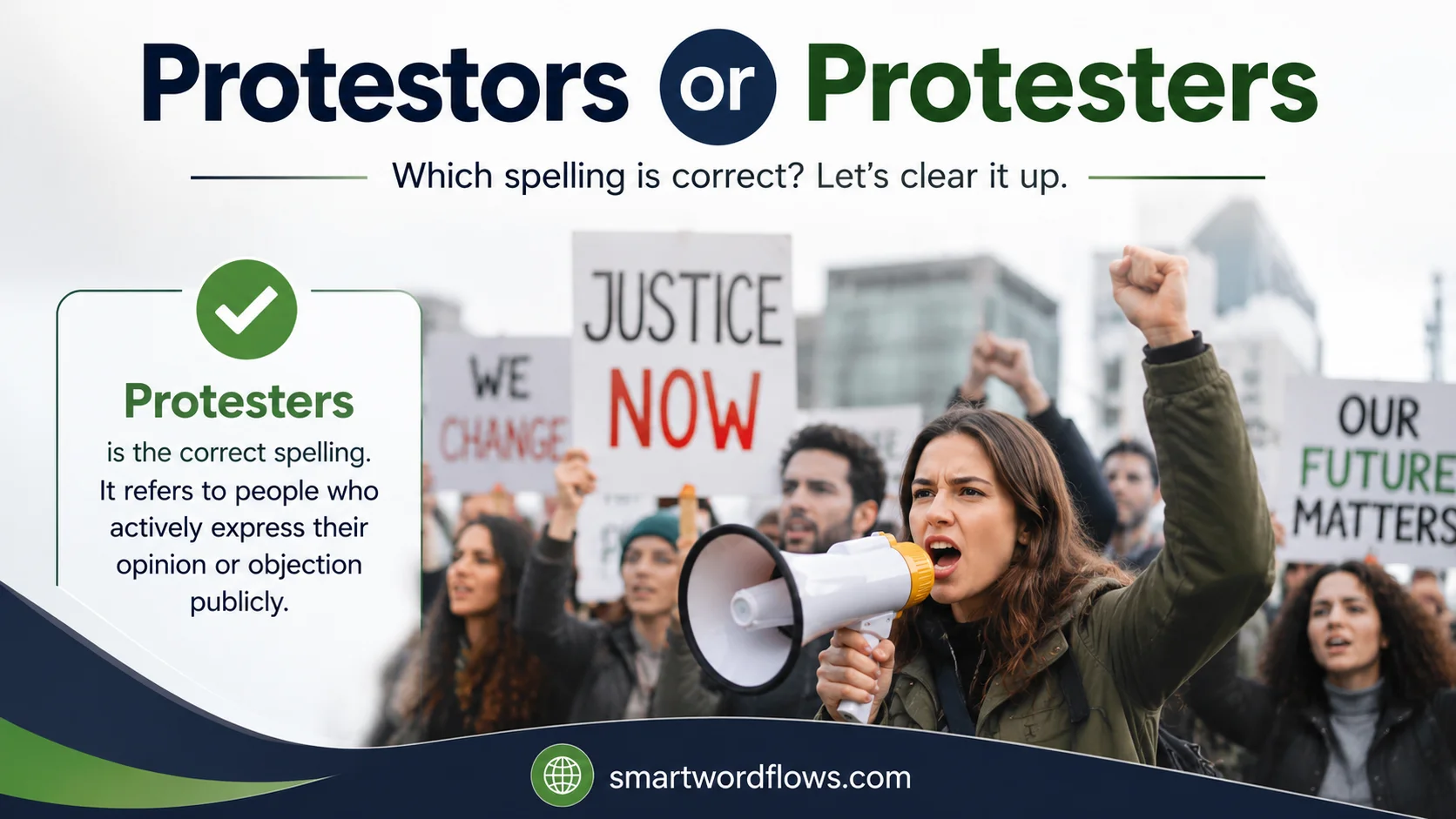

When choosing between Protestors or Protesters, both spellings refer to people who publicly express disagreement. However, protesters is far more common and widely preferred in academic, professional, edited, and journalistic writing. If you’re unsure which form to use, protesters is usually the safest choice. Understanding this small spelling difference can help you write with greater confidence and avoid unnecessary confusion.
English often includes words that look slightly different but share the same meaning and pronunciation. That’s why you may come across protestors and protesters while reading articles or browsing online. Although both forms are recognized, protesters generally appears more frequently in standard written English. Whichever spelling you choose, the most important thing is to remain consistent throughout your writing.
Protesters or Protestors: The Quick Answer
Here’s the simplest way to understand the difference:
| Spelling | Correct? | Meaning | General Usage |
| Protester | Yes | A person who protests | More common |
| Protesters | Yes | More than one person who protests | More common plural form |
| Protestor | Yes | A person who protests | Less common alternative |
| Protestors | Yes | More than one person who protests | Less common plural form |
If you’re unsure which spelling to choose, use “protester” and “protesters.”
For example:
Thousands of protesters gathered outside the government building.
That sentence sounds natural to most English speakers and follows the more widely used spelling.
However, calling protestors incorrect would be misleading. The form is established in English and appears in reputable dictionaries and published writing.
The important point is this: “protesters” is usually the preferred spelling, but “protestors” isn’t automatically a spelling mistake.
What Does “Protester” Mean?
A protester is a person who publicly expresses disagreement, opposition, or objection to something.
The word usually refers to someone participating in a protest, demonstration, march, rally, or another organized expression of dissent.
For example:
- A group of protesters marched through the city.
- The protesters demanded changes to the proposed law.
- Police officers monitored the demonstration as protesters gathered.
- Several protesters held signs outside the building.
The word can apply to many different situations. A protester might object to a government policy, workplace decision, environmental issue, social injustice, or local development project.
The term itself doesn’t tell you whether the protest is peaceful, disruptive, large, or small. Those details depend on the context.
Examples of protesters
You might encounter the word in contexts involving:
- Political demonstrations
- Civil rights movements
- Environmental campaigns
- Labor disputes
- Student demonstrations
- Anti-war movements
- Public policy disagreements
- Community opposition
- Consumer boycotts and related demonstrations
The central idea remains the same: a protester is someone who protests.
What Does “Protestor” Mean?
A protestor is an alternative spelling of protester.
In general English, it refers to the same thing: a person who protests or takes part in a protest.
For example:
The protestors gathered outside the courthouse.
You could rewrite the sentence as:
The protesters gathered outside the courthouse.
The basic meaning doesn’t change.
This is why the debate over protester vs. protestor isn’t really a debate about two different concepts. Instead, it’s primarily a question of spelling preference and usage frequency.
Think of it like two roads leading to the same destination. The spelling differs, but the meaning generally arrives at the same place.
Protester vs. Protestor: Is There a Difference in Meaning?
In modern general English, there’s usually no meaningful difference in meaning between “protester” and “protestor.”
Both words describe a person who protests.
Consider these two sentences:
The protesters gathered in the town square.
The protestors gathered in the town square.
The reader will normally understand both sentences in exactly the same way.
Neither spelling automatically tells the reader:
- What political position the person supports
- What issue they’re protesting
- Whether the protest is peaceful
- Whether the person organized the event
- Whether the person attended voluntarily
- Whether the person belongs to a particular group
Those details must come from the surrounding context.
A useful distinction
The difference is primarily orthographic, meaning it concerns the written form of the word.
| Word | What it tells you |
| Protester | A person who protests |
| Protestor | An alternative spelling for a person who protests |
| Protest | The act or event of expressing opposition |
| Protesting | The action of expressing opposition |
So, if you’re writing an article about a demonstration, you can generally use either protesters or protestors without changing the fundamental meaning.
Why Are There Two Spellings?
English has a long history of borrowing words from different languages and combining different word-building patterns.
That’s one reason English spelling can sometimes feel less like a perfectly organized filing cabinet and more like a drawer full of cables.
The two spellings protester and protestor reflect different suffix patterns.
The suffix -er commonly forms nouns referring to people who perform an action:
- teach → teacher
- run → runner
- work → worker
- speak → speaker
- protest → protester
The suffix -or also appears in many nouns that describe people or things associated with an action:
- act → actor
- operate → operator
- inspect → inspector
- supervise → supervisor
English doesn’t always apply these patterns consistently. Historical development, Latin and French influence, pronunciation, and established usage all play a role in determining which forms become standard.
In the case of protester and protestor, both forms have gained enough usage to remain recognizable and accepted.
However, the -er form has become more widespread in modern general English.
Why “Protester” Is Usually the Better Default
If you have no specific style guide to follow, protester is generally the safer choice.
There are several practical reasons.
It’s more common
The spelling protester appears more frequently in contemporary general English than protestor.
That means most readers are likely to recognize it immediately.
It follows a familiar pattern
English speakers regularly form words with -er to describe someone performing an action.
For example:
- protest → protester
- organize → organizer
- campaign → campaigner
- demonstrate → demonstrator
Although the final example uses -or, the overall language system allows both suffixes in different words.
It feels natural in everyday writing
If you’re writing a school essay, blog post, news article, report, or general website content, protester is usually the most straightforward option.
It’s widely understood
You don’t need to worry about readers misunderstanding protester. It’s a familiar word across English-speaking contexts.
Is “Protestor” a Real Word?
Yes.
Protestor is a real and established English word.
It’s not simply a typo created by someone who doesn’t know how to spell protester. The alternative form appears in published English and is recognized by major dictionaries.
That said, there’s an important distinction between valid and preferred.
A word can be valid without being the most commonly used option.
For example, one spelling might appear frequently while another remains relatively uncommon. Both can still be legitimate.
That’s the situation with protester and protestor.
So, if you write:
The protestors marched through the city.
You haven’t necessarily made a spelling error.
If you write:
The protesters marched through the city.
You’ve chosen the more common form.
Is “Protestors” a Spelling Mistake?
No, “protestors” isn’t necessarily a spelling mistake.
It’s an accepted variant of protesters.
However, your choice may still matter depending on your audience.
If you’re writing for:
- A newspaper
- A university
- A government agency
- A professional publication
- A business
- An academic journal
- A website with an editorial style guide
you should follow that organization’s preferred spelling.
Style guides often prioritize consistency. If an organization uses protesters throughout its publications, switching randomly between protesters and protestors can make your writing look inconsistent.
The key rule is simple:
Don’t treat the less common spelling as automatically wrong. Instead, choose one form and use it consistently.
Protesters vs. Protestors in American English
For US English, protesters is generally the better default.
American readers will easily understand both forms. However, protester and protesters are the forms you’re more likely to encounter in mainstream general writing.
If you’re writing an American English article, essay, report, or blog post and don’t have a house style to follow, choose:
- protester for singular
- protesters for plural
Examples
One protester spoke to reporters.
Hundreds of protesters gathered downtown.
The protesters carried signs calling for reform.
This doesn’t mean protestor is forbidden in American English. It simply means that protester is generally the more practical choice.
Protesters vs. Protestors in British English
British English also uses protester and protesters, while protestor and protestors can appear as alternative forms.
The same basic principle applies: the spelling may vary according to publication, writer, or editorial preference.
You shouldn’t assume that protestor is exclusively British or that protester is exclusively American. English usage doesn’t divide that neatly.
Regional English varieties often overlap considerably. Publications also develop their own style preferences.
Therefore, if you’re writing for a British audience, the best approach is still to check the relevant publication or organization’s style guide.
If no specific guidance exists, protester remains a clear and widely understood choice.
Protesters or Protestors: Which Is More Common?
When comparing the two spellings, protesters generally has the stronger presence in contemporary English.
Usage frequency matters because it tells you what readers are most accustomed to seeing.
However, frequency alone doesn’t determine whether a word is correct.
That’s an important distinction.
Consider this simple comparison:
More common does not always mean the only correct form.
In this case:
- Protesters = more common
- Protestors = less common but accepted
- Both = generally understood to have the same meaning
For writers, that leads to a practical conclusion: choose protesters unless you have a reason to use protestors.
What Do Dictionaries Say About “Protester” and “Protestor”?
Major dictionaries are useful when you’re trying to determine whether a word is recognized in standard English.
Dictionaries such as Merriam-Webster, Cambridge Dictionary, Collins Dictionary, and the Oxford English Dictionary document established English vocabulary and usage.
Their treatment of these forms supports an important point: protestor isn’t simply a nonexistent or invented word.
At the same time, dictionary entries and usage evidence should be interpreted carefully.
A dictionary may recognize a word without suggesting that it’s the most common form. Some words are common, while others are less frequent variants.
For current writing, it’s helpful to consider three things together:
- Dictionary recognition
- Actual usage frequency
- The style guide you’re expected to follow
That combination gives you a much more reliable answer than simply asking whether a spelling “looks right.”
Also Read This: Emaculate vs. Immaculate: Which One Is Correct?
Protester or Protestor: Which Should You Use?
For most writers, the answer is straightforward:
Use “protester” when:
- You’re writing general content.
- You’re writing in US English.
- You want the more common spelling.
- You’re writing for a broad audience.
- No style guide requires another form.
- You want the spelling most readers expect.
Use “protestor” when:
- Your publication specifically prefers it.
- You’re following an established organizational style.
- You’re maintaining consistency with existing content.
- You’re quoting a source that uses that spelling.
- You have a specific editorial reason for choosing it.
There’s no need to make the decision more complicated than it is.
If you’re staring at the screen wondering which spelling to type, protester is the safe bet.
Protester vs. Protestor in Formal Writing
Formal writing deserves a little extra attention because consistency and editorial standards matter more in professional settings.
Academic writing
In an academic essay, protester is a clear and widely understood choice.
For example:
Researchers interviewed protesters who participated in the demonstration.
If your university or journal has a style guide, follow it.
News writing
News organizations often maintain detailed style guides. A newsroom may prefer one spelling throughout its reporting.
The best choice isn’t necessarily the spelling you personally prefer. It’s the spelling that matches the publication’s editorial standards.
Government writing
Government agencies may also follow internal style manuals.
If you’re preparing an official document, consistency matters. Use the organization’s preferred form.
Business writing
In ordinary professional communication, protester is generally the easiest option.
It is familiar, clear, and unlikely to distract the reader.
Legal writing
Legal documents can involve specialized terminology and jurisdiction-specific conventions. If a particular court, organization, or legal publication has a defined style preference, follow it.
The general principle remains unchanged: both forms can refer to a person who protests, but “protester” is usually the more common default.
Protester vs. Protestor vs. Protest: What’s the Difference?
These words are related, but they don’t perform the same grammatical role.
| Word | Part of Speech | Meaning | Example |
| Protester | Noun | A person who protests | The protester spoke to reporters. |
| Protestor | Noun | Alternative spelling of protester | The protestor held a sign. |
| Protest | Noun/Verb | An act of opposition or the act of objecting | The group organized a protest. |
| Protesting | Verb/Gerund | The act of expressing opposition | They were protesting the decision. |
Here’s another way to see it:
The protesters organized a protest because they were protesting a new policy.
Each form plays a different role.
- Protesters = the people
- Protest = the event or act
- Protesting = the action
This distinction becomes particularly useful when you’re writing longer sentences about demonstrations.
Protester vs. Protestor: Singular and Plural Forms
The singular and plural forms are easy to remember.
| Singular | Plural |
| Protester | Protesters |
| Protestor | Protestors |
Singular examples
A protester spoke with the journalist.
One protestor left the demonstration early.
Plural examples
Several protesters gathered near the entrance.
The protestors marched toward the city center.
The important thing is to keep the spelling consistent within the word itself.
If you choose protester, the plural is protesters.
If you choose protestor, the plural is protestors.
You wouldn’t normally mix the forms without a specific reason.
Common Mistakes With Protesters and Protestors
Although the spelling difference is simple, writers sometimes make avoidable mistakes.
Mistake: Assuming “protestor” is always wrong
This is the biggest misconception.
Protestor is an accepted variant, so automatically marking it as incorrect isn’t accurate.
Mistake: Treating the two words as different types of people
In ordinary modern English, the two spellings don’t normally indicate different meanings.
A protester and a protestor generally describe the same kind of person.
Mistake: Switching spellings randomly
Consistency matters.
For example, don’t write:
The protesters arrived early. Later, the protestors spoke to reporters.
Unless you’re deliberately discussing the spelling difference, switching forms serves no useful purpose.
Choose one spelling and stick with it.
Mistake: Assuming suffix rules always work perfectly
English spelling doesn’t follow a single mathematical formula.
The fact that many words use -er doesn’t mean every person-related noun must use -er. Likewise, the presence of -or in words such as actor doesn’t mean protestor must be the preferred spelling.
Language develops through history and usage. It’s rarely as tidy as a spreadsheet.
Why Does “Protester” Sound More Natural?
One reason protester may feel more natural to many readers is its familiar -er pattern.
English frequently creates nouns for people who perform actions by adding -er.
Consider:
- Teach → teacher
- Work → worker
- Run → runner
- Drive → driver
- Speak → speaker
- Write → writer
Because protest is a verb, the form protester fits a pattern English speakers already know well.
However, that doesn’t fully explain why protestor exists or why some writers use it. English has absorbed words from many linguistic sources and developed competing patterns over centuries.
The result is a language where both regular and historically influenced forms coexist.
That’s why you can’t always predict the accepted spelling simply by looking at a suffix.
Real-World Examples of “Protester”
The word protester works naturally across a wide range of situations.
Political protests
Thousands of protesters gathered outside the parliament building.
Environmental protests
Environmental protesters called for stricter pollution controls.
Student demonstrations
Student protesters organized a march across campus.
Labor disputes
The protesters demanded better working conditions.
Civil rights demonstrations
Protesters marched peacefully through the city.
Community opposition
Local protesters objected to the proposed development.
Notice something important here: the word protester itself doesn’t explain the cause.
You need additional information to understand what the person supports or opposes.
That’s why good writing usually gives readers context rather than relying on the label alone.
Real-World Examples of “Protestor”
The alternative spelling can appear in similar sentences:
The protestors gathered outside the building.
Several protestors spoke with local journalists.
Police officers monitored the crowd as protestors arrived.
The protestors called for changes to the proposed policy.
In each example, replacing protestors with protesters would generally preserve the meaning.
That’s the clearest evidence that the difference is mainly one of spelling rather than definition.
A Simple Style Guide for Choosing the Right Spelling
If you need a quick decision, use this mini style guide.
| Situation | Recommended Choice |
| General US English | Protester |
| General online content | Protester |
| School essay | Protester |
| Blog post | Protester |
| Business communication | Protester |
| Academic paper | Follow the required style guide |
| News article | Follow the publication’s style guide |
| Organization with a house style | Follow its preferred spelling |
| Quoting a source | Preserve the original wording when appropriate |
This approach keeps your writing clear without pretending that the alternative spelling doesn’t exist.
Case Study: Choosing a Spelling for a News Article
Imagine you’re writing a news story about a large public demonstration.
You have two possible opening sentences:
Option A: Hundreds of protesters gathered outside the city hall on Monday.
Option B: Hundreds of protestors gathered outside the city hall on Monday.
Both sentences communicate the same basic information.
However, if you’re writing for a general American audience and your publication hasn’t specified a preference, Option A is usually the better choice.
Why?
- It’s the more common spelling.
- Readers recognize it immediately.
- It aligns with widespread contemporary usage.
- It avoids introducing an unnecessary spelling variation.
Now imagine your newspaper’s internal style guide consistently uses protestors.
In that case, Option B becomes the correct editorial choice for that publication.
The lesson is simple: usage preference can depend on context, but the underlying meaning remains the same.
Is “Protester” More Correct Than “Protestor”?
It’s tempting to ask which spelling is more correct, but that question needs a little nuance.
If by “correct” you mean the standard and widely preferred spelling, then protester is usually the better answer.
If by “correct” you mean a legitimate English spelling, then protestor also qualifies.
So the most accurate answer is:
Both “protester” and “protestor” are correct, but “protester” is generally more common and is the safer default choice.
That’s the distinction many quick spelling answers miss.
Language isn’t always a courtroom where one form wins and the other gets thrown out. Sometimes two forms coexist, while one simply becomes more popular.
FAQs:
1. Is “protestors” or “protesters” correct?
Both protestors and protesters are correct spellings. They refer to people who publicly express disagreement or opposition. However, protesters is more commonly used.
2. Which is more common: protestors or protesters?
Protesters is the more common spelling in modern English. It is widely preferred in professional, academic, journalistic, and edited writing.
3. Do protestors and protesters have the same meaning?
Yes. Both words have the same meaning and describe people who take part in a protest or publicly show disagreement with something.
4. Should I use “protesters” in formal writing?
Yes. Protesters is generally the safer choice for formal writing because it is more widely recognized and commonly used by major publications and professional organizations.
5. Can I use “protestors” instead of “protesters”?
Yes, you can use protestors, as it is an accepted spelling. Just make sure you use the same spelling consistently throughout your article or document.
Conclusion:
In the debate over Protestors or Protesters, both spellings are acceptable and carry the same meaning. However, protesters is the more common and preferred choice in most academic, professional, journalistic, and formal writing. If you’re unsure which spelling to choose, go with protesters and use it consistently throughout your writing.