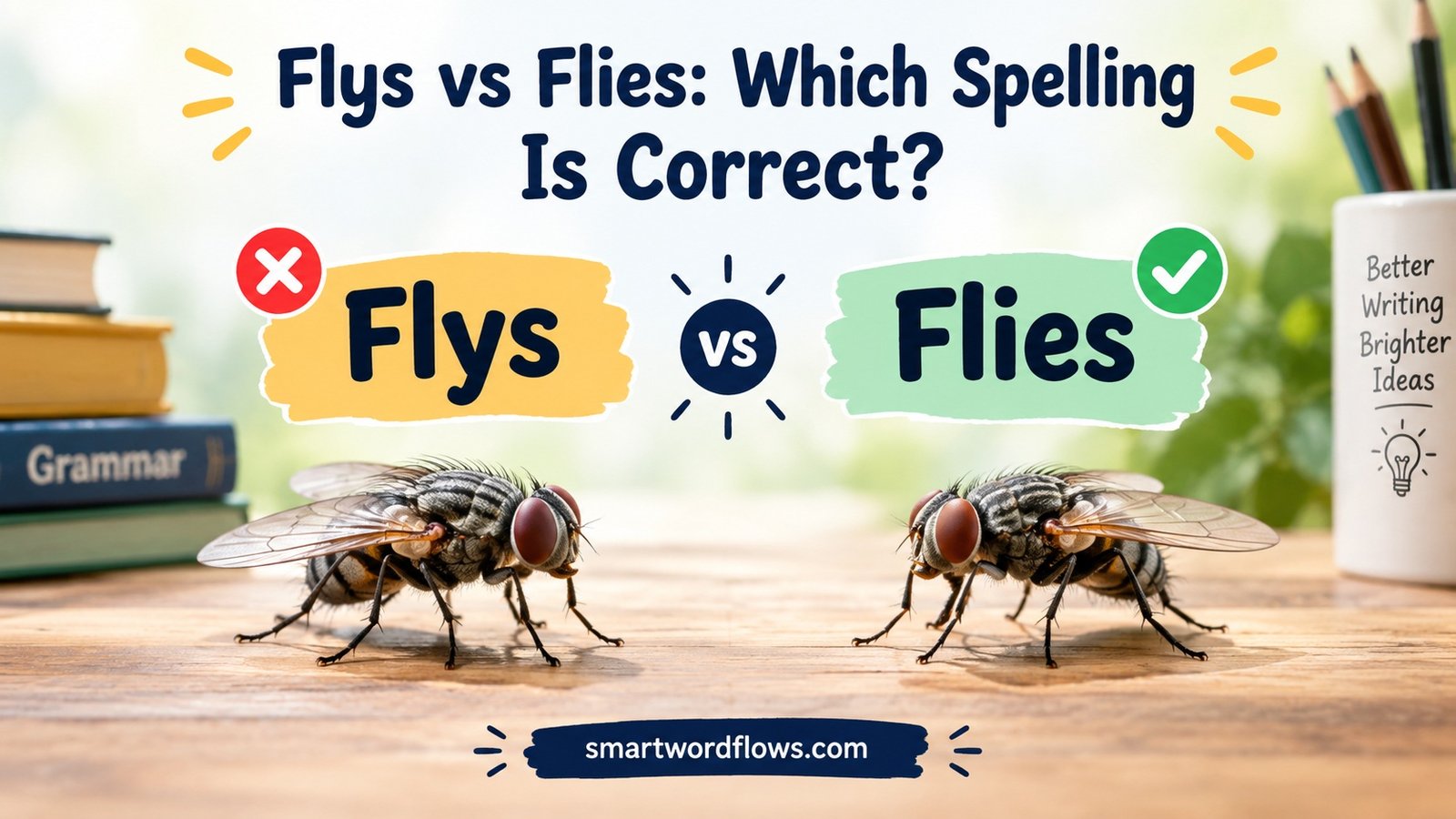

Flys vs Flies: Which Spelling Is Correct? explains why Flies is the correct spelling, while Flys is incorrect in English. The confusion is a classic English problem because both forms look similar, yet their uses are different. Flies is the correct word in standard writing when used as the plural of fly, while it can also work as a verb form for movement through the air, as in “the bird flies.” It may also refer to insects, depending on the context and meaning. In normal usage, Flys is incorrect and is rarely used in modern English. The right form follows basic grammar rules: a noun ending in y often changes to ies in its plural form, rather than simply adding s. This rule helps learners understand the difference and avoid small mistakes.
Students can become confused by unexpected spelling changes, especially when typing quickly makes the wrong version appear natural. A tiny difference can create common mistakes in emails, assignments, school work, and everyday messages. To write better, regular practice with the correct spelling is useful. Flies can function as both a noun and a verb: “The flies are insects” uses a plural noun, while “The plane flies through the air” describes an action. Learning the definition, meaning, form, and uses makes writing clearer, more accurate, professional, and natural.
A simple guide is to avoid Flys in most situations and choose Flies when the context requires the plural of fly or the appropriate verb form. This habit prevents mistakes, strengthens communication skills, and keeps writing polished. Clear examples can show the differences between the two forms, helping learners avoid being tricked by their similar appearance. With practice, writers can correctly choose the standard form, remember the right and proper usage, and avoid trying to mix the two words.
Quick Answer
Flies is the correct standard spelling. Flys is not the standard form for the ordinary plural noun or the third-person singular present verb.
Here’s the basic difference:
| Form | Correct? | Use |
| fly | Yes | Singular noun or base verb |
| flies | Yes | Plural noun or third-person singular verb |
| flys | No, in standard usage | Usually a spelling error |
Examples
- Correct: There are several flies in the kitchen.
- Correct: The bird flies across the lake.
- Correct: She flies to Chicago every month.
- Incorrect: There are several flys in the kitchen.
- Incorrect: The bird flys across the lake.
- Incorrect: She flys to Chicago every month.
The key rule is simple:
fly → flies
The spelling changes because fly ends with a consonant + y.
Comparison Overview
The easiest way to understand flys vs flies is to compare their grammatical roles.
| Word | Standard English? | Grammatical role | Example |
| fly | Yes | Singular noun | A fly landed on the table. |
| fly | Yes | Base verb | Birds fly south. |
| flies | Yes | Plural noun | Several flies entered the room. |
| flies | Yes | Third-person singular verb | The bird flies quickly. |
| flys | No, for these standard uses | — | Use flies instead. |
Notice something important: flies doesn’t have just one job.
It can mean more than one insect:
Two flies landed near the window.
It can also describe an action:
The eagle flies above the mountains.
The surrounding words tell you which meaning applies.
This distinction matters because many spelling questions are actually grammar questions in disguise. Once you know whether flies acts as a noun or verb, choosing the correct form becomes much easier.
Main Differences Between Flys vs Flies
The biggest difference between flys vs flies is that flies is the standard English form while flys isn’t the normal grammatical spelling.
There are two major uses of flies.
Flies as a plural noun
When flies refers to more than one insect, it’s a plural noun.
- One fly
- Two flies
- Several flies
- Hundreds of flies
For example:
A fly landed on my plate.
Change the number from one to more than one:
Several flies landed on my plate.
The spelling doesn’t become flys. The final y changes to i, followed by -es.
Flies as a verb
Flies also works as the third-person singular present form of fly.
Compare these sentences:
- I fly to Dallas.
- You fly to Dallas.
- We fly to Dallas.
- They fly to Dallas.
- He flies to Dallas.
- She flies to Dallas.
The subject determines the verb form.
So if the subject is he, she, or it, the standard form is usually flies, not flys.
For example:
She flies to New York every summer.
The eagle flies above the valley.
The plane flies over the ocean.
This is one reason the spelling mistake appears so often. Writers know that a third-person singular verb normally takes -s, so they may write flys. English spelling has an extra step here.
Why Does Fly Become Flies?
The spelling of flies follows a common English pattern involving words that end in consonant + y.
When many such words take a plural ending or form their third-person singular present verb, the y changes to i and -es is added.
The basic pattern looks like this:
consonant + y → i + es
That gives us:
- fly → flies
- try → tries
- cry → cries
- carry → carries
- study → studies
- hurry → hurries
So:
fly + es → flies
The result isn’t flys.
Why “Flys” Looks Reasonable
The mistake makes sense because English has plenty of words that simply add -s.
For example:
- book → books
- car → cars
- tree → trees
- dog → dogs
- chair → chairs
A reader might therefore assume:
fly + s = flys
But English spelling treats a final consonant + y differently in many grammatical forms.
That’s why:
- baby → babies
- city → cities
- story → stories
- puppy → puppies
- fly → flies
Understanding the pattern is more useful than memorizing flies by itself.
The Important Consonant + Y Rule
Here’s the rule that will save you from many similar spelling mistakes.
When a word ends in a consonant followed by y, the y usually changes to i before -es when forming the plural or certain verb forms.
Examples
| Singular/Base Form | Changed Form |
| fly | flies |
| baby | babies |
| city | cities |
| party | parties |
| story | stories |
| country | countries |
| puppy | puppies |
| library | libraries |
| try | tries |
| carry | carries |
The word doesn’t simply gain an s. Its ending changes.
But There Is an Important Exception
Words ending in vowel + y normally keep the y and simply add -s.
Compare:
| Word | Correct Form |
| boy | boys |
| toy | toys |
| day | days |
| key | keys |
| monkey | monkeys |
| journey | journeys |
This creates a useful contrast:
consonant + y:
fly → flies
vowel + y:
toy → toys
That distinction explains why flys looks plausible but isn’t the standard spelling.
What Does “Flies” Mean?
The word flies can have different meanings depending on how you use it.
“Flies” as a Noun
As a noun, flies is the plural of fly.
A fly is a type of small winged insect. The word can refer to various insects belonging to the order Diptera.
For example:
The flies gathered around the food.
Here, flies refers to multiple insects.
Other examples include:
- The window was covered with flies.
- Several flies were buzzing around the kitchen.
- We noticed a few flies near the trash can.
- The restaurant uses screens to keep flies outside.
The singular form is fly:
One fly landed on the wall.
The plural form is:
Three flies landed on the wall.
“Flies” as a Verb
As a verb, flies describes an action involving movement through the air.
For example:
The hawk flies over the field.
Here, flies doesn’t refer to insects. It describes what the hawk does.
Other examples:
- The plane flies across the Atlantic.
- The bird flies from tree to tree.
- She flies home every Friday.
- The kite flies beautifully in strong wind.
Context makes the meaning clear.
Fly vs Flies: Understanding the Grammar
Many people searching for flys vs flies actually need to understand when to use fly and when to use flies.
The answer depends on the subject and grammatical role.
Verb Forms With Different Subjects
| Subject | Correct Verb | Example |
| I | fly | I fly every month. |
| You | fly | You fly often. |
| We | fly | We fly together. |
| They | fly | They fly tomorrow. |
| He | flies | He flies tomorrow. |
| She | flies | She flies every week. |
| It | flies | It flies over the house. |
The important contrast is:
They fly.
versus:
She flies.
You wouldn’t normally write:
She flys.
The correct spelling is:
She flies.
Why “He Flys” Is Incorrect
The verb fly follows the same spelling pattern as other verbs ending in consonant + y.
Compare:
- try → tries
- cry → cries
- study → studies
- carry → carries
- fly → flies
Therefore:
He tries.
She studies.
The bird flies.
The same spelling principle appears across all three examples.
Flys vs Flies Examples
Examples make this distinction much easier to remember.
Correct Examples With “Flies” as a Noun
The flies are gathering near the window.
Several flies landed on the fruit.
We closed the door to keep the flies outside.
The kitchen had too many flies.
Two flies were buzzing around the light.
In each sentence, flies means more than one fly.
Correct Examples With “Flies” as a Verb
The eagle flies high above the valley.
My brother flies to Los Angeles tomorrow.
The airplane flies over the mountains.
A hummingbird flies from flower to flower.
Time flies when you’re having fun.
In these examples, flies describes an action.
Incorrect Examples With “Flys”
These examples show the common error:
| Incorrect | Correct |
| Two flys are on the wall. | Two flies are on the wall. |
| The bird flys away. | The bird flies away. |
| She flys to Miami. | She flies to Miami. |
| Time flys quickly. | Time flies quickly. |
| Several flys entered the room. | Several flies entered the room. |
The correction is consistent every time:
flys → flies
Read More:Phoenix vs Pheonix: Which Spelling Is Correct?
Common Mistakes With Flys and Flies
Some errors appear repeatedly because English spelling doesn’t always follow the simplest pattern.
Mistake: Adding Only “-s”
A writer may think:
fly + s = flys
That approach works with many words. It doesn’t work here.
The correct form is:
fly → flies
Mistake: Writing “He Flys”
This error usually comes from remembering the general rule that singular third-person verbs take -s.
For example:
- He runs.
- She walks.
- It works.
However, verbs ending in consonant + y follow a different spelling pattern:
- He tries.
- She cries.
- It carries.
- The bird flies.
Mistake: Confusing Noun and Verb Uses
Consider these two sentences:
The flies are annoying.
The bird flies away.
The spelling is identical, but the grammatical role differs.
In the first sentence, flies is a noun.
In the second, flies is a verb.
Mistake: Assuming Every Final Y Becomes IES
This isn’t correct either.
Look at:
- boy → boys
- toy → toys
- day → days
- key → keys
These words end in vowel + y, so they generally keep the y.
The distinction matters:
consonant + y → often ies
vowel + y → usually ys
That’s why:
fly → flies
but:
toy → toys
Is “Flys” a Word?
For ordinary standard English, flys isn’t the spelling you should use for either the plural of fly or the third-person singular form of fly.
If you’re writing an article, email, school assignment, report, or everyday message, use flies.
There can be unusual cases where a particular name, title, brand, username, or other proper label uses a nonstandard spelling. A special name doesn’t change the ordinary grammatical rule.
So when the question is:
Is the plural of fly “flys”?
The answer is no.
The standard plural is:
flies
When the question is:
Is “he flys” correct?
Again, the answer is no.
The standard form is:
he flies
The same principle applies in both cases.
What Is the Plural of Fly?
The plural of fly is flies.
The basic transformation is:
one fly → two flies
Here are more examples:
- one fly
- two flies
- five flies
- many flies
- several flies
- thousands of flies
For example:
One fly was sitting on the windowsill.
Change the noun to plural:
Five flies were sitting on the windowsill.
The spelling changes from fly to flies rather than flys.
This is one of the most important facts to remember when dealing with flys vs flies.
Flies as a Verb: Present-Tense Examples
The verb fly changes to flies when the subject is third-person singular in the present tense.
Singular subjects
- He flies.
- She flies.
- It flies.
- The bird flies.
- The plane flies.
- The pilot flies.
Plural subjects
- They fly.
- Birds fly.
- Planes fly.
- Pilots fly.
This gives you another quick test.
If the subject is he, she, or it, ask whether the sentence needs the third-person singular form.
For example:
The eagle ___ across the sky.
The subject is the eagle, which is singular. Therefore:
The eagle flies across the sky.
Not:
The eagle flys across the sky.
Common Expressions With “Flies”
The word flies appears in several familiar English expressions.
“Time flies”
This expression means that time seems to pass quickly.
Time flies when you’re having fun.
Here, flies is a verb. The subject is time, which is singular.
You wouldn’t write:
Time flys when you’re having fun.
The correct form remains:
Time flies when you’re having fun.
“Drop Like Flies”
This expression describes people or things falling, collapsing, or becoming unavailable in large numbers.
For example:
Players started dropping like flies after the exhausting match.
The phrase is idiomatic, so its meaning isn’t simply about insects.
“As the Crow Flies”
This phrase refers to the straight-line distance between two places rather than the distance along roads or paths.
For example:
It’s only five miles away as the crow flies.
This expression uses flies as a verb because a crow flies.
Fly, Flies, Flew, Flown, and Flying
If you’re learning the verb fly, don’t stop at fly vs flies. English uses several forms of this irregular verb.
| Verb Form | Example |
| fly | Birds fly south. |
| flies | The bird flies south. |
| flew | The bird flew south. |
| flown | The bird has flown south. |
| flying | The bird is flying south. |
Fly
Use fly as the base form.
Birds fly south in winter.
Flies
Use flies with a third-person singular present subject.
The bird flies south.
Flew
Use flew for the simple past.
The bird flew south yesterday.
Flown
Use flown as the past participle with auxiliary verbs such as has, have, or had.
The bird has flown away.
Flying
Use flying for the present participle or gerund.
The bird is flying over the lake.
These forms are different from the noun plural, but learning them together makes the spelling pattern much easier to understand.
A Simple Trick to Remember “Flies”
Here’s an easy memory trick:
One fly, two flies; one bird flies.
The first half reminds you about the plural noun.
The second half reminds you about the verb.
You can also remember the broader pattern:
try → tries
cry → cries
carry → carries
fly → flies
Whenever a word ends in consonant + y, check whether the grammatical form requires the y → i + es pattern.
A Second Memory Trick
Think of fly as having a little spelling transformation attached to it:
fly + es = flies
The y doesn’t survive in this form.
That single visual connection can help prevent the common fly’s mistake.
Flys vs Flies: A Practical Case Study
Imagine you’re writing a sentence about a bird.
You start with:
The bird flys over the lake.
At first glance, the sentence looks almost correct. The subject is singular, so adding -s to fly seems logical.
Now apply the consonant + y rule.
The base verb is:
fly
The third-person singular form becomes:
flies
So the corrected sentence is:
The bird flies over the lake.
Now consider a different sentence:
Three flys landed on the table.
Here, fly is a noun rather than a verb. The word refers to multiple insects.
The plural rule produces:
Three flies landed on the table.
The interesting part is that both sentences need exactly the same spelling:
- The bird flies.
- Three flies landed nearby.
The grammatical roles differ. The spelling doesn’t.
Facts About the Word “Flies”
A few facts help put the spelling into context.
- Flies is the standard plural of fly.
- Flies is also the third-person singular present form of the verb fly.
- Fly can function as both a noun and a verb.
- The spelling flies follows the common consonant + y spelling pattern.
- Flys isn’t the standard grammatical spelling for these ordinary uses.
- Flew is the simple past form of fly.
- Flown is the past participle of fly.
- Flying is the present participle and gerund form.
- The spelling rule also appears in words such as try → tries and cry → cries.
- Words ending in vowel + y, such as boy, normally keep the y when forming the plural: boys.
These facts show why the answer isn’t simply an arbitrary spelling choice.
Flys vs Flies: Quick Comparison Table
| Question | Correct Answer |
| Is flies correct? | Yes |
| Is flys the standard plural of fly? | No |
| What is the plural of fly? | Flies |
| Is “two flies” correct? | Yes |
| Is “two flys” correct? | No |
| Is “he flies” correct? | Yes |
| Is “he flys” correct? | No |
| Is “birds fly” correct? | Yes |
| Is “a bird flies” correct? | Yes |
| What is the past tense of fly? | Flew |
| What is the past participle? | Flown |
| What is the -ing form? | Flying |
faqs
Is “flys” or “flies” correct?
Flies is correct in standard English. Use it as the plural of fly and as the third-person singular present form of the verb fly.
Is “flys” a correct word?
Flys isn’t the standard grammatical form for the ordinary plural of fly or the third-person singular form of the verb. In normal writing, use flies.
What is the plural of fly?
The plural of fly is flies.
One fly → two flies.
Is it “two flys” or “two flies”?
The correct phrase is two flies.
Two flies were buzzing near the window.
Is it “he flys” or “he flies”?
The correct form is he flies.
He flies to London every month.
conclusion
Understanding the difference between “Flys” and “Flies” can help you avoid a common spelling and grammar mistake. In standard English, “flies” is the correct spelling in most situations. It can refer to the plural form of “fly,” meaning insects, or serve as the third-person singular form of the verb “fly,” such as “She flies to London.” The word “flys” is generally incorrect in standard English and should not be used in normal writing.
Remembering this simple rule can make your writing clearer and more accurate. Whenever you need to describe multiple insects or someone who travels through the air, choose “flies.” By using the correct spelling and understanding its different meanings, you can communicate your ideas confidently and avoid unnecessary grammar errors.




1 thought on “Flys vs Flies: Which Spelling Is Correct?”