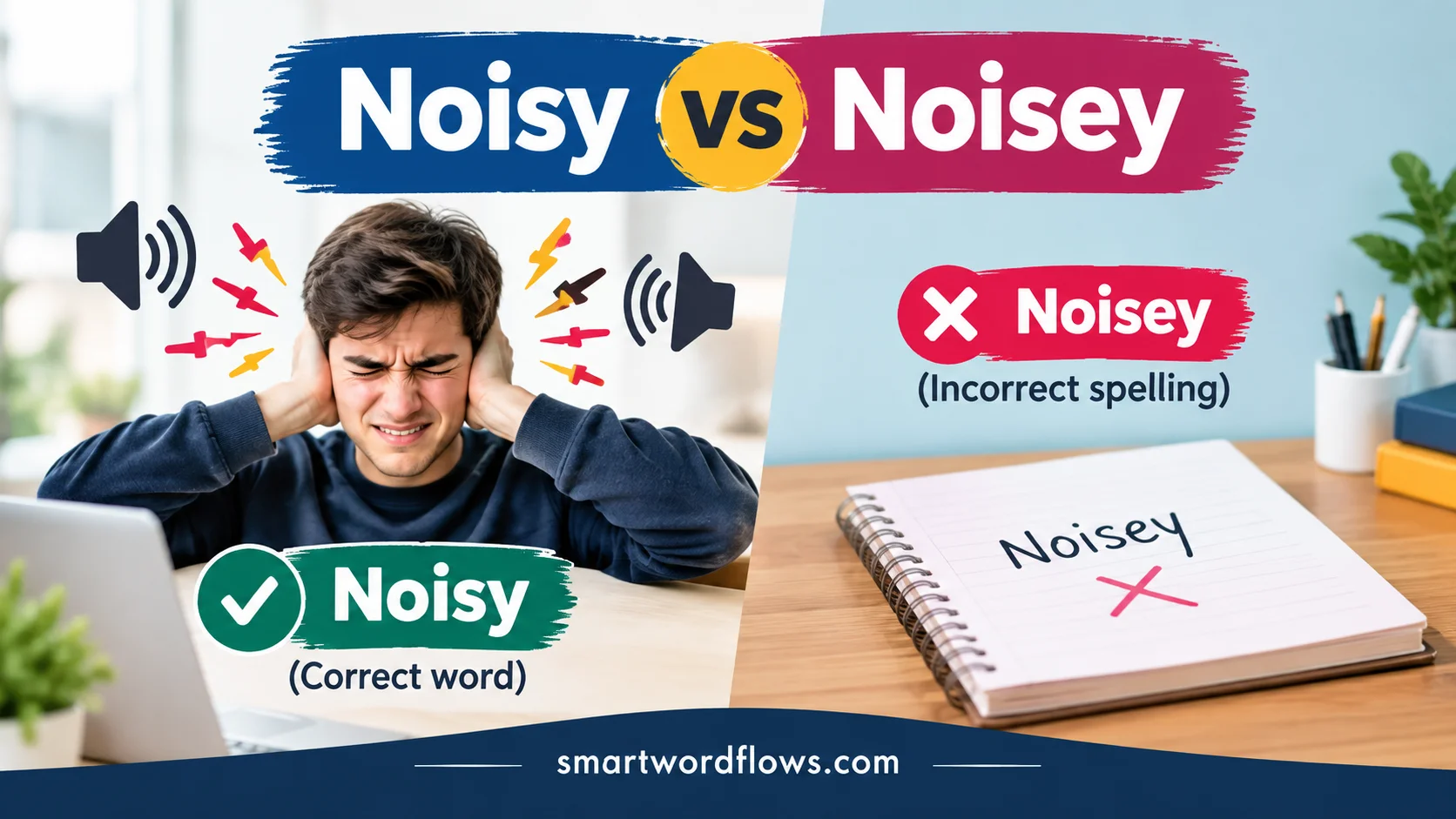

Noisy vs Noisey can be confusing because both words look and sound almost the same, but only Noisy is the correct English spelling in standard English. It is an adjective used to describe sound when there is a lot of noise, loud sounds, or constant noise. You can describe a noisy classroom, busy street, or loud machine as noisy. Noisey is usually a misspelling, although it may appear as a brand name or creative title.
The correct form is important in formal writing, academic work, emails, and professional communication. Using the standard spelling improves English grammar, spelling accuracy, and writing confidence. Whether you write essays, blog posts, business emails, or social media captions, choosing Noisy keeps your writing clear, professional, and grammatically correct. Learners often become confused because of similar pronunciation, but dictionaries and grammar guides recognize Noisy in standard English. This helps you communicate effectively and avoid errors that can affect the quality and credibility of your writing.
Quick Answer
Noisy is the correct standard English spelling.
Noisey is generally a misspelling of noisy when you want to describe someone or something that makes a lot of noise.
For example:
- Correct: The classroom was very noisy.
- Incorrect: The classroom was very noisey.
The word noisy comes from noise + -y. When the suffix -y attaches to noise, English drops the final e, producing noisy rather than noisey.
The same spelling principle appears in other words where a base word ending in e changes before a suffix beginning with a vowel.
So the easiest rule to remember is:
Noise → noisy, not noisey.
Comparison Overview
The difference between noisy and noisey is straightforward once you separate standard spelling from common spelling mistakes.
| Word | Standard English? | Part of Speech | Meaning | Example |
| Noisy | Yes | Adjective | Producing or characterized by a lot of noise | The street is noisy during rush hour. |
| Noisey | No, generally | — | Usually an incorrect spelling of noisy | Avoid noisey in standard writing. |
| Noise | Yes | Noun | An unwanted, unpleasant, or noticeable sound | The noise woke me up. |
| Noisier | Yes | Comparative adjective | More noisy | This room is noisier than the other one. |
| Noisiest | Yes | Superlative adjective | Most noisy | Friday was the noisiest day. |
The important point is that noisy has a legitimate grammatical role and meaning. Noisey generally doesn’t represent a separate standard English word with its own meaning.
Main Differences Between Noisy vs Noisey
The biggest difference between noisy vs noisey is simple: noisy is the accepted spelling, while noisey is normally a spelling error.
However, understanding the reason behind the spelling makes the distinction easier to remember.
Noisy Is the Correct Spelling
Noisy describes something that makes a lot of sound or creates an environment filled with noticeable sound.
You can describe a place, person, machine, animal, event, or situation as noisy.
For example:
- The cafeteria became noisy after lunch.
- We moved because the apartment was too noisy.
- That old refrigerator is surprisingly noisy.
- The children became noisy during the game.
- Traffic makes this road extremely noisy.
Noisey Is Usually a Misspelling
Noisey isn’t the standard spelling of the adjective.
People often write it because they see the base word noise and assume that adding -y requires keeping the final e. English spelling doesn’t work that way here.
Think of the transformation as:
noise + y → noisy
Not:
noise + y → noisey
This is one of those spelling patterns that can feel counterintuitive until you see it several times.
The Difference in One Sentence
If you need to describe something that produces a lot of sound, choose noisy every time in standard English.
What Does “Noisy” Mean?
Noisy is an adjective that describes something or someone that produces a lot of sound, especially sound that is noticeable, excessive, distracting, or unpleasant.
The exact feeling behind the word depends on context.
For instance, a concert can be noisy because hundreds of people and loud instruments create intense sound. A neighbor can also be noisy if they repeatedly play loud music late at night.
The word doesn’t always mean that the sound itself is harmful. It simply emphasizes a high level of sound or a situation where the amount of sound stands out.
Examples of “Noisy”
Here are several common uses:
- The restaurant became noisy during the dinner rush.
- My new apartment overlooks a noisy intersection.
- The washing machine makes a noisy rattling sound.
- The students became noisy when the teacher left the room.
- We couldn’t sleep because the hotel hallway was noisy.
Notice how noisy can describe both people and things. It can also describe an entire environment.
Why Is “Noisy” the Correct Spelling?
The spelling comes from the base noun noise and the suffix -y.
When English forms noisy, the final e in noise disappears:
noise → noisy
This spelling makes sense when you consider the role of the final e. In noise, the final e helps establish the word’s pronunciation. When the suffix -y is added, English spelling conventions don’t require that e to remain.
The resulting word is pronounced approximately NOY-zee.
The spelling therefore becomes:
- noise
- noisy
- noisier
- noisiest
Not:
- noisey
- noisyer
- noisyest
This distinction becomes especially useful when you move beyond the basic adjective.
Why Is “Noisey” Incorrect?
The spelling noisey looks reasonable at first glance because it appears to combine noise and -y directly.
That’s precisely what makes the mistake so common.
English spelling contains many words where adding a suffix changes the spelling of the original word. Writers sometimes preserve letters that should disappear, especially when they form a word based on a familiar root.
With noisy, the standard form doesn’t retain the final e from noise.
A Simple Way to See It
Start with:
NOISE
Add the adjective-forming idea represented by -Y:
NOISE + Y
The standard spelling becomes:
NOISY
The e disappears.
Therefore:
Noisy = correct standard spelling
Noisey = generally incorrect spelling
Noisy: Part of Speech and Grammar
Noisy is an adjective.
An adjective gives information about a noun or describes a person, place, object, animal, or situation.
For example:
- noisy classroom
- noisy street
- noisy engine
- noisy crowd
- noisy children
The adjective can also appear after a linking verb.
Compare these two structures:
Before a noun:
We live on a noisy street.
After a linking verb:
The street is noisy.
Both sentences use noisy correctly.
Comparative and Superlative Forms
When you compare different levels of noise, the word changes.
| Form | Meaning | Example |
| Noisy | Producing a lot of noise | The office is noisy. |
| Noisier | Producing more noise than something else | The office is noisier today. |
| Noisiest | Producing the most noise among a group | Friday was the noisiest day. |
The spelling changes from y to i before -er and -est.
So:
noisy → noisier → noisiest
Don’t write:
- noisyer
- noisyest
Noisy, Noisier, and Noisiest
Understanding these three forms helps prevent several related spelling mistakes.
Noisy
Use noisy when you’re describing something without making a direct comparison.
The classroom is noisy.
Noisier
Use noisier when comparing two things or situations.
The cafeteria is noisier than the library.
Here, the comparison tells readers that the cafeteria produces more noise than the library.
Noisiest
Use noisiest when identifying the thing with the greatest level of noise within a particular group.
That was the noisiest classroom in the entire building.
The word doesn’t simply mean “very noisy.” It usually establishes a comparison with other members of the group.
How to Use “Noisy” in a Sentence
You can use noisy in many everyday contexts because sound appears everywhere.
Describing Places
Places often become noisy because of traffic, people, machinery, music, or other activity.
- The downtown area gets noisy after sunset.
- The airport terminal was incredibly noisy.
- This neighborhood becomes noisy during festivals.
- The restaurant is usually noisy on weekends.
Describing People
You can describe people as noisy when they make a lot of sound or behave loudly.
- The children were noisy after recess.
- The guests became noisy as the evening continued.
- The students grew noisy while waiting for the teacher.
However, noisy can sometimes sound mildly critical when applied to people. If you want a gentler description, words such as energetic or lively may communicate a different tone.
Describing Machines
Machines frequently produce mechanical sounds.
- The old fan is noisy.
- The engine became increasingly noisy.
- That air conditioner is unusually noisy at night.
Here, noisy describes the sound produced by the machine rather than the machine’s appearance or performance.
Noisy vs. Loud: What’s the Difference?
Noisy and loud overlap, but they don’t mean exactly the same thing.
Loud usually focuses on volume or intensity. Noisy often focuses on the presence of a lot of sound, especially when that sound becomes distracting or unwanted.
Consider these examples:
The television is loud.
This tells you that the television’s volume is high.
The neighborhood is noisy.
This suggests that many sounds or persistent sounds make the environment difficult to ignore.
The distinction becomes clearer in everyday situations.
| Word | Main Focus | Example |
| Noisy | Lots of noticeable or unwanted sound | The office is noisy today. |
| Loud | High volume or intensity | The music is too loud. |
A room can be noisy because several people are talking even when nobody speaks particularly loudly.
Likewise, a single alarm can be loud without making the entire environment generally noisy.
Read This: In Tact vs. Intact: Which Spelling Is Correct?
Noisy vs. Noise: Understanding the Difference
Another common confusion involves noise and noisy.
The words are related, but they have different grammatical functions.
Noise is primarily a noun.
Noisy is an adjective.
Compare:
The noise kept me awake.
Here, noise names the sound.
The neighbors were noisy.
Here, noisy describes the neighbors.
Quick Comparison
| Word | Part of Speech | Meaning | Example |
| Noise | Noun | A sound, especially an unwanted or noticeable one | The noise was distracting. |
| Noisy | Adjective | Producing or containing lots of noise | The room was noisy. |
A useful memory trick is to think of noise as the thing and noisy as the description.
How to Pronounce “Noisy”
Noisy is commonly pronounced approximately:
NOY-zee
Its pronunciation doesn’t preserve a separate sound for the final e in noise.
The word has two syllables:
noi-sy
The first syllable sounds like noy, while the second resembles zee.
This pronunciation is another reason that spelling noisey can feel unnecessary. The standard written form is simply noisy.
Common Mistakes With “Noisy”
Spelling mistakes often happen because writers apply a logical pattern that doesn’t match standard English usage.
Here are the most common errors.
Writing “Noisey”
Incorrect:
The classroom was noisey.
Correct:
The classroom was noisy.
Writing “Noisyer”
Incorrect:
This street is noisyer at night.
Correct:
This street is noisier at night.
Writing “Noisyest”
Incorrect:
This was the noisyest restaurant in town.
Correct:
This was the noisiest restaurant in town.
Confusing Noisy With Noise
Incorrect:
The room is full of noisy.
Correct:
The room is full of noise.
Or:
The room is noisy.
The first sentence needs a noun after full of. The second uses the adjective correctly.
Correct and Incorrect Examples
The following examples make the spelling difference easier to recognize.
| Incorrect | Correct |
| The street is noisey. | The street is noisy. |
| My neighbors are noisey. | My neighbors are noisy. |
| The machine sounds noisey. | The machine sounds noisy. |
| This room is noisyer. | This room is noisier. |
| That was the noisyest event. | That was the noisiest event. |
| The noisey engine woke me. | The noisy engine woke me. |
These aren’t differences in meaning. They’re differences between the standard spelling and common errors.
Noisy vs. Noisey in Formal and Informal Writing
In formal writing, choosing noisy is especially important.
Academic papers, professional emails, business reports, resumes, applications, and published articles all benefit from standard spelling.
For example:
The laboratory became noisy during equipment testing.
That sentence looks natural and professional.
Using noisey instead could make the writer appear careless even though the intended meaning remains obvious.
Where “Noisy” Belongs
Use noisy in:
- Academic writing
- Business communication
- School assignments
- News writing
- Professional emails
- Reports
- Essays
- Website content
- Technical documentation
- Everyday messages
If you encounter noisey online, it may simply be a typo. It can also appear as part of a username, brand name, character name, or intentional creative spelling.
That doesn’t make it the standard spelling of the adjective.
How to Remember the Correct Spelling
The simplest memory trick is:
Noise becomes noisy.
Think of the transformation as:
noise → noisy
Then extend it:
noisy → noisier → noisiest
A useful sentence to memorize is:
The noisy dog made a lot of noise.
This sentence puts both related words together and shows their different grammatical roles.
Another useful reminder:
Noisy has no “e” before the “y.”
Once that pattern becomes familiar, noisey starts to look as unusual as it actually is in standard English.
Noisy in Different Contexts
The adjective noisy works across a surprisingly wide range of situations.
Noisy Places
Common examples include:
- Busy streets
- Airports
- Restaurants
- Schools
- Construction sites
- Shopping centers
- Train stations
- Concert venues
- Sports stadiums
For example:
The train station becomes extremely noisy during rush hour.
Noisy People and Groups
People can create noise through conversation, laughter, shouting, cheering, or other activities.
Examples include:
- Noisy children
- Noisy students
- Noisy neighbors
- Noisy crowds
- Noisy guests
- Noisy audiences
The meaning depends heavily on context. A noisy crowd at a football match might be enthusiastic rather than annoying.
Noisy Objects and Machines
Many machines naturally produce mechanical sounds.
Examples include:
- Noisy engines
- Noisy fans
- Noisy air conditioners
- Noisy washing machines
- Noisy generators
- Noisy appliances
For instance:
The washing machine became noticeably noisy during the spin cycle.
Noisy Situations
Some situations become noisy because many sound sources occur at once.
Examples include:
- Parties
- Traffic jams
- Construction projects
- Public celebrations
- Sporting events
- Busy markets
The word works particularly well when the overall environment matters more than one specific sound.
Noisy vs. Other Related Words
Several words connect closely with noisy, but each carries a slightly different meaning.
| Word | Part of Speech | Basic Meaning |
| Noise | Noun | A noticeable or unwanted sound |
| Noisy | Adjective | Producing or containing a lot of noise |
| Loud | Adjective | Producing sound at high volume |
| Quiet | Adjective | Producing little sound |
| Silent | Adjective | Producing or involving no audible sound |
| Soundless | Adjective | Without sound |
| Noisily | Adverb | In a noisy manner |
Consider these examples:
The room was quiet.
The room was noisy.
These descriptions sit at opposite ends of a general sound spectrum.
Meanwhile:
The music was loud.
This focuses more directly on volume.
Choosing the right word lets you communicate a more precise idea instead of simply saying that something makes sound.
Is “Noisey” Ever Correct?
In standard English, noisey isn’t the accepted spelling of the adjective meaning “making a lot of noise.”
However, you might encounter the spelling in special circumstances.
A person could deliberately use Noisey as:
- A username
- A fictional character’s name
- A creative project title
- A brand or product name
- A stylized spelling
- An informal online expression
Those cases don’t change the normal spelling rule.
For ordinary writing, use noisy.
If you’re quoting an existing name that officially uses Noisey, preserve its original spelling. Proper names can follow their own conventions.
Case Study: Choosing the Right Word
Imagine you’re writing a report about a workplace.
You want to explain that employees struggle to concentrate because several teams talk throughout the day.
You could write:
The office is loud.
That’s understandable, but it doesn’t provide much detail.
A stronger sentence would be:
The office becomes increasingly noisy during afternoon meetings because several teams work in the same open space.
The word noisy works better because the problem comes from the overall sound environment rather than one unusually loud sound.
Now consider a different situation:
The presentation was difficult to hear because the speaker’s microphone was too loud.
Here, loud fits because the issue concerns the microphone’s volume.
This small distinction can make your writing much more precise.
When Should You Use “Noisy”?
Use noisy when you need an adjective describing a person, place, object, environment, or situation that produces or contains a significant amount of sound.
For example:
- Noisy neighborhood
- Noisy classroom
- Noisy engine
- Noisy restaurant
- Noisy crowd
- Noisy children
- Noisy street
If you’re describing the sound itself rather than the thing producing it, noise may be the better choice.
The noise was unbearable.
If you’re describing the source or environment, choose noisy.
The room was noisy.
When Should You Avoid “Noisey”?
In ordinary standard English, avoid noisey.
This applies especially when you’re writing something that other people will evaluate or publish.
Instead of:
The neighbors were noisey last night.
Write:
The neighbors were noisy last night.
Instead of:
The machine is getting noisey.
Write:
The machine is getting noisy.
The correction is simple, but it makes the writing look much more polished.
FAQs:
1. Is Noisy or Noisey correct?
Noisy is the correct spelling in standard English. Noisey is generally considered a misspelling and should be avoided in formal writing.
2. What does Noisy mean?
Noisy is an adjective used to describe something that makes a lot of noise or produces loud sounds. For example, a crowded classroom can be noisy.
3. Is Noisey an English word?
Noisey is not the standard spelling of the adjective. You may sometimes see it used as a brand name or creative name, but Noisy is the correct form for normal English writing.
4. Why do people spell Noisy as Noisey?
People often make this spelling mistake because Noisy and Noisey look and sound similar. The pronunciation can make learners choose the wrong spelling.
5. Can I use Noisy in American and British English?
Yes. Noisy is the correct spelling in both American English and British English. You can safely use it in essays, emails, professional communication, and everyday writing.
Conclusion:
Understanding Noisy vs Noisey is simple: Noisy is the correct spelling, while Noisey is generally a misspelling. Remembering this difference can improve your spelling accuracy, writing confidence, and overall English grammar. Use Noisy whenever you want to describe something that produces a lot of noise or loud sounds.