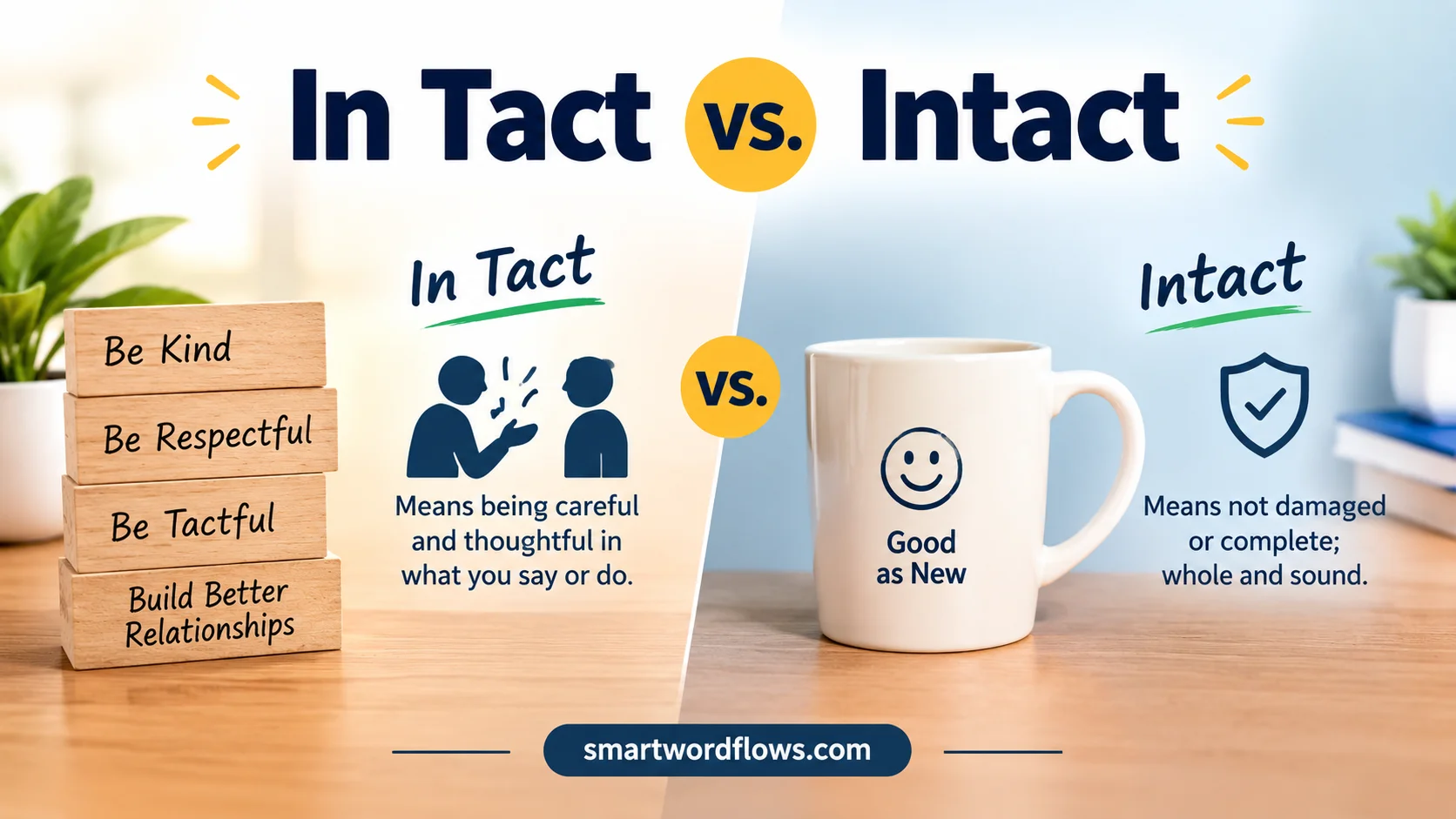

In Tact vs. Intact can be confusing because both forms look similar, but only intact is correct in standard English. The word intact means whole, complete, undamaged, or unchanged. It describes something that remains in its original condition without being broken, harmed, or altered. In contrast, in tact is usually a spelling error. Understanding this simple difference can improve your grammar, writing accuracy, and overall English vocabulary, helping your writing sound more natural and professional.
The confusion becomes easier when you understand tact as a separate noun meaning diplomacy, sensitivity, or careful communication. Meanwhile, intact is written as one word and is the accepted form in dictionaries, academic writing, business communication, and everyday English. Writers, students, and professionals may confuse these words because of their pronunciation, but focusing on their meaning and correct usage helps you avoid common mistakes and communicate more clearly in different situations.
Quick Answer
Intact is the correct spelling when you mean whole, complete, undamaged, or unchanged in an important way.
In tact is generally incorrect when used as a replacement for intact. It often occurs because writers mistakenly interpret intact as the combination of the words in and tact.
Here’s the simplest way to remember it:
If you mean “whole or undamaged,” write “intact” as one word.
Examples
- Correct: The package arrived intact.
- Incorrect: The package arrived in tact.
- Correct: The building remained intact after the storm.
- Incorrect: The building remained in tact after the storm.
However, tact is a real English word on its own. It means skill and sensitivity when dealing with people or difficult subjects.
For example:
- She handled the criticism with tact.
- His tact helped prevent an uncomfortable conversation.
So, intact and tact aren’t interchangeable words.
Comparison Overview
The easiest way to understand in tact vs. intact is to compare the terms side by side.
| Term | Correct standard word? | Part of speech | Meaning | Example |
| Intact | Yes | Adjective | Whole, complete, undamaged, or preserved | The painting remained intact. |
| Tact | Yes | Noun | Sensitivity and skill when dealing with people | She answered with tact. |
| In tact | No, when intended to mean intact | Two separate words | Usually a spelling error | ❌ The painting remained in tact. |
The key point is simple: intact has its own established meaning and spelling. You shouldn’t split it into two words simply because the spelling appears to contain in.
Main Differences Between In Tact and Intact
The main difference between in tact vs. intact comes down to spelling, meaning, and grammatical function.
Intact is an adjective. It describes something that remains whole, complete, or undamaged.
Tact is a noun. It describes a person’s ability to communicate or behave sensitively, especially during delicate situations.
In tact isn’t the standard spelling of the adjective intact. When someone writes it that way, they usually intend to write intact.
| Feature | Intact | Tact | In tact |
| Spelling | One word | One word | Two words |
| Part of speech | Adjective | Noun | Not normally a standard expression for this meaning |
| Meaning | Whole or undamaged | Sensitivity in communication | Usually an error for intact |
| Common use | “The structure remained intact.” | “He responded with tact.” | ❌ “The structure remained in tact.” |
| Standard usage | Yes | Yes | No, for the intended meaning of intact |
This distinction matters because a single space can change how readers interpret a word. In this case, however, adding the space doesn’t create a valid alternative spelling of intact.
What Does “Intact” Mean?
Intact means that something remains whole, complete, undamaged, or substantially unchanged.
The word can describe physical objects, abstract ideas, structures, records, systems, relationships, and many other things.
For example, if a glass falls but doesn’t break, you could say:
“The glass remained intact.”
If a historical document survives without missing pages, you might write:
“The document is remarkably intact.”
The word doesn’t necessarily mean that something looks brand new. An old object can be scratched, faded, or worn while still remaining intact.
That distinction is important.
Imagine an old wooden door that has survived for 200 years. Its surface might have cracks and faded paint. If the door still has its main parts and hasn’t been destroyed, you can reasonably describe it as intact.
Core meanings of intact
Depending on the context, intact can mean:
- Whole
- Complete
- Undamaged
- Preserved
- Still present
- Still in its original condition
- Not broken apart
- Not destroyed
- Not significantly altered
The exact shade of meaning depends on what you’re describing.
Why Is “Intact” Spelled as One Word?
The spelling intact comes from Latin intactus, which means untouched or unharmed. English adopted the word through French and developed it into the modern adjective used today.
That history helps explain why treating the word as in + tact creates confusion.
The modern English word intact isn’t formed by simply placing the preposition in before the noun tact. Its spelling and meaning developed as a unit.
You can find the word documented as a single adjective in major English dictionaries, including:
These references consistently treat intact as one word.
Is “In Tact” Ever Correct?
This question needs a little care because in and tact are both legitimate English words.
However, that doesn’t make in tact a legitimate spelling of intact.
For example, in can function as a preposition:
- The documents are in the folder.
- She works in the office.
- The children are in the classroom.
Meanwhile, tact is a noun:
- He showed considerable tact.
- Diplomacy requires patience and tact.
- She handled the sensitive issue with tact.
You could theoretically encounter the words in and tact next to each other in unusual grammatical circumstances. That doesn’t mean in tact becomes an alternative spelling of intact.
When your intended meaning is whole, complete, or undamaged, use intact.
The important distinction
Compare these sentences:
The original structure remained intact.
Here, intact means the structure remained whole or preserved.
She discussed the matter with tact.
Here, tact means sensitivity and good judgment.
The words belong to different grammatical categories and perform different jobs.
Intact vs. Tact: What Is the Difference?
The difference between intact and tact becomes obvious once you focus on what each word describes.
Intact describes a condition.
Tact describes a social skill.
Think of it this way:
Intact describes the state of something. Tact describes the way someone handles something.
For example, a damaged vase isn’t intact because its physical condition has changed.
A person who explains that damaged vase to its owner politely might show tact.
Examples with intact
- The seal remained intact.
- The package arrived intact.
- The historical site is still largely intact.
- The original design remains intact.
Examples with tact
- She answered the question with tact.
- He used tact when discussing the employee’s mistake.
- The manager handled the complaint with tact.
- Good tact can prevent unnecessary conflict.
These meanings don’t overlap in normal usage.
How to Use “Intact” Correctly
Knowing the definition helps, but seeing intact in different contexts makes the word much easier to use naturally.
For Something That Is Undamaged
One of the most common uses of intact involves physical objects.
If something survives an event without breaking or suffering serious damage, you can describe it as intact.
For example:
“The phone fell from the table but remained intact.”
This doesn’t necessarily mean the phone looks brand new. It simply tells the reader that it remained whole enough to be considered undamaged in the relevant sense.
You might also write:
- The box arrived intact despite the rough delivery.
- The vase survived the move intact.
- The equipment was recovered intact.
- The spacecraft’s capsule returned intact.
For Something That Remains Complete
Intact can also describe something that still contains all its essential parts.
Consider a book with every page still present. Even if the cover has faded, the book could remain intact.
Likewise:
- The complete collection survived intact.
- The archive remained intact.
- The original set is still intact.
- The manuscript survived with its main sections intact.
In this sense, intact emphasizes completeness rather than appearance.
For Something That Remains Unchanged
The word can also describe something that continues in essentially its original form.
For example:
“The central purpose of the agreement remained intact after the revisions.”
Here, nothing physical needs to remain undamaged. Instead, the important idea or purpose continues to exist.
You can use this sense with:
- Plans
- Principles
- Traditions
- Systems
- Agreements
- Structures
- Institutions
- Designs
For instance:
“The renovation modernized the building while keeping its historic character intact.”
That sentence communicates a subtle idea. The building changed in some ways, yet its defining historical character survived.
For Figurative and Abstract Ideas
English frequently uses intact beyond physical objects.
You can describe something abstract as intact when an important quality remains preserved.
Examples include:
- dignity
- trust
- privacy
- independence
- reputation
- confidence
- identity
- integrity
Consider this sentence:
“Despite the criticism, she emerged with her confidence intact.”
Confidence isn’t a physical object. Still, intact clearly communicates that the quality remained strong and undiminished.
Examples of “Intact” in Sentences
Here are varied examples showing how intact works across everyday, professional, historical, and figurative contexts.
- The package arrived intact despite several days of rough weather.
- The antique vase remained intact after the movers carefully transported it.
- Investigators found the original document intact inside the locked cabinet.
- The storm damaged several homes but left the old stone chapel intact.
- The museum preserved the painting with its original frame intact.
- Most of the ancient wall remains intact after centuries of exposure.
- The company changed its branding while keeping its core identity intact.
- The technician returned the computer with all of its original components intact.
- The agreement survived several negotiations with its central principles intact.
- The archaeological team discovered a nearly intact collection of pottery.
- Her sense of humor remained intact even during the stressful project.
- The family managed to keep the old tradition intact for several generations.
- The archive contains an intact series of letters from the early twentieth century.
- The rescue team recovered the equipment intact from the damaged vehicle.
- The chef delivered the elaborate cake intact after a long journey.
- The historic neighborhood retains several intact buildings from the nineteenth century.
- His reputation remained intact after the investigation cleared him of wrongdoing.
- The researchers kept the original samples intact for later testing.
- The renovation left the building’s original staircase intact.
- The book’s pages were yellowed, but the complete text remained intact.
Notice how the word works naturally with both physical and abstract nouns.
Common Mistakes With “Intact”
Even experienced writers occasionally make mistakes with words that sound as though they could contain multiple smaller words.
Mistake: Writing “In Tact”
The most common error is simply adding a space.
Incorrect: The package arrived in tact.
Correct: The package arrived intact.
The same rule applies whether you’re writing casually or professionally.
Mistake: Confusing “Intact” With “Tact”
Because the letters overlap, writers sometimes assume the words have related meanings.
They don’t.
Intact means whole or undamaged.
Tact means sensitivity and skill when dealing with people or delicate situations.
Compare:
“The sculpture remained intact.”
The sculpture wasn’t destroyed.
“The curator spoke with tact.”
The curator communicated carefully.
Mistake: Assuming “Intact” Means Perfect
This is a subtler mistake.
Something doesn’t have to be perfect to be intact.
An old chair might have scratches, faded fabric, and signs of age. If its essential structure remains complete, you might still describe it as intact.
Similarly, a document can have stains while remaining intact.
Therefore:
Intact ≠ perfect
Instead:
Intact = still whole, complete, or preserved in the relevant sense.
Read More: Vender vs Vendor: Which Spelling Is Correct?
Intact vs. Untouched vs. Undamaged vs. Unchanged
Several English words overlap with intact, but they aren’t exact substitutes.
| Word | Primary meaning | Example |
| Intact | Whole or complete without significant damage or loss | The artifact remained intact. |
| Untouched | Not handled, disturbed, altered, or used | The food remained untouched. |
| Undamaged | Not physically harmed | The package was undamaged. |
| Unchanged | Remaining the same | The original plan remained unchanged. |
| Complete | Containing all necessary parts | The collection is complete. |
| Preserved | Kept in good or original condition | The historic site was carefully preserved. |
These distinctions become especially useful in precise writing.
For example, a meal could remain untouched because nobody ate it. That doesn’t necessarily mean the meal remained intact. Food can be touched without being destroyed.
Likewise, a policy can remain unchanged, while intact might emphasize that its essential principles survived revisions.
Case Study: Choosing the Right Word
Imagine a historic library suffers a major storm.
The roof loses several tiles. Some windows break. However, the main archive room remains structurally complete, and its collection survives without major loss.
A writer could say:
“The archive remained intact despite the storm.”
That sentence works because the collection survived as a complete whole.
Now suppose nobody entered one particular reading room during the storm.
You might say:
“The reading room remained untouched.”
That focuses on the fact that nobody disturbed it.
If the building suffered no physical damage, you could say:
“The building remained undamaged.”
If the library’s original preservation policy continued exactly as before, you could say:
“The policy remained unchanged.”
Each word highlights a different detail.
That’s why choosing between similar words isn’t merely about grammar. It affects the precision of your meaning.
Intact in Formal and Professional Writing
Intact works comfortably in professional writing because it expresses a precise idea without sounding overly technical.
You’ll often see it in contexts involving preservation, continuity, evidence, structures, records, and systems.
Academic writing
- The original sample remained intact throughout the experiment.
- Researchers preserved the historical record intact for future analysis.
Business writing
- The company’s core strategy remained intact after the restructuring.
- The acquisition allowed the brand to remain largely intact.
Technical writing
- Keep the protective seal intact until installation.
- Inspect the cable to ensure that its insulation remains intact.
Historical writing
- Several sections of the original fortress remain intact.
- The archive contains an unusually intact collection of correspondence.
Legal and administrative writing
- The original agreement remained intact after the amendment.
- The records must remain intact during the review process.
The word fits all of these settings because its meaning is specific and easy to understand.
Is “Intact” Formal or Casual?
Intact is neither excessively formal nor strongly casual. It works across a wide range of writing.
In conversation, you might say:
“Luckily, my laptop survived intact.”
In a report, you could write:
“The original structure remained largely intact following the restoration.”
Both sentences sound natural.
However, context can determine whether another word would be clearer.
For everyday speech, whole, fine, or undamaged may sometimes sound more relaxed.
For formal writing, intact can offer a concise way to express the idea of preservation or completeness.
How to Remember the Correct Spelling
The easiest memory trick is straightforward:
Intact means “still whole,” and the word itself stays whole.
Don’t split it into in tact.
Another useful association is:
IN TACT ❌ → INTACT ✅
When you’re talking about something that survived without being broken apart, use the single word intact.
A quick memory test
Ask yourself:
“Do I mean whole, complete, or undamaged?”
If the answer is yes, write:
intact
If you’re talking about someone’s ability to handle a sensitive conversation gracefully, write:
tact
For example:
- The package remained intact.
- The manager responded with tact.
That simple distinction handles most situations.
Intact Pronunciation
Intact is commonly pronounced approximately as:
in-TAKT
The stress falls on the second syllable.
The pronunciation doesn’t sound like a phrase made from in and tact. That’s another reason it’s useful to learn the word as a complete unit.
If you’re unsure while writing, focus on the meaning rather than trying to reconstruct the spelling from its sound.
Word Forms Related to “Intact”
Intact primarily functions as an adjective.
It describes a noun:
- an intact building
- an intact document
- an intact collection
- an intact system
- an intact relationship
You may occasionally encounter the noun intactness, which refers to the state of being intact. However, it is considerably less common than the adjective intact.
In ordinary writing, it’s usually better to restructure a sentence if intactness sounds awkward.
For example:
Less natural: The intactness of the structure impressed the researchers.
More natural: The fact that the structure remained intact impressed the researchers.
Clear writing doesn’t need to force a rare noun form when a familiar construction works better.
“In Tact” vs. “Intact” in Writing and Editing
Spelling mistakes can survive surprisingly long when writers don’t notice that a word has been split incorrectly.
The error may appear in:
- Drafts
- Emails
- School assignments
- Business reports
- Website content
- Social media posts
- Product descriptions
- Historical articles
- Technical documents
Spell-checking tools can catch many instances of in tact, but automated tools shouldn’t replace careful proofreading.
Context matters.
A useful editing habit is to search your document for “in tact.” If you find the phrase, check what you intended to say.
If you meant whole, complete, or undamaged, change it to:
intact
For example:
The original records remained in tact.
Change it to:
The original records remained intact.
That tiny correction can make your writing look much more polished.
Intact vs. Complete: Are They the Same?
Not always.
Complete generally means that something contains all the required or expected parts.
Intact emphasizes that something has remained whole or preserved without significant damage, destruction, or loss.
Consider a puzzle.
If all 500 pieces are present, the puzzle is complete.
If the assembled puzzle hasn’t been disturbed or broken apart, you could describe it as intact.
The concepts overlap, yet the emphasis differs.
This distinction becomes particularly useful in professional and academic writing because precise word choice helps readers understand exactly what happened.
Intact vs. Whole: Are They the Same?
Again, the meanings overlap.
Whole is often more general and conversational.
Intact tends to emphasize preservation.
Compare these sentences:
“The apple is still whole.”
This sounds simple and natural.
“The apple remained intact after falling from the tree.”
This emphasizes the fact that the apple wasn’t broken apart by the fall.
Both can work, but intact often carries a stronger sense of something surviving an event.
Intact vs. Preserved: What’s the Difference?
Preserved suggests that someone or something actively kept an object, quality, or condition from being lost or damaged.
Intact describes the resulting state.
For example:
“The museum carefully preserved the manuscript.”
This sentence focuses on the preservation process.
“The manuscript remains intact.”
This sentence focuses on its current condition.
That distinction is subtle but useful.
One describes what happened to protect something. The other describes the condition that remains.
Common Phrases With “Intact”
Certain combinations occur frequently in natural English.
Remain intact
This is one of the most common patterns.
- The original structure remained intact.
- The evidence remained intact.
- Her confidence remained intact.
Keep intact
This means to preserve something without breaking, damaging, or altering it significantly.
- The restoration team wanted to keep the original design intact.
- Please keep the seal intact.
Leave intact
This means not to disturb, remove, or alter something.
- The workers decided to leave the historic doorway intact.
- The renovation plan will leave the original staircase intact.
Survive intact
This emphasizes that something endured a difficult event without significant damage.
- Several artifacts survived intact.
- The documents survived the fire intact.
These combinations make intact particularly useful in descriptive and explanatory writing.
Quick Comparison: Intact, Tact, and In Tact
| Expression | Meaning | Correct usage |
| Intact | Whole, complete, undamaged, or preserved | The package arrived intact. |
| Tact | Sensitivity and good judgment in dealing with people | She handled the issue with tact. |
| In tact | Usually an incorrect attempt to spell intact | ❌ The package arrived in tact. |
The most important lesson is easy to remember:
Intact is one word when it means whole or undamaged.
FAQs:
1. Is “in tact” correct?
No. In tact is generally considered incorrect when you mean whole, complete, or undamaged. The correct spelling is intact.
2. What does “intact” mean?
Intact means something is whole, complete, undamaged, or unchanged. For example, “The package arrived intact.”
3. What does “tact” mean?
Tact is a noun that means diplomacy, sensitivity, or the ability to communicate carefully without offending others.
4. Is “intact” one word?
Yes. Intact is always written as one word when it has the meaning of remaining whole or undamaged.
5. How can I remember “intact” vs. “in tact”?
Remember that intact describes something that remains whole and undamaged. When you want this meaning, always choose intact, not in tact.
Conclusion:
Choosing intact instead of in tact is a simple but important spelling rule. Intact means whole, complete, or undamaged, while tact has a different meaning related to diplomacy and sensitivity. Once you understand this difference, you can avoid a common spelling mistake and make your writing more accurate, clear, and professional.