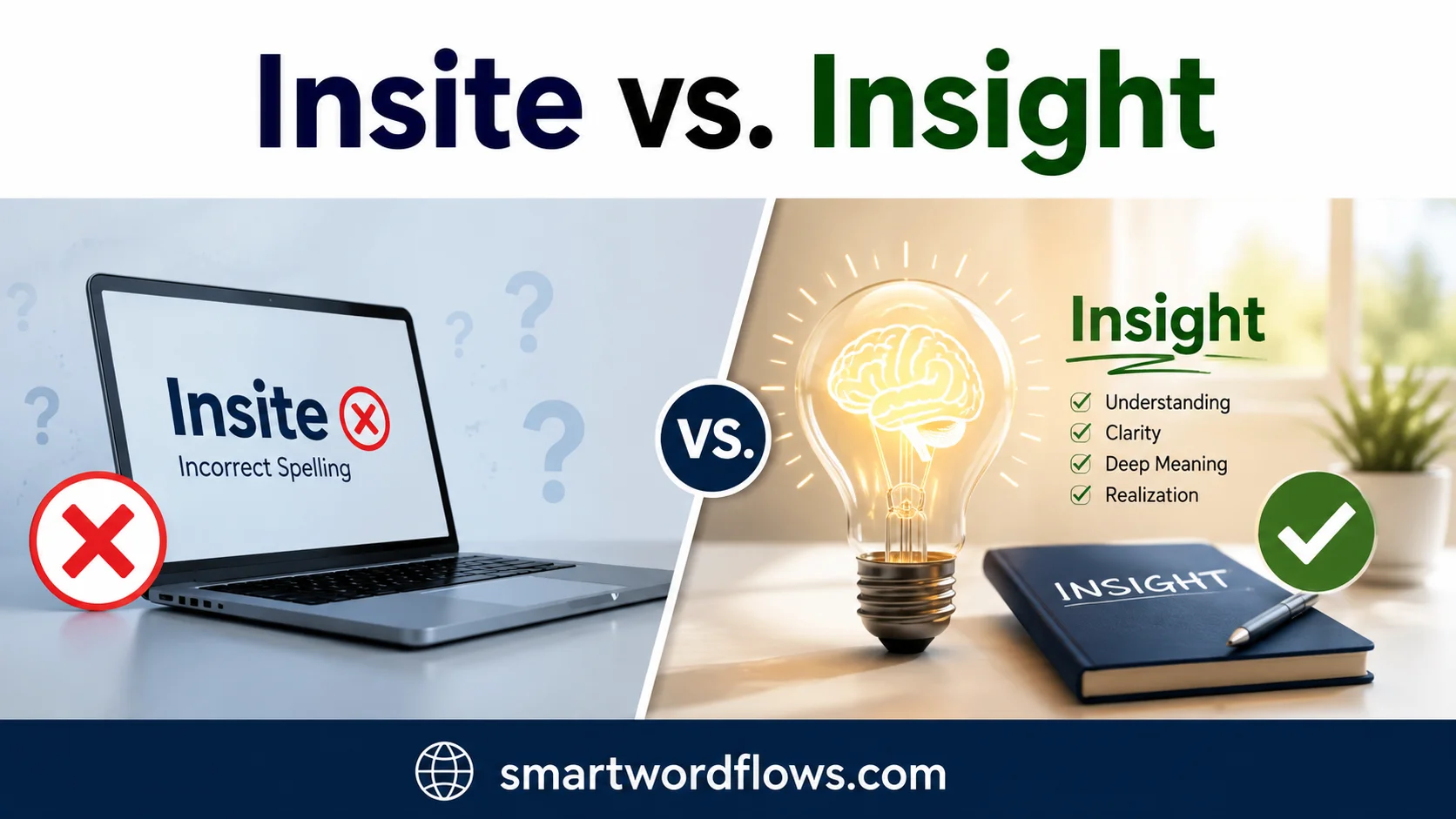

Insite vs. Insight can confuse writers because both words have an identical sound, look similar, and create a common spelling mix-up. The correct spelling is insight, which means understanding, deep understanding, clear perception, or a useful realization about a person, situation, or problem. Insite is usually a spelling mistake, spelling error, or typo. In academic writing, business writing, and professional writing, choosing the correct word improves clarity, accuracy, and credibility. Words ending in -sight can help you remember the difference and improve spelling accuracy.
In professional and academic settings, insight can describe a valuable realization, such as customer insight or market insight. A business report, school assignment, blog post, or professional email should use the correct form to maintain professionalism. However, InSite may appear online as a brand, brand name, or software platform used by companies or organizations. This is an exception, not the normal English word. Always consider the context, meaning, and usage before choosing the word.
Quick Answer
Insight is the correct spelling when you mean a deep or clear understanding of something.
Insite is generally not the standard English spelling of this word. It may occur as part of a specific name, title, brand, organization, or specialized designation, but it shouldn’t replace insight in ordinary writing.
In sight is a separate two-word phrase meaning visible or within view.
The easiest rule to remember
- Insight = deep understanding
- In sight = visible or within view
- Insite = generally not the standard spelling for either meaning
For example:
The interview gave me valuable insight into her decision.
But:
The finish line was finally in sight.
The first sentence concerns understanding. The second concerns visibility.
Comparison Overview
| Form | What it means | Correct standard usage | Example |
| Insight | Deep or clear understanding | Yes | “The study offers valuable insight into the problem.” |
| In sight | Visible or within view | Yes | “The mountains finally came in sight.” |
| Insite | Not normally the standard noun meaning understanding | Usually no | Don’t use it as a spelling of insight. |
The distinction becomes even clearer when you look at dictionary definitions. Cambridge defines insight as a clear, deep, and sometimes sudden understanding of a complicated problem or situation. Oxford likewise describes it as an understanding of what something is like and as the ability to understand the truth about people or situations.
Merriam-Webster emphasizes a similar idea, describing insight as the ability to understand people and situations clearly or to perceive the inner nature of something.
Meanwhile, in sight works differently. It’s a phrase rather than the noun insight. Merriam-Webster defines it in terms of being at or within a reasonable distance or time. In everyday use, it commonly refers to something being visible or approaching within view.
Main Differences Between Insite vs. Insight
The biggest difference between insite vs. insight is simple: insight is the established English noun for deep understanding.
The apparent similarity between the forms creates the trouble.
Insight Means Deep Understanding
When you have insight, you understand something beyond its obvious surface.
Imagine looking at a locked door. Knowing that the door won’t open gives you information. Discovering that the lock is broken gives you an insight into why it won’t open.
That distinction matters.
Cambridge describes insight as a clear, deep, and sometimes sudden understanding of a complicated problem or situation.
For example:
- “The research provides insight into how children learn.”
- “Her comments gave me new insight into the disagreement.”
- “The documentary offers valuable insight into rural life.”
- “His experience gives him considerable insight into the industry.”
In each sentence, insight points toward understanding.
Insite Is Not the Normal Spelling of Insight
If you’re writing about understanding, don’t shorten or simplify insight to insite.
The spelling may look logical because English contains the word site. Your ear may also suggest the spelling because insight sounds like “in-site.”
Still, standard spelling doesn’t follow sound alone.
This is one of those moments when English plays a small trick on you. You hear one sequence of sounds, but the written word has a different structure.
The correct form remains:
insight
Not:
insite
In Sight Has a Completely Different Meaning
The phrase in sight contains two separate words.
Here, sight refers to seeing or visibility.
Compare these sentences:
The report gave us insight into the problem.
The solution was finally in sight.
The first sentence means that the report helped us understand the problem.
The second means that the solution appeared within view or reach.
Merriam-Webster treats in sight and insight as separate entries because they perform different grammatical and semantic jobs.
What Does Insight Mean?
Insight is a noun connected with understanding, perception, and discernment.
It can describe either the ability to understand something deeply or a particular understanding that you gain.
Oxford identifies both countable and uncountable uses. You can talk about insight generally, or you can refer to an insight or several insights.
Insight as Deep Understanding
Consider this example:
Maya understands that sales are falling.
That’s useful information.
Now suppose Maya studies customer behavior and discovers that sales fall whenever the checkout process becomes complicated.
That’s more than information. It’s an insight because she has identified an underlying relationship.
This is why the word appears frequently in business, research, education, journalism, psychology, and everyday conversation.
Insight as a Useful Observation
You can also use insight for a particular observation that helps explain something.
For example:
The survey provided several useful insights into customer preferences.
Here, insights means meaningful conclusions or observations gained from the survey.
Oxford gives examples of insight used with subjects such as business, education, research, and human behavior.
Insight Can Be Sudden
Insight doesn’t always arrive gradually.
Sometimes you wrestle with a problem for hours and then suddenly understand what’s wrong. That moment can be described as a flash of insight.
For example:
With a sudden insight, she realized why the experiment had failed.
This usage captures an important feature of the word: insight can describe the moment when something previously unclear suddenly makes sense.
How to Use Insight in a Sentence
The word insight works naturally in many settings.
Everyday Examples
- “Talking to him gave me valuable insight into the situation.”
- “Her explanation offered some useful insight.”
- “The conversation gave me a better insight into his concerns.”
- “That experience gave her greater insight into the problem.”
Academic Examples
- “The study provides new insights into language development.”
- “The research offers valuable insight into social behavior.”
- “The book gives readers an interesting insight into the period.”
- “The experiment produced several important insights.”
Workplace Examples
- “The survey revealed valuable insights into customer behavior.”
- “The meeting gave the team greater insight into the project’s risks.”
- “Her experience provides useful insight into the industry.”
- “The data gave managers new insights into employee preferences.”
Personal Examples
- “Living abroad gave him new insight into another culture.”
- “Her story gave me some insight into what she was experiencing.”
- “The conversation provided unexpected insight into his personality.”
Cambridge’s dictionary examples similarly use insight with phrases such as insight into human relationships, insight into group dynamics, and insights into events or human behavior.
Insite vs. Insight Examples
The quickest way to understand this spelling issue is to compare incorrect and correct sentences.
| Incorrect in ordinary English | Correct |
| The report gave us valuable insite. | The report gave us valuable insight. |
| She has great insite into human behavior. | She has great insight into human behavior. |
| We gained new insite into the problem. | We gained new insight into the problem. |
| His research provides useful insites. | His research provides useful insights. |
| The interview offered an interesting insite into her career. | The interview offered an interesting insight into her career. |
The pattern is consistent. When the sentence means understanding, use insight.
Common Mistakes With Insite and Insight
The spelling problem usually comes from pronunciation, visual similarity, or confusion with in sight.
Mistake: Writing Insite Instead of Insight
This is the most direct error.
Someone may hear:
“The report gives us insight into the problem.”
Because insight sounds like “in-site,” they may write:
“The report gives us insite into the problem.”
That spelling is incorrect for the standard noun.
The fix is simple: memorize insight as a complete word.
Mistake: Treating Insite as a Short Form
Some writers assume insite is simply a shorter spelling of insight.
It isn’t.
You shouldn’t remove the gh merely because those letters don’t produce a separate sound in modern pronunciation.
English has many words whose spelling preserves historical forms that pronunciation no longer makes obvious. Insight is one of them.
Mistake: Confusing Sound With Spelling
Cambridge gives the US pronunciation of insight as /ˈɪn.saɪt/.
That pronunciation makes the spelling confusion understandable.
When spoken aloud, the word sounds like:
in-sight
Yet its written form is:
insight
This is a useful reminder that pronunciation can guide spelling, but it can’t always determine it.
If you learned the word primarily through conversation, this mistake becomes especially easy to make.
Mistake: Confusing Insight With In Sight
This error changes the meaning rather than simply changing the spelling.
Compare:
The article gave me insight into the issue.
Here, the article helped you understand something.
Now compare:
The finish line was in sight.
Here, you could see the finish line or consider it close enough to be within view or reach.
A quick test can help:
Can you replace the word with “understanding”?
If yes, insight is probably correct.
Are you talking about something being visible or within view?
If yes, choose in sight.
Mistake: Using the Wrong Plural
The plural of insight is insights.
For example:
The report revealed three important insights.
Not:
The report revealed three important insites.
This becomes especially important in business and academic writing because insights frequently refers to multiple conclusions or observations.
Mistake: Assuming Only “Insight Into” Is Possible
The construction insight into is extremely common:
The study provides insight into consumer behavior.
However, standard dictionaries also record other constructions, including insight about, insight on, and insight as to in appropriate contexts. Oxford specifically lists these patterns in its usage information.
So don’t turn a useful pattern into an inflexible rule.
In most general writing, though, insight into is an especially natural choice when you’re describing deeper understanding of a subject.
Insight vs. In Sight: A Crucial Difference
This distinction deserves special attention because insight and in sight can sound exactly alike in ordinary speech.
Insight
Insight is one word and functions as a noun.
It means:
- deep understanding
- perceptive understanding
- awareness of underlying factors
- a useful observation
- a clearer understanding of a person or situation
Example:
The interview gave the journalist valuable insight into the company’s culture.
In Sight
In sight consists of two words.
It relates to visibility or something being within view.
Examples:
- “The coastline finally came in sight.”
- “The finish line is in sight.”
- “No other buildings were in sight.”
- “Help was finally in sight.”
A Simple Test
When you’re unsure, ask yourself:
Am I talking about understanding or seeing?
If you’re talking about understanding, use insight.
If you’re talking about seeing, use in sight.
That’s the cleanest distinction between the two.
Why Do People Write Insite Instead of Insight?
There are several understandable reasons behind the mistake.
The Pronunciation Makes It Look Logical
English spelling isn’t always phonetic.
Insight is pronounced /ˈɪn.saɪt/ in both US and UK English according to Cambridge.
Nothing in that pronunciation clearly signals the letters gh.
Someone encountering the word for the first time may naturally guess:
in-site
instead of:
insight
The mistake makes sense phonetically. It simply isn’t the standard spelling.
The Word “Site” Is Familiar
The separate word site means a place or location.
That makes insite look familiar at first glance.
Your brain recognizes in and site as ordinary English elements. Unfortunately, familiarity isn’t the same thing as correctness.
The Silent Letters Create a Trap
The gh in insight doesn’t contribute a separate consonant sound in modern pronunciation.
That’s why hearing the word isn’t enough to reconstruct its spelling accurately.
The safest approach is to learn the word visually as a whole:
I-N-S-I-G-H-T
Read This: Moment vs Momment: Difference, Correct Spelling, Meaning, and Usage
How to Remember the Correct Spelling of Insight
A useful memory trick is to connect insight with the idea of seeing into something.
Think of the word as a metaphor:
in + sight → seeing into something deeply
You aren’t literally looking through an object. Instead, you’re looking beneath the surface to understand what something really means.
For example, someone may know that a company has declining sales. An analyst with insight can identify the deeper reasons behind that decline.
The connection between sight and understanding also fits the historical development of the word. Oxford traces insight through Middle English with a sense related to “inner sight” and wisdom.
So when you’re tempted to write insite, remember:
Insight means seeing deeply, not simply seeing.
That mental connection makes the spelling easier to retain.
Insight: Singular and Plural Forms
Understanding the singular and plural forms helps prevent another common error.
Singular: Insight
Use insight for one understanding or for the concept generally.
Examples:
- “The interview provided valuable insight.”
- “Her experience gave her considerable insight.”
- “The research offers new insight into the issue.”
Plural: Insights
Use insights when you’re referring to multiple observations, conclusions, or pieces of understanding.
Examples:
- “The researchers discovered several important insights.”
- “The report contains valuable insights.”
- “Customer interviews produced three major insights.”
Oxford explicitly recognizes both countable and uncountable uses of insight, which explains why both insight and insights can be correct depending on the sentence.
Insight Synonyms and Their Differences
Several words overlap with insight, but they aren’t identical.
| Word | Main idea | Example |
| Insight | Deep understanding | “The interview gave her insight into the problem.” |
| Understanding | General grasp of something | “He has a good understanding of the subject.” |
| Perception | Awareness or interpretation | “Her perception of the situation changed.” |
| Discernment | Ability to recognize subtle differences | “His discernment helped him judge the situation.” |
| Awareness | Knowledge that something exists or happens | “The campaign increased awareness.” |
| Comprehension | Ability to understand information | “The lesson improved reading comprehension.” |
| Intuition | Understanding without conscious reasoning | “Her intuition told her something was wrong.” |
These words overlap, but replacing insight with any synonym can change the emphasis.
For example, awareness means knowing that something exists. Insight generally goes further by suggesting a deeper understanding of what something means or how it works.
When Should You Use Insight?
Use insight when your sentence describes a deeper understanding rather than basic information.
You might use it when discussing:
- human behavior
- customer preferences
- scientific findings
- historical events
- personal experiences
- business decisions
- social issues
- complex problems
- literature and art
- relationships
- research conclusions
For example:
The interviews provided valuable insight into customer expectations.
The interviews didn’t merely tell the company what customers said. They helped reveal patterns in customer thinking and behavior.
That’s exactly where insight fits.
When Should You Use Insite?
For ordinary English writing, insite shouldn’t replace insight.
If you want to express the idea of deep understanding, write:
insight
not:
insite
There is one important qualification. Insite can appear in names or other specific designations. A company, organization, project, product, or title may intentionally use that spelling. In such cases, the official name controls.
That doesn’t make insite a standard alternative spelling of insight.
If you’re writing your own sentence and you mean deep understanding, the safe choice is insight.
Real-World Case Study: Why the Difference Matters
Imagine a business manager reviewing customer complaints.
The manager sees that many customers abandon their shopping carts before completing a purchase. That’s a fact.
After analyzing customer interviews, the manager discovers that shoppers become frustrated when unexpected shipping costs appear near checkout.
That’s an insight.
The distinction looks small, but it matters:
| Stage | What the manager learns |
| Observation | Customers abandon their carts. |
| Information | Abandonment happens frequently during checkout. |
| Analysis | Many customers react negatively to unexpected shipping costs. |
| Insight | Unexpected costs create a major barrier to completing purchases. |
| Action | The company makes shipping costs visible earlier. |
This illustrates what makes insight stronger than ordinary information. Insight helps reveal the meaning or underlying reason behind what you observe.
Insite vs. Insight in Professional Writing
Spelling matters even more in professional communication because small errors can undermine an otherwise polished document.
Consider a business report:
“The survey provides valuable insite into customer behavior.”
The reader may understand what you mean. Still, the spelling error distracts from the credibility of the report.
The corrected version is:
“The survey provides valuable insight into customer behavior.”
That single correction makes the sentence standard and professional.
The same principle applies to:
- resumes
- cover letters
- academic papers
- business reports
- presentations
- emails
- websites
- marketing content
- research summaries
- application essays
A spelling mistake doesn’t always destroy meaning. It can still weaken the impression your writing creates.
Common Phrases With Insight
Learning common word combinations can make correct usage much easier.
Useful phrases include:
- gain insight
- provide insight
- offer insight
- give insight
- valuable insight
- useful insight
- fresh insight
- new insight
- deep insight
- greater insight
- insight into something
- insights into something
- a flash of insight
- a lack of insight
Examples:
The study provides valuable insight into consumer behavior.
Her experience gave us greater insight into the challenges involved.
The book offers fresh insights into human relationships.
A sudden flash of insight helped him solve the puzzle.
Oxford’s usage examples include combinations such as valuable insights, useful insights, gain insight, fresh insight, and insight into, confirming how widely these patterns are used in standard English.
Insite vs. Insight: Quick Decision Guide
When you’re proofreading, use this simple process.
If you mean deep understanding
Choose:
insight
The article provides useful insight into the issue.
If you mean something visible
Choose:
in sight
The harbor was finally in sight.
If you’re referring to a specific name
Check the official spelling.
If an organization, product, project, or other entity officially uses Insite, retain that spelling when referring to that specific entity.
If you’re unsure
Ask what the sentence means.
Understanding? → insight
Visibility? → in sight
Specific official name? → follow the official spelling
Insite vs. Insight: Key Differences at a Glance
| Feature | Insight | In sight | Insite |
| Standard English form | Yes | Yes | Not normally as the noun meaning understanding |
| Number of words | One | Two | One |
| Main meaning | Deep understanding | Visible or within view | Usually not the intended standard noun |
| Part of speech | Noun | Phrase | Depends on specific name or use |
| Example | “She offered valuable insight.” | “The shore came in sight.” | “Insite” may be a proper name |
| Plural | Insights | — | Depends on the specific name |
| Common error | Sometimes misspelled insite | Sometimes confused with insight | Often used accidentally for insight |
FAQs:
1. Is insight or insite correct?
Insight is the correct English spelling when you mean understanding, perception, or a useful realization. Insite is usually a spelling mistake.
2. What does insight mean?
Insight means a clear or deep understanding of a person, situation, problem, or idea.
3. Is insite ever correct?
Yes, InSite can be correct when it is used as a brand name, company name, software name, or other proper name. It isn’t normally used as a standard English word.
4. Why do people confuse insite vs insight?
People confuse them because they sound alike and look similar. Fast typing and unfamiliarity with the spelling can also cause the mistake.
5. How can I remember the difference?
Remember that insight contains -sight, which connects with seeing and understanding. When you mean understanding or perception, choose insight.
Conclusion:
Insight is the correct word for expressing understanding, perception, or a useful realization. Insite is generally a spelling error unless it is an official brand or proper name. Knowing this simple difference can improve your writing accuracy, clarity, and professionalism.