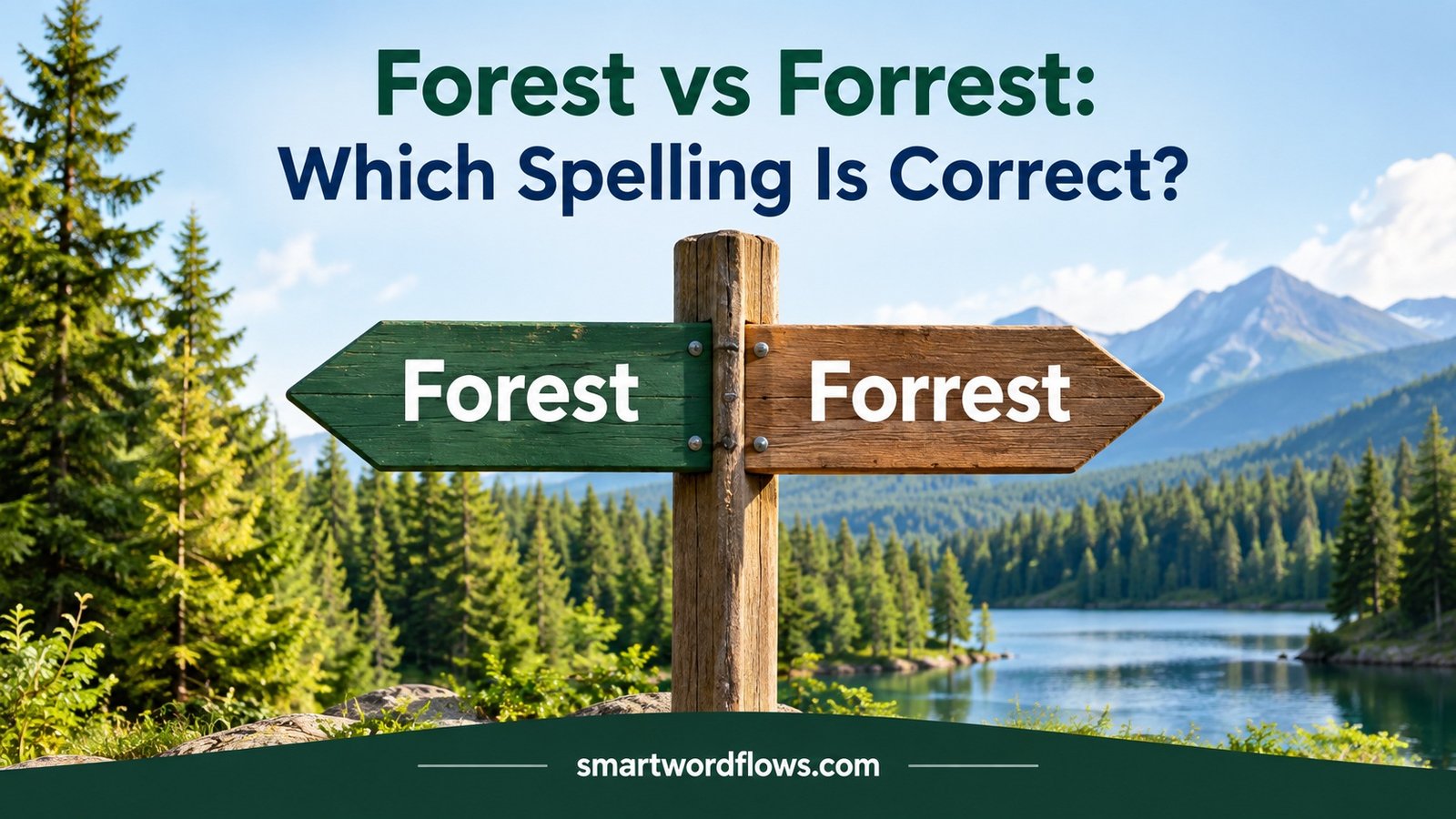

Forest vs Forrest: Which Spelling Is Correct? helps writers separate the word for trees from the personal name and avoid common spelling mistakes.
When writers, learners, and English users compare forest and forrest, the main challenge is spelling accuracy, because the two words can share the same sound when spoken, creating confusion around pronunciation, spelling difference, and homophone use. In English grammar and the English language, forest is the correct spelling for a natural area, large area, or woodland space filled with trees, plants, wildlife, and natural vegetation. It can describe woodland areas, wooded land, a wooded area, rainforests, and a rainforest, and it fits naturally into nature writing, environmental writing, environmental discussions, books, maps, everyday conversations, and written communication. Forrest, however, is generally a personal name, proper name, first name, last name, or surname, as seen in Forrest Gump and Nathan Bedford Forrest, the latter being a historical figure, while Forrest can also refer to a fictional character.
Looking at usage, meaning, context, origins, and uses makes the distinction easier: Forest is a common noun, while Forrest is normally a proper noun. This difference matters in an essay, email, blog post, social media caption, professional writing, professional communication, and casual communication, where the correct word, word choice, correct usage, and accuracy improve clarity. A useful memory tip is to connect forest with nature, natural environment, natural beauty, trees and plants, and land, while Forrest connects with a name. Understanding this word distinction, spelling rule, grammar rules, spelling rules, and usage rules can build grammar confidence, writing confidence, writing skills, and writing clarity, while reducing spelling mistakes, common mistakes, common spelling mistakes, incorrect usage, and incorrect spelling. The extra r and letter are therefore important in modern English, especially when communicate and accurately matter and you want to write without hesitation. Vocabulary, grammatical usage, language learning, and careful attention to meaning make the choice easy and simple.
Quick Answer: Forest or Forrest?
Forest is the correct spelling when you mean a large area of land covered with trees and plants.
Forrest is usually a proper name, especially a person’s first name or surname. It can also occur in established place names and other proper names.
Here is the simplest rule to remember:
Forest = trees and woodland. Forrest = usually a name.
For example:
- We walked through the forest before sunset.
- The forest was filled with tall pine trees.
- Forrest called me yesterday.
- Forrest lives near the university.
Writing forrest when you mean a wooded area is normally a spelling mistake in modern standard English. However, Forrest is not inherently an incorrect spelling. It is a legitimate proper name with a long history.
The distinction becomes especially important when you’re writing someone’s name. If a person’s legal or established name is Forrest, changing it to Forest simply because the latter is the ordinary English word would be incorrect.
Comparison Overview
| Feature | Forest | Forrest |
| Main use | Common noun | Proper noun |
| Basic meaning | A large area covered with trees | Usually a personal name or surname |
| Capitalization | Usually lowercase | Capitalized when used as a name |
| Refers to woodland | Yes | No, in ordinary modern English |
| Can be a first name | Rarely, but possible as a name | Yes |
| Can be a surname | Yes | Yes |
| Pronunciation in US English | /ˈfɔːr.ɪst/ | /ˈfɔːr.ɪst/ |
| Example | The forest is beautiful. | Forrest arrived early. |
| Common spelling mistake | — | Using forrest for woodland |
The important point is that Forest and Forrest aren’t simply two interchangeable spellings. Their roles in a sentence usually differ.
Cambridge defines forest as a large area of land covered with trees and plants. Oxford similarly defines it as a large area of land thickly covered with trees.
Forrest, meanwhile, has developed primarily as a name. Historical surname sources connect it with the word forest, particularly people who lived or worked in or near forests.
Main Differences Between Forest vs Forrest
The easiest way to understand Forest vs Forrest is to separate meaning from spelling.
Forest describes something.
Forrest usually identifies someone or something by name.
That difference sounds simple, but it solves most spelling questions immediately.
Forest Means a Large Area of Trees
A forest is a large area where trees and other plants grow. Forests can vary dramatically in size, climate, vegetation, and wildlife.
You might talk about a tropical forest, pine forest, boreal forest, or old-growth forest. The word can also appear in environmental, scientific, geographic, and everyday writing.
For example:
- The hikers entered the forest early in the morning.
- The region contains a large tropical forest.
- Several species live in the forest.
- A fire spread rapidly through the dry forest.
- The researchers studied the forest ecosystem.
Oxford also notes a figurative use of forest, such as a “forest of cranes,” meaning a dense mass of tall objects.
Forrest Is Usually a Name
Forrest commonly functions as a proper noun.
It may appear as someone’s first name:
Forrest moved to Chicago last year.
It may also appear as a surname:
James Forrest signed the document.
Because names identify particular people, they normally begin with capital letters.
This creates an immediate visual difference:
- forest → ordinary noun
- Forrest → proper name
That capital letter matters, but the extra r matters too.
Forest Can Also Appear in Names
There’s an important wrinkle here: Forest itself can also be used as a proper name or surname.
That means the distinction isn’t an absolute rule that says “Forest can never be a name.” It can’t.
For example, a person may legitimately have Forest as a first name or surname. Likewise, Forest can occur in place names.
The practical rule is therefore more precise:
Use the spelling that belongs to the particular meaning or official name you’re referring to.
If you’re describing woodland, use forest. If you’re writing a person’s name, copy the person’s established spelling exactly.
What Does Forest Mean?
The ordinary noun forest refers to a large area of land covered with trees and plants. Cambridge lists it as both countable and uncountable and gives examples involving pine forests, dense forests, forest floors, and forests in different regions.
Oxford gives a similar definition and notes that forest can refer to a thickly tree-covered area.
Forest as a Common Noun
In most sentences, forest works like an ordinary common noun.
For example:
The children explored the forest with their parents.
Here, forest doesn’t identify one specific named place. It simply describes a type of natural environment.
You can use articles and determiners with it:
- a forest
- the forest
- this forest
- that forest
- several forests
- dense forest
The plural is straightforward:
forest → forests
For example:
The country contains several large forests.
Forest in Environmental and Scientific Writing
The word appears frequently in discussions about ecology and environmental science.
Common expressions include:
- forest ecosystem
- forest habitat
- forest conservation
- forest management
- forest floor
- forest canopy
- forest fire
- forest wildlife
- forest resources
- forest restoration
Forestry is the related field concerned with planting and caring for trees and forests. Cambridge defines forestry as the science of planting and taking care of large areas of trees.
So if you’re writing about environmental science, forest is the standard spelling.
Common Forest Examples
Consider these sentences:
- The trail winds through a dense forest.
- Birds nested high in the forest canopy.
- The researchers examined the forest ecosystem.
- Heavy rain made the forest floor muddy.
- The government introduced new forest conservation measures.
None of these sentences needs the spelling Forrest.
What Does Forrest Mean?
Forrest is primarily encountered as a proper name. It can function as a given name and surname.
Historical sources connect the surname to the noun forest. Wiktionary describes Forrest as a topographical surname associated with someone who lived or worked in a royal forest. It also identifies Forrest as a male given name transferred from the surname.
Ancestry’s entry, drawing on the Dictionary of American Family Names, likewise describes Forrest as an English topographic or occupational surname associated with forests.
Forrest as a First Name
When Forrest is someone’s first name, it must retain its established spelling.
For example:
Forrest joined the team after lunch.
It would be wrong to change the name to:
Forest joined the team after lunch.
unless the person’s actual name is Forest.
This is one reason spelling accuracy matters beyond grammar. A misspelled person’s name can change the identity you’re referring to.
Forrest as a Surname
Forrest is also an established surname.
For example:
Dr. Forrest published the study in 2025.
Here, the double r isn’t an error. It’s part of the person’s family name.
Historical surname records show the Forrest name in the United States, United Kingdom, Canada, and Scotland. Ancestry’s surname research also records historical Forrest families in US census and other genealogical records.
Forrest in Place and Other Proper Names
Forrest can also appear in established names.
For example, Forrest County is a place name in Mississippi. Forrest also appears in the name of the fictional character Forrest Gump.
These uses demonstrate an important writing principle: proper names don’t have to follow the spelling you would expect from the ordinary dictionary word.
If an official name contains two r’s, preserve those two r’s.
Forest vs Forrest Grammar and Capitalization
Grammar gives you another useful clue when deciding between Forest vs Forrest.
Common Noun vs Proper Noun
Forest is normally a common noun.
The forest looked beautiful after the rain.
Forrest is usually a proper noun.
Forrest looked tired after the journey.
The difference is similar to other common-noun and proper-name pairs.
Think about:
- city vs. Chicago
- river vs. Mississippi
- company vs. Microsoft
- forest vs. Forrest
The comparison isn’t exact in every situation, but the capitalization principle is useful.
When Forest Is Capitalized
You generally don’t capitalize forest simply because it seems important.
For example:
We spent the afternoon in the forest.
not:
We spent the afternoon in the Forest.
However, capitalization can change when Forest forms part of an official name.
That means context still matters.
Why Context Changes the Correct Spelling
Consider these two sentences:
The forest is about five miles away.
Forrest is about five miles away.
The pronunciation may sound identical. The meanings are completely different.
The first sentence describes a wooded area.
The second identifies a person named Forrest.
This is why proofreading based only on sound can fail. Your ears may not catch the error. Your understanding of the sentence will.
Is Forrest a Correct Spelling?
Yes. Forrest is a legitimate spelling, especially when used as a personal name or surname.
What isn’t normally correct is using lowercase forrest as the modern standard noun for a wooded area.
For example:
We spent the day walking through the forest.
Correct.
We spent the day walking through the forrest.
Incorrect when forrest is intended to mean a wooded area.
The distinction becomes clearer when you remember that Forrest developed as a surname connected historically with forest-related occupations and locations.
So calling Forrest “wrong” without context would be misleading.
Forrest is wrong for the ordinary noun in modern standard English. It is perfectly correct as an established name.
Read More:Kindergarten vs Kindergarden: Which Spelling Is Correct?
Is “Forrest” a Misspelling of “Forest”?
Sometimes. It depends on what the writer means.
Suppose someone writes:
We spent the weekend camping in the forrest.
If the writer means a wooded area, forrest is a spelling error.
The corrected sentence is:
We spent the weekend camping in the forest.
Now consider:
Forrest called to confirm the reservation.
If Forrest is the person’s actual name, the spelling is correct.
This gives you a reliable proofreading test:
Ask what the word refers to.
If it refers to trees and woodland, choose forest.
If it identifies a person or established proper name, check the official spelling.
Why Do People Confuse Forest and Forrest?
The confusion is understandable. The two forms are almost twins on the page.
The Extra R Looks Natural
English contains many words where doubled consonants are common. That makes Forrest look like it could simply be an alternative spelling of forest.
Historically, the connection isn’t imaginary. The surname Forrest developed from the same broader word family associated with forests.
Still, modern standard English uses forest for the ordinary noun.
Pronunciation Creates Confusion
This is probably the biggest practical problem.
Cambridge lists the US pronunciation of both forest and Forrest as /ˈfɔːr.ɪst/.
In other words, if someone says the word aloud, you may not know which spelling they mean.
That’s why spelling from dictation can be tricky.
You need context.
Familiar Names Reinforce the Confusion
The spelling Forrest is particularly recognizable because of well-known personal names.
A familiar example is Forrest Gump, the fictional character from the novel and film of the same name.
Once people become accustomed to seeing Forrest as a name, they may accidentally transfer the spelling to the ordinary noun.
Forest vs Forrest Pronunciation
For US English, forest and Forrest are generally pronounced alike.
Cambridge gives:
- forest: /ˈfɔːr.ɪst/
- Forrest: /ˈfɔːr.ɪst/
That makes this pair a useful example of why English spelling can’t always be predicted from pronunciation.
When you hear someone say the word, you can’t reliably determine whether they mean the natural environment or a person’s name.
For example, imagine someone says:
“I met Forrest yesterday.”
Without seeing the sentence, you can’t know whether Forrest is someone’s name. Context provides the missing information.
Forest vs Forrest: Origin and History
The history behind these words explains why their similarity isn’t accidental.
Origin of Forest
Oxford traces forest to Middle English. The word came through Old French from Late Latin forestis, associated with woodland or uncultivated land. Oxford notes that the historical sense involved wooded areas kept for hunting and explains the connection with Latin foris, meaning “outside.”
The modern meaning gradually became broader.
Today, forest normally refers to a large area covered with trees. It doesn’t require the historical connection with royal hunting grounds.
Origin of the Forrest Name
The surname Forrest has a closely related history.
Ancestry’s Dictionary of American Family Names entry describes Forrest as an English topographic name for someone who lived in or near a royal forest. It could also describe someone whose occupation involved working in such an area.
Wiktionary similarly describes the surname as a topographical name connected with people who lived or worked in a royal forest.
So the extra r isn’t simply random.
Names often develop spelling variations over centuries. A family name can preserve a form that differs from the modern spelling of the related common word.
Forest vs Forrest in Real-World Sentences
Seeing the words in context makes the distinction much easier.
Talking About Nature
Use forest:
- The hikers entered the forest before sunrise.
- The forest contains hundreds of plant species.
- A narrow path runs through the forest.
- The fire damaged thousands of acres of forest.
- The children learned about forest wildlife.
Talking About People
Use Forrest if that is the person’s established name:
- Forrest arrived at noon.
- I sent the report to Forrest.
- Forrest and Maria attended the meeting.
- Mr. Forrest signed the agreement.
Talking About Official Names
Follow the established spelling of the proper name:
- Forrest County is a proper place name.
- The character is named Forrest Gump.
The important thing is consistency. Don’t “correct” an official name to fit your expectations.
Correct vs Incorrect Examples
| Incorrect or Misleading | Correct | Explanation |
| We walked through the forrest. | We walked through the forest. | The ordinary noun takes one r. |
| The forrest was dense. | The forest was dense. | Woodland is spelled forest. |
| Forest called me yesterday. | Forrest called me yesterday. | Use the person’s actual name. |
| We studied Forrest conservation. | We studied forest conservation. | The environmental term is forest. |
| forrest Gump is a fictional character. | Forrest Gump is a fictional character. | Proper names are capitalized and spelled exactly. |
Common Mistakes With Forest and Forrest
Several mistakes appear repeatedly because the words look so similar.
Writing “Forrest” for Woodland
This is the most common error.
❌ We hiked through the forrest.
✅ We hiked through the forest.
Remember: trees = forest.
Changing Someone’s Name
Suppose someone’s name is Forrest.
❌ Forest Smith attended the meeting.
✅ Forrest Smith attended the meeting.
The second spelling respects the person’s established name.
Lowercasing a Proper Name
If Forrest refers to a person, don’t normally write it as lowercase.
❌ forrest sent the email.
✅ Forrest sent the email.
Assuming the Extra R Makes a Different Pronunciation
It usually doesn’t in US English.
Because the two spellings are generally homophones, adding the second r doesn’t provide a useful pronunciation clue.
Treating the Pair as an American-British Difference
This is another important point.
Forest vs Forrest isn’t like color vs colour or center vs centre.
The difference isn’t a standard US-versus-British spelling variation. Forest is the standard ordinary noun in both major varieties of English.
Forrest is primarily a proper name or surname.
Forest vs Forrest in American English
In US English, forest is the standard noun for a large tree-covered area.
For example:
The park contains a dense forest.
Cambridge’s American Dictionary gives forest as a noun meaning a large area full of trees, usually wild.
The spelling Forrest appears primarily when a name or other proper noun requires it.
This means you shouldn’t choose Forrest simply because you’re writing for an American audience. The intended meaning determines the spelling.
A Simple Case Study: Choosing the Right Spelling
Imagine you’re proofreading three sentences:
A: We spent two days exploring the forrest.
B: Forrest emailed the final report.
C: The forest contains several rare bird species.
Sentence A contains the spelling error because the writer means woodland.
Sentence B is correct if the person’s established name is Forrest.
Sentence C is correct because it refers to a natural environment.
The interesting part is that the words can sound identical. You can’t solve all three sentences by pronunciation alone.
Context is the deciding factor.
How to Remember Forest vs Forrest
A simple memory trick can save you from repeated mistakes.
Remember “Forest = Trees”
If you’re picturing trees, trails, wildlife, or woodland, write:
forest
One r after the o.
Remember “Forrest = Name”
If you’re referring to a person named Forrest, preserve:
Forrest
Two rs.
Ask One Question
When you’re unsure, ask:
Am I talking about trees or a name?
If the answer is trees, choose forest.
If the answer is someone’s name, check whether the name is spelled Forrest or Forest.
That tiny question can prevent a surprisingly common spelling error.
Forest vs Forrest: Which One Should You Use?
Use forest when you’re referring to:
- a wooded area
- trees and plants
- wildlife habitat
- forest ecosystems
- conservation
- forestry
- forest fires
- forest floors
- forest canopies
- natural landscapes
Use Forrest when you’re referring to:
- a person named Forrest
- a family with the surname Forrest
- an established place name containing Forrest
- another official name that specifically uses Forrest
The key isn’t the number of letters.
It’s the meaning.
FAQs
1. Is “forest” the correct spelling?
Yes. Forest is the standard English spelling for a large area covered mainly by trees and other vegetation.
2. Is “Forrest” a misspelling of “forest”?
Not always. Forrest is mainly used as a proper name or surname. It isn’t the standard spelling for a wooded area.
3. What is the difference between forest and Forrest?
Forest is a common noun referring to a wooded area. Forrest is generally a personal name or surname and should be capitalized when used as a name.
4. Can “Forrest” be used to describe a group of trees?
No. In standard English, use forest when you mean a large area covered with trees. Forrest is normally reserved for names.
5. How can I remember the difference between forest and Forrest?
Think of forest as the place filled with trees. If Forrest appears with a capital letter, it’s likely being used as someone’s name.
Conclusion
Forest and Forrest look very similar, but they have different uses. Forest is the correct common noun for a large, wooded area, while Forrest is generally used as a personal name or surname. Knowing this simple distinction can help you avoid spelling mistakes in everyday writing.
When you’re talking about trees, wildlife, or a wooded landscape, choose forest. When the word refers to a person’s name, Forrest may be correct. Keeping this difference in mind makes your writing clearer and more accurate.




1 thought on “Forest vs Forrest: Which Spelling Is Correct?”