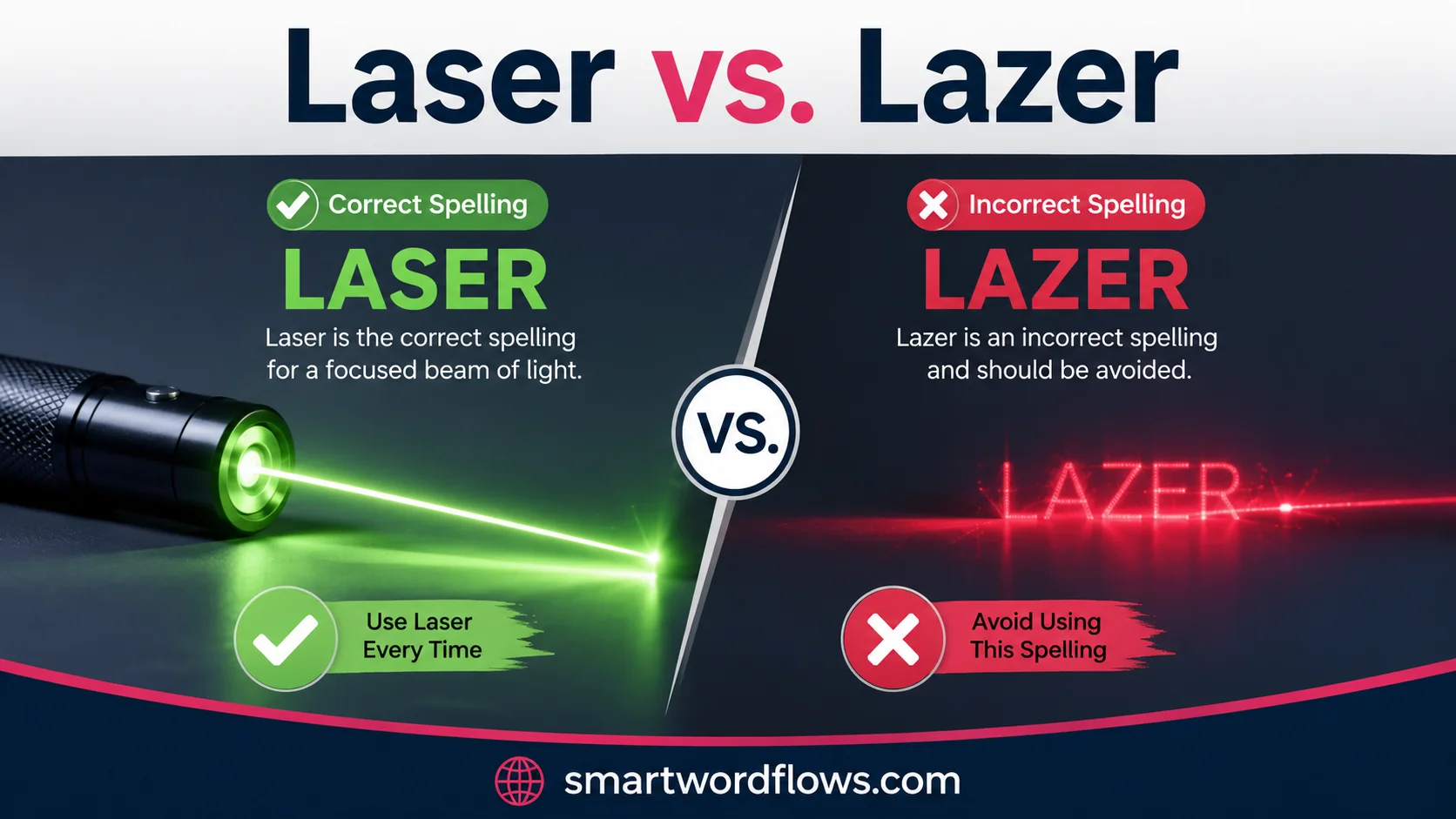

Laser vs. Lazer is a common spelling question when you’re browsing online, doing a project, or using a Google search. The difference is simple: laser is the correct spelling in standard English. It is a five-letter word often used for laser pointers and other forms of technology. Lazer and lasor are usually mistakes, although you may see them in informal writing or brand names. The Australian Writers’ Centre discusses the English language, including its weirdness, rules, and flexibility, but writing correctly keeps your meaning clear.
The word laser is an acronym meaning Light Amplification by Stimulated Emission of Radiation. The acronym meaning comes from Light Amplification, Stimulated Emission, and Radiation. People sometimes mistakenly write lazer because it sounds natural when spoken. However, the established spelling remains laser, and this is the accepted form in standard English. When comparing laser and lazer, choosing laser is the safest option for formal and casual writing alike.
Quick Answer
Laser is the correct standard spelling. Lazer is usually a misspelling.
The word laser describes a device or the concentrated electromagnetic radiation it produces. The term comes from the acronym Light Amplification by Stimulated Emission of Radiation. Because the original phrase contains stimulated, the established spelling uses s, not z.
The confusion comes mainly from pronunciation. In standard English, laser is pronounced roughly “LAY-zer.” The s sounds like a z, even though the word is spelled with an s.
| Spelling | Standard use? | Meaning |
| laser | Yes | A scientific technology or the light it produces |
| lazer | Usually no | Common phonetic misspelling of laser |
| Lazer | Sometimes | May be an intentional brand, product, character, or creative name |
One important exception matters: Lazer can be correct when it’s a deliberate proper name. A company or product creator can choose almost any spelling for its name. That doesn’t make lazer the standard spelling of the scientific term.
Comparison Overview
The simplest way to understand laser vs. lazer is to separate spelling from meaning.
| Feature | Laser | Lazer |
| Correct scientific spelling | Yes | No |
| Standard dictionary term | Yes | Not as the standard technology spelling |
| Used in technical writing | Yes | No |
| Used in medical writing | Yes | No |
| Used in academic writing | Yes | No |
| Pronunciation | Usually “LAY-zer” | Usually intended to sound the same |
| Original acronym | Matches LASER | Doesn’t match |
| Can appear in a brand name? | Yes | Yes |
| Can be a creative spelling? | Yes | Yes |
| Refers to a separate technology? | No | No |
The key point is that laser and lazer aren’t two competing technologies.
There isn’t a scientific device called a “lazer” that works differently from a laser simply because its name contains a z. In most everyday cases, someone writing lazer simply means laser.
Main Differences Between Laser vs. Lazer
The biggest difference between laser vs. lazer is spelling rather than technology.
Laser Is the Standard Word
Laser is an established English noun with a precise scientific meaning. It can refer to the device that generates the radiation or, depending on context, the beam itself.
Merriam-Webster defines laser as a device that generates coherent electromagnetic radiation, commonly in the ultraviolet, visible, or infrared regions. It also lists laser as a verb meaning to subject something to laser action or treatment.
You might therefore see sentences such as:
- The technician aligned the laser beam.
- The surgeon used a laser during the procedure.
- The machine performs laser cutting.
- The barcode scanner uses a laser.
- The printer relies on laser technology.
All of these use the standard spelling.
Lazer Is Usually a Phonetic Misspelling
Lazer looks logical if you spell words according to how they sound.
Consider the pronunciation:
laser → “LAY-zer”
Because the s produces a sound similar to z, someone unfamiliar with the word’s history might naturally write lazer.
That’s where the confusion starts.
English contains plenty of words whose spelling doesn’t perfectly match their pronunciation. Laser happens to be one of those words. Its spelling comes from its technical origin rather than from a simple attempt to represent its sound.
The Difference Is Not Between Two Kinds of Light
This point deserves emphasis.
Laser and lazer don’t describe two different forms of electromagnetic radiation.
A laser can produce highly controlled electromagnetic radiation through stimulated emission. The word lazer, when used as a misspelling, doesn’t describe another physical process.
So this isn’t like comparing:
- laser vs. LED
- laser vs. maser
- laser vs. flashlight
- laser vs. infrared source
Those comparisons involve actual technological or physical distinctions.
Laser vs. lazer is primarily a spelling question.
What Does Laser Mean?
A laser is a device that generates a concentrated form of electromagnetic radiation through a process called stimulated emission.
That explanation sounds technical, but the basic idea isn’t difficult.
Atoms and molecules can exist in different energy states. Under the right conditions, energy can cause particles in a material to reach an excited state. When stimulated emission occurs, an incoming photon can trigger the release of another photon with matching characteristics.
That process can produce light that has a high degree of coherence and can be concentrated into a narrow beam.
The U.S. Department of Energy describes stimulated emission as a quantum process in which an excited atom is induced to emit another photon with the same wavelength.
This controlled behavior gives lasers their remarkable usefulness.
What Makes Laser Light Different?
Ordinary light sources typically emit many wavelengths and send light in many directions.
A laser can produce light with characteristics that make it exceptionally useful for precision applications.
Important properties include:
- High directionality: The beam can travel in a relatively narrow path.
- Coherence: The emitted light has a strong relationship between its waves.
- Spectral selectivity: Many lasers operate over a narrow range of wavelengths.
- High intensity: Energy can be concentrated into a small area.
- Controllability: Engineers can design lasers for specific wavelengths, pulse durations, powers, and applications.
These properties explain why the same basic technology can appear in a grocery-store scanner and in sophisticated scientific research.
What Does LASER Stand For?
The word LASER originally comes from:
L — Light
A — Amplification
S — Stimulated
E — Emission
R — Radiation
Together:
Light Amplification by Stimulated Emission of Radiation
The U.S. Department of Energy uses this expansion when describing laser processing technology.
This is the clearest reason laser is spelled with an s.
The S represents stimulated.
If you replace that S with Z, you no longer preserve the original acronym.
Why the Acronym Matters
Over time, laser stopped behaving like an acronym in everyday English and became an ordinary word.
People don’t usually spell it as L.A.S.E.R. They simply write laser.
That transition is common with technical terms. The U.S. Department of Energy’s style guidance itself lists laser among familiar acronyms that function as words.
So the modern word is simply:
laser
Not:
lazer
Why Is Laser Spelled With an S Instead of a Z?
The answer has two parts: history and pronunciation.
The Historical Reason
The original expression contains stimulated, giving the word its S.
That’s the strongest spelling clue.
The Pronunciation Reason
The English pronunciation makes the S sound like a Z.
For example:
laser → LAY-zer
That sound can trick your brain into expecting a z.
But spelling doesn’t always follow sound. In this case, the spelling preserves the word’s technical origin.
A useful memory trick is:
Laser has an S because stimulated emission has an S.
That’s short enough to remember when you’re writing.
Why Do People Spell Laser as Lazer?
The spelling lazer usually develops through phonetic reasoning.
When people learn a word primarily by hearing it, they may try to reconstruct its spelling from its sound. That’s especially likely when they don’t know the word’s origin.
Imagine someone hearing:
“The machine uses a laser.”
If they have never seen the word written, lazer may seem natural.
The pronunciation strongly supports that guess.
Common Reasons for the Confusion
People may write lazer because:
- The s sounds like z.
- They learned the word through conversation.
- They haven’t encountered the acronym.
- They assume English spelling should match pronunciation.
- They associate the sound with words that use z.
- Autocorrect or informal online writing reinforces the spelling.
None of those reasons changes the standard spelling.
Is Lazer a Correct Word?
Usually, no, if you’re referring to laser technology.
If you’re writing:
“The technician repaired the lazer.”
the standard correction is:
“The technician repaired the laser.”
Likewise:
- lazer beam → laser beam
- lazer pointer → laser pointer
- lazer cutting → laser cutting
- lazer treatment → laser treatment
- lazer printer → laser printer
However, saying that lazer is always wrong would be too broad.
A person, company, artist, game developer, or manufacturer can intentionally use Lazer as a proper name.
For example, if a fictional character is called “Lazer,” the spelling is part of that character’s name.
The same principle applies to branding.
Standard Term vs. Proper Name
Consider this distinction:
Standard technology:
The factory uses a laser to cut steel.
Intentional name:
The company named its fictional product Lazer.
The first sentence follows standard scientific English. The second may be perfectly correct because Lazer functions as a chosen name.
Does Laser vs. Lazer Have Different Meanings?
In ordinary usage, no separate scientific meaning exists for “lazer.”
When someone writes lazer instead of laser, readers generally infer the intended word from context.
For example:
“The doctor used a lazer treatment.”
Most readers understand that the writer means laser treatment.
That doesn’t make lazer the correct technical spelling. It simply means the intended meaning remains obvious.
This distinction matters in professional writing. A word can be understandable without being standard.
That’s why editors, teachers, scientists, technicians, and medical professionals generally use laser.
Laser Pronunciation vs. Lazer Pronunciation
The pronunciation creates much of this spelling confusion.
Laser is commonly pronounced approximately:
LAY-zer
The final sound resembles the z sound in words such as zero.
That’s why lazer looks phonetically reasonable.
But pronunciation isn’t the spelling rule.
Think of it this way:
| What you hear | What you write |
| “LAY-zer” | laser |
| “LAY-zer” | Not normally lazer |
The sound stays essentially the same while the written form changes.
A Simple Pronunciation Reminder
If you’re unsure, don’t spell the word based on its sound.
Remember:
LASER = Light + Amplification + Stimulated + Emission + Radiation
That gives you the correct S immediately.
Is Laser or Lazer Correct in American English?
Laser is the standard spelling in American English.
It’s also the standard spelling in British English and other varieties of English.
This isn’t a situation like:
- color vs. colour
- center vs. centre
- theater vs. theatre
Those examples involve recognized regional spelling differences.
Laser vs. lazer doesn’t work that way.
Lazer isn’t simply the American version of laser.
When referring to the technology, laser remains the standard form.
The History of the Word Laser
The history of laser makes the spelling even easier to understand.
Before the modern laser existed, scientists worked on related concepts involving masers. A maser uses stimulated emission to generate or amplify electromagnetic radiation at microwave or related wavelengths.
The development of the laser extended these ideas toward optical wavelengths.
The Smithsonian notes that researchers initially referred to emerging optical devices as “optical masers.” Gordon Gould later used the term laser, which became the established name.
The First Working Laser
Theodore Maiman and his assistant Irnee D’Haenens built the first operating laser at Hughes Aircraft in May 1960.
Their device used a synthetic ruby crystal and a xenon flashlamp. On May 16, 1960, Maiman demonstrated the first operating laser, according to the Smithsonian’s National Museum of American History.
The original ruby laser didn’t produce the continuous beam people often imagine today. It produced short pulses of laser light.
That detail is easy to overlook.
The familiar image of a continuously glowing laser beam came later as different laser designs emerged.
How a Laser Works in Simple Terms
A useful way to picture a laser is to imagine a room full of synchronized runners.
Ordinary light behaves more like a crowd moving in many directions at different speeds. A laser creates conditions that encourage light emission to become much more organized.
At a basic level, a laser contains three important elements:
- A gain medium that can produce or amplify light.
- An energy source that excites the medium.
- An optical cavity that helps reinforce the desired light.
The gain medium might involve a solid, gas, liquid, semiconductor, or another engineered material.
The energy source pushes the system into an excited state. Under suitable conditions, stimulated emission produces additional photons that reinforce the light already present.
The result is a controlled laser output.
The exact design varies enormously between laser types. A small semiconductor laser inside an optical device is obviously very different from a high-power industrial laser used for metal processing.
Where Lasers Are Used Today
The word laser appears in an enormous range of technical and everyday applications.
Medicine
Lasers have become important tools in medicine because doctors can deliver energy to highly specific areas.
Medical applications include:
- Ophthalmic procedures
- Tissue cutting
- Tissue coagulation
- Dermatological treatments
- Certain diagnostic techniques
- Removal or treatment of selected lesions
- Specialized surgical procedures
NIST documentation describes laser applications in both diagnosis and therapy. Examples include retinal treatments, surgical cutting, tissue coagulation, and selective interaction with particular tissues.
The wavelength and energy settings matter enormously. Different tissues absorb different wavelengths in different ways. Medical professionals therefore select laser systems according to the desired interaction with tissue.
Manufacturing
Industrial lasers can perform extremely precise operations.
Common uses include:
- Cutting
- Welding
- Drilling
- Engraving
- Marking
- Surface treatment
- Material removal
- Additive manufacturing processes
The U.S. Department of Energy notes that commercial laser-processing systems are used for applications such as surface hardening, material removal, and welding.
NIST has also documented high-power laser measurement work involving manufacturing systems reaching 20 kilowatts in welding applications.
That’s a useful reminder that “laser” doesn’t simply mean the tiny red pointer used in a classroom.
Communication
Lasers play an important role in optical communications.
Fiber-optic systems can use light to carry enormous amounts of information over long distances. NIST research describes optical communications as a major application area for photonic technologies and highlights the high frequencies and bandwidths available from optical signals.
In practical terms, the same broad laser technology family can help move information through fiber-optic networks.
Retail and Scanning
Barcode scanners provide another familiar example.
You might encounter laser-based scanning technology in retail environments, inventory systems, and measurement equipment.
The Smithsonian’s history of laser development highlights how quickly the technology moved from laboratory experiments toward practical scanning applications.
Read More: Finaly vs Finally: Differences, Correct Spelling, Meaning, and Usage
Printers and Optical Storage
Lasers have also played important roles in printing and optical data storage.
Optical discs such as CDs, DVDs, and Blu-ray media use optical systems that rely on lasers to read stored information.
The basic principle is remarkably precise: a focused light source interacts with microscopic structures on an optical medium and a detector interprets the returned signal.
Common Laser Terms You Should Spell Correctly
Because laser appears in many compound terms, the same spelling rule applies throughout.
| Correct term | Common misspelling |
| laser beam | lazer beam |
| laser pointer | lazer pointer |
| laser printer | lazer printer |
| laser cutting | lazer cutting |
| laser engraving | lazer engraving |
| laser treatment | lazer treatment |
| laser surgery | lazer surgery |
| laser technology | lazer technology |
| laser scanner | lazer scanner |
| laser welding | lazer welding |
| laser light | lazer light |
| laser measurement | lazer measurement |
If the word describes the scientific technology, choose laser.
Laser vs. Lazer in Formal Writing
When you’re writing professionally, spelling accuracy matters more than it might in casual conversation.
Use laser in:
- Academic assignments
- Research papers
- Scientific articles
- Medical documents
- Engineering reports
- Product manuals
- Business reports
- Technical websites
- News articles
- Educational content
A misspelling such as lazer may not prevent readers from understanding your sentence. It can still make the writing look less polished.
Technical terminology benefits from consistency. When an established term already exists, there’s little reason to replace it with a phonetic alternative.
Common Laser vs. Lazer Mistakes
Here are some realistic examples.
Incorrect
The engineer adjusted the lazer beam.
Correct
The engineer adjusted the laser beam.
Incorrect
The machine uses lazer cutting technology.
Correct
The machine uses laser cutting technology.
Incorrect
The doctor recommended lazer treatment.
Correct
The doctor recommended laser treatment.
Incorrect
He bought a lazer pointer.
Correct
He bought a laser pointer.
The pattern is simple: if you’re describing the technology, use laser.
When Lazer Can Actually Be Correct
This is where context prevents an overly simplistic answer.
Lazer can appear as an intentional spelling in names.
For instance, imagine a fictional game character named Lazer. Changing the spelling to Laser would alter the character’s official name.
The same applies to:
- Business names
- Product names
- Entertainment titles
- Character names
- Usernames
- Creative projects
- Marketing campaigns
A proper name doesn’t have to follow the ordinary spelling of the word it resembles.
Why This Doesn’t Change the Standard Spelling
Suppose a company intentionally calls a product Lazer Pro.
That doesn’t mean dictionaries, engineers, or scientists should suddenly start spelling the technology lazer.
It simply means Lazer Pro is that particular product’s chosen name.
This is similar to how a company can deliberately misspell an ordinary word in a brand name. Branding and standard vocabulary follow different rules.
Laser vs. Lazer Example Sentences
Standard Laser Usage
- The technician aligned the laser with the sensor.
- The factory uses laser cutting to produce precise components.
- She used a laser pointer during the presentation.
- The printer uses a laser to transfer information onto the printing system.
- The surgeon used a specialized laser during the procedure.
- Researchers measured the material with a laser beam.
- The barcode scanner relies on optical technology involving a laser.
- Engineers developed a new laser welding system.
Incorrect Standard Usage
- The technician aligned the lazer with the sensor.
- The factory uses lazer cutting.
- She used a lazer pointer.
- Researchers measured the material with a lazer beam.
Intentional Name Usage
- The fictional weapon is called Lazer X.
- The company branded its product Lazer Pro.
The last examples aren’t spelling errors if those names are officially written that way.
Laser vs. Lazer Case Study: From a Spelling Confusion to Real Technology
Consider a simple workplace example.
A manufacturing company needs to cut small metal components accurately. An employee writes a purchasing request for a “lazer cutting machine.”
The purchasing department understands the request. There is no mystery about what the employee wants.
However, the standard technical term is laser cutting machine.
That small spelling difference matters because technical documents often become search terms, catalog entries, specifications, training materials, and maintenance records.
Using the established terminology makes communication cleaner.
The physical technology remains the same. The issue is terminological precision.
This is why spelling isn’t merely cosmetic in technical fields. Good terminology helps people find the right equipment, documentation, standards, and instructions.
Other Common Misspellings of Laser
Lazer isn’t the only phonetic variation people may invent.
You might occasionally encounter forms such as:
- lazor
- lasor
- layzer
- laysar
These aren’t standard spellings of the technology.
They usually arise because someone tries to reproduce the sound rather than recall the established written form.
Among them, lazer is particularly common because the pronunciation strongly resembles the spelling.
Still, the rule remains straightforward:
Use laser.
Laser vs. Lazer Memory Trick
If you only remember one thing from this article, remember this:
Laser has an S because LASER contains “Stimulated.”
Break it down:
Light
Amplification
Stimulated
Emission
Radiation
That gives you:
LASER
not:
LAZER
Another useful trick is to connect the spelling to the phrase stimulated emission. Both words belong to the scientific explanation behind the technology.
Is Lazer an English Word?
This question requires a little nuance.
If someone asks whether lazer is the standard spelling of the scientific technology, the answer is no.
The established English word is laser. Major dictionary treatment recognizes laser as the standard term and traces its origin to the acronym for light amplification by stimulated emission of radiation.
However, English contains many proper names and creative spellings that don’t follow ordinary vocabulary rules.
So Lazer can exist as a name without becoming the standard spelling of laser.
The context tells you what you’re looking at.
Is Lazer an American Spelling of Laser?
No.
American English does not normally use lazer as an alternative spelling of laser.
The spelling laser is standard in American English.
So if you’re writing for a U.S. audience, don’t change laser to lazer because you think the latter is an American variation.
It isn’t.
Does Laser Always Mean a Visible Red Beam?
Not at all.
This is another misconception worth clearing up.
People often picture a red laser pointer because it’s familiar. However, lasers can operate at many different wavelengths.
Laser systems can produce radiation in regions such as:
- Ultraviolet
- Visible light
- Infrared
Merriam-Webster’s technical definition specifically describes lasers as producing coherent electromagnetic radiation commonly in ultraviolet, visible, or infrared regions.
That means a laser doesn’t have to look like a bright red line.
In many applications, the laser output isn’t visible to the human eye at all.
Laser vs. Lazer: Why the Correct Spelling Matters
You might wonder whether one letter really matters.
In casual conversation, probably not much.
If someone says lazer while pointing toward a laser pointer, everyone knows what they mean.
Written language works differently.
Established spelling gives readers a reliable standard. It helps technical information remain consistent across textbooks, databases, manuals, scientific publications, product catalogs, and search systems.
More importantly, laser isn’t an arbitrary spelling.
It preserves the history of the technology itself.
That’s why the S matters.
Quick Facts About Laser
Here are several useful facts worth remembering:
- Laser is an acronym-derived word.
- The acronym stands for Light Amplification by Stimulated Emission of Radiation.
- Merriam-Webster records the first known use of laser in 1957.
- Theodore Maiman demonstrated the first operating laser in May 1960.
- Maiman’s first operating laser used a synthetic ruby crystal.
- The first laser produced pulsed output rather than the continuous beam commonly imagined today.
- Lasers are used in medicine, manufacturing, communications, scanning, measurement, printing, research, and many other fields.
- Lazer isn’t the standard spelling of the technology.
- Lazer may still be valid as an intentional proper name or brand spelling.
- The S in laser comes from stimulated.
FAQs:
1. Is “laser” or “lazer” correct?
Laser is the correct spelling in standard English. Lazer is generally considered a misspelling.
2. Why do people spell laser as “lazer”?
People may write lazer because it matches the way laser sounds when spoken.
3. What does LASER stand for?
LASER stands for Light Amplification by Stimulated Emission of Radiation.
4. Is “lasor” a correct spelling?
No. Lasor is also an incorrect spelling. The standard English word is laser.
5. Can “lazer” ever be used?
You may see lazer in informal writing or brand names, but laser should be used in standard English.
Conclusion:
When comparing Laser vs. Lazer, the choice is straightforward: laser is the correct and accepted spelling. Lazer and lasor are common spelling mistakes that can appear because of pronunciation or informal usage. Remembering the correct spelling will help you write more clearly in English, whether you’re working on a project, searching online, or discussing laser technology.