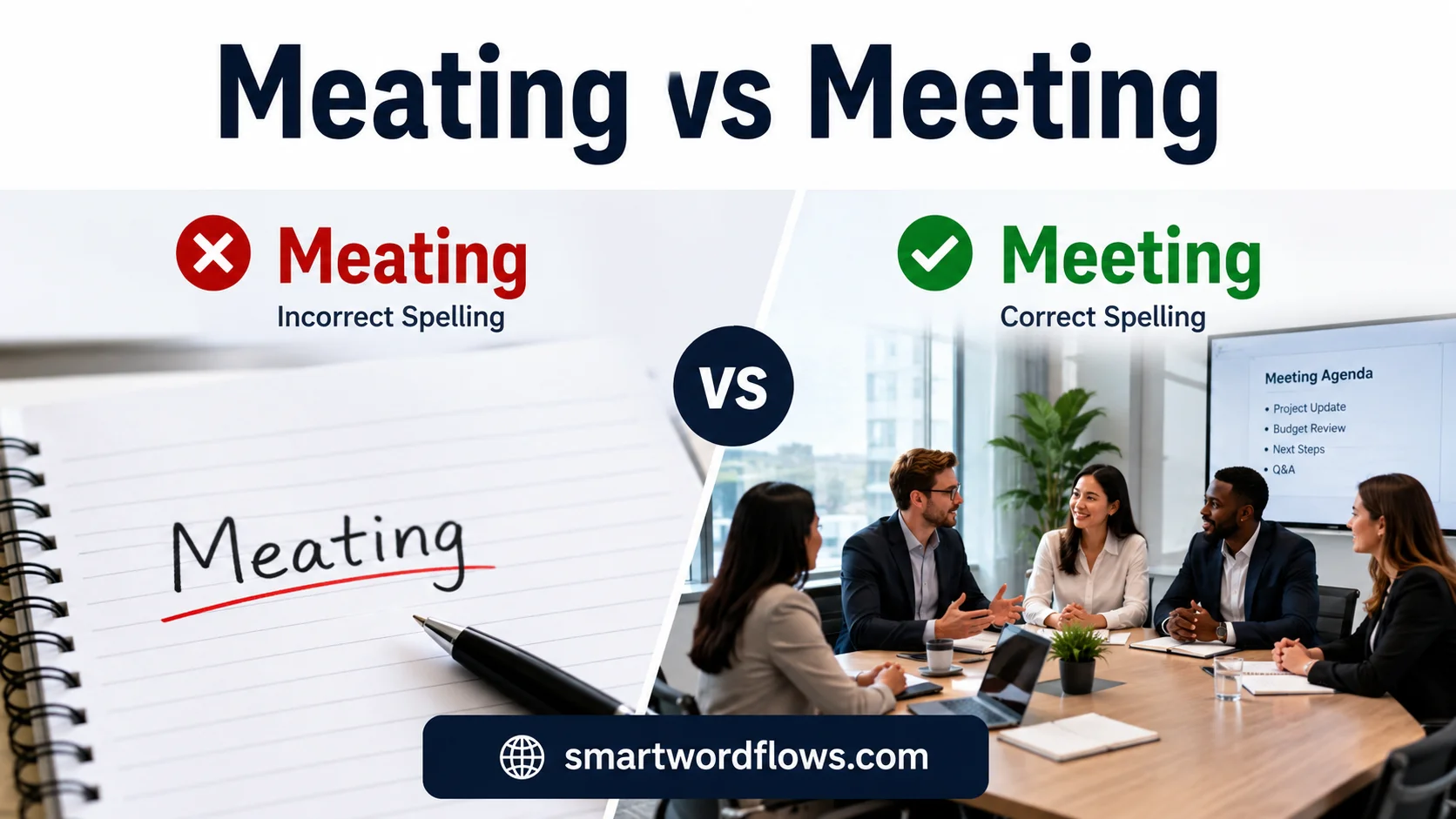

Meating vs Meeting is a common spelling question in English writing. The correct word is meeting, which means a gathering of people for a discussion, while meating is usually a spelling error. Because the words look similar and sound alike, many writers make this mistake in emails and messages. Knowing the difference between meating and meeting improves clarity, accuracy, and proper usage, especially when you want your writing to look professional and grammatically correct.
A meeting can be a business meeting, a Google meeting, or a casual team huddle where people discuss plans. Correct spelling is important in business communication, professional emails, office communication, and professional documents, because tiny spelling mistakes can affect credibility. Learning the definitions, pronunciation, and common examples helps you avoid common mistakes and choose the right word with confidence in both formal contexts and informal contexts. This simple rule keeps your writing precise and professional.
Quick Answer
The difference between Meating vs Meeting is simple:
- Meeting is the correct English word. It means a gathering, discussion, or occasion where people come together.
- Meating is usually an incorrect spelling of meeting and does not have a common meaning in standard English.
Example:
Correct: “The team has a meeting at 2 PM.”
Incorrect: “The team has a meating at 2 PM.”
A simple way to remember it:
People meet at a meeting. They do not have a meating.
Comparison Overview
The following table shows the basic difference between meating and meeting:
| Word | Correct Usage | Meaning | Example |
| Meeting | Correct | A gathering, discussion, or planned interaction between people | “We have a meeting with the client tomorrow.” |
| Meating | Usually incorrect | Not a standard English word in normal communication | “I scheduled a meating.” |
The confusion happens because both words have similar pronunciation. However, their origins and meanings are completely different.
The word meeting comes from the verb meet, which means to come together or encounter someone. When you add “-ing” to “meet,” it becomes meeting.
The word meating, if interpreted literally, would come from meat + ing, which would suggest something related to meat. However, English speakers do not normally use this word in everyday language.
Main Differences Between Meating vs Meeting
Understanding the main differences between Meating vs Meeting makes it easier to choose the right word.
| Difference | Meeting | Meating |
| Spelling | M-E-E-T-I-N-G | M-E-A-T-I-N-G |
| Standard English Usage | Yes | No, in most cases |
| Root Word | Meet | Meat |
| Meaning | A gathering or interaction | Usually a spelling mistake |
| Common Context | Business, school, personal conversations | Rare wordplay or incorrect writing |
The biggest difference comes from their root words:
- Meet → Meeting means people coming together.
- Meat → Meating would relate to animal flesh, but it is not a normal English expression.
For example:
Meeting:
“The employees attended a meeting to discuss the new company policies.”
This sentence talks about people gathering.
Meating:
“The employees attended a meating.”
This sentence is incorrect because the writer most likely means a meeting.
What Does Meeting Mean?
The word meeting has several meanings depending on the situation. At its core, it describes a moment when people come together for a specific purpose.
A meeting can be formal, such as a business discussion, or informal, such as meeting a friend for coffee.
Meeting as a Noun
As a noun, meeting refers to an event where people gather.
Examples:
- “The board meeting lasted three hours.”
- “Our family meeting helped solve the problem.”
- “The teacher arranged a meeting with the parents.”
In professional environments, meetings often help teams:
- Share information
- Make decisions
- Solve problems
- Plan future activities
- Review progress
For example, a software development team may hold a weekly meeting to discuss project updates, challenges, and upcoming tasks.
Meeting as a Verb Form
The word meeting can also act as the present participle form of the verb meet.
Examples:
- “I am meeting my friend after work.”
- “She is meeting the manager tomorrow.”
- “They are meeting new customers this week.”
Here, meeting does not describe a scheduled event. Instead, it describes the action of encountering or spending time with someone.
What Does Meating Mean?
The word meating creates confusion because it looks like a real English word. However, in normal English usage, meating is not recognized as a standard word for a gathering or discussion.
Most people write meating because they confuse the words:
- Meat
- Meet
These words sound similar but have different meanings.
The Meaning Behind Meat
The word meat refers to the flesh of animals used as food.
Examples:
- “The restaurant serves fresh meat dishes.”
- “Some people choose not to eat meat.”
If someone writes meating, they may unintentionally create a word that appears connected to meat. However, it does not replace meeting.
Can Meating Ever Be Used?
In rare situations, someone may intentionally use meating as a creative word. For example, a food company might create a playful name related to meat products.
However, in regular writing:
- Business emails
- Academic writing
- Professional documents
- Everyday communication
you should always use meeting when referring to people gathering together.
Read More: Emaculate vs. Immaculate: Which One Is Correct?
Why Do People Confuse Meating and Meeting?
The confusion between Meating vs Meeting happens for several reasons.
Similar Pronunciation
When people speak quickly, meeting and meating sound almost identical.
English has many examples where words share similar sounds but have different spellings:
| Similar Sound Words | Different Meanings |
| Their / There | Possession vs Location |
| Hear / Here | Listening vs Place |
| Weather / Whether | Climate vs Choice |
| Meet / Meat | Come together vs Food |
Because people often learn words through sound before spelling, these mistakes are common.
Influence of Familiar Words
The word meat is very common. When someone hears “meeting,” their brain may connect the sound with “meat” and accidentally create meating.
This happens especially when people write quickly without checking spelling.
Lack of Reading Practice
People who frequently read books, articles, and professional writing usually recognize correct spellings more easily. Regular exposure helps your brain remember word patterns.
For example:
A person who often sees “team meeting,” “staff meeting,” and “business meeting” will naturally know that “meeting” is correct.
Grammar Explanation: Why Meeting Is Correct
The grammar behind meeting is simple.
The base verb is:
Meet
When adding “-ing,” the word becomes:
Meet + ing = Meeting
Unlike many verbs that drop the final letter before adding “-ing,” the word meet keeps both “e” letters.
Examples:
- See → Seeing
- Agree → Agreeing
- Meet → Meeting
The spelling remains connected to the original verb.
Common Mistakes With Meeting
Many people make small mistakes when using meeting. Understanding these errors can improve your writing.
Using Meating Instead of Meeting
Incorrect:
“I have a meating with my boss tomorrow.”
Correct:
“I have a meeting with my boss tomorrow.”
The correct word is always meeting when talking about people gathering.
Confusing Meeting With Appointment
Although meetings and appointments can overlap, they are not always the same.
| Meeting | Appointment |
| Usually involves discussion or collaboration | Usually involves visiting someone or receiving a service |
| Often includes multiple people | Often involves one person and a professional |
| Example: Team meeting | Example: Doctor appointment |
Examples:
- “I have a meeting with my manager.”
- “I have a dentist appointment.”
Incorrect Use of Apostrophes
A common mistake is writing:
“The company’s weekly meeting’s are important.”
The correct sentence:
“The company’s weekly meetings are important.”
The apostrophe is unnecessary because meetings is simply the plural form.
Different Types of Meetings and Their Uses
Meetings happen in almost every area of life. They help people exchange ideas and coordinate actions.
| Type of Meeting | Purpose | Example |
| Business Meeting | Discuss company matters | Reviewing sales goals |
| Team Meeting | Share updates | Weekly project discussion |
| Staff Meeting | Inform employees | Announcing workplace changes |
| Parent Meeting | Discuss student progress | Teacher and family discussion |
| Community Meeting | Address local issues | Neighborhood planning |
A good meeting has a clear purpose. Without preparation, meetings can waste time and leave people confused.
Professional Uses of the Word Meeting
In workplaces, the word meeting appears frequently in communication.
Common professional phrases include:
- Schedule a meeting
- Attend a meeting
- Hold a meeting
- Join a meeting
- Cancel a meeting
- Reschedule a meeting
Examples:
- “Please schedule a meeting with the marketing team.”
- “The director will hold a meeting next Monday.”
- “I need to attend a meeting before lunch.”
A well-written professional message always uses the correct spelling because small errors can affect credibility.
Social Uses of Meeting
A meeting does not always involve work. People use this word in everyday life too.
Examples:
- “I’m meeting my friends tonight.”
- “They met for the first time at college.”
- “We had a chance meeting at the airport.”
The word can describe planned events or unexpected encounters.
How to Remember Meating vs Meeting Easily
A simple memory trick can prevent this mistake forever:
Meeting = Meet + People
Think:
“People meet in a meeting.”
Meating = Meat
Think:
“Meat belongs in the kitchen, not in a conference room.”
This small connection makes the difference easier to remember.
Real-Life Examples of Meating vs Meeting
| Incorrect Sentence | Correct Sentence | Reason |
| “We have a meating tomorrow.” | “We have a meeting tomorrow.” | A gathering is called a meeting. |
| “The manager arranged a meating.” | “The manager arranged a meeting.” | Meating is not the correct term. |
| “The team meeting was productive.” | Correct | Meeting describes a group discussion. |
Synonyms for Meeting and When to Use Them
The word meeting has several alternatives. Choosing the right synonym can make your writing more precise.
| Synonym | Meaning | Example |
| Gathering | People coming together | “The family gathering was enjoyable.” |
| Conference | Formal meeting with many participants | “She attended a business conference.” |
| Session | A period of organized activity | “The training session lasted two hours.” |
| Discussion | Exchange of ideas | “We had a discussion about the plan.” |
| Assembly | Group gathering for a purpose | “Students attended the school assembly.” |
| Consultation | Professional advice meeting | “The patient had a consultation.” |
Each synonym has a slightly different meaning, so choose one based on the situation.
FAQs:
1. Is “Meating” or “Meeting” correct?
Meeting is the correct word when you mean a gathering of people for discussion. Meating is usually a spelling error.
2. What does “Meeting” mean?
A meeting is a planned gathering where people come together for discussion, communication, or to make decisions.
3. Why do people confuse “Meating” and “Meeting”?
People confuse these words because they look similar and can sound almost the same when spoken quickly. This makes spelling mistakes common.
4. Can I use “Meating” in professional writing?
Generally, no. Use meeting in professional emails, business communication, office messages, and other formal writing.
5. How can I remember the correct spelling?
Remember that meeting is the standard word for a gathering or discussion. Checking the spelling before sending an email can help you avoid this common mistake.
Conclusion
Understanding Meating vs Meeting is simple once you remember that meeting is the correct spelling for a gathering or discussion. Using the right word improves your English writing, clarity, and professional communication.