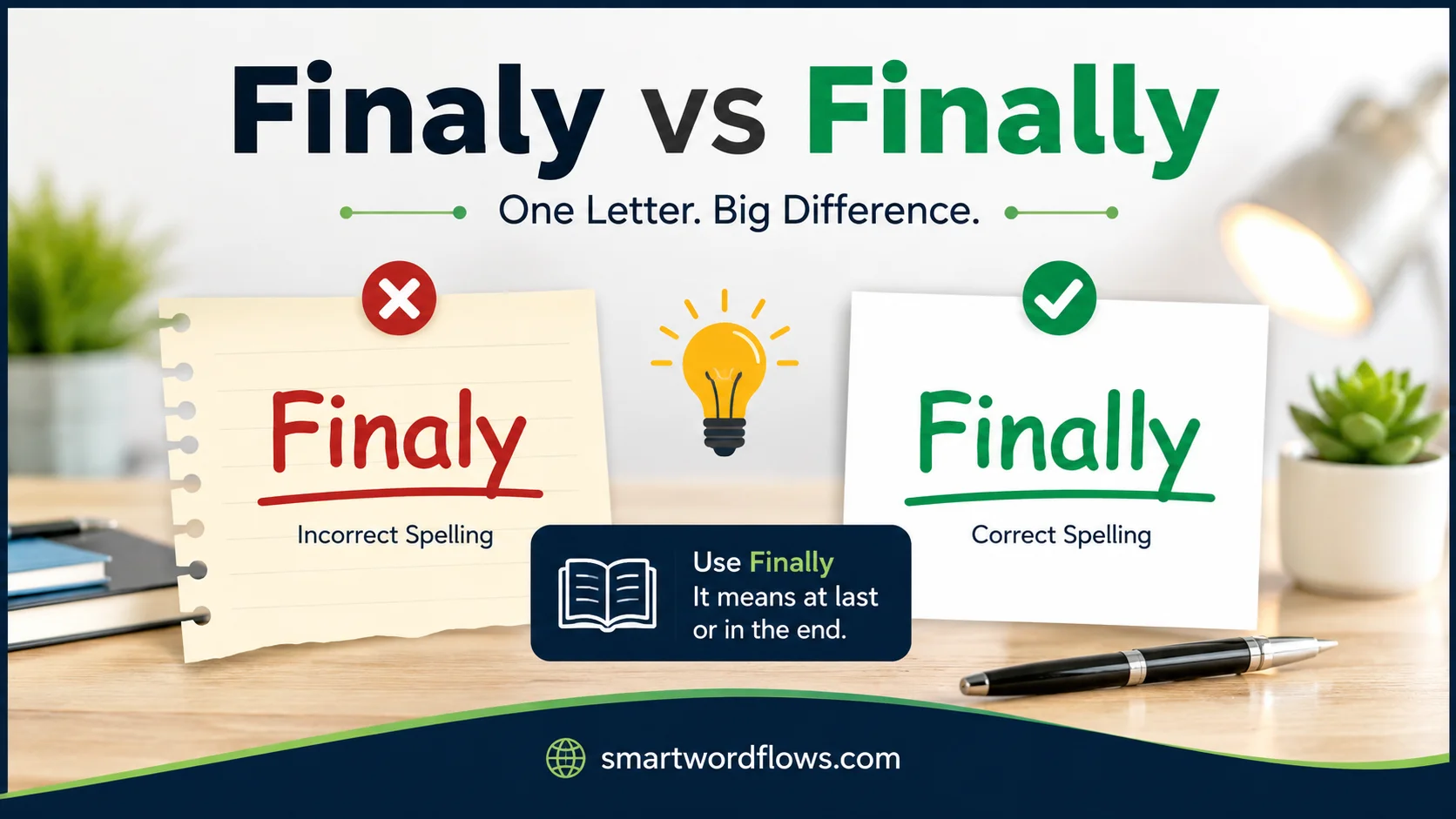

Finaly vs Finally can confuse learners because both words look similar and sound alike. The correct spelling is Finally, while Finaly is incorrect and misspelled. This common spelling mistake can happen when typing quickly in a sentence or email. If you wonder how to spell it, remember that finally is an adverb meaning at the end, conclusion, ultimately, or lastly. The easiest trick is remembering the double “ll” instead of a single “l”. This trick helps you spell it correctly.
The spelling becomes easier when you compare the strings fina, y, fina-l-y, and fina-ll-y. The wrong spelling is fina-l-y, but the correct spelling is fina-ll-y. The missing letter is another l, a consonant. Pronunciation, mispronounced sounds, and mispronunciation may cause confusion, but they do not change the spelling. Whether discussing the Romans who conquered a contest or using the word in daily writing, choose Finally with double l, not single l. This simple rule makes everyday writing clearer and easier.
Quick Answer
Finally is the correct spelling. Finaly is incorrect.
The word finally is an adverb with several related meanings. It can describe something that happens after waiting or difficulty, introduce the last point in a series, or describe something that has become settled or definite.
| Spelling | Correct? | Meaning | Example |
| finally | ✅ Yes | At last; eventually; as the last point | “We finally arrived.” |
| finaly | ❌ No | No standard English meaning | “We finaly arrived.” ❌ |
A simple way to remember the spelling is:
final + ly = finally
So when you’re choosing between finaly or finally, choose finally.
Comparison Overview
The main difference between finaly and finally isn’t a difference in meaning. It’s a difference between a correct spelling and a misspelling.
| Feature | Finaly | Finally |
| Standard English spelling | ❌ No | ✅ Yes |
| Used in dictionaries as the standard word | ❌ No | ✅ Yes |
| Part of speech | — | Adverb |
| Can mean “at last” | ❌ | ✅ |
| Can introduce the last point | ❌ | ✅ |
| Suitable for formal writing | ❌ | ✅ |
| Suitable for everyday conversation | ❌ | ✅ |
| Contains two l’s | ❌ | ✅ |
For example:
- ❌ I finaly completed the project.
- ✅ I finally completed the project.
The second sentence is correct because finally follows the standard spelling of the English word.
Main Differences Between Finaly vs Finally
The Finaly vs Finally difference becomes clearer when you look at spelling, grammar, meaning, and usage separately.
Spelling
Finally contains two consecutive l’s:
f-i-n-a-l-l-y
The incorrect form finaly contains only one:
f-i-n-a-l-y
That missing l turns a correct word into a spelling error.
Grammar
Finally is an adverb. It can modify a verb, a clause, or an entire sentence.
For example:
“She finally understood the instructions.”
Here, finally tells you when or under what circumstances she understood them.
By contrast, finaly isn’t a standard English adverb.
Meaning
Finally commonly expresses an outcome that comes after waiting, effort, difficulty, or a sequence.
Consider:
“After three hours, the bus finally arrived.”
The word suggests that the arrival happened later than expected or after a period of waiting.
Standard Usage
Use finally in:
- Academic writing
- Business writing
- Emails
- Articles
- School assignments
- Everyday conversation
- Formal presentations
- Instructions
Avoid finaly in standard English writing.
Why Is “Finally” Spelled With Two Ls?
The spelling becomes easier to remember when you look at the word’s structure.
The base adjective is final. When you add -ly to form the adverb, the result is:
final + ly → finally
The two l’s aren’t an accidental feature. One belongs to final, while the other begins the suffix -ly.
This same visual pattern appears in other words:
| Base Word | + -ly | Correct Adverb |
| final | + ly | finally |
| real | + ly | really |
| total | + ly | totally |
| usual | + ly | usually |
| personal | + ly | personally |
The pattern doesn’t mean every English word behaves identically. English spelling has plenty of exceptions. Still, remembering final + ly gives you a reliable shortcut for this particular word.
A Simple Memory Trick
Think of the word as two pieces:
FINAL + LY
Don’t remove either L.
That produces:
FINALLY ✅
This trick works especially well when you’re typing quickly and your fingers want to produce finaly automatically.
What Does “Finally” Mean?
The word finally has several closely related meanings.
Finally Means “At Last”
This is perhaps the most common use.
“I finally found my missing wallet.”
The sentence suggests that finding the wallet took some time or effort.
Another example:
“After months of preparation, the team finally launched the product.”
Here, finally highlights the completion of a process that took time.
Finally Means “As the Last Point”
You can also use finally to introduce the last item in a discussion, list, argument, or set of instructions.
“First, check the address. Second, confirm the payment. Finally, submit the order.”
In this sentence, finally doesn’t mean that someone waited a long time. Instead, it tells the reader that submitting the order is the last step.
Finally Means “Definitively”
A more formal use appears when something becomes settled or determined.
“The terms have not been finally agreed upon.”
Here, finally relates to a definite or settled decision rather than simply meaning “after a long wait.”
This use appears more often in formal or professional contexts.
How to Use “Finally” in a Sentence
Understanding where finally belongs can make your writing sound much more natural.
Finally at the Beginning of a Sentence
When finally introduces the last point in a sequence, it commonly appears at the beginning.
Finally, review your answers before submitting the test.
Finally, we need to discuss the project’s budget.
Finally, turn off the equipment before leaving.
A comma usually follows finally when it functions as an introductory adverb.
Finally Before the Main Verb
When finally describes an action that happened after waiting or difficulty, it often comes before the main verb.
“She finally called me.”
“We finally reached the hotel.”
“He finally understood the problem.”
This position puts emphasis on the fact that the event eventually happened.
Finally After a Form of “Be”
The word can also appear after a form of be.
“The results were finally announced.”
“The agreement was finally approved.”
The placement sounds natural because finally describes when the announcement or approval occurred.
Finally With Auxiliary Verbs
You can also use finally around auxiliary or modal structures.
“The team has finally completed the project.”
“The company will finally release the update.”
The exact position can change depending on the verb structure. The key is to place finally where its timing or emphasis remains clear.
Finaly vs Finally Examples
Seeing the incorrect and correct forms side by side makes the distinction straightforward.
| Incorrect | Correct |
| I finaly finished my work. | I finally finished my work. |
| She finaly arrived home. | She finally arrived home. |
| We finaly found the answer. | We finally found the answer. |
| Finaly, let’s review the results. | Finally, let’s review the results. |
| He finaly understood the lesson. | He finally understood the lesson. |
| The decision was finaly announced. | The decision was finally announced. |
The pattern is consistent: whenever the intended word is the adverb meaning “at last” or “as the last point,” spell it finally.
Finally vs At Last
Finally and at last can often express the same basic idea, especially when something happens after a long wait.
Compare:
“We finally arrived home.”
“We arrived home at last.”
Both sentences tell you that getting home happened after some delay.
However, the tone can differ.
At last often carries a stronger emotional sense of relief, satisfaction, or impatience.
For example:
“At last! The weekend is here.”
That sounds more expressive than:
“Finally, the weekend is here.”
Meanwhile, finally works especially well when you’re describing a sequence or introducing a final point.
“First, we reviewed the data. Next, we discussed the results. Finally, we prepared the report.”
You wouldn’t normally replace the last finally with at last in that structure.
Finally vs Lastly
These two words overlap when you’re listing points, but they aren’t identical.
Lastly primarily signals the last item in a sequence.
Finally has that function too. However, it has the additional meaning of something happening after waiting or delay.
| Word | Main Function | Example |
| finally | At last or as the last point | “We finally reached an agreement.” |
| lastly | Introduces the final point | “Lastly, check the references.” |
Compare these sentences:
“The train finally arrived.”
Here, finally means the train arrived after waiting.
“Lastly, check the train schedule.”
Here, lastly introduces the final item in a sequence.
That’s the key distinction.
Finally vs Eventually
Finally and eventually sometimes overlap because both can refer to something happening after time passes.
However, they don’t always carry the same emphasis.
Finally often highlights the moment when the expected result occurs.
“She finally answered my email.”
The sentence can suggest that the writer had been waiting for the response.
Eventually focuses more broadly on what happened after a period of time or a series of events.
“She eventually moved to another city.”
The emphasis isn’t necessarily on frustration or anticipation. It simply tells you what happened in the end.
Compare the Tone
“He finally apologized.”
This can suggest that the apology took a long time and the speaker had been waiting for it.
“He eventually apologized.”
This sounds more neutral about the process.
The difference is subtle, but it matters when you want precise wording.
Finally vs In the End
In the end often describes the eventual result of a situation.
For example:
“In the end, we decided to stay home.”
This focuses on the final outcome after considering different possibilities.
Compare it with:
“We finally decided to stay home.”
This can place more emphasis on the delay before making the decision.
Both can work in many contexts, but they aren’t always interchangeable.
A Useful Rule
Use finally when you want to highlight:
- An awaited event
- Completion after effort
- The last step
- The final point
Use in the end when you want to highlight:
- The eventual outcome
- A final decision
- The result of a process involving alternatives
Is “Finaly” a Word?
No. Finaly isn’t the standard spelling of an English word.
If you see finaly in an email, social media post, article, comment, or message, it is normally a spelling mistake for finally.
Online writing contains countless typos. A word appearing frequently on the internet doesn’t automatically make it correct.
For example:
- ❌ “I finaly got the job.”
- ✅ “I finally got the job.”
The second sentence follows standard English spelling.
Why Do People Write “Finaly”?
Several simple factors can cause the mistake:
- Typing quickly
- Forgetting the second l
- Confusing the spelling pattern
- Learning English as a second language
- Relying on pronunciation
- Making an accidental keyboard error
- Failing to notice the typo during proofreading
The error is understandable. It still needs correction in polished writing.
Common Finaly vs Finally Mistakes
Dropping the Second “L”
This is the most direct mistake.
❌ “I finaly finished the report.”
✅ “I finally finished the report.”
The correct form contains two l’s.
Treating “Finaly” as a Short Form
Some writers may assume that finaly is an accepted shortened spelling.
It isn’t.
There is no standard spelling rule that turns finally into finaly.
Confusing “Final” and “Finally”
These words belong to the same family, but they serve different grammatical roles.
Final is usually an adjective:
“This is the final chapter.”
Finally is an adverb:
“I finally finished the chapter.”
The difference matters because final describes a noun while finally modifies an action, clause, or statement.
Overusing “Finally”
Even though finally is correct, using it repeatedly can make writing sound predictable.
For example:
“First, we opened the file. Finally, we checked the title. Finally, we saved it. Finally, we closed the program.”
The grammar isn’t necessarily the main problem. The repetition makes the writing clumsy.
Depending on the meaning, you could use:
- next
- afterward
- lastly
- eventually
- in the end
- ultimately
- at last
Choose the alternative based on what you actually mean.
Final vs Finally: Understanding the Word Family
The word finally connects with several other English words.
| Word | Part of Speech | Meaning | Example |
| final | Adjective | Last or ending | “This is the final exam.” |
| finally | Adverb | At last; as the last point | “She finally arrived.” |
| finalize | Verb | Make something final | “They finalized the agreement.” |
| finalized | Verb/adjective | Made final or complete | “The schedule is finalized.” |
| finalization | Noun | The act of making something final | “Finalization took several days.” |
Understanding the word family can prevent confusion.
Consider these two sentences:
“We reached the final stage.”
“We finally reached the last stage.”
The first sentence describes the stage. The second describes when or how the action happened.
Pronunciation of “Finally”
In standard US English, finally is commonly pronounced approximately:
/ˈfaɪ.nə.li/
A simple pronunciation guide is:
FI-nuh-lee
The spelling and pronunciation don’t require you to pronounce the two l’s as separate sounds.
That’s worth remembering because pronunciation isn’t always a reliable guide to English spelling.
Words can contain letters that aren’t strongly represented in their spoken form. If you spell finally from sound alone, it’s easy to leave out the second l.
Read More: Waring vs. Wearing: Differences, Meanings, and Correct Usage With Examples
Examples of Finally in Everyday English
The word appears naturally across many situations.
Everyday Conversation
“I finally got some sleep.”
“She finally called me back.”
“We finally found a parking space.”
“He finally finished his coffee.”
Each example describes an event that happened after some waiting, effort, or delay.
School and Education
“I finally understood the math problem.”
“The teacher finally returned our exams.”
“Finally, check your answers before turning in the test.”
Here, finally can describe an eventual result or introduce the last instruction.
Workplace Communication
“We finally completed the report.”
“The client finally approved the proposal.”
“Finally, let’s review the deadlines.”
These examples work in both everyday professional communication and more formal workplace writing.
Formal Writing
“Finally, the study examines the long-term effects.”
“The proposal was finally approved.”
“The researchers finally reached a consistent conclusion.”
In formal writing, finally can help organize a sequence of arguments or describe a conclusion reached after investigation.
Case Study: Choosing the Right Word
Imagine a project manager explaining a delayed software launch.
The first version says:
“The update was finaly released.”
There are two problems. First, finaly is misspelled. Second, the sentence could better communicate the delay.
A corrected version is:
“The update was finally released after several weeks of testing.”
Now the sentence tells the reader both what happened and why “finally” matters.
The word signals that the release came after a period of waiting or preparation.
Now consider a different situation:
“Finally, the team reviewed the security requirements.”
Here, finally doesn’t necessarily mean the team waited weeks. It simply identifies reviewing the security requirements as the last point in the sequence.
That small difference demonstrates why context matters.
Finaly vs Finally: Quick Reference
| Question | Answer |
| Is finaly correct? | ❌ No |
| Is finally correct? | ✅ Yes |
| What does finally mean? | At last, eventually, or as the last point |
| What part of speech is finally? | Adverb |
| How many l’s are in finally? | Two |
| Can finally introduce a list item? | Yes |
| Can finally mean “after a delay”? | Yes |
| Is finally suitable for formal writing? | Yes |
| Is finaly an alternative spelling? | No |
How to Remember the Correct Spelling of Finally
The easiest method is to stop thinking of finally as one difficult string of letters.
Break it apart:
FINAL + LY
Then put the pieces together:
FINALLY
The second l belongs to -ly.
The Memory Formula
FINAL + LY = FINALLY
Not:
FINAL + Y = FINALY ❌
This quick mental check can save you from one of the most common spelling slips involving this word.
Mini Practice Quiz: Finaly or Finally?
Choose the correct form in each sentence.
Questions
- We ______ reached the station.
- ______, check your answers before submitting the test.
- She ______ understood what the instructions meant.
- The company ______ approved the proposal.
- Which spelling is correct: finaly or finally?
- After several attempts, he ______ solved the problem.
- ______, let’s discuss the final item on the agenda.
Answers
- finally
- Finally
- finally
- finally
- finally
- finally
- Finally
If you selected finally every time, you’ve got the spelling rule down.
When Should You Use “Finally”?
Use finally when the context calls for one of its established meanings.
Use Finally When Something Happens After Waiting
“The doctor finally arrived.”
The event happened after a period of waiting.
Use Finally When Something Happens After Difficulty
“She finally solved the puzzle.”
The result followed effort or difficulty.
Use Finally for the Last Point in a Sequence
“Finally, save the document.”
This tells the reader that saving is the last step.
Use Finally When Something Becomes Definite
“The details were finally confirmed.”
This emphasizes that the details have reached a settled state.
Don’t Use “Finaly”
If you mean the adverb finally, always use the spelling with two l’s.
Finaly vs Finally in Search, Writing, and Communication
Spelling becomes especially important when you’re writing content that other people will read.
A typo such as finaly might seem tiny. Yet repeated spelling errors can make otherwise strong writing look rushed or poorly edited.
This matters in:
- Blog posts
- Resumes
- Cover letters
- Business emails
- School assignments
- Reports
- Website copy
- Professional documents
- Social media captions
A reader might understand finaly immediately. Understanding, however, isn’t the same as correctness.
Professional writing depends on small details. One missing letter won’t ruin an entire document, but consistently accurate spelling makes your writing feel more polished and trustworthy.
FAQs:
1. Is “Finaly” a correct spelling?
No. Finaly is an incorrect and misspelled form. The correct spelling is Finally, with a double “l”.
2. What is the difference between Finaly and Finally?
Finally is the correct English adverb, while Finaly is simply a spelling mistake. Finally can mean at the end, ultimately, or lastly.
3. Why do people spell Finally as Finaly?
People often make this mistake when typing quickly because the two forms look similar and have a similar sound. Remembering the double l can help.
4. How can I remember the spelling of Finally?
A simple trick is to remember fina-ll-y. The double “ll” in the middle is the important part. Avoid writing it as fina-l-y.
5. Can Finally be used in a sentence?
Yes. For example: “After several hours of work, I finally finished my assignment.” Here, finally shows that something happened at the end.
Conclusion:
Understanding Finaly vs Finally is simple once you remember one important spelling rule: Finally always has a double “l.” Finaly is an incorrect spelling and should be avoided in formal and everyday writing. Since this word is commonly used to show the end, conclusion, ultimately, or lastly, knowing its correct form can make your writing clearer and more professional.
When you’re typing quickly, especially in a sentence, message, or email, it’s easy to leave out one letter. Before submitting your writing, quickly check whether you have written fina-ll-y, not fina-l-y. This small habit can prevent a common spelling mistake and help you use Finally correctly every time.