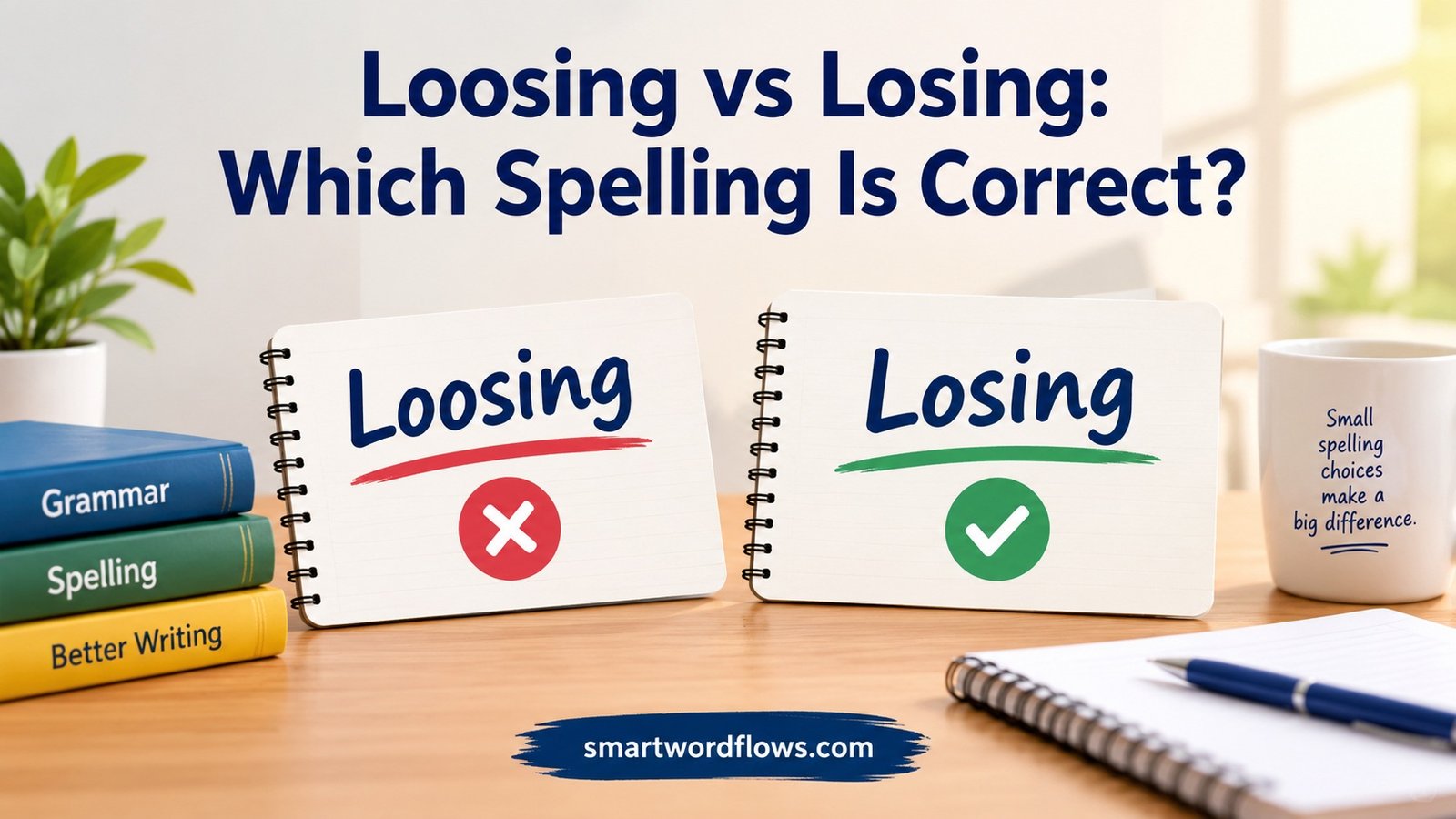

Loosing vs Losing: Which Spelling Is Correct? helps English learners understand why these similar words have different meanings and uses in English. Loosing and losing look similar, which can leave people, English learners, and experienced writers confused about the correct word.
The phrase “I’m loosing my mind” may look right because loose has two O’s, but losing is the correct spelling for failing, misplacing something, being defeated, or no longer having something. Loosing is a real word, although uncommon, and its meaning involves releasing, untying, setting free, freeing something, or letting go. This difference creates an important spelling distinction in the English language. In grammar, word usage, and everyday communication, losing is frequently used, such as when you lose a game, lose control, or discuss losing something, while loosing functions as a verb connected with release. The distinction matters in informal writing, digital writing spaces, social media posts, emails, blogs, and business communication, where spelling rules and English spelling patterns can be harder to notice during fast writing moments. Seasoned writers may make mistakes while typing, especially during mid-sentence work when they are focused on ideas.
Simple memory tricks can make learning easier: connect losing with failure, reduction, or something gone, and connect loosing with release, untie, or freedom. Better spelling accuracy, writing clarity, and English communication skills come from slowing down and checking context clues before making a word choice. Readers and writers can remember that the correct form is losing for loss or failure, while loosing describes an act of releasing. This reduces writing errors and prevents overthinking when these nearly identical words appear in sentences. The correct usage and incorrect usage become clearer through word meaning, vocabulary, grammatical usage, accuracy, clarity, and grammatical correctness. A single extra letter can create a different meaning, so noticing small mistakes and matching the word to its context helps maintain strong writing, spelling, and language skills.
Quick Answer: Loosing vs Losing
Losing is the correct spelling when you mean failing to keep something, failing to win, misplacing something, or experiencing a reduction.
Loosing is a legitimate word when it means releasing, freeing, or setting something loose.
For example:
- Correct: I keep losing my keys.
- Correct: Our team is losing the game.
- Correct: She is losing weight.
- Correct: The company is losing money.
- Correct: The archer is loosing an arrow.
So, if you’re talking about something disappearing, declining, or being lost, use losing. If you’re talking about releasing something, loosing may be the right choice.
Comparison Overview
| Word | Base Word | Main Meaning | Commonness | Example |
| Losing | Lose | Failing to keep, win, or possess something | Very common | He is losing the match. |
| Loosing | Loose | Releasing or setting something free | Uncommon | The archer is loosing an arrow. |
| Lose | Lose | Fail to keep or win something | Very common | Don’t lose your phone. |
| Loose | Loose | Not tight or firmly fixed; free | Common | The screw is loose. |
The crucial difference lies in the base word. Losing comes from lose, while loosing comes from loose.
That distinction becomes much easier once you stop looking only at the spelling. Think about the meaning first. Are you losing something or loosing something from a restraint?
Main Differences Between Loosing vs Losing
The biggest difference between loosing and losing involves their roots and meanings.
Losing comes from the verb lose. It commonly describes the absence, failure, defeat, or reduction of something.
Loosing comes from the verb loose. It describes the act of releasing something that was restrained, confined, tied, or held.
Here’s the basic contrast:
Lose → Losing = no longer having or failing to win
Loose → Loosing = releasing or setting free
This distinction explains why “losing weight” is correct while “loosing weight” is incorrect in standard modern usage.
What Does “Losing” Mean?
Losing is the present participle and gerund form of lose.
The verb lose has several related meanings. It can describe physically misplacing something, failing to win, no longer possessing something, or experiencing a decline.
For example:
- I keep losing my glasses.
- The team is losing the championship game.
- She is losing interest in the project.
- The business is losing customers.
- He is losing patience.
- We’re losing valuable time.
Notice the common idea behind these examples. Something is being lost, reduced, missed, or no longer retained.
The word doesn’t always involve a physical object. You can lose confidence, attention, control, hope, patience, time, money, or an opportunity.
That flexibility makes losing extremely common in everyday English.
What Does “Loosing” Mean?
Loosing is the present participle and gerund form of loose when loose functions as a verb.
As a verb, loose means to release, free, or let something go. This meaning differs from the more familiar adjective loose, which describes something that isn’t tight or firmly attached.
For example:
- The soldiers were loosing arrows.
- The handler was loosing the dogs from their restraints.
- The prisoner was finally loosed from his chains.
- The spell seemed to be loosing a powerful force.
You won’t see this form nearly as often as losing. Still, uncommon doesn’t mean incorrect.
In modern writing, loosing often appears in literary, historical, poetic, or formal contexts. It can also appear when writers deliberately use the verb loose to describe releasing something.
Losing and Loosing Are Different Verb Forms
A simple word-family comparison makes the distinction clearer:
Lose → losing
- lose
- loses
- lost
- losing
Loose → loosing
- loose
- looses
- loosed
- loosing
The spelling follows the base word.
If your sentence needs the verb lose, use losing. If it needs the verb loose, use loosing.
This isn’t simply a matter of adding or removing an o. You’re choosing between two different words.
When to Use “Losing”
Losing belongs in a huge range of everyday situations. Whenever lose provides the intended meaning, its -ing form is losing.
Losing Something
You use losing when you no longer have something or can’t find it.
For example:
- I’m losing my keys again.
- She worries about losing her phone.
- He keeps losing his wallet.
- We’re losing valuable documents.
Here, the objects aren’t being released. They’re being misplaced or no longer retained.
That’s why losing is correct.
Losing a Game or Competition
You also use losing when someone fails to win a competition.
Examples include:
- Our team is losing the game.
- They were losing by two points.
- She hates losing at chess.
- The player was losing the match before the comeback.
The opposite of winning in these examples is losing.
You wouldn’t say “The team is loosing the game” in standard English. That spelling changes the word from lose to loose and therefore changes its meaning.
Losing Weight
One of the most common mistakes involves this phrase.
The correct expression is:
losing weight
For example:
She has been losing weight through regular exercise and healthier meals.
Why? The phrase uses the verb lose. It means having less weight.
Loosing weight doesn’t express that meaning.
The confusion probably comes from the fact that loose can describe something that isn’t tight. However, loose and lose are different words with different meanings.
Losing Interest, Control, Patience, or Hope
English uses losing in many figurative expressions.
You can lose:
- interest
- control
- patience
- hope
- confidence
- focus
- motivation
- concentration
- trust
- respect
For example:
After several delays, customers started losing interest in the product.
Or:
She was losing patience after waiting for nearly an hour.
These expressions describe something gradually disappearing or diminishing. That makes losing the correct form.
Losing Your Way
Losing your way can describe both a literal and figurative situation.
Literally, it means becoming unable to find the correct route:
We were losing our way in the unfamiliar neighborhood.
It can also have a figurative meaning:
After changing careers several times, he felt like he was losing his way.
Again, the underlying verb is lose, so the correct form is losing.
When to Use “Loosing”
Loosing has a narrower meaning. Use it when loose functions as a verb meaning to release, free, or let loose.
Loosing Something That Was Restrained
Suppose an animal is tied up and someone releases it. The action can be described with the verb loose.
For example:
The farmer was loosing the horses from their restraints.
The horses aren’t being lost. They’re being released.
That one distinction solves the spelling problem.
Loosing an Arrow
One traditional use of loosing involves archery.
An archer can loose an arrow, meaning release it from the bow.
For example:
The archer drew the bow and prepared for loosing the arrow.
Or:
The warrior was loosing arrows toward the target.
This usage often appears in historical fiction, fantasy writing, descriptions of archery, and older literature.
Loosing Something Into the World
Writers can also use loosing figuratively to describe releasing something powerful or uncontrolled.
For example:
The experiment resulted in loosing a dangerous force into the environment.
This construction is less common than ordinary expressions using release. Still, it can be grammatically valid when the intended meaning is setting something loose.
Why “Loosing” Sounds Unusual Today
The word loosing is correct in the right context, but modern speakers don’t use it frequently.
Most everyday situations call for losing instead. People commonly talk about losing money, losing weight, losing a game, losing time, or losing interest.
By contrast, people usually say releasing, freeing, or letting loose rather than using loosing.
That difference in frequency explains why loosing may look like a typo when you encounter it.
However, context matters. A word can be uncommon without being wrong.
Losing vs Loosing Examples
Seeing the two words side by side makes the distinction much easier.
Correct Uses of “Losing”
| Sentence | Why “losing” is correct |
| I’m losing my keys. | You can no longer find them. |
| We are losing the game. | Your team isn’t winning. |
| She is losing weight. | Her weight is decreasing. |
| He is losing patience. | His patience is diminishing. |
| They are losing money. | They are experiencing a financial loss. |
| I’m losing focus. | Your concentration is declining. |
| She is losing hope. | Her hope is fading. |
Correct Uses of “Loosing”
| Sentence | Why “loosing” is correct |
| The archer is loosing an arrow. | The arrow is being released. |
| They were loosing the horses. | The horses were being freed. |
| The keeper was loosing the dogs. | The dogs were being released. |
| The warrior began loosing arrows. | The arrows were being released from the bow. |
The meanings remain distinct even though the spellings differ by only one letter.
Incorrect vs Correct Examples
| Incorrect | Correct | Reason |
| Loosing weight | Losing weight | Weight is decreasing. |
| Loosing the game | Losing the game | The team is being defeated. |
| Loosing my keys | Losing my keys | The keys are misplaced. |
| Loosing money | Losing money | Money is being lost. |
| Loosing patience | Losing patience | Patience is diminishing. |
| Loosing interest | Losing interest | Interest is fading. |
The mistake becomes obvious when you ask what the sentence actually means.
If you mean not having, failing, decreasing, or being defeated, choose losing.
If you mean releasing or setting free, consider loosing.
Common Phrases With “Losing”
Because lose has many meanings, losing appears in countless everyday expressions.
Some of the most common include:
- losing weight
- losing money
- losing time
- losing a game
- losing interest
- losing patience
- losing control
- losing hope
- losing focus
- losing your way
- losing confidence
- losing sleep
- losing an opportunity
- losing touch
- losing your temper
Consider the phrase losing touch. It doesn’t mean physically releasing something. It means becoming less connected or communicating less often.
Similarly, losing your temper means becoming angry. The word still comes from lose, not loose.
Read More:Programming vs Programing: Which Spelling Is Correct?
Common Phrases With “Loosing”
Because loosing is relatively uncommon, its natural uses tend to involve literal or figurative release.
Examples include:
- loosing an arrow
- loosing the dogs
- loosing a horse
- loosing a captive
- loosing a prisoner
- loosing something from its restraints
- loosing a force
- loosing a torrent
These examples share one central idea: something is being released.
If that idea doesn’t fit your sentence, losing is probably the word you need.
Why Do People Confuse Loosing and Losing?
The confusion isn’t surprising. The words differ by just one letter, and their base forms, lose and loose, already cause trouble for many English learners.
The Similar Spelling
Look at the relationship:
- lose → losing
- loose → loosing
The extra o in loosing comes directly from loose.
When people remember only the sound or general appearance of the word, they can easily insert an extra o into losing.
That’s particularly common in phrases such as losing weight, losing money, and losing a game.
The Connection Between “Loose” and “Lose”
The two base words have different meanings.
Lose generally involves failing to keep, find, win, or retain something.
Loose usually describes something that isn’t tight or firmly attached. As a verb, it can mean to release something.
Compare these:
The rope is loose.
The archer is loosing the arrow.
Now compare them with:
She is losing her keys.
The meanings point to different word families.
Pronunciation Differences
Pronunciation can also help you distinguish the words.
Lose ends with a voiced /z/ sound.
Loose ends with an unvoiced /s/ sound.
The same distinction carries into their -ing forms.
The vowel sound stays similar while the consonant sound changes.
That difference can be useful, especially when you’re speaking and writing at the same time.
Loosing vs Losing Pronunciation
| Word | IPA | Related Base Word |
| Lose | /luːz/ | Lose |
| Losing | /ˈluːzɪŋ/ | Lose |
| Loose | /luːs/ | Loose |
| Loosing | /ˈluːsɪŋ/ | Loose |
The key sound difference is the final consonant of the base word.
Lose uses the voiced /z/ sound.
Loose uses the unvoiced /s/ sound.
You can feel this distinction by placing your fingers lightly against your throat. The /z/ sound creates vocal-cord vibration while /s/ does not.
That small pronunciation difference mirrors the difference in spelling.
Losing vs Loosing: Grammar and Word Forms
Understanding the complete word families makes the spelling much easier to remember.
Lose → Losing
The forms of lose include:
- lose
- loses
- lost
- losing
Examples:
Don’t lose your ticket.
He often loses his keys.
She lost her wallet yesterday.
They are losing valuable time.
The spelling losing drops the final e from lose before adding -ing.
Loose → Loosing
The verb loose can form:
- loose
- looses
- loosed
- loosing
For example:
The handler will loose the dogs.
The handler loosed the dogs.
The handler is loosing the dogs.
These forms belong to the loose word family.
The distinction is easier when you identify the base verb before adding -ing.
Loosing vs Losing in American English
In American English, losing is overwhelmingly the form you’ll need in ordinary writing.
American readers routinely encounter expressions such as:
- losing weight
- losing money
- losing a job
- losing a game
- losing interest
- losing patience
- losing time
Loosing remains an English word, but its meaning is much narrower and its everyday frequency is far lower.
Therefore, if you’re writing an email, school assignment, business document, article, or social media post, losing will usually be the correct choice when the sentence involves lose.
That doesn’t make loosing an incorrect spelling. It simply means the two words serve different grammatical and semantic purposes.
Common Mistakes With Loosing and Losing
“Loosing Weight” vs “Losing Weight”
❌ She is loosing weight.
✅ She is losing weight.
Her weight is decreasing. Nothing is being released.
“Loosing a Match” vs “Losing a Match”
❌ Our team is loosing the match.
✅ Our team is losing the match.
The team is failing to win.
“Loosing Your Keys” vs “Losing Your Keys”
❌ I keep loosing my keys.
✅ I keep losing my keys.
The keys aren’t being freed. They’re being misplaced.
“Loosing Money” vs “Losing Money”
❌ The company is loosing money.
✅ The company is losing money.
The business is experiencing financial losses.
“Loosing Your Temper” vs “Losing Your Temper”
❌ He’s loosing his temper.
✅ He’s losing his temper.
The expression means becoming angry.
A Simple Case Study: Why Context Matters
Imagine an editor receives two sentences:
Sentence A: The company is loosing customers every month.
Sentence B: The hunter is loosing an arrow.
At first glance, the words look almost identical. Yet only one sentence needs correction.
In Sentence A, the company is losing customers. Customers are no longer remaining with the company. The correct form is losing.
Sentence B describes an arrow being released. Here, loosing can be correct because it comes from the verb loose.
This example shows why spelling alone isn’t enough. Meaning determines which word belongs in the sentence.
How to Remember the Difference Between Losing and Loosing
The “Lose” Memory Trick
Connect losing with something you don’t have anymore.
Think:
Lose = no longer have it.
So:
- losing keys
- losing money
- losing time
- losing a game
- losing patience
The “Loose” Memory Trick
Connect loosing with releasing something.
Think:
Loose = set free.
So:
- loosing an arrow
- loosing the dogs
- loosing a captive
This gives you a simple mental shortcut:
If something disappears or you fail to keep it, think “losing.”
If something is released, think “loosing.”
A Simple Question to Ask Yourself
When you’re unsure, ask:
“Am I talking about losing something or releasing something?”
If the answer is losing, use losing.
If the answer is releasing, loosing may fit.
This quick test works particularly well when you’re proofreading your own writing.
Loosing vs Losing in Real Sentences
Here are several examples that show the contrast naturally.
Examples With “Losing”
I’m losing my patience with this slow computer.
The team is losing the final by three points.
She worries about losing her job.
We’re losing daylight quickly.
He keeps losing his phone.
The store is losing customers to competitors.
Don’t risk losing your opportunity.
Each sentence describes something being lost, reduced, missed, or no longer retained.
Examples With “Loosing”
The archer was loosing arrows toward the target.
The keeper was loosing the hounds.
The soldier began loosing arrows from the castle wall.
The story describes a wizard loosing a powerful force.
These examples all involve release.
Frequently Asked Questions About Loosing vs Losing
Is “loosing” a correct word?
Yes. Loosing is a legitimate word when it functions as the -ing form of the verb loose and means releasing or setting something free.
However, it isn’t the correct replacement for losing.
Is “loosing” the same as “losing”?
No. Losing comes from lose, while loosing comes from loose.
Losing generally means failing to keep, find, win, or retain something.
Loosing means releasing or setting something free.
Is it losing weight or loosing weight?
The correct expression is losing weight.
For example:
She is losing weight through regular exercise.
The phrase describes a reduction in weight, so it uses the verb lose.
Is it losing a game or loosing a game?
The correct phrase is losing a game.
If someone fails to win a game, they’re losing it.
Loosing a game doesn’t express that meaning.
Why do people spell losing as loosing?
People often confuse losing and loosing because the words look similar and their base words, lose and loose, are also commonly confused.
The extra o belongs to loose, not lose.
What is the difference between loose, lose, losing, and loosing?
Loose usually means not tight or firmly attached. As a verb, it can mean release.
Lose means fail to keep, find, or win something.
Losing is the -ing form of lose.
Loosing is the -ing form of loose when loose means release.
How do you pronounce losing and loosing?
In standard US English, losing has a /z/ sound in the middle, while loosing has an /s/ sound.
The pronunciation difference reflects their different base words: lose and loose.
conclusion
Losing and loosing may look almost identical, but they have different meanings and uses. Losing is the correct word when you mean failing to win, misplacing something, or no longer having something. Loosing, on the other hand, comes from loose and means releasing or setting something free.
Understanding the difference between loosing vs losing can help you avoid a common spelling mistake in emails, schoolwork, professional writing, and everyday communication. When in doubt, remember the root word: lose → losing and loose → loosing. With this simple distinction, choosing the right spelling becomes much easier.




1 thought on “Loosing vs Losing: Which Spelling Is Correct?”