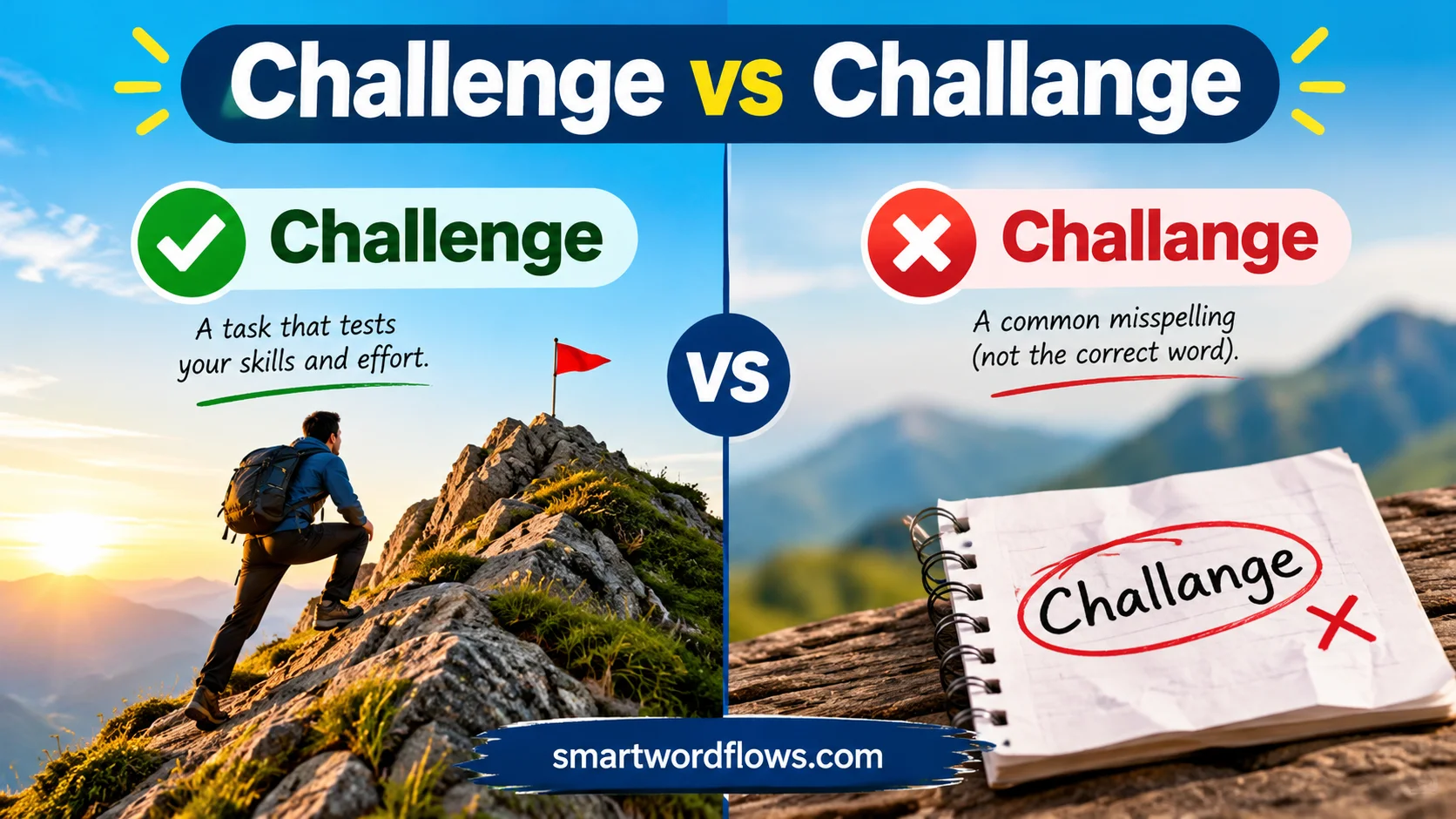

When comparing Challenge vs Challange, Challenge is the correct English spelling, while Challange is an incorrect misspelling that often confuses writers.
The confusion between these similar-looking words can appear in everyday writing, emails, social media posts, academic work, professional documents, and conversations. Challenge means a difficult task or situation that requires effort, skill, or determination. Learning the correct usage makes it easier to avoid spelling errors and communicate clearly.
Quick Answer
Challenge is the correct spelling.
Challange is an incorrect spelling and should not be used in standard English writing.
The correct form is:
- ✅ Challenge
- ❌ Challange
For example:
Learning a new language can be a rewarding challenge.
Not:
Learning a new language can be a rewarding challange.
The mistake usually happens because writers hear the word and assume it contains the spelling -lange. In reality, the correct spelling contains -lenge:
c-h-a-l-l-e-n-g-e
A useful way to remember it is to focus on the middle and ending:
chal + lenge = challenge
Comparison Overview
The difference between challenge and challange is straightforward once you look closely at their spelling and grammatical status.
| Feature | Challenge | Challange |
| Correct spelling | Yes | No |
| Standard English word | Yes | No |
| Dictionary spelling | Yes | No |
| Noun | Yes | No |
| Verb | Yes | No |
| Adjective form | Challenging | Incorrectly written as challanging |
| Past-tense form | Challenged | Incorrectly written as challanged |
| Suitable for formal writing | Yes | No |
| Common spelling mistake | No | Yes |
The important point is that challange isn’t an alternative spelling of challenge. It doesn’t represent a different dialect, meaning, or grammatical form.
It’s simply a spelling error.
Challenge vs Challange at a Glance
Challenge can function as both a noun and a verb.
As a noun:
The exam presented a serious challenge.
As a verb:
The lawyer decided to challenge the evidence.
By contrast, challange has no standard grammatical role in English. If you see it in a sentence, the writer almost certainly intended to write challenge.
Main Differences Between Challenge and Challange
The main difference between challenge vs challange comes down to one spelling pattern.
Challenge Is the Correct Word
Challenge is a standard English word with several meanings. It can describe something difficult that requires effort, a dispute against an idea, or an invitation to compete.
For example:
- The project presented a difficult challenge.
- She decided to challenge the decision.
- The coach challenged the players to improve.
- He enjoys taking on new challenges.
The spelling remains recognizable across its related forms.
Challange Is a Misspelling
Challange doesn’t have a separate meaning. Writers sometimes insert an a where the correct spelling requires an e.
Compare the two forms:
Challange → c-h-a-l-l-a-n-g-e
Challenge → c-h-a-l-l-e-n-g-e
The difference is small visually. The correct spelling uses e after the double l.
That tiny detail makes a major difference in standard written English.
What Does “Challenge” Mean?
The word challenge has a surprisingly broad range of uses. Its meaning depends heavily on context.
As a noun, challenge commonly refers to something difficult that requires skill, effort, patience, or determination.
For example:
Finishing the marathon was a major challenge.
Here, challenge describes a difficult undertaking.
The word can also describe a problem or obstacle:
Finding enough qualified workers remains a challenge for the company.
However, challenge often carries a more constructive tone than problem. A problem emphasizes something that needs fixing. A challenge can suggest an opportunity to demonstrate ability or overcome difficulty.
Challenge as a Noun
Common noun meanings include:
- A difficult task:
The final exam was a real challenge. - A difficult situation:
The team faced several challenges during the project. - An obstacle:
Limited funding created a significant challenge. - A test of ability:
The competition provided a serious challenge. - An invitation to compete:
He accepted the champion’s challenge.
The noun form works in both casual and formal writing.
Challenge as a Verb
As a verb, challenge can mean several things.
It may mean to test someone’s ability:
The difficult assignment challenged her mathematical skills.
It may mean to question something:
The researchers challenged the traditional explanation.
It can also mean to confront or dispute:
The attorney challenged the validity of the contract.
Finally, it can mean to invite someone to compete:
The champion challenged his rival to another match.
Context determines which meaning the reader understands.
Why Is “Challange” Incorrect?
The spelling challange is incorrect because standard English spells the word challenge.
The confusion often centers on the vowel after the double l.
The incorrect version contains:
challange
The correct version contains:
challenge
Notice the crucial difference:
-l-a-n-g-e ❌
-l-e-n-g-e ✅
The word therefore follows this spelling:
C H A L L E N G E
Not:
C H A L L A N G E
This distinction becomes especially useful when you write the related forms challenged, challenges, and challenging.
Why Do People Spell Challenge as “Challange”?
Spelling mistakes rarely happen for just one reason. With challange, pronunciation and visual patterns both contribute to the confusion.
Pronunciation Doesn’t Reveal Every Letter
English spelling often doesn’t match pronunciation perfectly.
When you hear challenge, the vowel sounds don’t clearly tell you whether the written word contains a or e in the relevant position. Someone who learned the word mainly through conversation might therefore make a reasonable-sounding spelling guess.
That’s one reason spelling requires more than simply writing what you hear.
Visual Pattern Confusion
English contains many familiar words ending in -ange, including:
- change
- strange
- range
- exchange
- arrange
- orange
Because these patterns are common, challange can look plausible even though it’s wrong.
The brain often recognizes familiar letter patterns quickly. Unfortunately, that shortcut can produce spelling errors when a word follows a different pattern.
Typing Errors
Fast typing can also cause the mistake.
When you’re writing quickly, your fingers may produce a familiar vowel without conscious attention. Spell-check software can usually catch challange, but writers shouldn’t rely entirely on automated correction.
Limited Exposure to Written English
Someone who hears a word frequently but rarely reads it may struggle to reproduce its spelling.
For example, a student might know exactly what challenge means and use it correctly in conversation while still writing challange.
That isn’t a vocabulary problem. It’s a spelling problem.
How to Spell Challenge Correctly
The easiest approach involves memorizing the word’s internal structure rather than trying to reconstruct it from pronunciation.
Break the Word Into Parts
Think of it as:
chal + lenge
Then combine the parts:
challenge
The most important spelling point is the e after the double l.
Remember the Double L
The word begins with:
chal
That gives you:
c-h-a-l-l
The word then continues with:
e-n-g-e
Together:
c-h-a-l-l-e-n-g-e
A Simple Memory Trick
Remember this phrase:
The challenge has an E.
Whenever you’re unsure whether to write challange or challenge, check the vowel after the double l.
If you’ve written a, stop.
The correct letter is e.
Challenge: Noun vs Verb
Understanding the grammar of challenge makes the word easier to use accurately.
“Challenge” as a Noun
When challenge acts as a noun, it names something.
For example:
The new position presents an exciting challenge.
The word identifies the difficult or demanding situation.
Here are several additional examples:
- The mountain climb was the biggest challenge of the trip.
- Learning advanced mathematics can become a rewarding challenge.
- The company faces a major financial challenge.
- Managing the growing team became an unexpected challenge.
- The tournament gave every player a difficult challenge.
“Challenge” as a Verb
When challenge acts as a verb, it describes an action.
For example:
The professor challenged the students to defend their arguments.
Here, challenged describes what the professor did.
More examples include:
- The journalist challenged the official explanation.
- The coach challenged the team to work harder.
- The student challenged the accuracy of the answer.
- The competitor challenged the reigning champion.
- The new evidence challenges the earlier conclusion.
The same basic word can therefore express both a difficulty and an action.
Common Forms of Challenge
The word changes slightly depending on how you use it grammatically.
| Grammatical form | Correct spelling | Example |
| Base noun | challenge | This is a serious challenge. |
| Base verb | challenge | They challenge the decision. |
| Plural noun | challenges | The project has several challenges. |
| Third-person verb | challenges | She challenges the assumption. |
| Past tense | challenged | He challenged the ruling. |
| Past participle | challenged | The claim was challenged. |
| Present participle | challenging | The task is challenging. |
Why “Challenging” Matters
A particularly common spelling mistake is challanging.
The correct form is:
challenging
Not:
challanging
The spelling changes when the suffix -ing is added. The final e disappears before -ing, producing challenging.
For example:
The course is challenging but rewarding.
The same pattern appears in other English words, such as:
- make → making
- write → writing
- create → creating
- challenge → challenging
Challenge vs Challange in a Sentence
Seeing the words in context makes the difference much easier to recognize.
Correct Usage
The new assignment is a challenge, but I’m ready for it.
She challenged the assumptions behind the study.
The company overcame several challenges during its expansion.
The coach challenged every player to improve.
Learning another language can be challenging at first.
Incorrect Usage
These sentences contain the common spelling error:
❌ The new assignment is a challange.
❌ She challanged the assumptions behind the study.
❌ The company overcame several challanges.
❌ The coach challanged every player.
❌ Learning another language can be challanging.
Every incorrect form should be replaced with the appropriate form of challenge.
Read This: Training vs Trainning: Which One Is Correct?
Common Spelling Mistakes With Challenge
Although challange is the main error, several other forms appear in informal writing.
| Incorrect | Correct |
| challange | challenge |
| challanges | challenges |
| challanged | challenged |
| challanging | challenging |
| chalenge | challenge |
These mistakes usually involve either dropping a letter or choosing the wrong vowel.
The safest strategy involves learning the word family together instead of memorizing only one form.
challenge → challenges → challenged → challenging
Once this pattern becomes familiar, you’ll spot incorrect versions much faster.
How to Remember the Correct Spelling
Spelling improves when you attach a word to a memorable pattern.
For challenge, remember these three points:
- It begins with chall-.
- It contains -enge- rather than -ange-.
- Its -ing form is challenging, not challanging.
A useful visual reminder looks like this:
CHALL + ENGE
The key sequence is:
E-N-G-E
That final pattern separates challenge from the common misspelling challange.
Another Useful Strategy
Write the correct word several times:
challenge
challenge
challenge
Then use it naturally:
Every challenge creates an opportunity to learn something new.
Repeated exposure helps build visual memory. Eventually, the incorrect version will look unusual.
Challenge vs Similar Words
Although several words overlap with challenge, they don’t always carry exactly the same meaning.
Challenge vs Difficulty
A difficulty is something that makes an activity hard.
A challenge can mean the same thing, but it often suggests something you can actively tackle or overcome.
Compare:
The difficult terrain created a difficulty for the hikers.
The difficult terrain created a challenge for the hikers.
Both sentences work. The second can sound slightly more active and goal-oriented.
Challenge vs Problem
A problem usually emphasizes something that needs a solution.
A challenge can emphasize the effort required to deal with something difficult.
For example:
Finding qualified employees is a problem.
This focuses on the issue itself.
Finding qualified employees is a challenge.
This focuses more on the difficulty involved in solving it.
The distinction isn’t absolute. In many contexts, the words can overlap.
Challenge vs Test
A test usually measures knowledge, skill, performance, or ability.
A challenge has a broader meaning.
For example:
The final exam was a difficult test.
Running a business during an economic downturn was a major challenge.
A test can be a challenge, but not every challenge is a test.
Is “Challange” Ever Correct?
In standard English, challange is not the correct spelling of challenge.
You may occasionally encounter the spelling online in usernames, comments, posts, filenames, or other informal material. Its appearance doesn’t make it an accepted spelling.
If you’re writing something that needs standard English, use challenge.
This matters especially in:
- Academic papers
- Resumes
- Cover letters
- Business emails
- Reports
- Articles
- Presentations
- Professional websites
- Formal applications
In these settings, a spelling error can distract readers from your actual message.
Challenge in Different Contexts
The versatility of challenge explains why it’s such a useful word.
Academic Writing
Academic writers often use challenge when discussing limitations, competing theories, difficult research problems, or assumptions that need examination.
For example:
Researchers continue to face challenges when collecting reliable long-term data.
The word works particularly well when discussing complex problems without making the writing sound unnecessarily negative.
Professional Writing
In business communication, challenge often describes an obstacle without sounding defeatist.
For example:
The company faces several challenges as it enters international markets.
This sounds more constructive than simply saying:
The company has several problems.
However, writers shouldn’t use challenge as a vague substitute for problem when the latter is more precise.
Everyday Conversation
In everyday speech, challenge often describes something difficult but worthwhile.
For example:
Getting used to my new schedule has been a challenge.
Or:
Cooking that recipe was quite a challenge!
The word sounds natural in casual conversation because people frequently describe experiences in terms of effort and difficulty.
Sports and Competition
Sports provide another major use of challenge.
A player might challenge another competitor. A team might face a difficult challenge. A champion might accept a challenge from a rival.
For example:
The defending champion accepted the challenge from the tournament’s newest contender.
Here, challenge carries a competitive meaning rather than simply describing difficulty.
Challenge Pronunciation
The standard pronunciation of challenge is:
/ˈtʃæl.ɪndʒ/
The word contains two syllables, with the first syllable receiving the main stress.
challenge (ˈtʃæl.ɪndʒ)
The pronunciation can help you recognize the word when someone says it aloud. However, pronunciation alone won’t reliably tell you whether the written word contains a or e in every position.
That’s why spelling memory matters.
Synonyms for Challenge
Depending on the context, several words can replace challenge.
| Synonym | Meaning or use |
| Difficulty | Something that requires effort to overcome |
| Obstacle | Something that blocks progress |
| Problem | Something that needs a solution |
| Test | Something that measures ability or knowledge |
| Trial | A difficult experience or period |
| Task | Work that needs to be completed |
| Hurdle | A barrier that must be overcome |
| Demand | Something requiring considerable effort |
| Adversity | A difficult or unfavorable circumstance |
| Contest | A competitive struggle or competition |
These words aren’t perfect substitutes in every sentence.
For instance, challenge can mean question or dispute, while difficulty generally cannot.
The lawyer challenged the evidence.
You couldn’t naturally replace challenged with difficultied.
That’s why context matters when choosing synonyms.
Challenge vs Challange: Correct and Incorrect Examples
Here are several direct comparisons that reinforce the spelling difference.
| Incorrect sentence | Correct sentence |
| The project was a major challange. | The project was a major challenge. |
| She accepted the challange. | She accepted the challenge. |
| We faced several challanges. | We faced several challenges. |
| He challanged the decision. | He challenged the decision. |
| The assignment was challanging. | The assignment was challenging. |
The incorrect versions don’t represent alternative spellings. Each one should be corrected.
A Practical Case Study: Spotting the Error
Imagine that a student finishes an essay and writes:
The biggest challange facing modern businesses is adapting to rapid technological change.
The meaning is completely clear. The reader understands the intended word immediately.
Still, the spelling should be corrected:
The biggest challenge facing modern businesses is adapting to rapid technological change.
This example demonstrates an important point: a spelling error doesn’t necessarily prevent understanding, but it can reduce the professionalism of your writing.
Now imagine the same error appearing five or six times throughout a formal report. The mistake becomes much more noticeable.
One incorrect letter might seem insignificant. Repeated errors can affect how readers judge the care behind the entire document.
Why Correct Spelling Matters
Correct spelling isn’t merely about satisfying a grammar checker.
When you spell a common word correctly, readers can focus on your ideas instead of stumbling over mistakes.
This becomes especially important in professional contexts.
A resume containing challange may make a recruiter question the applicant’s attention to detail. An academic paper containing repeated spelling errors may distract from otherwise strong research. A business proposal can lose polish when basic words appear incorrectly.
Correct spelling therefore supports clarity, credibility, and readability.
Challenge vs Challange: Key Differences
The entire comparison can be reduced to a few essential facts.
| Question | Answer |
| Which spelling is correct? | Challenge |
| Is “challange” a standard English word? | No |
| Can “challenge” be a noun? | Yes |
| Can “challenge” be a verb? | Yes |
| What is the plural? | Challenges |
| What is the past tense? | Challenged |
| What is the -ing form? | Challenging |
| What letter causes the main spelling confusion? | E vs. A |
| Is “challange” appropriate in formal writing? | No |
The most important distinction remains simple:
Challenge = correct
Challange = incorrect
FAQs :
1. Is “Challenge” or “Challange” correct?
Challenge is the correct English spelling. Challange is a misspelling and shouldn’t be used in standard English writing.
2. What does “Challenge” mean?
A challenge is a difficult task, situation, or problem that requires effort, skill, or determination to overcome.
3. Why do people spell Challenge as Challange?
People often write Challange because it looks and sounds similar to Challenge. The extra “a” is a common spelling error.
4. Is “Challange” a real English word?
No. Challange isn’t considered a correct English word. Use Challenge in academic, professional, and everyday writing.
5. How can I remember the correct spelling of Challenge?
Remember that Challenge contains “lenge” after “chal.” Breaking the word into chal-lenge can help you avoid the incorrect Challange spelling.
Conclusion :
Challenge is the only correct spelling in standard English, while Challange is a common spelling mistake. Remembering the correct form will help you write more accurately in emails, assignments, social media posts, and professional documents.