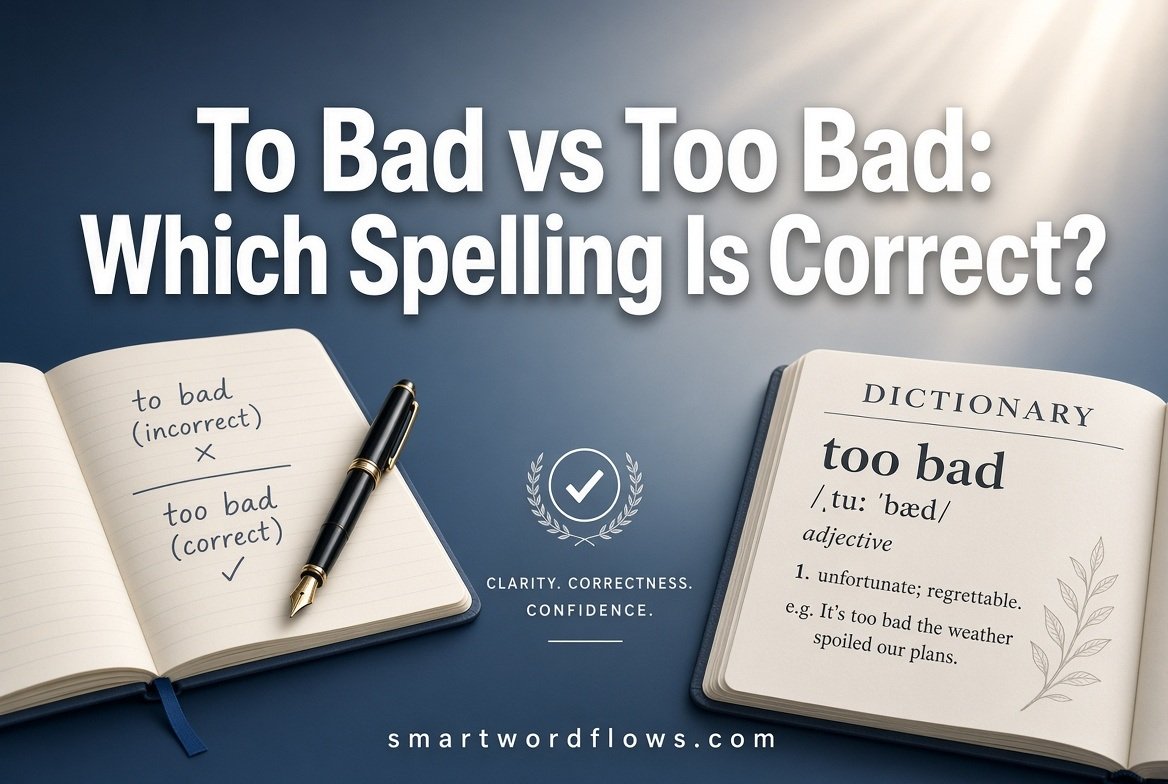

The To Bad vs Too Bad: Which Spelling Is Correct? question becomes easy when you focus on grammar, meaning, and the correct phrase rather than spelling alone. Too bad is the standard expression in American English and standard American English for something unfortunate, disappointing, or regrettable, and it can express sympathy or disappointment. For example, “It’s too bad you missed the game” is correct, while “It’s to bad you missed the game” is incorrect. In everyday speech, too and to sound the same, so they may seem exactly alike, but their grammatical roles are different in written English.
The confusion exists because too and to are homophones with similar pronunciation, yet their grammar rules and usage are different. In the phrase usage too bad, too works as an adverb and modifies the adjective bad. It can add emphasis, express degree or excess, and mean more than necessary; in other situations, it can also mean “also.” By contrast, to commonly works as a preposition showing direction, connection, or a relationship, and it can serve as an infinitive marker. This gives the words different grammatical structure, sentence structure, and grammatical meaning. To bad isn’t normally a fixed phrase in standard usage, because the words usually belong to separate grammatical structures.
In English writing, this remains a common mistake, particularly during casual writing, fast typing, or writing quickly. A simple typo, especially leaving out the extra o, can produce the incorrect form in an email, school assignment, blog post, text message, or professional document. To use correctly, learn to recognize the familiar expression too bad instead of second guessing the spelling each time. Understanding the difference between these forms makes the word choice clearer and improves writing clarity. This guide also helps you use the phrase naturally in everyday communication, strengthen your English usage, and follow standard English more confidently.
Quick Answer: To Bad vs Too Bad
“Too bad” is correct when you mean “unfortunate,” “regrettable,” or “more bad than acceptable.”
“To bad” is generally incorrect when you’re trying to use the common expression.
For example:
- Too bad you couldn’t come to the party.
- That’s too bad.
- The weather was too bad for a picnic.
- The damage wasn’t too bad after all.
You can also find to immediately before bad in a grammatically correct sentence. However, that doesn’t make “to bad” a standard expression.
For example:
She contributed to bad behavior.
Here, to connects contributed with bad behavior. It doesn’t mean the same thing as too bad.
The easiest rule to remember
If you’re expressing regret, disappointment, or excessive degree, use too bad.
If to has a separate grammatical job, such as showing a relationship or forming an infinitive, use to.
Comparison Overview
| Phrase | Word type | Main meaning | Common use | Example |
| too bad | Adverb + adjective | Unfortunate, regrettable, or excessively bad | Very common | Too bad you missed the concert. |
| to bad | Preposition/infinitive marker + adjective | Not normally a fixed expression | Context-dependent | The policy contributed to bad results. |
The important point is that too bad works as a recognizable phrase. To bad generally doesn’t.
Consider this sentence:
Too bad we arrived late.
The phrase expresses disappointment about arriving late.
Now consider:
The delay contributed to bad results.
Here, to isn’t describing the degree of bad. It connects the verb contributed to the noun phrase bad results.
That grammatical difference explains why the spelling matters.
Main Differences Between To Bad vs Too Bad
The biggest difference between to bad vs too bad comes down to grammar and meaning.
“Too Bad” Is a Common English Expression
Too bad is an established expression in English. Depending on context, it can communicate disappointment, sympathy, regret, or excessive severity.
For example:
Too bad you couldn’t stay longer.
The speaker expresses regret that the person couldn’t stay.
In another sentence, too bad can describe something that exceeds an acceptable level:
The traffic was too bad to continue driving safely.
Here, too means that the traffic was bad to an excessive or problematic degree.
So the same spelling can appear in slightly different situations while retaining the word too.
“To Bad” Is Usually Two Separate Words
The combination to bad isn’t normally an English expression.
That doesn’t mean the two words can never appear next to each other. They can. The difference lies in the structure around them.
Consider:
His actions contributed to bad publicity.
The phrase to bad publicity contains:
- to — a preposition
- bad — an adjective
- publicity — a noun
The adjective bad describes publicity. The word to connects contributed with the noun phrase.
Compare that with:
Too bad about the publicity.
Here, too bad works as an expression of regret.
These sentences may look similar at first glance. Their grammar tells a different story.
What Does “Too Bad” Mean?
The phrase too bad has more than one closely related use. Understanding those uses makes the spelling much easier to remember.
“Too Bad” Means Unfortunate
One common meaning of too bad is unfortunate or regrettable.
For example:
You missed the last train? Too bad.
The speaker means that the situation is unfortunate.
Another example:
It’s too bad that the event was canceled.
Here, too bad communicates disappointment about the cancellation.
You could replace it with phrases such as:
- That’s unfortunate.
- That’s a shame.
- That’s disappointing.
- It’s regrettable.
The exact choice depends on the tone and situation.
“Too Bad” Means More Bad Than Acceptable
The word too can also mean that something exceeds a desirable or acceptable level.
For example:
The soup is too hot to eat.
Here, too doesn’t simply mean very. It means the soup has a temperature that creates a problem.
The same principle applies to:
The weather was too bad for the flight to operate.
The weather wasn’t merely bad. Its severity was enough to prevent something from happening.
This distinction matters because too often carries the idea of excess.
“Too Bad” as a Short Response
You may also see too bad as a brief conversational response:
“I can’t come tonight.”
“Too bad!”
The meaning depends heavily on context and tone.
In a sympathetic conversation, too bad can sound genuinely disappointed. In another situation, especially when someone says it sarcastically, the same words may sound dismissive.
Written communication removes many vocal clues. That’s why context matters.
“That’s Too Bad”
That’s too bad is another very common construction.
For example:
“My flight was canceled.”
“Oh, that’s too bad.”
In this situation, the phrase usually communicates sympathy or disappointment.
It doesn’t necessarily mean that the flight itself was exceptionally terrible. Instead, it responds to an unfortunate situation.
What Does “To Bad” Mean?
Unlike too bad, to bad doesn’t normally function as a standalone English expression.
This is where many spelling mistakes happen.
A writer may hear:
“That’s too bad.”
Because to and too sound alike, they may type:
“That’s to bad.”
That spelling is incorrect.
The sentence needs too because the phrase expresses disappointment.
When “To” Can Appear Before “Bad”
There are legitimate sentences in which to appears directly before bad.
For example:
The new policy contributed to bad outcomes.
Here, to is a preposition. The word bad modifies outcomes.
Another example:
Exposure to bad weather can damage equipment.
Again, to connects exposure with bad weather.
Notice what happens when you remove the noun:
Exposure to bad.
That doesn’t normally communicate the same idea as too bad.
The structure matters.
“To Bad” Isn’t an Alternative Spelling of “Too Bad”
This is the key point.
To bad and too bad aren’t two accepted spellings of the same phrase.
They are different grammatical combinations.
If you’re trying to say:
That’s unfortunate.
Write:
That’s too bad.
Don’t write:
That’s to bad.
If you’re describing something as excessively bad, write:
The situation is too bad to ignore.
Not:
The situation is to bad to ignore.
To vs Too: Understanding the Difference
The easiest way to master to bad vs too bad is to understand the two words separately.
What Does “To” Mean?
To has several important grammatical functions.
It commonly works as a preposition:
- Go to school.
- Give the book to Maria.
- Listen to the teacher.
- Talk to your friend.
It can also introduce an infinitive:
- to learn
- to write
- to improve
- to understand
For example:
She wants to learn English.
Here, to helps form the infinitive to learn.
What Does “Too” Mean?
Too is an adverb with two major uses.
First, it can mean also:
I want to go too.
Second, it can mean more than necessary or desirable:
The box is too heavy.
The phrase too bad uses this second meaning when it describes an excessive degree.
However, too bad can also function as the established expression meaning unfortunate or regrettable.
Why “Too Bad” Uses “Too”
Look at the structure:
The conditions are too bad to continue.
The word too modifies the adjective bad. It indicates an excessive degree.
Now look at:
Too bad you can’t come.
This is an idiomatic expression that communicates disappointment.
In both cases, too is the appropriate word.
Why Do People Confuse “To Bad” and “Too Bad”?
The confusion isn’t surprising. English contains many words that sound alike while having different spellings and meanings.
Similar Pronunciation
In standard American English, to and too are homophones in ordinary speech.
That means they generally have the same pronunciation even though they have different spellings and grammatical functions.
When you hear:
“too bad”
you can’t rely on sound alone to decide which spelling to use.
You have to consider the meaning.
Fast Typing Creates More Errors
Modern writing often happens quickly.
People type texts while commuting, send messages between meetings, or write comments without proofreading. A tiny spelling distinction can easily slip through.
Because to is extremely common, writers may accidentally type it when they mean too.
The same pattern appears with other common homophones:
- your / you’re
- there / their / they’re
- its / it’s
- than / then
- to / too / two
These mistakes don’t usually reflect a lack of understanding. Often, they’re simply errors caused by speed or sound-based spelling.
English Homophones Make Spelling Tricky
Homophones are words that sound alike but have different meanings or spellings.
To and too belong to this group.
A useful way to think about homophones is this:
Your ears hear the sound. Your writing needs the meaning.
When you’re unsure, don’t sound out the word. Ask what grammatical job it performs.
“Too Bad” in Different Contexts
The phrase appears in everyday English, but its tone can change depending on the setting.
Too Bad in Everyday Conversation
Consider:
“I forgot my umbrella.”
“That’s too bad.”
The phrase expresses sympathy.
Another example:
“We missed the beginning of the movie.”
“Too bad. Let’s find out what happened.”
The meaning is similar, but the short response sounds more casual.
Too Bad in Text Messages and Social Media
In informal communication, you’ll often see:
- Too bad!
- That’s too bad.
- Too bad you couldn’t make it.
Because texting doesn’t include vocal tone, readers sometimes interpret short responses differently from what the writer intended.
For example, “Too bad.” could sound sympathetic or dismissive depending on the conversation.
A slightly fuller sentence can make your intention clearer:
That’s too bad. I hope you get another chance.
Too Bad in School and Academic Writing
Too bad is grammatically correct in academic writing. However, it may sound informal when you’re discussing serious research or formal analysis.
For example:
It is too bad that the experiment failed.
This sentence is understandable. A formal academic version might say:
The failure of the experiment was unfortunate.
The spelling doesn’t change. The register does.
Too Bad in Professional Writing
Business writing often benefits from precise wording.
Instead of:
It’s too bad that the shipment was delayed.
You might write:
Unfortunately, the shipment was delayed.
However, too bad isn’t grammatically wrong in a professional context. It’s simply more conversational.
To Bad vs Too Bad Examples
Examples make this distinction much easier to remember.
Correct Examples With “Too Bad”
Here are several natural uses:
Too bad you couldn’t join us.
That’s too bad. I know you were looking forward to it.
The weather was too bad for outdoor activities.
It’s too bad that the store closed early.
The damage wasn’t too bad after the storm.
Too bad we didn’t leave earlier.
Notice that every sentence gives too a grammatical reason to be there.
Incorrect Examples With “To Bad”
These sentences contain the common spelling mistake:
❌ To bad you missed the show.
Correct:
✅ Too bad you missed the show.
Another example:
❌ That’s to bad.
Correct:
✅ That’s too bad.
And:
❌ The weather was to bad for hiking.
Correct:
✅ The weather was too bad for hiking.
The mistake comes from choosing the word based on sound rather than meaning.
Genuine Sentences Containing “To” Before “Bad”
Now consider sentences where to really is correct:
The experience contributed to bad decisions.
The company responded to bad reviews.
Exposure to bad weather can damage the structure.
The change led to bad results.
In each example, to connects one part of the sentence with another. It isn’t replacing too.
That’s an important distinction. The words can appear beside each other in some grammatical constructions without forming the phrase too bad.
Read More:Message vs Messege: Which Spelling Is Correct?
Common Mistakes With To Bad and Too Bad
Writing “To Bad” When You Mean “Too Bad”
This is the most common mistake.
If you mean unfortunate, choose too bad.
❌ It’s to bad that you missed it.
✅ It’s too bad that you missed it.
Confusing “Too Bad” With “Very Bad”
The words too and very aren’t interchangeable in every sentence.
Compare:
The movie was very bad.
This means the movie was extremely poor.
Now:
The movie was too bad to recommend.
This means its poor quality reached a level that prevents a recommendation.
The second sentence contains an idea of excess or an undesirable degree.
Consider another pair:
The coffee is very hot.
The coffee is too hot to drink.
The first sentence describes intensity. The second indicates that the intensity creates a problem.
Assuming “Too Bad” Always Means “Extremely Bad”
That’s another common misunderstanding.
When someone says:
That’s too bad.
they usually aren’t saying that the situation is extremely bad.
They may simply mean:
That’s unfortunate.
Context determines the meaning.
Misreading the Tone of “Too Bad”
Tone can completely change how too bad feels.
Compare:
“You didn’t get the ticket? That’s too bad.”
This may express sympathy.
Now imagine someone says:
“You ignored the warning and lost your chance? Too bad.”
That can sound dismissive.
The spelling remains identical. The emotional effect changes because of context and delivery.
Too Bad vs Very Bad vs So Bad
These three expressions can overlap, but they aren’t identical.
| Expression | Main idea | Example |
| too bad | Unfortunate or excessively bad | It’s too bad you missed the train. |
| very bad | High degree of badness | The road conditions were very bad. |
| so bad | Strong emphasis on degree | The traffic was so bad that we turned around. |
Too Bad
Too bad can describe an excessive degree:
The damage was too bad to repair cheaply.
It can also express regret:
Too bad you couldn’t stay.
Very Bad
Very bad simply increases the intensity of bad:
The storm caused very bad conditions.
It doesn’t automatically suggest that the conditions exceeded a particular limit.
So Bad
So bad often emphasizes a strong degree and may introduce a result:
The traffic was so bad that we arrived an hour late.
The construction so…that commonly shows a consequence.
Is “Too Bad” Always Correct?
Too bad is the correct form when you mean the common expression or when too means an excessive degree.
However, that doesn’t mean too bad fits every sentence involving the adjective bad.
For example:
The movie was very bad.
Changing this to:
The movie was too bad.
can change the intended meaning. The second version can suggest that the movie was bad beyond an acceptable or useful level.
Similarly:
She had a bad day.
doesn’t become:
She had a too bad day.
The word too needs an appropriate grammatical structure.
This is why learning the phrase as a whole isn’t enough. Understanding the role of too gives you more control over the language.
How to Remember To vs Too
A simple memory trick can prevent most to bad vs too bad mistakes.
Remember the Extra “O”
Think of the extra o in too as representing more.
Too can mean:
- more than necessary
- more than desirable
- also
Examples:
This bag is too heavy.
I want one too.
By contrast, to commonly points toward a destination, relationship, or infinitive.
We went to school.
I spoke to him.
I want to learn.
Use the Substitution Test
When you’re unsure, ask whether too could mean also or excessively.
For example:
Too bad you missed the game.
Could too mean also here? No.
Could it relate to the established expression of regret or an excessive degree? Yes.
Now:
I went to the store.
Could too replace to? No.
The sentence needs the preposition to.
This quick test often catches the mistake before you press send.
To Bad vs Too Bad in American English
In American English, too bad is the standard spelling for the familiar expression.
You’ll commonly see it in:
- everyday conversations
- text messages
- informal emails
- books
- articles
- social media
- general American writing
The pronunciation of to and too makes the distinction a spelling issue in many cases.
For writers, the safest approach is to identify the grammatical function rather than relying on sound.
If you’re expressing regret:
Too bad.
If you’re showing that something exceeds an acceptable degree:
It’s too bad to ignore.
If to connects a verb or noun to another part of the sentence:
The problem contributed to bad results.
The surrounding words usually make the answer clear.
To Bad vs Too Bad: Quick Grammar Test
Try these examples before checking the answers.
Fill in the Blank
- ___ bad you couldn’t attend.
- The delay contributed ___ bad results.
- The soup is ___ hot to eat.
- I want to come ___.
- She spoke ___ the manager about the issue.
- That’s ___ bad.
- The company reacted ___ bad publicity.
- The weather was ___ bad for a picnic.
Answers
- Too — it expresses disappointment.
- to — it connects contributed with bad results.
- too — it indicates excessive heat.
- too — it means also.
- to — it functions as a preposition.
- too — it is the expression too bad.
- to — it connects reacted with bad publicity.
- too — it indicates that the weather was excessively bad for the activity.
This test highlights an important point: the correct choice depends on the grammatical job of the word.
A Practical Case Study: “Too Bad” in Everyday Writing
Imagine you’re replying to a friend who planned to attend a concert.
They send this message:
“I couldn’t get a ticket. I really wanted to go.”
You might respond:
That’s too bad.
The phrase expresses sympathy.
Now imagine you’re describing the concert conditions:
“The rain was too bad to continue.”
Here, too bad has a different function. It describes an excessive degree of poor weather.
Finally, imagine you’re writing about a review:
“The company responded to bad reviews.”
Here, to bad appears as part of a larger phrase. It isn’t an alternative spelling of too bad.
These three examples show why context matters more than sound.
Common Alternatives to “Too Bad”
Sometimes you may want a different expression, especially in formal writing.
When You Mean “Unfortunate”
Use:
- That’s unfortunate.
- That’s a shame.
- That’s disappointing.
- It’s regrettable.
- Unfortunately, that happened.
Example:
That’s unfortunate because the event had been planned for months.
When You Mean “Excessively Bad”
Depending on context, you might use:
- excessively poor
- unacceptably bad
- seriously damaged
- severe
- beyond an acceptable level
For example:
The road conditions were too bad to drive safely.
A more formal alternative could be:
The road conditions were severe enough to make driving unsafe.
The best alternative depends on the exact meaning.
Why Context Matters More Than Spelling Alone
Spelling rules become easier when you connect them to meaning.
If you memorize only this:
“Always write too bad.”
you may still struggle with sentences containing both to and bad.
Instead, understand the structure.
Ask These Questions
When you see to bad or too bad, ask:
- Am I expressing disappointment?
- Am I describing something as excessively bad?
- Does too mean “also”?
- Is to showing a relationship between words?
- Is to introducing an infinitive?
- Does the phrase continue with a noun after bad?
Those questions reveal which word belongs in the sentence.
Frequently Asked Questions About To Bad vs Too Bad
Is “to bad” grammatically correct?
To bad isn’t normally a fixed English expression. However, to can appear directly before bad when the words perform separate grammatical functions, as in “contribute to bad results.”
Is “too bad” correct?
Yes. Too bad is the standard expression when you mean something is unfortunate, regrettable, or excessively bad.
Is it “to bad” or “too bad”?
When you mean unfortunate or regrettable, use too bad.
Too bad you couldn’t come.
What does “too bad” mean?
Too bad commonly means unfortunate or regrettable. It can also mean that something is bad to an excessive or unacceptable degree.
Is “too bad” rude?
Not necessarily. Too bad can sound sympathetic, neutral, or dismissive depending on context and tone.
For example:
That’s too bad. I hope everything works out.
sounds sympathetic.
A short:
Too bad.
can sound colder or even sarcastic in certain situations.
What is another way to say “too bad”?
Depending on the meaning, you can use that’s unfortunate, that’s a shame, that’s disappointing, or it’s regrettable.
Why do “to” and “too” sound the same?
They are homophones in standard American English. Their similar pronunciation means you often need to rely on context and grammar to choose the correct spelling.
Can “to” and “bad” appear next to each other?
Yes. For example:
The decision contributed to bad results.
Here, to is a preposition and bad modifies results. This isn’t the phrase too bad.
conclusion
When comparing To Bad vs Too Bad, the correct phrase is “too bad.” It is commonly used to describe something unfortunate, disappointing, or regrettable. For example, you can say, “It’s too bad that you missed the meeting.” The phrase “to bad” is not normally correct when expressing disappointment. The word “too” means “more than needed” or can add emphasis, which fits naturally in this expression.
Remembering the difference can help you avoid a common spelling and grammar mistake in everyday writing. Whenever you want to express regret, disappointment, or sympathy, choose “too bad.” Whether you are writing a message, email, article, or social post, using the correct phrase will make your English clearer and more natural.




1 thought on “To Bad vs Too Bad: Which Spelling Is Correct?”