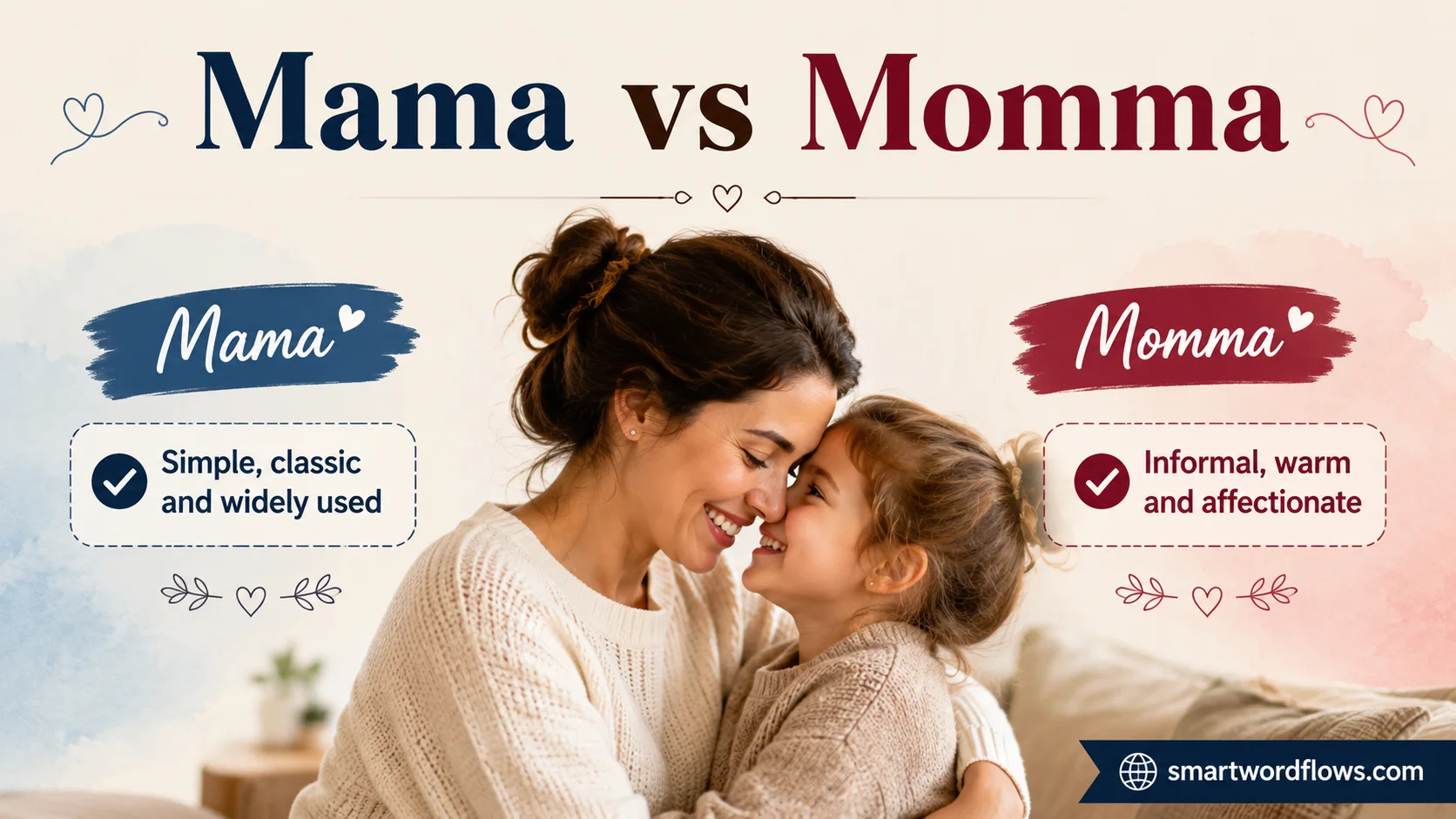

Mama vs Momma can be confusing, but both words are correct and commonly used as informal terms for mother. The choice often depends on culture, region, family preference, and personal style. While “mama” is widely recognized, “momma” is also common, especially in American English. Both words can describe or directly address your mother, and they usually carry a warm, affectionate tone. Understanding their meaning, spelling, and usage can help you choose the right word naturally in everyday writing and conversation.
The words mama and momma have interesting connections to early baby language. The simple “ma” sound is easy for babies to produce, which may explain why similar words for mother appear across many languages. Forms such as māma, mamá, maman, maa, mamã, eomma, and mama occur in different cultures. Historically, Latin “mamma” also means “breast,” adding another interesting connection to the word’s development and its association with motherhood.
Quick Answer
“Mama” and “momma” are both correct informal words for “mother.”
The main difference is spelling and usage, not basic meaning. Mama is generally the more familiar and widely recognized form across English varieties. Momma is also an established spelling and can sound more folksy, affectionate, regional, or conversational depending on the speaker.
For example:
- “My mama makes the best pancakes.”
- “My momma makes the best pancakes.”
Both sentences communicate essentially the same idea.
However, the emotional impression can differ slightly. Mama often feels simple, warm, and familiar. Momma may sound more like a particular person’s natural speech or family vocabulary.
If you’re writing a formal document, neither is usually the best choice. Mother generally fits formal writing better.
Comparison Overview
| Word | Correct Spelling? | Meaning | Typical Tone | Common Context |
| Mama | Yes | Mother | Warm and affectionate | Family speech, informal writing |
| Momma | Yes | Mother | Warm, conversational, sometimes folksy | Family speech, dialogue, informal writing |
| Mom | Yes | Mother | Casual and everyday | American English |
| Mommy | Yes | Mother | Childlike and affectionate | Children’s speech |
| Mother | Yes | Female parent | Neutral or formal | Professional and formal writing |
The important point is that correctness doesn’t depend on which spelling you personally prefer.
If your mother goes by Mama, changing it to Momma can feel unnatural. Likewise, if someone has always written Momma, correcting them to Mama isn’t necessary simply because one version looks more familiar to you.
At a Glance
- Mama = a widely recognized affectionate word for mother.
- Momma = another correct informal spelling for mother.
- Mother = the more formal general term.
- Mom = a common everyday American English form.
- Mommy = commonly associated with children’s speech.
- Both mama and momma can be correct depending on context.
Main Differences Between Mama and Momma
The biggest differences between mama and momma involve spelling, personal preference, regional speech, and tone.
Spelling Difference
The most obvious difference is the extra “m” in momma.
- Mama → M-A-M-A
- Momma → M-O-M-M-A
The two words developed as informal forms of mother, and both have established usage in English.
The spelling momma may visually emphasize the “mom” sound that many American English speakers associate with their mother. Meanwhile, mama has a simpler repeated-syllable pattern.
Neither spelling needs quotation marks simply because it’s informal.
Meaning Difference
In ordinary use, mama and momma mean the same basic thing: mother.
There can be differences in emotional flavor, but there isn’t a major dictionary-level difference in the person being identified.
For example:
“Her mama taught her to cook.”
and
“Her momma taught her to cook.”
Both statements identify the same relationship.
The difference comes from how the word feels, not from a different family relationship.
Tone Difference
Mama often feels warm and affectionate without sounding strongly tied to one particular dialect.
Momma, by contrast, can carry a more conversational or folksy feeling in some American contexts.
That doesn’t mean every speaker hears the words differently. Personal experience strongly influences how each spelling feels.
For one reader, Momma may immediately bring to mind childhood. For another, Mama may feel more natural because that’s the word their family used.
Usage Difference
Mama has broad usage across many English-speaking communities and also appears in numerous other languages and cultures.
Momma has a particularly familiar place in informal American English, although its use isn’t limited to one region or social group.
Writers may also choose momma when they want dialogue to sound especially personal or conversational.
Personal Preference
Family vocabulary can be surprisingly powerful.
A child may grow up calling their mother Mama, Momma, Mom, Mommy, or another family-specific name. That choice can remain meaningful long after childhood.
Because of this, personal preference can matter more than a general style rule.
If someone writes:
“I love my Momma.”
there’s no need to “correct” it to:
“I love my Mama.”
The original spelling may reflect that person’s identity and family tradition.
What Does “Mama” Mean?
Mama is an informal and affectionate term for mother.
It commonly appears in family conversations, personal writing, children’s speech, songs, stories, and other contexts where people speak about a mother with familiarity.
The word also has a broader linguistic history. Forms resembling mama occur in many languages around the world. This similarity isn’t surprising because simple sounds such as ma are easy for young children to produce. Words built around those sounds have developed into familiar terms for mothers in many cultures.
In English, mama can be used by both children and adults.
For example:
- “Mama is making dinner tonight.”
- “I called Mama after work.”
- “Her mama taught her how to sew.”
- “The child reached for his mama.”
- “She still calls her mother Mama.”
Notice that mama doesn’t necessarily imply that the speaker is a child. Adults can use it naturally when talking about their own mothers.
What Does “Momma” Mean?
Momma is an informal term meaning mother.
Like mama, it can express affection, familiarity, and closeness. The spelling sometimes gives the word a more strongly conversational or folksy appearance.
Consider this sentence:
“Momma always told me to keep my word.”
The spelling may make the sentence feel more personal than the more neutral:
“My mother always told me to keep my word.”
That’s largely a matter of tone and voice.
The word can also appear in literary dialogue when an author wants to preserve how a character naturally refers to their mother.
Examples of “Momma”
- “Momma made my favorite meal for dinner.”
- “I promised Momma I’d call when I arrived.”
- “His momma raised him to treat people with respect.”
- “The little girl ran straight toward her momma.”
- “Momma always had a story ready for us.”
Is “Mama” or “Momma” the Correct Spelling?
Both are correct spellings.
This is the most important answer for anyone searching mama vs momma correct spelling.
English contains many words with spelling variations that remain legitimate. A less frequently used spelling doesn’t automatically become an error.
The confusion often happens because people assume that one form must be the original while the other must be a mistake. That’s not how informal vocabulary works.
Mama is widely established.
Momma is also established.
The real question should often be:
Which spelling fits this speaker, audience, or context best?
That’s a much more useful question than asking which word is “allowed.”
Why Does “Momma” Have Two M’s?
The double m in momma is simply part of its established spelling.
English spelling doesn’t require every word to follow one simple visual pattern. Established words can contain doubled consonants for many historical and linguistic reasons.
In momma, the spelling also visually connects the first part of the word with mom, a very familiar American English word for mother.
Still, it’s important not to assume that every person who says momma pronounces it exactly the same way. English pronunciation varies significantly across regions, families, and speakers.
Spelling and pronunciation influence each other, but they aren’t identical systems.
Why Do People Spell It “Mama”?
People choose mama for several practical and personal reasons.
First, the spelling is short and immediately recognizable. It also has a long history as an affectionate term for mother.
For many people, mama simply feels natural because it’s the form they learned first.
It also works comfortably in both personal writing and creative contexts.
Common Reasons Someone Chooses “Mama”
- Their family has always used Mama.
- They prefer its simpler spelling.
- They want a warm and affectionate tone.
- The word fits their cultural or linguistic background.
- They’re writing for a broad English-speaking audience.
- The spelling matches a person’s established name or nickname.
Sometimes there’s no deeper reason. It just feels right.
Why Do People Spell It “Momma”?
The spelling momma can reflect personal speech, family tradition, or a desired conversational tone.
For example, a writer creating dialogue might choose:
“Momma, can we go home now?”
rather than:
“Mama, can we go home now?”
The first version may create a slightly different voice for the character. The meaning remains the same.
Common Reasons Someone Chooses “Momma”
- Their family traditionally spells it that way.
- They associate it with their childhood.
- They want a casual or affectionate sound.
- They’re reproducing someone’s natural speech.
- They’re writing dialogue.
- They prefer the visual connection to mom.
Again, momma isn’t simply a careless version of mama.
Mama vs Momma in American English
The distinction becomes especially interesting in American English.
Americans commonly use mom as an everyday term for mother. However, mama and momma remain familiar informal forms.
Usage can vary from one family to another. Regional speech patterns can also influence which form feels natural.
For instance, one family might say:
“Ask Mom.”
Another might say:
“Ask Mama.”
Another might naturally use:
“Ask Momma.”
None of these choices automatically tells you that the speaker has made a grammatical mistake.
A Useful Rule for American English
When writing American English, choose the form that matches your intended voice:
- Use mom for ordinary everyday American conversation.
- Use mama for a warm and familiar expression.
- Use momma when that spelling reflects personal, family, regional, or character voice.
- Use mother for formal or neutral contexts.
Also Read This: Taught vs Tought: Correct Spelling and Usage
Mama vs Momma in British English
British English generally favors mum and mummy rather than mom and mommy.
That doesn’t mean British speakers cannot use mama or momma. They certainly can. Personal, cultural, literary, and family usage can bring these words into British English as well.
The key distinction is that mum is usually the more typical everyday British English term.
For example:
- American English: “I’m going to call Mom.”
- British English: “I’m going to call Mum.”
- Informal alternative: “I’m going to call Mama.”
This is a useful reminder that English isn’t one single fixed system. Regional vocabulary matters.
Mama vs Momma vs Mommy vs Mom
These four words all relate to the same family relationship, but they don’t create exactly the same impression.
| Term | Meaning | Tone | Typical Association |
| Mama | Mother | Affectionate | Family and warm speech |
| Momma | Mother | Affectionate and conversational | Informal American usage |
| Mom | Mother | Casual and neutral | Everyday American English |
| Mommy | Mother | Childlike and affectionate | Young children’s speech |
Consider how these sentences feel:
- “My mom is coming over.” — casual and everyday.
- “My mama is coming over.” — warmer and more personal.
- “My momma is coming over.” — more conversational or folksy.
- “My mommy is coming over.” — more childlike.
The relationship stays the same, but the emotional color changes.
Is “Mama” More Correct Than “Momma”?
No.
It’s more useful to say that mama is generally more familiar or widespread in many contexts than to call it more correct.
Correctness and frequency aren’t the same thing.
Imagine a family whose mother has always been called Momma. Telling that family that their spelling is wrong simply because Mama appears more often would miss the point.
Language lives through actual speakers. Family traditions, dialects, literature, and personal choices all influence how people use words.
So the practical answer is:
Mama is not more grammatically correct than momma. Both are legitimate informal forms.
Is “Momma” a Misspelling of “Mama”?
No, not inherently.
If someone accidentally types momma when they intended mama, that may be a spelling mistake in that particular context. However, the word itself isn’t an incorrect spelling.
That’s an important distinction.
A spelling can be intentional and established even when another spelling is more common.
Think About It This Way
Suppose a writer creates a character who says:
“My momma taught me everything I know.”
Changing momma to mama could subtly change the character’s voice.
The writer may have selected momma deliberately.
In creative writing, preserving authentic vocabulary can matter just as much as following general spelling conventions.
Capitalization of Mama and Momma
Capitalization depends on how the word functions in a sentence.
When Mama or Momma works like a person’s name or direct form of address, capitalization is common.
Direct Address
“Thank you, Mama.”
“Momma, can you help me?”
Here, the word functions much like a name.
When the word acts as a general noun, lowercase can be appropriate.
General Reference
“Her mama picked her up from school.”
“His momma worked two jobs.”
Style guides and individual writing contexts can create small differences in capitalization practice. The main idea is simple: capitalize the term when you’re using it as a name or direct address.
Mama vs Momma in Formal and Informal Writing
Neither mama nor momma is usually the first choice for formal writing.
If you’re writing a business document, academic paper, official report, or formal biography, mother will generally sound more appropriate.
Compare:
Informal: “My mama encouraged me to keep studying.”
Formal: “My mother encouraged me to continue my education.”
However, formal writing can still contain Mama or Momma when the word is someone’s established name, a quotation, a title, or an important part of the subject’s identity.
Context always wins.
Mama vs Momma in Dialogue
Dialogue is one of the places where the distinction becomes especially useful.
Imagine a novel featuring a character who grew up calling their mother Momma. Writing:
“Momma, I don’t want you to leave.”
can feel more authentic than replacing the character’s natural word with mother.
Writers often make these choices to communicate:
- Character voice
- Age
- Family background
- Regional speech
- Emotional closeness
- Social setting
Case Study: Character Voice
Consider two fictional characters.
Character A:
“Mama, I’ll be home before dark.”
Character B:
“Momma, I’ll be home before dark.”
The basic meaning doesn’t change. Yet the two spellings may suggest different voices to readers.
Character A’s wording may feel broadly familiar and affectionate. Character B’s wording may feel more distinctly conversational or regionally marked.
The writer doesn’t need to explain this difference directly. The word choice does some of the work.
Mama vs Momma in Everyday Messages
Text messages provide another useful example.
If someone writes:
“Mama, did you get home safely?”
the message feels personal and affectionate.
If they write:
“Momma, did you get home safely?”
the emotional meaning remains almost identical.
The best choice is usually the spelling the family already uses.
Practical Rule
Don’t change someone’s preferred spelling just because another form is more common.
Names, nicknames, and family titles are personal. If a person writes Momma, respect that choice.
Common Mistakes With Mama and Momma
People often make a few predictable mistakes when comparing these words.
Assuming Momma Is Wrong
This is the biggest misconception.
Momma is a legitimate informal spelling, not merely a typo.
Treating Mama as Universally Preferred
Although mama is widely familiar, that doesn’t make it the correct choice for every speaker.
Confusing Tone With Meaning
The words can have different emotional or regional impressions. However, their core meaning remains mother.
Ignoring Family Preference
A family may have its own established spelling. That preference deserves consideration.
Using Informal Terms in Formal Contexts
Mama and momma generally belong in informal, personal, or stylistic contexts. Mother often works better when the writing needs a formal tone.
Mama vs Momma: Which One Should You Use?
The simplest answer is: use the spelling that best fits your context.
Choose Mama when you want a familiar, affectionate form that most readers will understand immediately.
Choose Momma when it reflects a person’s preferred spelling, family tradition, speech pattern, or the voice of a character.
Choose Mom when you want a common, casual American English term.
Choose Mother when you need a formal or neutral word.
Quick Decision Guide
| If you want to… | Best choice |
| Sound warm and affectionate | Mama |
| Reflect a family spelling | Mama or Momma |
| Preserve someone’s preferred wording | Use their preference |
| Write casual American English | Mom |
| Create childlike speech | Mommy |
| Write formally | Mother |
| Create conversational character dialogue | Mama or Momma |
Frequently Asked Questions About Mama vs Momma
Is “Mama” correct English?
Yes. Mama is a correct and established informal English term for mother. People commonly use it in family conversations, personal writing, children’s speech, and affectionate references to their mothers.
Is “Momma” correct English?
Yes. Momma is also an established informal spelling for mother. It can appear in everyday speech, family writing, creative dialogue, and contexts where a speaker’s personal or regional voice matters.
Which is more common, Mama or Momma?
Mama is generally the more widely familiar spelling, although usage varies by region, community, family, and context. Greater frequency doesn’t make momma incorrect.
Do Mama and Momma mean the same thing?
In most everyday contexts, yes. Both words commonly mean mother. Their main differences involve spelling, tone, personal preference, and regional or stylistic usage.
Should Mama and Momma be capitalized?
Capitalize Mama or Momma when the word functions as a name or direct form of address, such as “Thank you, Mama.” Lowercase can be appropriate when the word functions as a general noun, such as “Her mama lives nearby.”
Final Verdict: Mama vs Momma
When it comes to mama vs momma, there isn’t a simple battle where one spelling wins and the other loses.
Both “mama” and “momma” are correct informal forms meaning “mother.” The more familiar choice for many readers is mama, while momma can add a more conversational, affectionate, or regional flavor.
The smartest choice depends on context and personal preference.
If you’re writing about your own mother, use the spelling your family naturally uses. If you’re writing dialogue, choose the form that fits the character’s voice. If you’re writing formally, mother will usually be the safest option.
Most importantly, don’t mistake less common for incorrect. English has room for both Mama and Momma, just as families have room for their own ways of expressing love.
The right word isn’t always the most common one. Sometimes it’s simply the one that sounds like home.
Key Takeaways
- Mama and Momma are both correct spellings.
- Mama is generally more widely recognized.
- Momma can sound more conversational or folksy in some contexts.
- Both words commonly mean mother.
- Family preference can determine which spelling feels right.
- Mother is usually better for formal writing.
- Mom is a common everyday term in American English.
- Capitalize Mama or Momma when using it as a name or direct address.
- In creative writing, either spelling can help establish character voice and tone.
- Momma isn’t simply a misspelling of Mama.
FAQs :
1. Is “mama” or “momma” correct?
Both mama and momma are correct. They’re informal terms for mother, and the preferred spelling often depends on personal, regional, or cultural preference.
2. What’s the difference between mama and momma?
There’s usually no difference in meaning. Both words refer to a mother in an informal and affectionate way. Mama is generally more widely used.
3. Is “momma” a proper English word?
Yes. Momma is a recognized informal English word for mother. It’s especially common in American English and may sound warm or affectionate.
4. Should mama and momma be capitalized?
Capitalize Mama or Momma when you use it as a name or direct title, such as “I asked Momma.” Keep it lowercase when used generally, such as “Her mama called.”
5. Which spelling should I use: mama or momma?
Use the spelling that fits your audience, region, and writing style. If you want the simpler and more widely recognized form, mama is usually the best choice.
Conclusion :
Mama and momma are both correct informal words for mother. Although mama is more common and widely recognized, momma is also natural and affectionate. Your choice can depend on family tradition, culture, region, and personal preference.