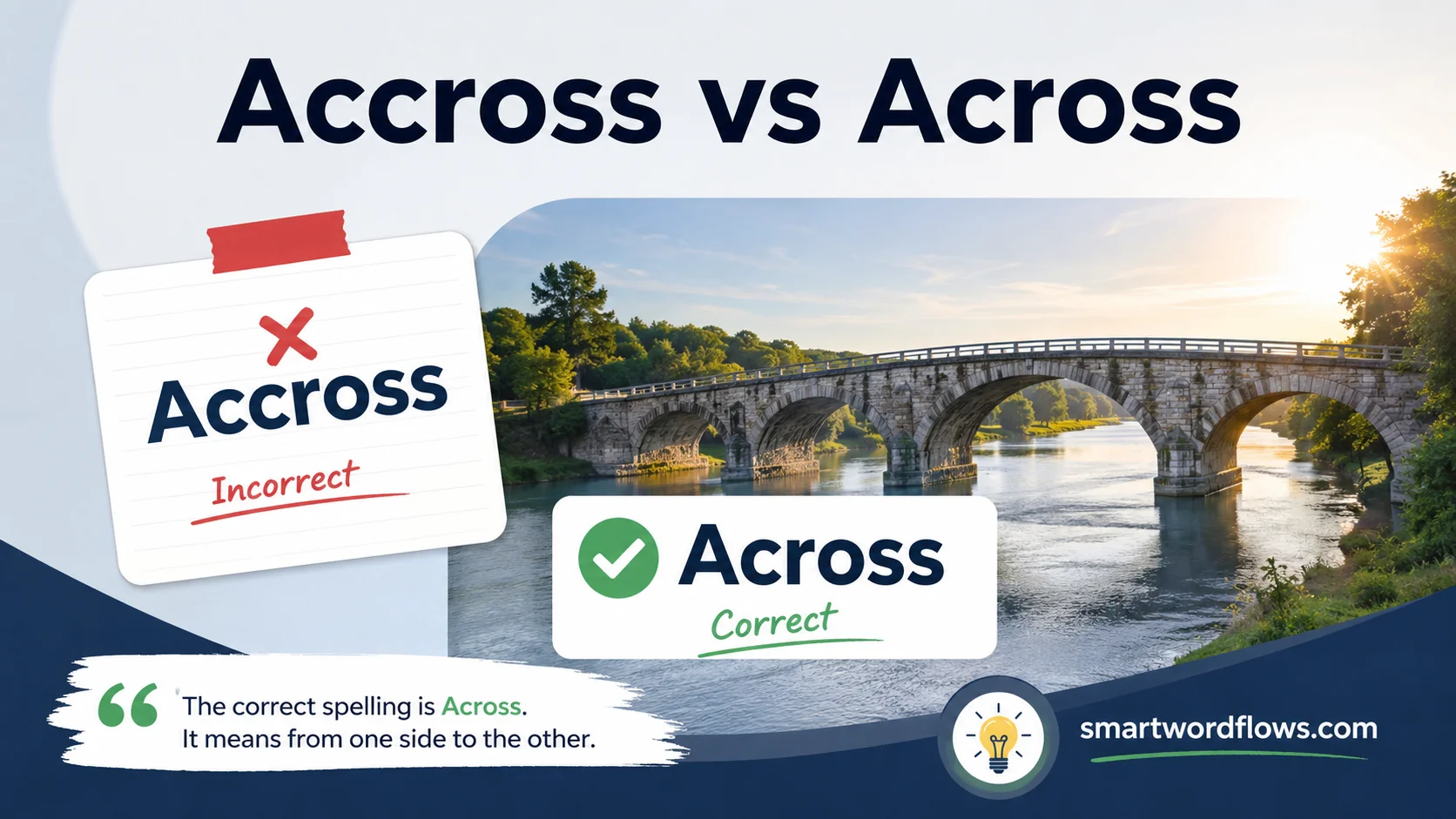

Accross vs Across is a common spelling confusion for English speakers and learners. The correct English word is across, while accross is a misspelling. Many people think the extra c looks natural because some English words contain double consonants. However, standard English spelling uses one C in across. This simple rule is easy to remember and helps you spell the word correctly in everyday writing. Recognizing this small error can make your English look more precise and professional.
In writing, this small grammar slip can appear in an email, school assignment, business report, or social media post. Although the meaning is usually clear, using the wrong spelling can reduce clarity and confidence. A useful memory trick is to remember that across has only one C. With real-life examples, practical exercises, and regular practice, you can detect the mistake instantly and avoid second guessing. This approach makes the rule simple and helps keep your English polished and professional.
Quick Answer: Accross vs Across
Across is the correct spelling.
Accross is an incorrect spelling and should not be used in standard English writing.
| Word | Correct spelling? | Meaning | Example |
| Across | Yes | From one side to another or throughout an area | We walked across the bridge. |
| Accross | No | Misspelling of across | We walked accross the bridge. |
The easiest way to remember the correct spelling is to think of A + CROSS = ACROSS.
The word cross begins with one c. When you add a to the beginning, you get across, not accross.
Correct: She ran across the field.
Incorrect: She ran accross the field.
There is no standard English rule that recognizes accross as an alternative spelling of across. If you’re writing an essay, email, report, article, application, or other formal text, always use across.
Comparison Overview
The difference between accross vs across becomes clear when you compare their spelling, meaning, pronunciation, and grammatical use.
| Feature | Across | Accross |
| Standard English spelling | Yes | No |
| Correct in formal writing | Yes | No |
| Correct in academic writing | Yes | No |
| Correct in professional writing | Yes | No |
| Meaning | From one side to another, throughout, or on the opposite side | None as a standard English word |
| Pronunciation | Commonly pronounced /əˈkrɔːs/ with dialect variation | Not a standard word |
| Word type | Preposition and adverb | Misspelling |
| Example | He walked across the street. | He walked accross the street. |
The key distinction is simple: across has one c.
Unlike some spelling differences between American and British English, this isn’t a regional variation. You don’t switch between across and accross depending on where you live. Across is the standard spelling in both American and British English.
Main Differences Between Accross vs Across
The main difference between accross vs across is that one is a correctly spelled English word and the other is not.
Across Is the Correct Spelling
Across is an established English word with several related meanings. It can describe movement from one side of something to another.
For example:
- The children ran across the playground.
- She walked across the street.
- They sailed across the ocean.
- He jumped across the stream.
In each sentence, across expresses movement from one side toward another.
The word can also describe position. Consider this sentence:
The library is across the street.
Here, across doesn’t describe movement. It tells you where the library is located in relation to the street.
It can also describe something that extends throughout a place or group:
The new policy applies across the company.
The meaning changes slightly according to context. The spelling doesn’t.
Accross Is a Misspelling
Accross isn’t a separate English word with its own definition. In standard writing, it is simply an incorrect version of across.
For example:
They drove accross the country.
The correct version is:
They drove across the country.
This distinction matters because a misspelled word can distract readers. In casual online communication, a typo may go unnoticed. In an academic paper or professional document, however, repeated spelling errors can affect how readers perceive the quality of the writing.
Across Has One C
The correct spelling is:
A-C-R-O-S-S
It contains:
- One c
- Two s letters at the end
- Seven letters in total
The incorrect version is:
A-C-C-R-O-S-S
It adds an unnecessary second c.
That extra letter is the entire spelling problem.
What Does Across Mean?
Across has several closely related meanings. Although it often describes movement, its use extends beyond physical movement.
Understanding these meanings can help you use the word naturally instead of simply memorizing its spelling.
Across Means From One Side to Another
This is probably the most familiar use of across.
When something moves from one side of a place or object to the other, you can use across.
Examples include:
- We walked across the bridge.
- The dog ran across the yard.
- She swam across the pool.
- They drove across the desert.
Imagine standing on one side of a river and walking to the opposite bank. You move across the river.
The word therefore connects two sides or points.
Across Can Describe Location
Across can also indicate that something is located on the other side of a particular place.
For example:
The coffee shop is across the street.
The sentence doesn’t say that the coffee shop is moving. Instead, across identifies its position.
Another example is:
His office is across the hall.
Again, the word describes location rather than movement.
This distinction is useful because many learners initially associate across only with actions such as walking, running, or driving.
Across Can Mean Throughout an Area
The word can also describe something distributed over a large area, group, or system.
For example:
- The company has offices across the country.
- The campaign reached people across the world.
- The rule applies across all departments.
- The storm caused damage across the region.
In these examples, across means something similar to throughout or over a broad area.
It doesn’t necessarily refer to one physical journey from Point A to Point B.
Across Can Describe Something Spreading
English speakers also use across when something spreads over a surface or area.
Consider:
A smile spread across her face.
The smile isn’t physically traveling from one side of her face to the other in a literal sense. The expression develops over the face.
Similarly:
The news spread across social media.
Here, across describes distribution through a broad communication network.
This figurative use shows how flexible the word can be.
Across as a Preposition and Adverb
Across commonly functions as both a preposition and an adverb.
Across as a Preposition
A preposition connects the word to another element in the sentence.
For example:
She walked across the bridge.
The phrase across the bridge tells us where she walked.
Other examples include:
- They traveled across the country.
- He ran across the field.
- We sailed across the lake.
Across as an Adverb
Across can also function as an adverb when it doesn’t directly introduce an object.
For example:
He walked across.
The sentence can stand alone if the context already makes the destination or area clear.
Another example:
She looked across.
The surrounding conversation may tell us what she looked across toward.
The grammatical role depends on how the word functions in the particular sentence.
Why Is Accross Incorrect?
The spelling accross is incorrect because standard English spells the word with only one c.
There isn’t a second c between the a and r.
This is one of those spelling mistakes that feels plausible because English contains many words with doubled consonants. However, spelling patterns don’t always transfer from one word to another.
For instance, English has words such as:
- successful
- different
- accommodate
- necessary
- recommend
Some contain doubled letters while others don’t. You can’t reliably decide whether a consonant needs doubling simply by looking at another word.
The safest approach with across is to remember its established spelling.
Why Do People Spell Across as Accross?
Several factors can contribute to the mistake.
Confusion About Double Consonants
The most obvious explanation is the tendency to add a second c.
A writer may mentally divide the word incorrectly and produce:
A + CCROSS
Instead, the correct structure is:
A + CROSS
That small distinction makes the spelling much easier to remember.
Pronunciation Doesn’t Reveal the Spelling
English spelling and pronunciation don’t always line up neatly.
When you say across, the pronunciation doesn’t clearly tell you whether the word contains one c or two. That’s why listening alone isn’t enough to determine the spelling.
The same issue appears with many English words. Written English contains historical spellings and patterns that aren’t always obvious from modern pronunciation.
Typing Errors Can Create Accross
Fast typing can also produce accross accidentally.
A writer might hit the c key twice without noticing. If the text isn’t carefully reviewed, the mistake can remain in the final version.
Spell-checking software often identifies obvious misspellings. Still, proofreading remains useful because automated tools aren’t perfect.
Across Pronunciation and Word Form
The standard pronunciation of across varies slightly among English dialects. A common dictionary pronunciation is represented as /əˈkrɔːs/.
The word has two syllables:
a-cross
The stress falls on the second syllable:
a-CROSS
The spelling remains the same regardless of whether you’re speaking American English, British English, or another major variety of English.
Importantly, pronunciation doesn’t justify adding another c. The correct written form remains across.
Examples of Across in a Sentence
Seeing the word in different contexts makes its use easier to understand.
| Sentence | Meaning of “across” |
| She walked across the street. | From one side to another |
| We drove across the country. | From one part of the country to another |
| The store is across the road. | On the opposite side |
| He looked across the room. | Toward the other side of a space |
| The news spread across the city. | Throughout a broad area |
| The policy applies across the organization. | Throughout a group or system |
| They swam across the lake. | From one side of the lake to another |
| A smile spread across his face. | Over a surface |
| The storm moved across the region. | Through a broad geographical area |
| She shouted across the hall. | From one side of a space toward another |
Notice how the word retains a basic idea of extension from one point or side toward another, even when the meaning becomes figurative.
Across vs Cross
Across and cross are related words, but they don’t always perform the same grammatical job.
Compare these sentences:
We crossed the road.
and:
We walked across the road.
In the first sentence, crossed is the verb. It tells us what the subject did.
In the second sentence, walked is the verb while across describes the direction or path of movement.
This gives you a useful distinction:
| Word | Common role | Example |
| Cross | Verb | They crossed the bridge. |
| Across | Preposition/adverb | They walked across the bridge. |
The words are closely connected in meaning. They aren’t interchangeable in every sentence.
Across vs Through
Across and through can both describe movement, but they emphasize different relationships.
Across generally suggests movement from one side to another.
We walked across the field.
Through emphasizes movement within or inside something.
We walked through the forest.
Think of a football field. If you move from one sideline toward the other, you’re moving across it.
If you enter a forest and continue among the trees, you’re moving through it.
The distinction becomes clearer when you picture the physical space involved.
Read More: Kinesthesiology vs Kinesiology Difference Explained
Across vs Over
Across and over sometimes overlap.
For example:
The plane flew across the country.
This emphasizes the journey from one part of the country to another.
Now consider:
The bird flew over the field.
This emphasizes movement above the field.
The simplest distinction is:
- Across often focuses on movement from one side or area to another.
- Over often focuses on movement above something or across its surface.
Context can make either word appropriate in certain situations.
Common Accross vs Across Mistakes
The most common mistake is straightforward:
She walked accross the street.
Correct it to:
She walked across the street.
Here are several more examples.
| Incorrect | Correct |
| He ran accross the field. | He ran across the field. |
| They drove accross the state. | They drove across the state. |
| The message spread accross the country. | The message spread across the country. |
| She looked accross the room. | She looked across the room. |
| The bridge stretches accross the river. | The bridge stretches across the river. |
Mistake: Adding an Extra C
The biggest spelling problem is inserting cc where only c belongs.
Remember:
ACROSS
Not:
ACCROSS
Mistake: Treating Accross as a Variant
Some writers assume accross might be an acceptable alternative spelling.
It isn’t.
You should not treat the two forms as stylistic choices. There is no standard distinction such as one being formal and the other informal.
Mistake: Assuming British English Uses Accross
It doesn’t.
Across is standard in both American and British English. The spelling doesn’t change based on which variety of English you’re using.
How to Remember the Correct Spelling of Across
A simple memory trick can prevent the mistake.
Think “A + CROSS”
Break the word into two familiar parts:
A + CROSS = ACROSS
The word cross begins with one c, so across also has one c after the initial a.
Don’t memorize:
A + CCROSS
That’s the wrong pattern.
Another useful trick is to connect the word with a familiar phrase such as:
across the street
Because this is such a common expression, seeing it repeatedly can help reinforce the correct spelling.
Remember the “One C” Rule
If you need a very short memory aid, use this:
Across has one C.
The word ends with ss, which already gives it a visually distinctive ending. There is no need to add another c.
Is Accross Ever Correct?
In standard English, no.
You may encounter accross online because someone has made a typing or spelling mistake. It can also appear in usernames, informal posts, search queries, or other user-generated material.
However, its appearance in those contexts doesn’t make it a recognized spelling.
For formal and professional writing, use across.
This includes:
- Academic essays
- School assignments
- Business emails
- Resumes
- Cover letters
- Reports
- Articles
- Websites
- Research papers
- Applications
- Presentations
If a spelling checker underlines accross, the suggested correction will generally be across.
Across in American English
American English uses across as the standard spelling.
Importantly, British English also uses across.
That means this isn’t one of those cases where American and British spelling differ.
For example, there are well-known differences such as:
- color vs colour
- center vs centre
- organize vs organise
But across vs accross isn’t comparable.
The correct form remains across in both major varieties.
Synonyms and Related Expressions for Across
The best synonym depends on what across means in your sentence.
| Meaning of Across | Possible Alternative | Example |
| From one side to another | From side to side | The rope stretched from side to side. |
| Throughout an area | Throughout | The rule applies throughout the company. |
| On the opposite side | Opposite | The bank is opposite the station. |
| From one end to another | From end to end | The room was decorated from end to end. |
| Over a broad area | Throughout | The storm affected communities throughout the region. |
These aren’t perfect replacements in every sentence. Across has a wide range of uses, so context matters.
For example, you can say:
She walked across the bridge.
But replacing across with throughout would completely change the meaning:
She walked throughout the bridge.
That sentence doesn’t express the same idea.
A Practical Case Study: Fixing “Accross” in Everyday Writing
Imagine that a student writes:
The company has stores accross the country.
At first glance, the sentence looks perfectly understandable. The reader knows what the writer means.
However, the spelling is still incorrect.
The corrected sentence is:
The company has stores across the country.
Now consider what across means here. The sentence doesn’t necessarily mean that the stores form a literal line from one border to another. Instead, it means that the stores are distributed throughout the country.
This example highlights an important point: correct spelling and correct meaning are separate issues.
A writer can understand the meaning perfectly and still spell the word incorrectly.
Facts About the Word Across
Here are several useful facts to remember:
- Across is the standard spelling.
- Accross is a misspelling.
- Across contains seven letters.
- The word contains one c.
- It ends with two s letters.
- It commonly functions as a preposition or adverb.
- It can describe movement from one side to another.
- It can describe a position on the opposite side.
- It can describe distribution throughout an area.
- It can also have figurative uses such as a smile spread across her face.
- Across is standard in both American and British English.
- Accross should not be used as an alternative spelling.
FAQs:
1. Is “Accross” correct?
No. Accross is a misspelling. The correct English word is across, with only one C.
2. Why do people write “Accross”?
People often add an extra c because many English words contain double consonants. This makes the spelling easy to confuse.
3. What does “Across” mean?
Across means from one side to another or on the opposite side. It is a common English word used in everyday writing and speaking.
4. How can I remember the correct spelling?
Use a simple memory trick: remember that across has one C, not two Cs. Regular practice can make the correct spelling natural.
5. Can “Accross” be used in formal writing?
No. Avoid accross in emails, assignments, reports, and professional writing. Always use across.
Conclusion
Across is the correct spelling, while accross is an incorrect form. Remembering the one C rule can help you avoid this common spelling mistake and improve your writing, clarity, and confidence.