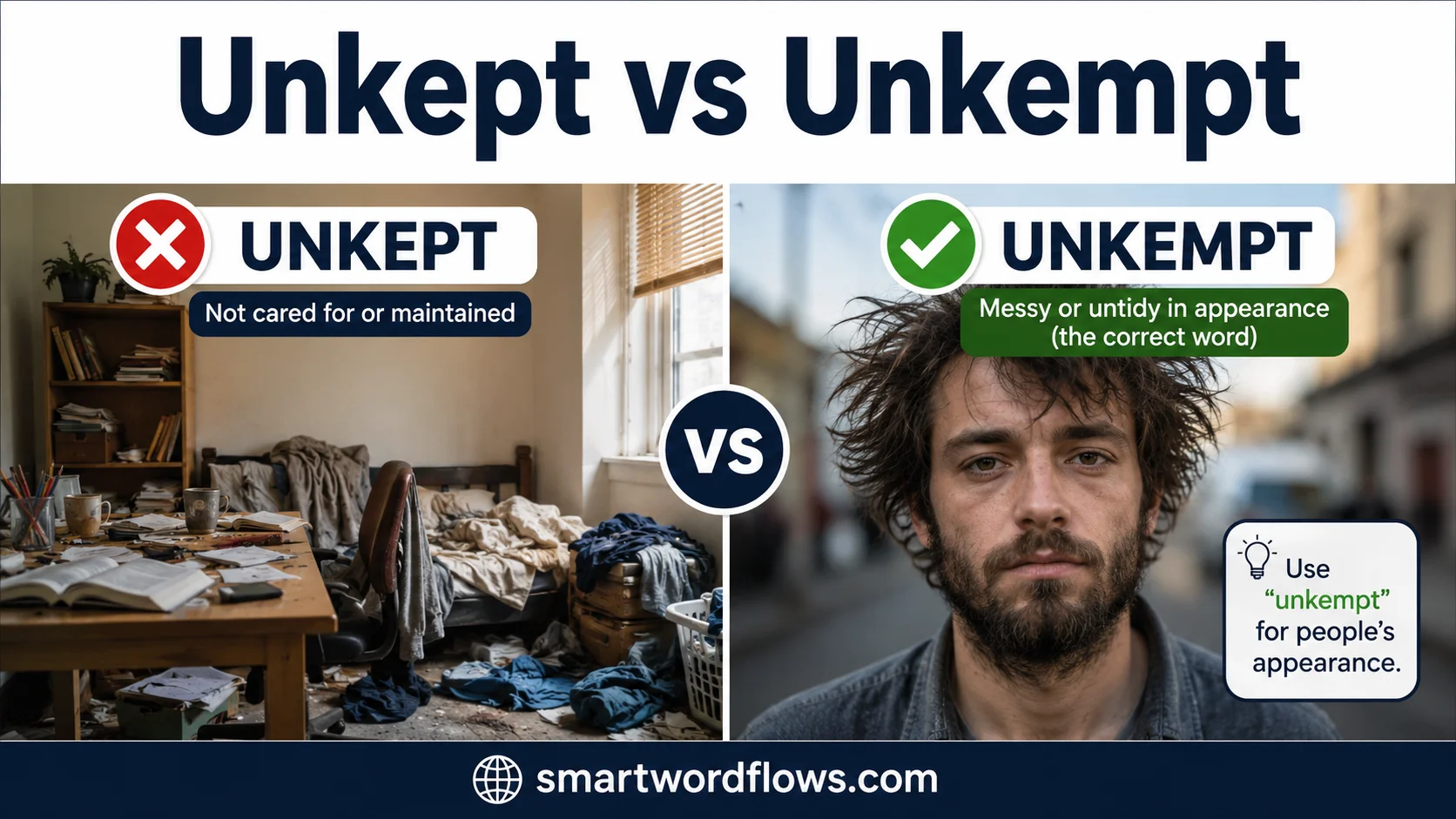

Unkept vs Unkempt can be confusing because both words relate to something being neglected or poorly maintained. However, unkempt is the more common choice when describing a messy appearance, especially untidy hair, clothing, or personal style. For example, you might describe someone as having unkempt hair after waking up. Unkept is also a correct English word, but it usually means not kept, maintained, or fulfilled, such as an unkept promise. Knowing this difference helps you use each word accurately.
The key difference between these words depends on context and meaning. Unkempt often suggests something looks untidy, disheveled, rough, or neglected, and it can also describe lawns, gardens, or other spaces. Unkept, on the other hand, generally focuses on something that hasn’t been kept, cared for, maintained, or honored. Interestingly, kempt is a real word meaning neat or tidy, although it appears less often in everyday English. Understanding these distinctions can prevent common spelling and grammar mistakes.
Quick Answer
Unkept means not kept, maintained, honored, fulfilled, or observed, depending on the context. For example, you can describe an unkept promise or an unkept commitment.
Unkempt means messy, untidy, neglected, or poorly groomed, especially when talking about someone’s appearance, hair, beard, clothing, yard, or surroundings.
| Word | Basic Meaning | Common Examples |
| Unkept | Not kept, maintained, honored, or fulfilled | unkept promise, unkept commitment |
| Unkempt | Messy, untidy, or poorly groomed | unkempt hair, unkempt appearance |
A simple memory trick works well:
Unkept = not kept.
Unkempt = looks messy or poorly groomed.
So, if you’re talking about someone’s messy hair, unkempt is usually the word you want. If you’re talking about a promise someone failed to honor, unkept can fit.
Comparison Overview
The easiest way to understand unkept vs unkempt is to compare how each word behaves in actual sentences.
| Feature | Unkept | Unkempt |
| Part of speech | Adjective | Adjective |
| Core idea | Something wasn’t kept | Something looks messy or neglected |
| Commonly describes | Promises, commitments, rules, standards, property | Hair, beards, clothing, people, gardens, yards |
| Related verb | Keep | Historically related to kempt/comb |
| Appearance-related | Sometimes, especially with property or spaces | Very common |
| Promise-related | Common | Generally incorrect |
| Grooming-related | Usually unnatural | Natural |
| Example | “He made an unkept promise.” | “His hair looked unkempt.” |
The distinction becomes clearer when you focus on the underlying idea. Unkept centers on something that wasn’t kept. Unkempt centers on something that isn’t neat or groomed.
Main Differences Between Unkept vs Unkempt
The biggest difference between unkept and unkempt lies in what you’re describing.
Unkept Means Something Was Not Kept
Unkept is formed from the negative prefix un- and the word kept. Its meaning therefore connects directly to the idea of something not being kept.
Depending on context, that can mean something wasn’t:
- Maintained
- Cared for
- Preserved
- Honored
- Fulfilled
- Observed
- Followed
For example, an unkept promise is a promise that someone didn’t fulfill. An unkept garden can mean a garden that hasn’t received proper maintenance.
Unkempt Means Messy or Poorly Groomed
Unkempt describes an appearance that lacks neatness or proper grooming.
You might describe someone’s:
- Hair
- Beard
- Clothing
- Appearance
- Personal presentation
You can also use unkempt for physical spaces, particularly places that look neglected or overgrown.
For example:
“His unkempt hair stuck out in every direction.”
Here, you’re describing the person’s appearance. You’re not saying the hair wasn’t “kept” in the grammatical sense of the verb keep.
The Extra “M” Changes More Than the Spelling
That extra m isn’t a decorative letter. It distinguishes two words with different histories and common uses.
Unkept connects naturally to the verb keep.
Unkempt developed around the idea of being not neatly combed or arranged.
That distinction explains why “unkept promise” sounds natural while “unkept hair” usually sounds awkward.
What Does “Unkept” Mean?
Unkept generally means not kept, maintained, fulfilled, honored, or observed.
The exact meaning depends heavily on the noun that follows it. That’s important because unkept doesn’t have just one narrow definition.
For example, an unkept promise hasn’t been fulfilled. An unkept garden hasn’t been properly maintained. An unkept rule hasn’t been followed.
The word can therefore describe both abstract things and physical things.
Unkept Promises
One of the clearest uses is unkept promise.
When someone promises to do something but fails to do it, the promise can be described as unkept.
“She was disappointed by his unkept promise.”
You could also say broken promise, which is often more natural in everyday conversation.
Unkept Commitments
An unkept commitment refers to an obligation or pledge that someone failed to fulfill.
“Several unkept commitments damaged the team’s trust in the organization.”
Here, unkept emphasizes the failure to honor an obligation.
Unkept Property or Land
Unkept can also describe property that hasn’t received proper care.
“The once-beautiful garden had become unkept.”
In this context, alternatives such as neglected, untended, or overgrown may sound more natural depending on exactly what you mean.
Examples of “Unkept”
- “He apologized for the unkept promise he made last year.”
- “The abandoned property had an unkept garden.”
- “Her frustration came from years of unkept commitments.”
- “The old path looked unkept after months without maintenance.”
- “They were tired of hearing excuses for another unkept agreement.”
Notice how the meaning changes slightly depending on the noun. That’s why context matters more than simply memorizing a dictionary definition.
What Does “Unkempt” Mean?
Unkempt means messy, untidy, disordered, or poorly groomed.
The word often describes someone whose appearance suggests that they haven’t taken care of their grooming. However, it can also describe physical surroundings that appear neglected.
Consider this sentence:
“The man walked into the office with an unkempt beard and wrinkled shirt.”
The word doesn’t necessarily mean he was dirty. It means his appearance looked untidy or poorly groomed.
Unkempt Hair
Unkempt hair is one of the most familiar combinations.
“His unkempt hair made it look as though he had skipped his morning routine.”
The hair might be tangled, uneven, messy, or simply not styled neatly.
Unkempt Beard
An unkempt beard looks messy or poorly groomed.
“His once-neat beard had become unkempt during the long trip.”
Again, the emphasis falls on appearance rather than whether someone literally “kept” the beard.
Unkempt Appearance
Unkempt appearance refers to an overall look that seems untidy or neglected.
“Despite his impressive qualifications, his unkempt appearance made a poor first impression.”
The phrase can describe hair, clothes, grooming, or several aspects of someone’s presentation at once.
Unkempt Gardens and Yards
You can also describe a yard, garden, or outdoor area as unkempt.
“The backyard looked unkempt, with weeds covering the flower beds.”
Here, unkempt suggests a lack of neatness and care.
Examples of “Unkempt”
- “His unkempt hair made him look as though he’d just rolled out of bed.”
- “The gardener transformed the unkempt yard within a few weeks.”
- “She noticed his unkempt beard before the interview began.”
- “The house had an unkempt appearance after years of neglect.”
- “The once-orderly garden looked unkempt after the winter.”
Unkept vs Unkempt: Grammar Difference
Both unkept and unkempt function primarily as adjectives.
The difference isn’t mainly grammatical. Instead, it comes from meaning, word history, and normal usage patterns.
How “Unkept” Works in a Sentence
Unkept modifies something that wasn’t kept, fulfilled, honored, or maintained.
Examples include:
- An unkept promise
- An unkept commitment
- An unkept agreement
- An unkept garden
- An unkept property
How “Unkempt” Works in a Sentence
Unkempt modifies something that appears messy or poorly groomed.
Examples include:
- Unkempt hair
- An unkempt beard
- An unkempt appearance
- Unkempt clothing
- An unkempt yard
The grammatical structure is similar, but the semantic role differs.
Why Do People Confuse Unkept and Unkempt?
These words practically invite confusion.
They look similar. They both begin with “un-.” They can also overlap around the broad idea of something lacking proper care.
However, their meanings aren’t interchangeable.
Imagine two sentences:
“He had unkept hair.”
“He had unkempt hair.”
The second sentence is the natural choice when you mean his hair looked messy.
Now compare:
“He made an unkept promise.”
Here, unkept makes sense because the promise wasn’t fulfilled.
The easiest approach is to ask yourself one question:
Am I describing something that wasn’t kept, or something that looks messy?
If it wasn’t kept, unkept may work.
If it looks messy, unkempt is usually the better choice.
Is “Unkept” a Correct Word?
Yes. Unkept is a legitimate English word, and it isn’t simply a misspelling of unkempt.
Its meaning comes from keep and kept, so it can naturally appear when something hasn’t been kept or fulfilled.
However, its use can feel less common or less idiomatic in some situations. Native speakers often choose more specific alternatives.
For example, instead of:
“The property was unkept.”
You might hear:
“The property was neglected.”
Or:
“The property was poorly maintained.”
The best choice depends on the precise meaning you’re trying to communicate.
Is “Unkempt” a Correct Word?
Yes. Unkempt is a standard English adjective with an established meaning.
It commonly describes something that looks messy, untidy, or inadequately groomed.
You’ll frequently encounter it with words connected to personal appearance:
- Unkempt hair
- Unkempt beard
- Unkempt clothing
- Unkempt appearance
It can also describe physical surroundings:
- Unkempt garden
- Unkempt lawn
- Unkempt yard
Because the word has a fairly specific meaning, it often works better than a vague word such as bad or poor.
Read More: Mama vs Momma: Correct Spelling and Difference
When Should You Use “Unkept”?
Use unkept when the central idea involves something that hasn’t been kept, fulfilled, honored, maintained, or observed.
Unkept Promises
This is one of the clearest contexts.
“Repeated unkept promises eventually weakened their relationship.”
The word emphasizes that someone failed to do what they promised.
Unkept Commitments
“The company’s unkept commitments frustrated its customers.”
Here, unkept means the commitments weren’t fulfilled.
Unkept Rules or Standards
The word can sometimes describe rules or standards that haven’t been observed.
“The policy was criticized because several standards remained unkept.”
In many modern contexts, however, unobserved, unmet, or unenforced may communicate the intended meaning more precisely.
Unkept Places
When referring to a physical place, unkept can suggest a lack of maintenance.
“The cemetery had become unkept over the years.”
Still, neglected, untended, or poorly maintained may sound more natural in many contexts.
When Should You Use “Unkempt”?
Use unkempt when you want to describe something that looks messy, untidy, or poorly groomed.
Unkempt Hair
“His unkempt hair caught everyone’s attention during the meeting.”
This is one of the most natural uses of the word.
Unkempt Appearance
“His unkempt appearance didn’t match the formal setting.”
The phrase describes an overall presentation rather than one specific feature.
Unkempt Clothing
“His unkempt clothing made him look unprepared for the event.”
Although wrinkled, sloppy, or untidy may sometimes be more precise, unkempt can describe clothing that contributes to a generally neglected appearance.
Unkempt Gardens and Yards
“The unkempt yard was filled with weeds and fallen branches.”
In this context, the word communicates visual neglect.
Unkept vs Unkempt Examples Side by Side
The following examples show how the two words behave differently in practical situations.
| Context | Correct Choice | Example |
| Promise | Unkept | “He apologized for his unkept promise.” |
| Commitment | Unkept | “The unkept commitment caused frustration.” |
| Hair | Unkempt | “Her unkempt hair looked windblown.” |
| Beard | Unkempt | “His unkempt beard needed trimming.” |
| Appearance | Unkempt | “He arrived with an unkempt appearance.” |
| Yard | Unkempt | “The unkempt yard needed regular care.” |
| Property | Unkept or unkempt, depending on meaning | “The property looked unkept.” |
| Garden | Unkept or unkempt, depending on emphasis | “The garden looked unkempt.” |
The last two examples deserve attention. Unkept and unkempt can occasionally overlap when describing neglected physical spaces. The distinction depends on what you’re emphasizing.
If you mean lack of maintenance, unkept can fit.
If you mean a visibly messy or untidy appearance, unkempt often sounds more natural.
Unkept vs Unkempt in Sentences
Here are additional examples that put the distinction into everyday language:
- “The manager apologized for the unkept promises made during the campaign.”
- “His unkempt hair made him look exhausted.”
- “The old house had an unkept appearance after years without repairs.”
- “She was frustrated by another unkept commitment.”
- “The man’s unkempt beard had grown considerably.”
- “The neglected garden looked increasingly unkempt.”
- “The agreement contained several unkept obligations.”
- “His clothes looked unkempt after sleeping in them.”
- “The abandoned property remained unkept for several years.”
- “She brushed her unkempt hair before leaving the house.”
- “The organization faced criticism over its unkept commitments.”
- “An unkempt lawn can make an otherwise attractive property look neglected.”
Common Mistakes With Unkept and Unkempt
A few mistakes appear repeatedly because the words look so similar.
Using “Unkept” for Hair
“Unkept hair” may be understandable, but “unkempt hair” is the standard and natural choice when you mean messy or poorly groomed hair.
Better:
“His unkempt hair needed a good brushing.”
Assuming “Unkept” Is a Misspelling
Don’t automatically correct unkept to unkempt.
Unkept is a real word. The question is whether it fits the meaning.
“She was hurt by his unkept promise.”
That sentence uses unkept appropriately.
Using “Unkempt” for Promises
An unkempt promise doesn’t make sense in standard usage because promises aren’t usually described as physically messy or poorly groomed.
Use:
Unkept promise
or, in many situations:
Broken promise
Treating the Words as Interchangeable
This is the biggest mistake.
Although both words can suggest neglect in certain contexts, they don’t carry the same meaning.
Unkept connects to something not being kept.
Unkempt connects to something looking untidy.
Unkept vs Unkempt: Which One Is More Common?
Unkempt is a familiar word in modern everyday English, particularly when discussing personal appearance.
People commonly encounter expressions such as:
- Unkempt hair
- Unkempt beard
- Unkempt appearance
- Unkempt yard
Unkept is more context-dependent. It’s especially useful when something hasn’t been fulfilled, honored, or maintained.
In everyday conversation, speakers may often choose a more specific alternative instead.
For example:
- Unkept promise → broken promise
- Unkept garden → neglected garden
- Unkept property → poorly maintained property
- Unkept commitment → unfulfilled commitment
That doesn’t make unkept incorrect. It simply means other words may sound more natural in certain contexts.
Unkept vs Unkempt in Formal and Professional Writing
Choosing the right word becomes especially important in professional writing because vague language can weaken an otherwise clear sentence.
For promises and obligations, unkept can work:
“The report addresses several unkept commitments made during the previous quarter.”
However, unfulfilled commitments may sound more precise in a formal report.
For physical appearance, unkempt works well:
“The employee’s unkempt appearance did not meet the company’s presentation standards.”
Still, writers should use the word carefully. Describing someone’s appearance as unkempt can sound judgmental depending on the context.
When possible, describe the specific issue:
“His hair appeared uncombed and his shirt was visibly wrinkled.”
That approach gives the reader concrete information instead of relying on a broad label.
Case Study: Choosing the Right Word
Consider a fictional workplace situation involving two employees.
Employee A promises to submit a report by Friday but doesn’t submit it.
The correct description would be:
“Employee A failed to fulfill an unkept promise.”
You could also write:
“Employee A broke the promise to submit the report.”
Now consider Employee B, who arrives at work with messy hair and a poorly groomed beard.
The appropriate description would be:
“Employee B had an unkempt appearance.”
Calling the appearance unkept would sound unnatural if the intended meaning is simply “messy.”
This example demonstrates the central rule: look at what the adjective describes and identify the kind of neglect involved.
Synonyms for “Unkept”
The best synonym depends on the intended meaning.
When “Unkept” Means Not Maintained
Useful alternatives include:
- Neglected
- Untended
- Unmaintained
- Overgrown
- Abandoned
For example:
“The unkept garden became an overgrown garden.”
When “Unkept” Means Not Fulfilled
Better alternatives include:
- Broken
- Unfulfilled
- Unhonored
- Unmet
- Unobserved
For example:
“He apologized for the broken promise.”
Don’t assume every synonym works in every context. Unmet works naturally with expectations or requirements, while broken works especially well with promises.
Synonyms for “Unkempt”
Unkempt has several useful alternatives, although each carries a slightly different tone.
- Messy — broad and informal
- Untidy — neutral and common
- Disheveled — especially useful for a person’s appearance
- Scruffy — often suggests a rough or casually neglected appearance
- Sloppy — can imply carelessness
- Neglected — emphasizes lack of care
- Unruly — useful for hair or vegetation that isn’t controlled
- Ungroomed — directly emphasizes a lack of grooming
For example, disheveled often describes someone who looks generally disordered, while unkempt can suggest ongoing neglect or a lack of grooming.
Unkept vs Unkempt: A Simple Memory Trick
If these words keep getting tangled in your head, use this quick trick:
Unkept = Not Kept
Think about something that wasn’t kept.
- Unkept promise
- Unkept commitment
- Unkept agreement
Unkempt = Messy Appearance
Think about something that looks messy or poorly groomed.
- Unkempt hair
- Unkempt beard
- Unkempt appearance
- Unkempt yard
One tiny distinction can save you from a surprisingly common word-choice mistake.
FAQs:
1. Is “unkept” a correct word?
Yes, unkept is a correct word. It usually means something was not maintained, cared for, or fulfilled, such as an unkept promise.
2. Is “unkempt” the correct word for messy hair?
Yes. Unkempt is the standard word for describing messy, untidy, or disheveled hair and appearance.
3. What is the main difference between unkept and unkempt?
Unkept generally means not kept or maintained, while unkempt usually means untidy or poorly groomed.
4. Can unkempt describe a place?
Yes. Unkempt can describe places such as lawns, gardens, yards, or buildings that look neglected or poorly maintained.
5. Which word is more common: unkept or unkempt?
Unkempt is much more common in everyday English, especially when talking about appearance, hair, clothing, or untidy surroundings.
Conclusion:
Unkept and unkempt are both valid English words, but they have different common uses. Use unkempt for something messy, untidy, or poorly groomed, especially a person’s appearance or hair. Use unkept when something hasn’t been maintained, kept, or fulfilled. Remembering this simple distinction will help you avoid confusion and choose the right word with confidence.