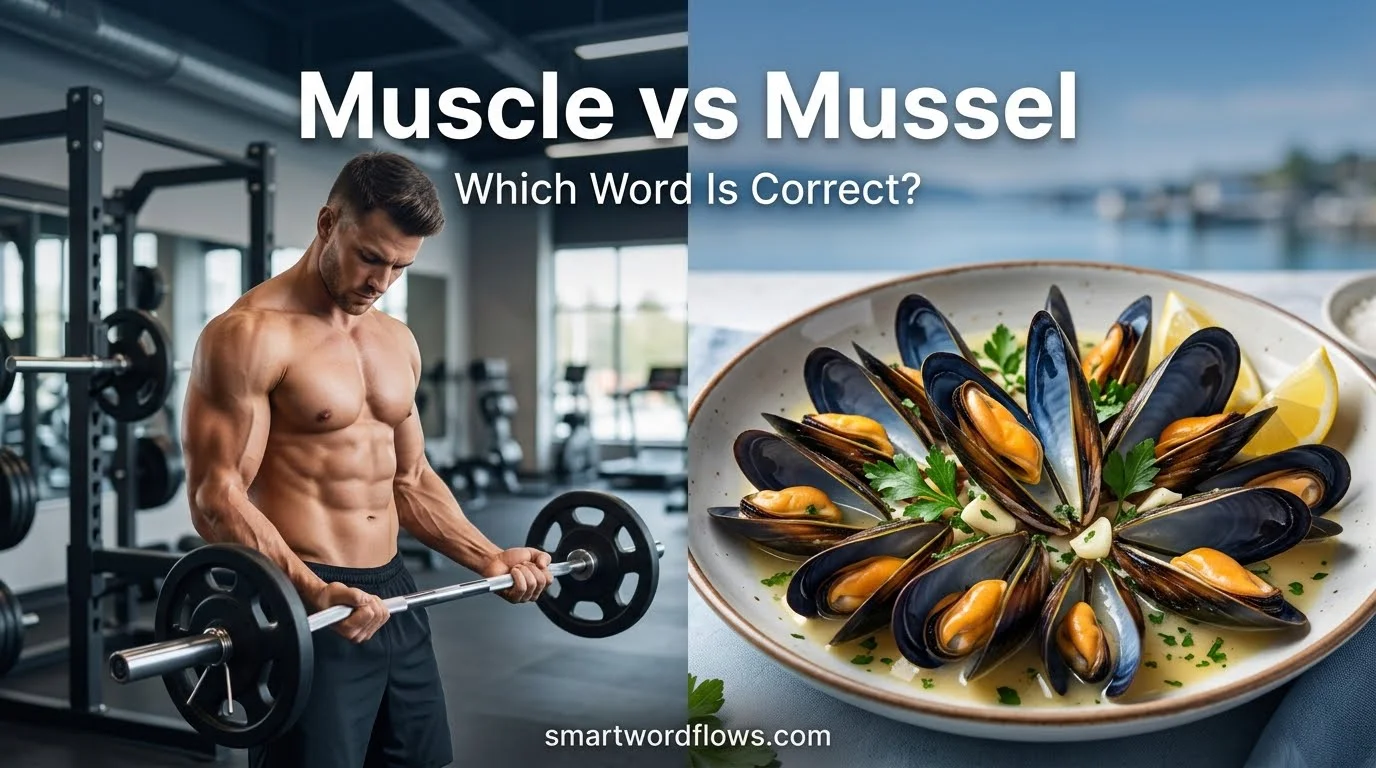

Have you ever wondered whether to write muscle or mussel? These two words sound exactly alike in standard American English, yet they describe completely different things. One relates to your body’s movement and strength. The other refers to a shelled aquatic animal that people often enjoy as seafood.
The confusion is easy to understand. Both words share the same pronunciation, and their spellings differ by only a few letters. If you type the wrong one, your sentence might still pass a basic spell-check because both are legitimate English words.
However, the difference becomes simple once you understand their meanings and contexts. Whether you’re writing about fitness, human anatomy, seafood recipes, or marine life, choosing the correct word helps your message stay clear.
In this guide, you’ll learn the meanings of muscle and mussel, discover how they differ in spelling and usage, explore practical examples, and practice choosing the right word in everyday sentences.
Quick Answer
Both muscle and mussel are correct English words, but they have different meanings.
- Muscle: A type of body tissue that contracts to produce movement, maintain posture, and generate force. The word can also describe strength or power.
- Mussel: An aquatic mollusk with two hinged shells. Some species live in saltwater, while others live in freshwater. Many are used as food.
Examples:
- Correct: Regular exercise can help you build muscle and improve strength.
- Correct: We ordered steamed mussels at the seafood restaurant.
Remember this simple rule: Muscles help you move, while mussels have shells.
Comparison Overview
The following table highlights the main differences between muscle and mussel.
| Feature | Muscle | Mussel |
| Part of speech | Noun and verb | Primarily a noun |
| Meaning | Body tissue or strength | A shelled aquatic mollusk |
| Pronunciation | /ˈmʌsəl/ | /ˈmʌsəl/ |
| Plural form | Muscles | Mussels |
| Common context | Anatomy, fitness, movement, power | Seafood, cooking, marine biology |
| Example | She injured a muscle during training. | The chef prepared fresh mussels. |
| Figurative meaning | Strength, influence, or power | No comparable common figurative meaning |
| Memory clue | Movement and strength | Shells and seafood |
The most important distinction is meaning, not pronunciation. Both words are pronounced the same way in standard American English, so listeners usually rely on context to understand which word someone means.
For example, if a trainer says, “You need to strengthen your muscle,” the fitness context makes the intended word clear. If a chef says, “These mussels need more garlic,” the food context points to the shellfish.
Although both words are nouns in their usual forms, muscle can also function as a verb. You might muscle a heavy box through a narrow doorway, meaning you use physical effort to move it.
Mussel, on the other hand, normally names the animal itself or its edible flesh. You wouldn’t use it to describe physical strength.
What Does Muscle Mean?
The word muscle refers to a specialized body tissue that contracts to produce force. Your muscles help you walk, lift objects, smile, breathe, and perform countless other actions throughout the day.
Muscles also support your posture and help stabilize your joints. Without them, even simple movements such as standing up from a chair or turning your head would be impossible.
The word has both literal and figurative meanings. In anatomy, it describes body tissue. In everyday conversation, it can also refer to physical strength, power, or influence.
Definition of Muscle
According to the biological meaning, a muscle consists of specialized cells that can contract and generate force. These cells work with the nervous system and other body structures to produce movement.
For example, when you bend your arm to lift a grocery bag, your muscles contract and coordinate the movement. Other muscles help stabilize your shoulder and control the motion.
The word muscle appears in several common expressions:
- Muscle strength: The ability of a muscle or group of muscles to produce force.
- Muscle growth: An increase in muscle size, often associated with resistance training.
- Muscle soreness: Discomfort that may occur after unfamiliar or strenuous physical activity.
- Muscle strain: An injury involving overstretched or torn muscle fibers.
- Muscle memory: A term commonly used for improved performance through repeated practice. It can refer to learned motor skills rather than literal memory stored in muscle tissue.
Here’s an example:
After several weeks of strength training, Daniel noticed greater muscle definition in his arms.
In this sentence, muscle refers to the tissue in his body. The word has nothing to do with seafood or shellfish.
Types of Muscles in the Human Body
Your body contains three main types of muscle tissue. Each has a distinct structure and role.
Skeletal muscles attach to bones, usually through tendons. They produce movements you can generally control voluntarily, including walking, running, lifting, and writing.
Your biceps, triceps, and quadriceps are familiar examples. Resistance exercises challenge these muscles and can help increase their strength and size over time.
Smooth muscle
Smooth muscle works inside many hollow organs and structures, including the intestines, bladder, and blood vessels. It generally operates without conscious control.
For instance, smooth muscle contractions help move food through your digestive system. You don’t need to think about each contraction for digestion to continue.
Cardiac muscle
Cardiac muscle forms the muscular wall of your heart. Its coordinated contractions pump blood throughout your body.
Unlike skeletal muscle, cardiac muscle contracts involuntarily. Its specialized cells help the heart maintain a continuous rhythm throughout life.
These examples demonstrate why muscle belongs in discussions about anatomy, exercise, physiology, and health.
Muscle as a Verb
Although people most often use muscle as a noun, it can also function as a verb. As a verb, it describes using physical strength, force, or determined effort to move something or overcome resistance.
Consider these examples:
- They muscled the heavy sofa through the doorway.
- The player muscled past two defenders to reach the goal.
- She muscled her way through a demanding training session.
- The company used its financial muscle to negotiate a better deal.
The final example uses muscle figuratively. Financial muscle means economic power or resources rather than actual body tissue.
Another common expression is muscle in, which means to force your way into a situation or become involved, sometimes aggressively.
For example: A rival company tried to muscle in on the contract.
These expressions show that muscle can describe both physical force and broader forms of power.
Example Sentences With Muscle
The best way to understand a word is to see how people use it in different situations.
| Example sentence | Meaning of muscle |
| Regular exercise helps strengthen your muscles. | Body tissue |
| The athlete pulled a muscle during practice. | Body tissue involved in movement |
| Her leg muscles felt tired after the hike. | Muscles in the leg |
| The surgeon explained how the heart muscle works. | Cardiac tissue |
| He used his muscle to move the cabinet. | Physical strength |
| The organization has considerable political muscle. | Influence or power |
| They muscled the cart up the steep ramp. | Used force to move something |
Notice how the meaning changes with context. In every example, however, the spelling remains muscle.
What Does Mussel Mean?
A mussel is a type of bivalve mollusk, an aquatic animal with two hinged shells. Mussels belong to a group of animals that also includes clams, oysters, and scallops.
Many mussels live attached to rocks, pilings, or other firm surfaces. Others live partly buried in sediment on the bottoms of rivers, lakes, and seas.
Some species are harvested for food, while others play important ecological roles. Freshwater mussels, for example, can filter particles from water and provide valuable information about the health of aquatic ecosystems.
Unlike muscle, the word mussel does not describe body tissue or physical strength. It refers to the animal or, in culinary contexts, the shellfish served as food.
Definition of Mussel
A mussel has two shells connected by a hinge. These shells protect its soft body from predators and environmental conditions.
Many marine mussels attach themselves to surfaces using strong threads called byssal threads. These threads help keep them anchored even when waves or currents move around them.
Freshwater mussels have different life cycles and adaptations. Many species live in rivers and lakes, and some depend on fish during part of their development.
For example:
The biologist found several freshwater mussels beneath the rocks along the riverbank.
Here, mussels refers to aquatic animals. Writing muscles would change the meaning entirely.
Mussels also appear in food-related writing:
The restaurant serves steamed mussels with garlic, butter, and fresh herbs.
In this sentence, the word identifies the shellfish prepared for a meal.
Types of Mussels
Mussels vary by habitat, species, and ecological role. Two broad groups are particularly useful to unders
Marine mussels live in saltwater environments, including coastal waters and rocky shorelines. Some form dense clusters on rocks, docks, and other hard surfaces.
The blue mussel (Mytilus edulis) is a well-known marine species. People harvest it commercially for food in several parts of the world.
Marine mussels can also influence coastal ecosystems by filtering suspended particles and providing habitat for small organisms.
Freshwater mussels
Freshwater mussels inhabit rivers, streams, and lakes. Many species spend their adult lives partially buried in sediment, where they filter food particles from the water.
Some freshwater mussels have complex reproductive cycles involving fish hosts. Their larvae attach temporarily to suitable fish before developing into juvenile mussels.
Freshwater mussels also face serious conservation challenges. Pollution, habitat changes, dams, and declines in host fish have contributed to population losses in many regions.
One important distinction is that not every mussel species is edible or harvested for food. Marine and freshwater mussels serve ecological roles beyond their value as seafood.
Mussels as Food
Mussels are popular in many cuisines because they cook relatively quickly and absorb the flavors of their cooking liquid. Chefs commonly steam them with garlic, herbs, wine, broth, or other seasonings.
You may encounter mussels in dishes such as:
- Steamed mussels: Cooked in a covered pot with liquid and seasonings.
- Mussels marinara: Shellfish served with a tomato-based sauce.
- Mussels with pasta: A seafood dish combining mussels, pasta, and herbs or sauce.
- Seafood soup: Mussels added to a broth containing vegetables or other seafood.
- Grilled mussels: Mussels cooked over heat, sometimes with butter or garlic.
Mussels also provide protein, vitamin B12, and minerals such as iron. Their nutritional value depends on the species, serving size, and preparation method.
Food safety matters, too. Buy mussels from reliable suppliers and follow local shellfish safety guidance. Keep them properly refrigerated before cooking, and discard cracked or damaged shells. After cooking, discard mussels that remain closed rather than forcing them open.
Raw or undercooked shellfish can carry harmful pathogens. People at increased risk from foodborne illness should follow medical and public-health guidance about avoiding raw shellfish.
These culinary examples provide a useful spelling clue: when a sentence mentions steaming, shells, seafood, or a recipe, mussel is usually the word you need.
Example Sentences With Mussel
The following examples show how mussel works in everyday writing, science, and cooking.
| Example sentence | Meaning of mussel |
| We ordered a bowl of steamed mussels. | Shellfish served as food |
| The mussel attached itself to a rock. | Marine animal |
| Freshwater mussels live in rivers and lakes. | Aquatic mollusks |
| She added mussels to the seafood pasta. | Ingredient in a dish |
| Scientists studied the mussel population. | Animal population |
| The shells of the mussels varied in size. | Protective shells of the animals |
| The chef cleaned the mussels before cooking. | Edible shellfish |
In each sentence, mussel or mussels refers to a shellfish. None of these examples calls for the spelling muscle.
Main Differences Between Muscle vs Mussel
The main difference between muscle and mussel lies in their meanings. However, spelling, grammatical use, and sentence context also help you choose correctly.
Although these words sound alike, they belong to different semantic categories. One relates to the body and strength. The other belongs to the animal world and often appears in food-related writing.
Difference in Meaning: Muscle vs Mussel
Muscle refers to tissue that produces force through contraction. It can also describe physical strength or figurative power.
Mussel refers to an aquatic animal with two hinged shells. The word commonly appears in discussions about shellfish, seafood, and aquatic habitats.
Compare these sentences:
- The swimmer strengthened her shoulder muscles. The sentence discusses body tissue.
- The swimmer ate mussels after the competition. The sentence discusses seafood.
The surrounding words make the distinction obvious. Shoulder and strengthened point toward anatomy, while ate points toward food.
Consider another pair:
- The company used its financial muscle to expand into new markets.
- The marine biologist examined a mussel collected from the shoreline.
The first sentence uses muscle figuratively to describe economic power. The second uses mussel literally to identify an animal.
Quick rule: If the sentence concerns movement, anatomy, or power, choose muscle. If it concerns shellfish, cooking, or aquatic life, choose mussel.
Difference in Spelling: Muscle vs Mussel
The spelling difference is small, which explains why these words can cause confusion.
- Muscle: M-U-S-C-L-E
- Mussel: M-U-S-S-E-L
Both words begin with m and end with le. The letters in the middle distinguish them.
In muscle, the spelling contains sc. In mussel, the spelling contains ss.
| Word | Middle letters | Helpful association |
| Muscle | sc | Strength and movement |
| Mussel | ss | Shellfish and seafood |
The difference may seem minor, but a single letter can change the meaning of your sentence.
For example:
- Correct: He developed stronger leg muscles.
- Incorrect for the intended meaning: He developed stronger leg mussels.
The second sentence accidentally suggests that he developed stronger shellfish rather than stronger leg tissue.
Likewise:
- Correct: The seafood platter included mussels.
- Incorrect for the intended meaning: The seafood platter included muscles.
The second version refers to body tissue, not the shellfish served on the platter.
The easiest way to avoid these errors is to connect each spelling with a specific meaning. Memorizing the letters alone can help, but understanding the word makes the distinction easier to remember.
Difference in Pronunciation: Muscle vs Mussel
In standard American English, muscle and mussel are homophones. Homophones are words that sound alike but have different meanings and often different spellings.
Both words are pronounced /ˈmʌsəl/. They have two syllables, with the stress on the first syllable.
The opening sound is the same vowel you hear in words such as sun and cup. The final syllable has an unstressed sound.
Because their pronunciation is identical, you usually cannot determine which word someone means by hearing the word alone. Instead, you rely on the sentence or situation.
For example, imagine hearing someone say:
I bought some mussels.
If the conversation concerns dinner, the speaker probably means shellfish. If the speaker is discussing an anatomy lesson and says something about muscles, the intended meaning changes.
Written English creates a different challenge. Readers can see the spelling, but a misspelled homophone may still look like a legitimate word.
That is why proofreading requires more than checking whether a word exists. You also need to check whether it fits the sentence.
Difference in Part of Speech: Muscle vs Mussel
Both muscle and mussel commonly function as nouns. However, muscle can also function as a verb.
As a noun, muscle identifies body tissue or strength.
Example: The athlete injured a muscle during practice.
As a verb, muscle describes using force or effort to move something or overcome resistance.
Example: They muscled the cabinet into the room.
By contrast, mussel is primarily a noun. It identifies a particular aquatic animal.
Example: The mussel clung tightly to the rock.
The plural forms follow regular English spelling patterns:
- One muscle; several muscles.
- One mussel; several mussels.
Both words add -s to form the plural. The spelling distinction remains unchanged.
| Grammatical use | Correct example |
| Singular noun | She strained a muscle. |
| Plural noun | His muscles felt tired. |
| Verb | They muscled the heavy box upstairs. |
| Singular noun | A mussel attached itself to the pier. |
| Plural noun | The cook washed the mussels. |
Understanding the grammatical role helps you identify muscle in sentences where it describes an action rather than a body part.
Difference in Context and Usage
Context is often the fastest way to distinguish these words. Certain topics and neighboring words strongly suggest one spelling over the other.
Use muscle in contexts involving:
- Human anatomy and physiology
- Exercise, fitness, and bodybuilding
- Muscle growth, soreness, and injuries
- Physical strength and movement
- Figurative power or influence
Examples:
- Weightlifting can help build muscle.
- The doctor examined the injured muscle.
- The organization has enough political muscle to influence the debate.
Use mussel in contexts involving:
- Seafood and cooking
- Marine biology
- Freshwater ecosystems
- Shellfish harvesting
- Aquatic animal populations
Examples:
- The restaurant serves mussels with garlic sauce.
- Freshwater mussels inhabit many rivers.
- Researchers monitored the mussel population.
One word can completely change the meaning of a sentence, even when the grammar remains correct.
Consider this example:
The chef prepared muscles with garlic and herbs.
The sentence is grammatically possible, but it doesn’t communicate the intended seafood dish. Readers may wonder whether the chef prepared edible animal tissue or whether the writer chose the wrong word.
Changing muscles to mussels resolves the problem immediately.
Read More:Emigrate vs Immigrate: Which Word Is Correct?
Muscle vs Mussel: How to Remember the Difference
You don’t need a complicated spelling rule to remember these words. A simple association between the word and its meaning is usually enough.
Associate Muscle With Movement
Think of the activities your muscles help you perform: walking, lifting, running, stretching, and reaching.
The word muscle belongs in sentences about strength and movement.
Try remembering this phrase:
Muscles help you move.
For example:
- Exercise strengthens your muscles.
- The runner stretched her leg muscles.
- The mechanic used muscle to move the heavy equipment.
The final example uses muscle to describe physical effort rather than a specific body part.
When a sentence mentions the gym, biceps, workouts, strength, or injuries, muscle will usually be the correct choice.
Associate Mussel With Shells and Seafood
Now picture a mussel attached to a rock or served in a bowl of seafood.
The word mussel belongs in sentences about shellfish and aquatic habitats.
Remember this phrase:
Mussels have shells.
For example:
- The fisherman collected mussels along the coast.
- We ordered mussels with tomato sauce.
- The researcher studied freshwater mussels in the river.
The double s in mussel can serve as a visual reminder of the word’s spelling. The association is a memory aid, not a formal spelling rule.
If the sentence mentions a shell, seafood recipe, river habitat, or marine animal, mussel is probably the right choice.
Use Context Clues to Choose the Correct Word
When you aren’t sure which spelling to use, examine the other words in your sentence.
| Context clue | Likely word | Example |
| Biceps | Muscle | His biceps muscle grew stronger. |
| Workout | Muscle | The workout challenged several muscles. |
| Injury | Muscle | She suffered a muscle strain. |
| Strength | Muscle | The team relied on physical muscle. |
| Shells | Mussel | The mussel’s shells were dark blue. |
| Seafood | Mussel | The menu featured steamed mussels. |
| River | Mussel | Freshwater mussels lived in the river. |
| Recipe | Mussel | The recipe called for two pounds of mussels. |
These clues aren’t absolute rules. A sentence about a mussel could mention its muscular foot, for instance. Still, context usually points you toward the intended word.
Common Mistakes When Using Muscle and Mussel
Because both spellings are valid, confusing them is different from making an ordinary typo. A spell-checker may accept the incorrect word without warning you.
The solution is to check meaning as well as spelling.
Writing Mussel Instead of Muscle
Writers sometimes choose mussel when they mean body tissue or strength.
Here are some common errors and their corrections.
| Incorrect sentence | Correct sentence | Why? |
| Exercise helps build mussel. | Exercise helps build muscle. | Exercise can increase muscle size and strength. |
| My mussels hurt after lifting weights. | My muscles hurt after lifting weights. | The sentence refers to body tissue. |
| He strained a mussel in his back. | He strained a muscle in his back. | A muscle strain is an injury. |
| She has strong leg mussels. | She has strong leg muscles. | The sentence describes physical strength. |
Each incorrect version uses a real English word in the wrong context. The correction depends on the intended meaning, not on whether the original spelling exists.
Writing Muscle Instead of Mussel
The opposite mistake occurs when writers use muscle in sentences about shellfish.
| Incorrect sentence | Correct sentence | Why? |
| We ate steamed muscles for dinner. | We ate steamed mussels for dinner. | The dish contains shellfish. |
| The chef added muscles to the pasta. | The chef added mussels to the pasta. | Mussels are a seafood ingredient. |
| The river contains several species of muscles. | The river contains several species of mussels. | The sentence refers to aquatic animals. |
| She cleaned the muscles before cooking them. | She cleaned the mussels before cooking them. | The shellfish need preparation before cooking. |
The correct spelling becomes obvious once you identify the subject. A chef prepares mussels, while a trainer helps you strengthen muscles.
Confusing Singular and Plural Forms
Another common problem involves choosing the right plural spelling.
The singular forms are muscle and mussel. Their regular plurals are muscles and mussels.
Notice the difference:
- Muscle → muscles
- Mussel → mussels
Both plural forms end in -s, but the original spelling stays the same.
Correct examples include:
- The physical therapist showed him exercises for his back muscles.
- The restaurant served a large bowl of mussels.
- The scientist examined several mussel species.
- The athlete rested her muscles after training.
Avoid switching the middle letters when forming a plural. The intended meaning determines whether you begin with muscle or mussel.
Why Spell-Checkers May Miss the Error
Traditional spell-checkers usually identify words that don’t match their dictionaries. They may not catch a wrong word when the spelling itself is valid.
For example, both sentences below contain correctly spelled English words:
- The athlete strengthened his muscles.
- The chef prepared mussels.
However, replacing muscles with mussels in the first sentence would create a meaning error rather than a conventional spelling error.
Grammar tools may detect some context mistakes, but they don’t catch every homophone confusion. A quick manual review remains useful.
Before submitting an article, email, assignment, or report, ask yourself:
- Does the word refer to body tissue or an aquatic animal?
- Do the surrounding words fit the intended meaning?
- Does the sentence still make sense when read aloud?
- Have I checked singular and plural forms?
A few seconds of proofreading can prevent an otherwise avoidable mistake.
Muscle vs Mussel in Real-Life Examples
The distinction becomes easier when you see how these words appear in everyday situations. The following examples cover fitness, food, and science.
Examples Related to Health and Fitness
In fitness writing, muscle appears in discussions about exercise, strength, recovery, and anatomy.
Consider these examples:
- Resistance training can help increase muscle strength.
- The physical therapist recommended exercises to strengthen her back muscles.
- He felt muscle soreness after his first weightlifting session.
- The athlete injured a calf muscle during practice.
- Adequate protein intake supports muscle repair and growth when combined with appropriate training.
Each sentence describes body tissue or its function. The word mussel wouldn’t fit these meanings.
Real-life scenario: Imagine writing a fitness article titled “How to Build Leg Muscle.” If you accidentally write “How to Build Leg Mussel,” the title becomes confusing because mussel refers to shellfish rather than anatomy.
The lesson is straightforward: use muscle when discussing exercise, movement, physical strength, or the body’s muscular system.
Examples Related to Food and Cooking
Food writing usually calls for mussel when discussing this shellfish.
Here are some examples:
- The chef steamed the mussels with garlic and parsley.
- Fresh mussels were the main ingredient in the seafood stew.
- She served mussels with crusty bread to soak up the broth.
- The recipe recommends cleaning the mussels before cooking.
- The seafood restaurant added a new mussel dish to its menu.
In these examples, the word refers to an edible aquatic animal.
Real-life scenario: Suppose you’re preparing a recipe for a food blog. Your title reads “Creamy Mussel Pasta With Garlic.” That’s the correct spelling because the dish contains shellfish.
Writing “Creamy Muscle Pasta” would suggest an entirely different ingredient and likely leave readers wondering what the recipe contains.
For recipe writers, restaurant owners, and food bloggers, this distinction is especially important because a single spelling error can make a menu item or headline look unprofessional.
Examples Related to Science and Nature
Scientific writing can use both words in the same article. The difference depends on what the writer describes.
For example:
Freshwater mussels filter particles from the water, while fish and other animals rely on muscles to swim and move.
Here, mussels refers to aquatic mollusks. Muscles refers to the body tissues that help animals move.
Another example:
Researchers examined the mussel’s attachment structures and compared them with the muscular systems of other aquatic animals.
This sentence discusses two different biological subjects. A mussel is an animal, while muscles are tissues found in many animals.
The comparison also shows why context matters. Even within biology, the two words aren’t interchangeable.
Muscle vs Mussel: Practice Quiz
Ready to test your understanding? Choose the correct word for each sentence. Use the meaning of the sentence rather than the pronunciation to guide your answer.
Fill in the Blanks
Complete each sentence with muscle or mussel. Use the plural form when necessary.
- The athlete worked hard to build stronger ______.
- We ordered a plate of steamed ______ at the seafood restaurant.
- The doctor explained how the heart ______ pumps blood.
- Freshwater ______ live in rivers, lakes, and streams.
- He strained a ______ while lifting a heavy box.
- The chef added garlic and herbs to the ______.
- The organization used its financial ______ to negotiate a deal.
- Marine ______ often attach themselves to rocks.
- Resistance training can improve ______ strength.
- The biologist studied the effects of pollution on the local ______ population.
Correct the Spelling Mistakes
Each sentence below uses the wrong word for the intended meaning. Rewrite it with the correct spelling.
- The runner stretched his leg mussels before the race.
- The restaurant served grilled muscles with lemon butter.
- Freshwater muscles can be affected by changes in water quality.
Answer Key and Explanations
Fill in the blanks
- Muscles — The sentence refers to body tissue used for movement and strength.
- Mussels — The sentence describes shellfish served as food.
- Muscle — The heart contains cardiac muscle.
- Mussels — Freshwater mussels are aquatic mollusks.
- Muscle — A muscle strain involves body tissue.
- Mussels — Garlic and herbs are seasonings used in the dish.
- Muscle — Financial muscle means economic power or influence.
- Mussels — Marine mussels can attach themselves to hard surfaces.
- Muscle — Muscle strength relates to the body’s ability to produce force.
- Mussel — A mussel population consists of aquatic mollusks.
Corrected sentences
- The runner stretched his leg muscles before the race.
- The restaurant served grilled mussels with lemon butter.
- Freshwater mussels can be affected by changes in water quality.
If you answered all the questions correctly, you’ve learned the main distinction. If you missed a few, revisit the memory tip: muscles help you move, while mussels have shells.
Frequently Asked Questions About Muscle vs Mussel
Is Muscle or Mussel the Correct Spelling?
Both muscle and mussel are correct English words. The right choice depends on what you want to describe.
Use muscle for body tissue, physical strength, or power. Use mussel for an aquatic mollusk with two hinged shells.
For example, muscle growth is correct when discussing fitness, while mussel soup is correct when discussing seafood.
Are Muscle and Mussel Pronounced the Same?
Yes. In standard American English, muscle and mussel are homophones, meaning they share the same pronunciation but have different meanings.
Both are pronounced /ˈmʌsəl/, with the stress on the first syllable. Because they sound alike, you need to rely on context to identify the intended word.
What Is the Plural of Muscle and Mussel?
The plural of muscle is muscles, while the plural of mussel is mussels.
Examples:
- Regular exercise helps strengthen your muscles.
- The restaurant served fresh mussels.
Both words form their plurals by adding -s. The spelling difference between the singular forms remains in the plural forms.
Can Muscle Be Used as a Verb?
Yes. Muscle can function as both a noun and a verb.
As a noun, it refers to body tissue or strength. As a verb, it means to use physical force or determined effort to move something or overcome resistance.
For example, They muscled the heavy desk through the doorway means they used force to move the desk.
What Is the Easiest Way to Remember Muscle vs Mussel?
Connect each word with a familiar image or activity.
- Muscle: Think about exercise, movement, strength, and the human body.
- Mussel: Picture a shellfish attached to a rock or served on a dinner plate.
Remember the phrase “Muscles help you move; mussels have shells.” This simple association can help you choose the correct spelling when writing or proofreading.
Conclusion
The difference between muscle and mussel is simple once you understand what each word means. Muscle refers to body tissue that produces movement and force. It can also describe physical strength or figurative power. Mussel, by contrast, refers to an aquatic mollusk with two hinged shells, some species of which are popular seafood.
Although both words sound the same in standard American English, their spellings and meanings aren’t interchangeable. Use muscle when writing about anatomy, exercise, or strength. Choose mussel when discussing shellfish, recipes, or aquatic habitats.Keep one easy reminder in mind: muscles help you move, while mussels have shells. With this simple distinction, you’ll be able to use both words correctly in everyday writing, professional documents, and blog posts.




1 thought on “Muscle vs Mussel: Which Word Is Correct?”