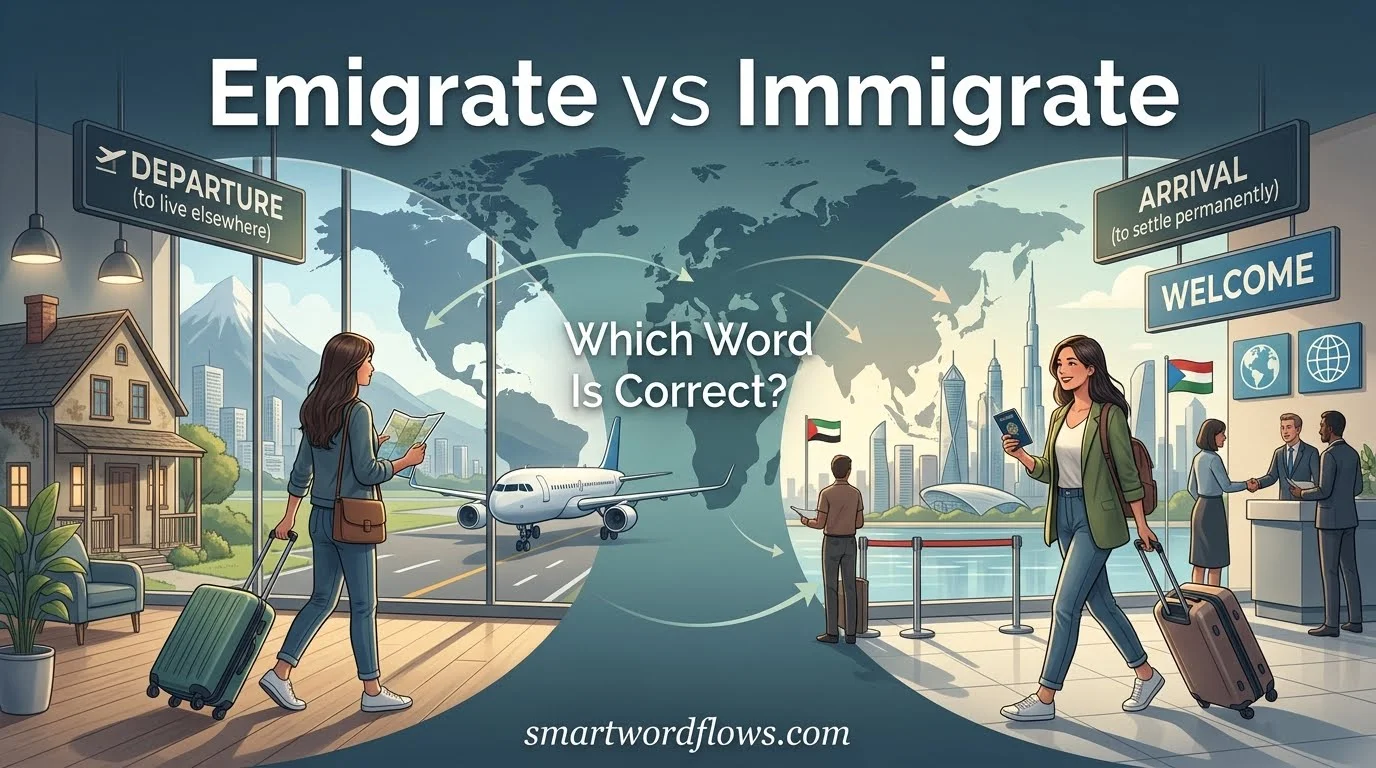

Have you ever wondered whether to write emigrate or immigrate when describing someone moving to another country? These two words look similar, sound similar, and relate to the same experience. However, they describe that experience from different perspectives.
The difference becomes clear when you think about where someone starts and where they end up. If a person leaves Pakistan to settle in the United States, that person emigrates from Pakistan and immigrates to the United States. Both words describe the same move, but each emphasizes a different side of the journey.
Choosing the right word matters when you write about international relocation, family history, employment abroad, population changes, or immigration policies. Fortunately, you don’t need to memorize complicated grammar rules to understand the distinction. A simple trick involving the letters E and I can help you remember which word to use.
Quick Answer
Emigrate means to leave one country to live in another. Immigrate means to enter another country to live there.
- Emigrate: She emigrated from India to start a new life abroad.
- Immigrate: She immigrated to Canada to start a new life there.
The key difference is the direction of movement. Emigrate focuses on the country a person leaves, while immigrate focuses on the country that person enters.
Here’s an easy way to remember:
- E = Exit: Emigrate means leaving a country.
- I = In: Immigrate means entering a country.
For example, if Daniel leaves Mexico and settles in the United States, he emigrates from Mexico and immigrates to the United States. You can use both words to describe his move accurately.
Comparison Overview
Although emigrate and immigrate refer to international relocation, they aren’t interchangeable in every sentence. The correct choice depends on which side of the move you want to emphasize.
| Feature | Emigrate | Immigrate |
| Meaning | To leave one country to live elsewhere | To enter another country to live there |
| Main focus | Departure | Arrival |
| Common preposition | From | To |
| Related person | Emigrant | Immigrant |
| Related noun | Emigration | Immigration |
| Example | He emigrated from Pakistan. | He immigrated to Canada. |
| Perspective | Country of departure | Country of destination |
Consider a family that moves from the United Kingdom to Australia. When discussing the family’s departure from the UK, you would use emigrate. When describing its arrival and settlement in Australia, you would use immigrate.
The words don’t describe two different kinds of people or two separate journeys. Instead, they describe the same international move from different perspectives.
What Does Emigrate Mean?
Definition of Emigrate
The verb emigrate means to leave your home country to settle in another country. It emphasizes the place a person departs from, rather than the place they plan to call home.
For example, suppose a family leaves Ireland and moves to New Zealand to build a new life. From Ireland’s perspective, the family has emigrated. The word highlights the family’s departure from its original country.
According to the Cambridge Dictionary, emigrate means leaving a country to live in another one. The term generally refers to relocation rather than an ordinary vacation or brief business trip.
English meaning – Cambridge Dictionary
You can use emigrate when discussing personal decisions, historical population movements, family backgrounds, and international relocation.
Examples include:
- Thousands of people emigrated from Ireland during periods of economic hardship.
- My great-grandparents emigrated from Italy in search of better opportunities.
- She plans to emigrate from Pakistan after accepting a permanent position overseas.
- Several skilled workers emigrated from the region over the past decade.
- They emigrated to Australia in 2018 to live closer to their relatives.
Notice that the word can appear with either from or to in certain constructions. Although emigrate from emphasizes the departure point, English speakers also say emigrate to another country. The verb itself focuses on leaving one’s country to settle elsewhere.
How to Use Emigrate in a Sentence
Using emigrate correctly becomes easier when you understand its role as a verb. You can change its form to match the time of an event or the subject of a sentence.
Here are some examples in different tenses.
| Tense | Example sentence |
| Simple present | Some families emigrate for better employment opportunities. |
| Present continuous | Several workers are emigrating from the region. |
| Simple past | Her grandparents emigrated from Poland in 1952. |
| Present perfect | Many residents have emigrated in recent years. |
| Past perfect | The family had emigrated before the conflict began. |
| Simple future | He will emigrate after completing his degree. |
The verb usually appears without a direct object in ordinary use. You don’t typically emigrate a person; instead, a person emigrates.
Pay attention to the preposition when you identify the country being left.
- Correct: They emigrated from Spain.
- Correct: They emigrated to Argentina.
- Correct: They emigrated from Spain to Argentina.
The third example gives both the starting point and the destination. It is particularly useful when you want to explain an international move without leaving readers guessing.
Examples of Emigrate in Everyday Writing
You might encounter emigrate in family stories, news reports, biographies, or conversations about career opportunities. Its meaning stays consistent across these situations.
Example about family history:
“My grandmother emigrated from Greece when she was 24 years old.”
This sentence emphasizes her departure from Greece. If the story later discusses her arrival in the United States, the writer could switch to immigrated.
Example about employment:
“Several engineers emigrated from their home country to pursue careers in Germany.”
The verb describes the engineers’ departure as part of a larger movement. It doesn’t necessarily explain whether every engineer received permanent residency or citizenship.
Example about historical events:
“During the nineteenth century, many Europeans emigrated to other parts of the world.”
Here, emigrated describes a broad historical pattern of international movement. The sentence focuses on people leaving their home countries rather than entering a particular destination.
These examples demonstrate an important point: emigrate describes the direction of movement from the perspective of the country being left. It doesn’t automatically tell you why someone moved or what legal status that person received.
Emigrate, Emigrant, and Emigration
The verb emigrate belongs to a word family. Understanding its related forms helps you discuss migration without repeating the same word in every sentence.
| Word | Part of speech | Meaning | Example |
| Emigrate | Verb | To leave a country to live elsewhere | They emigrated from Brazil. |
| Emigrant | Noun | A person who leaves a country to settle elsewhere | The emigrant left Brazil in 2005. |
| Emigration | Noun | The act or process of leaving a country to settle elsewhere | Emigration increased during the economic crisis. |
An emigrant is described from the perspective of the country the person leaves. For example, someone who leaves Japan to settle in Canada is an emigrant from Japan.
Emigration refers to the broader process. Governments, historians, and researchers may use the term when studying how many people leave a country and what factors influence their decisions.
For instance, a report might discuss rising emigration among young professionals. That wording focuses on the people leaving rather than the number entering a particular destination.
What Does Immigrate Mean?
Definition of Immigrate
The verb immigrate means to enter another country to live there. Unlike emigrate, which focuses on departure, immigrate highlights arrival and settlement in the destination country.
Imagine that a family moves from South Korea to the United States. If you are discussing the family’s new life in America, you can say that the family immigrated to the United States.
The Cambridge Dictionary defines immigrate as coming to live in a different country. The word is commonly used when someone relocates across national borders to establish a home.
definition in the Cambridge English Dictionary
Here are several examples:
- My parents immigrated to the United States in 1998.
- She hopes to immigrate to Canada after finding a suitable job.
- Many families immigrated to the country during the twentieth century.
- His grandparents immigrated from Lebanon when they were young.
- The couple immigrated to Australia and raised their children there.
The last two examples reveal an important detail. Although immigrate to commonly identifies the destination, English speakers also use immigrate from to identify someone’s place of origin when the sentence describes that person from the destination’s perspective.
For example, “His grandparents immigrated from Lebanon” describes their arrival and settlement in the destination country while naming their country of origin. The preposition alone doesn’t determine the verb’s meaning; the entire sentence and the perspective matter.
How to Use Immigrate in a Sentence
Like emigrate, immigrate is a verb. You can use it in different tenses to describe planned moves, completed relocations, and ongoing trends.
| Tense | Example sentence |
| Simple present | Many people immigrate to Canada each year. |
| Present continuous | Her relatives are immigrating to Australia. |
| Simple past | My grandfather immigrated to the United States in 1965. |
| Present perfect | Thousands of families have immigrated to the region. |
| Past perfect | They had immigrated before their children started school. |
| Simple future | She will immigrate to New Zealand next year. |
The phrase immigrate to is particularly useful when the destination matters.
Compare these examples:
- “He immigrated to France.” The sentence identifies the destination.
- “He immigrated from Morocco.” The sentence identifies his origin while describing his relocation from the destination’s perspective.
- “He immigrated from Morocco to France.” The sentence names both countries.
The final example is especially clear because it tells readers where the person started and where they settled.
Examples of Immigrate in Everyday Writing
The word immigrate appears in discussions about family relocation, work, education, and national population changes. These examples show how it works in different contexts.
Example about a family:
“My parents immigrated to Canada when I was five years old.”
The sentence emphasizes their arrival and settlement in Canada. It also provides a time reference that helps readers understand the family story.
Example about a career:
“After receiving a job offer, the researcher immigrated to Germany.”
This sentence describes relocation to Germany. However, the word alone doesn’t establish whether the researcher became a citizen or received a particular type of visa.
Example about a community:
“Many families immigrated to the city over several generations.”
The sentence describes a population trend from the receiving community’s perspective. It doesn’t specify the families’ countries of origin.
In each case, immigrate emphasizes entering a new country to live there. The word describes the movement itself rather than every legal or personal detail surrounding it.
Immigrant, Immigration, and Immigrate
The related nouns immigrant and immigration help you describe people and broader population movements.
| Word | Part of speech | Meaning | Example |
| Immigrate | Verb | To enter another country to live there | They immigrated to France. |
| Immigrant | Noun | A person who moves to another country to live there | The immigrant settled in France. |
| Immigration | Noun | The process or movement of people entering a country to live there | Immigration changed the town’s population. |
An immigrant is someone viewed from the perspective of the destination country. A person who leaves Egypt to settle in Canada is an immigrant to Canada.
Immigration describes the process or broader movement of people entering a country. You might see the term in discussions about immigration policy, population growth, labor markets, or family reunification.
For example, a newspaper might report that immigration has increased in a particular region. That statement focuses on people arriving rather than on the number leaving their original countries.
Keep the distinction in mind: emigrant and emigration focus on departure, while immigrant and immigration focus on arrival.
Read More:Imbed vs Embed: Which Spelling Is Correct?
Main Differences Between Emigrate and Immigrate
The easiest way to understand emigrate vs immigrate is to imagine standing at two ends of the same journey. One country loses a resident when that person leaves, while another country gains a new resident when that person arrives.
Both words are correct. The difference lies in the perspective you want to communicate.
Leaving a Country vs Entering a Country
The most important distinction is whether you’re emphasizing departure or arrival.
Use emigrate when you want readers to focus on someone leaving their country to settle elsewhere. Use immigrate when you want to focus on that person’s entry into a new country for residence.
Consider this example:
“Ahmed left Pakistan and moved to the United Kingdom.”
You can describe Ahmed’s move in two ways:
- Ahmed emigrated from Pakistan.
- Ahmed immigrated to the United Kingdom.
Neither sentence is more correct than the other. They simply emphasize different parts of the same move.
Think of a doorway. When someone walks out, the action looks like an exit from inside the room. From outside, that same movement looks like an entrance. The person’s movement hasn’t changed, but the viewpoint has.
This distinction becomes especially useful when writing about population statistics. A country may experience increased emigration while another experiences increased immigration because people are moving between them.
Emigrate From vs Immigrate To
Prepositions offer a practical way to choose the right word. In many everyday sentences, emigrate from identifies the country someone leaves, while immigrate to identifies the country someone enters.
Compare these examples:
| Sentence | What it emphasizes |
| She emigrated from India. | Her departure from India |
| She immigrated to Canada. | Her arrival in Canada |
| She emigrated from India to Canada. | Her departure and destination |
| She immigrated to Canada from India. | Her destination and country of origin |
The final two sentences describe the same relocation. You can choose either structure depending on which detail you want to emphasize first.
One important clarification: the prepositions are helpful patterns, not absolute rules that determine the meaning by themselves. Writers sometimes use emigrate to when naming a destination, and immigrate from when naming a person’s origin. Both constructions can be correct.
For example:
- “Many families emigrated to Australia during that period.”
- “Many families immigrated from Europe during that period.”
The first sentence presents the move as departure from the families’ original countries. The second describes those families entering a destination from Europe’s perspective as their place of origin.
When you’re unsure, ask yourself what the sentence is really about. Are you emphasizing leaving, or are you emphasizing arrival?
Emigrant vs Immigrant
The nouns emigrant and immigrant follow the same distinction as their related verbs.
An emigrant is a person who leaves a country to settle elsewhere. An immigrant is a person who enters another country to establish a home.
The same individual can be both.
Imagine that Sofia leaves Argentina and settles in Spain. Argentina is her country of departure, while Spain is her destination.
- In Argentina, Sofia is an emigrant.
- In Spain, Sofia is an immigrant.
These labels don’t describe two different people. They describe Sofia from two different national perspectives.
This distinction matters in historical writing, family research, journalism, and demographic studies. A record from the country a person left may describe that individual as an emigrant. A record from the receiving country may identify the same person as an immigrant.
Emigration vs Immigration
The nouns emigration and immigration describe the processes behind the movement.
Emigration refers to people leaving a country to live elsewhere. Immigration refers to people entering a country to live there.
For example, suppose 10,000 people leave Country A and settle in Country B during a given year. Those departures contribute to Country A’s emigration figures, while those arrivals contribute to Country B’s immigration figures.
The figures might be related, but they don’t always match perfectly. Countries may measure movement differently, use different reporting periods, or count people according to different residence criteria.
Here are some examples of each noun:
- Emigration: The government studied the effects of emigration on its workforce.
- Immigration: The city examined how immigration affected demand for housing.
- Both: The report compared emigration from the region with immigration into neighboring countries.
These distinctions help keep statistics and policy discussions clear. When a report discusses people leaving a country, emigration is usually the appropriate term. When it discusses people arriving, immigration is generally the better choice.
Can the Same Person Emigrate and Immigrate?
Absolutely. In fact, this is one of the easiest ways to understand the difference between the two words.
Imagine that Maria leaves Mexico and settles in the United States. Her move involves one departure and one arrival.
Mexico
Country of departure
Maria emigrates from Mexico
One international move
United States
Country of destination
Maria immigrates to the United States
Both statements are accurate because they describe different perspectives on Maria’s relocation.
You can also use both verbs in a single sentence:
“Maria emigrated from Mexico and immigrated to the United States in 2022.”
This construction is clear and grammatically correct. It works well when you want to identify both the country of departure and the destination.
The same principle applies to individuals, families, and larger groups. Someone who leaves Nigeria to settle in Ireland emigrates from Nigeria and immigrates to Ireland.
However, remember that these terms generally describe moving to another country to live there. A person who visits another country for a two-week vacation wouldn’t ordinarily be described as an emigrant or immigrant simply because they crossed a border.
Emigrate vs Immigrate vs Migrate
There’s a third word worth understanding: migrate. Although all three terms relate to movement, they don’t always mean exactly the same thing.
What Does Migrate Mean?
Migrate means to move from one place to another. Depending on the context, it can describe people, animals, or even the movement of data between computer systems.
Unlike emigrate and immigrate, migrate doesn’t inherently emphasize leaving one country or entering another. It offers a broader description of movement.
For example:
- Birds migrate south during colder months.
- Workers migrate from rural areas to large cities.
- Some families migrate across national borders for employment.
- A company migrates its files from one storage system to another.
In each example, migrate describes movement without requiring the specific departure-versus-arrival perspective associated with emigration and immigration.
When to Use Emigrate, Immigrate, or Migrate
Choosing the right word becomes straightforward once you identify the type of movement you’re describing.
| Word | Best used when | Example |
| Emigrate | Emphasizing departure from a country | They emigrated from Chile. |
| Immigrate | Emphasizing arrival in another country | They immigrated to Sweden. |
| Migrate | Discussing movement more generally | They migrated across Europe. |
Use emigrate or immigrate when the national perspective matters. Choose migrate when you want to describe movement broadly or when the precise departure-versus-arrival distinction isn’t important.
For example, “The birds migrated south” sounds natural because the sentence describes seasonal movement. Using emigrate or immigrate would usually be inappropriate for that ordinary context.
Likewise, someone moving from one neighborhood to another within the same city is generally described as moving or relocating rather than emigrating or immigrating. Those two verbs usually concern movement between countries.
Examples Comparing Emigrate, Immigrate, and Migrate
These sentences demonstrate how the words differ in real use:
Emigrate: “Several families emigrated from Portugal during the economic downturn.”
The sentence emphasizes their departure from Portugal.
Immigrate: “Several families immigrated to the United States during the same period.”
This version emphasizes their arrival in the United States.
Migrate: “Several families migrated across the Atlantic in search of new opportunities.”
This sentence describes the movement more broadly without focusing specifically on departure or arrival.
One detail is worth remembering: migrate can also describe international relocation. It isn’t incorrect simply because the movement crosses national borders. The main difference is that emigrate and immigrate make the direction easier to specify.
Common Mistakes to Avoid When Using Emigrate and Immigrate
Even experienced writers sometimes mix up these words. The good news is that most mistakes disappear once you identify the perspective behind the sentence.
Using Immigrate When You Mean to Emphasize Leaving
If you’re specifically discussing someone’s departure from a country, emigrate is usually the clearest choice.
Less precise: “She immigrated from Canada and started a new life overseas.”
Clearer: “She emigrated from Canada and started a new life overseas.”
The original sentence isn’t necessarily grammatically wrong. English speakers do use immigrated from to identify someone’s origin. However, if your goal is to emphasize leaving Canada, emigrated from communicates that perspective more directly.
Using Emigrate When You Mean to Emphasize Arrival
When the destination is the main focus, immigrate is generally the more appropriate word.
Less precise: “My grandparents emigrated to Australia and settled there.”
Clearer: “My grandparents immigrated to Australia and settled there.”
The first sentence can be correct because emigrate to is an established construction. The second simply places greater emphasis on the grandparents’ arrival and settlement in Australia.
This distinction is about meaning and emphasis rather than a strict rule that makes every alternative incorrect.
Confusing Immigration With Emigration
Mixing up these nouns can change the meaning of a sentence, particularly in reports and discussions about population trends.
Consider the difference:
- “The country experienced increased emigration.” More people left the country.
- “The country experienced increased immigration.” More people entered the country.
These statements describe opposite directions of movement. In a report about population change, confusing the two terms could misrepresent the trend.
Before publishing a sentence, check whether you’re describing people leaving or arriving. That simple step can prevent a significant error.
Assuming Emigrate and Immigrate Mean Ordinary Travel
Another common mistake is using these words for every international journey.
Someone who travels to France for a week-long vacation hasn’t ordinarily emigrated from their home country or immigrated to France. They’re visiting.
By contrast, someone who relocates to France to establish a home may be described as emigrating from their original country and immigrating to France.
The distinction concerns the purpose and nature of the move, not merely crossing an international border.
However, these words don’t automatically establish a person’s legal status. Someone can move to live in another country under different immigration arrangements, and the exact legal requirements depend on that country’s laws.
Easy Ways to Remember Emigrate vs Immigrate
You don’t need to memorize a long grammar rule to distinguish these words. A few simple memory tricks can help you choose correctly when writing.
Remember E for Exit
Connect the first letter of emigrate with exit.
When someone emigrates, the focus is on leaving a country to live somewhere else.
For example:
“David emigrated from South Africa.”
Think of David exiting his original country. The sentence emphasizes his departure.
Remember I for In
Connect the first letter of immigrate with in.
When someone immigrates, the focus is on entering another country to establish a home.
For example:
“David immigrated to Ireland.”
Think of David entering his new country of residence. The sentence emphasizes his arrival.
Remember that these letter associations are memory aids, not the words’ full linguistic definitions. They’re useful because they help you recall the main distinction quickly.
Use the From-and-To Test
If the E-and-I trick doesn’t come to mind, use the sentence itself to guide your choice.
Ask yourself two questions:
- Am I emphasizing the country the person leaves? Use emigrate.
- Am I emphasizing the country the person enters? Use immigrate.
For example, suppose Lina moves from Egypt to Germany.
| Question | Correct wording |
| What happened in Egypt? | Lina emigrated from Egypt. |
| What happened in Germany? | Lina immigrated to Germany. |
| How can I describe the whole move? | Lina emigrated from Egypt to Germany. |
This approach works in essays, professional writing, family histories, and everyday conversations.
Emigrate vs Immigrate: Practice Sentences
Ready to test your understanding? Fill in each blank with the correct form of emigrate or immigrate. Pay attention to whether the sentence emphasizes leaving or arriving.
- My great-grandparents decided to ______ from Italy in the early twentieth century.
- After receiving permanent employment, the family ______ to Canada.
- Thousands of people ______ from the region during the economic crisis.
- Her parents hope to ______ to Australia next year.
- The report examined why young professionals were ______ from the country.
- Many families have ______ to the United States over several generations.
- After leaving Japan, Ken ______ from his home country and settled in Brazil.
- The government studied patterns of ______ to understand why residents were leaving.
Answer Key With Explanations
- Emigrate — The sentence emphasizes leaving Italy.
- Immigrated — The family arrived in Canada to live there.
- Emigrated — The focus is on people leaving the region.
- Immigrate — The destination is Australia.
- Emigrating — The sentence emphasizes professionals leaving their country.
- Immigrated — The families entered the United States to settle there.
- Emigrated — The sentence emphasizes Ken’s departure from Japan.
- Emigration — The noun describes people leaving a country.
Notice that the correct form depends on both meaning and grammar. You must consider the sentence’s tense and structure as well as the direction of movement.
Frequently Asked Questions About Emigrate vs Immigrate
What Is the Main Difference Between Emigrate and Immigrate?
Emigrate means leaving one country to live in another, while immigrate means entering another country to live there. The first emphasizes departure, and the second emphasizes arrival.
For example, someone who leaves India to settle in Canada emigrates from India and immigrates to Canada.
Is It Emigrate From or Immigrate From?
Both constructions are possible, but they emphasize different perspectives.
Emigrate from directly highlights the country someone leaves. Immigrate from can identify a person’s country of origin while describing the move from the destination country’s perspective.
For example, “She emigrated from Brazil” emphasizes departure, while “She immigrated from Brazil to Portugal” emphasizes her relocation to Portugal while identifying Brazil as her origin.
Is It Immigrate To or Emigrate To?
Both can be correct.
Use immigrate to when emphasizing entry into a destination country. Use emigrate to when describing departure from the original country while naming the destination.
For example, “He immigrated to Germany” emphasizes his arrival. “He emigrated to Germany” describes the same relocation from the perspective of leaving his original country.
Can Someone Be Both an Emigrant and an Immigrant?
Yes. A person can be an emigrant from one country and an immigrant to another.
Someone who leaves Nigeria to settle in the United Kingdom is an emigrant from Nigeria and an immigrant to the UK. Both labels describe the same person from different perspectives.
What Is the Difference Between Immigration and Emigration?
Immigration describes people entering a country to live there. Emigration describes people leaving a country to settle elsewhere.
For example, when a family moves from Mexico to Canada, the move counts as emigration from Mexico and immigration to Canada.
Is Migrate the Same as Emigrate or Immigrate?
Not exactly. Migrate is a broader term for moving from one place to another. It can describe international relocation, movement between regions, and seasonal movement by animals.
Emigrate and immigrate are more specific because they emphasize departure from or arrival in another country.
Do Emigrate and Immigrate Always Mean Moving Permanently?
Both words commonly describe moving to another country to establish residence, often with an intention to stay long-term. However, dictionary definitions and everyday usage don’t always require a guarantee of lifelong residence.
A person’s future plans can change. Someone who immigrates to a country may later return home or move elsewhere. The words describe the relocation from a particular perspective rather than promising that the person will remain there forever.
Conclusion
The difference between emigrate vs immigrate comes down to perspective. Emigrate means leaving one country to live elsewhere, while immigrate means entering another country to establish a home. Both words are correct, and the right choice depends on which part of the move you want to emphasize.
Remember the simple trick: E for Exit and I for In. Someone who leaves Pakistan to settle in Canada emigrates from Pakistan and immigrates to Canada. Once you understand that distinction, choosing the right word becomes much easier. Whether you’re writing about family history, international relocation, or population trends, use the word that best communicates the direction of movement.




1 thought on “Emigrate vs Immigrate: Which Word Is Correct?”