
Have you ever typed planing when you meant planning? You aren’t alone. These two words look almost identical, yet they don’t mean the same thing.
The confusion comes from one small letter. Planning has two n’s, while planing has only one. That difference isn’t just a spelling detail. It points to two different base verbs and two different meanings.When you talk about preparing for a trip, organizing an event, setting up a project, or deciding what you’ll do next, planning is the word you need. When you talk about smoothing or shaping wood with a plane, planing is correct.
So, both spellings are legitimate English words. The trick is knowing which word matches your meaning.This guide explains planing vs planning in detail. You’ll learn their meanings, spelling rules, grammatical forms, pronunciation, common mistakes, examples, and an easy way to remember the difference.
Quick Answer: Planing vs Planning
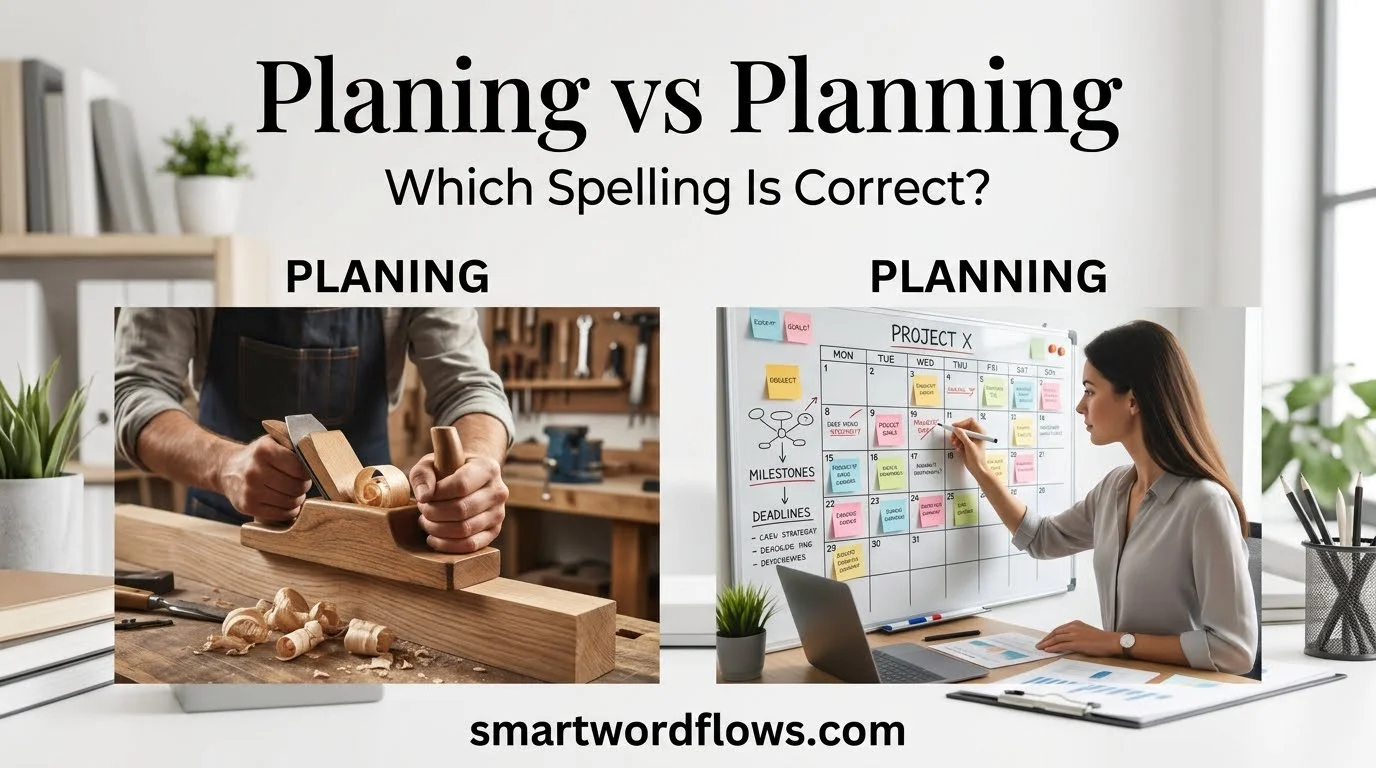
Planning is the correct spelling when you mean making plans, preparing for something, or deciding how something will be done.
Planing is also a correct English word. It refers mainly to smoothing, flattening, or shaping a surface with a plane, especially in woodworking.
For example:
- We are planning our vacation for next summer.
- The carpenter is planing the wooden board.
The easiest way to remember the distinction is:
Plan → planning
Plane → planing
If you’re talking about schedules, preparation, goals, arrangements, or future actions, use planning.
If you’re talking about a woodworking tool or the process of smoothing wood with that tool, use planing.
Comparison Overview
| Word | Correct Spelling? | Base Word | Main Meaning | Common Context |
| Planning | Yes | Plan | Making plans or deciding what to do | Everyday, business, school, travel |
| Planing | Yes | Plane | Smoothing or shaping a surface with a plane | Carpentry, woodworking, manufacturing |
There is an important point here: planing isn’t simply a misspelling of planning.
Both words have a place in English. Their meanings separate them.
Planning appears frequently in everyday communication. You might discuss planning a wedding, planning a vacation, planning a business project, or planning your week.
Planing, by contrast, usually appears in technical or practical contexts. A carpenter might spend several hours planing rough wood until the surface becomes smooth.
The words also come from different verbs:
- plan + -ing = planning
- plane + -ing = planing
That small distinction solves most spelling questions involving these words.
Main Differences Between Planing vs Planning
The biggest difference between planing and planning isn’t simply the number of letters. It is the meaning of the underlying verb.
What Does Planning Mean?
Planning is the act of deciding what you’re going to do and how you’re going to do it.
The word can describe something as simple as deciding where to eat tonight or as complex as preparing a five-year business strategy.
For example:
- I’m planning a birthday party for my sister.
- The team is planning its next product launch.
- We spent several weeks planning the trip.
- She is planning to study abroad next year.
- Careful planning helped us avoid unnecessary delays.
In each sentence, nobody is cutting, shaving, or smoothing wood. The people are thinking ahead and organizing future actions.
The noun planning can also describe a broader process. Cambridge defines it as the act of deciding how to do something and also uses it for fields such as urban or environmental planning. Oxford similarly defines planning as the act or process of making plans for something.
What Does Planing Mean?
Planing comes from the verb plane.
In woodworking, to plane something means to make it smoother or flatter by using a plane. A plane is a tool designed to remove thin layers from a material, particularly wood.
For example:
- The carpenter is planing the rough board.
- Planing made the wooden surface smooth.
- The craftsman finished planing the door before sanding it.
- The worker is planing the edge of the table.
Here, planing has nothing to do with making plans.
The Oxford Advanced American Dictionary gives planing as the -ing form of plane and defines the woodworking sense as making wood smoother or flatter with a plane.
So, if a carpenter is holding a woodworking plane and removing thin layers from a board, planing is exactly the right word.
Planning vs Planing: The Base-Word Test
When you’re unsure which spelling to use, go back to the base verb.
Ask yourself:
Does the word come from plan?
If yes, use planning.
Does it come from plane?
If yes, use planing.
Think of these as two separate families:
Plan family
- plan
- plans
- planned
- planning
- planner
Plane family
- plane
- planes
- planed
- planing
Once you see the two families separately, the spelling becomes much easier.
Why Is Planning Spelled With Two Ns?
The spelling planning follows a common English spelling pattern.
When the verb plan takes the suffix -ing, the final consonant is doubled:
plan + ing → planning
The same general pattern appears in words such as:
- run → running
- sit → sitting
- stop → stopping
- swim → swimming
- begin → beginning
The doubled consonant isn’t decorative. It reflects a standard spelling pattern used with certain short verbs before endings such as -ing and -ed.
The word plan is short and ends with a single consonant after a short vowel sound. When the suffix is added, English spelling convention doubles that final consonant.
That’s why this is correct:
planning
And this is generally incorrect when you mean making plans:
planing
The difference becomes especially noticeable in professional writing.
Compare:
- The company is planning a new marketing campaign.
- The company is planing a new marketing campaign.
The second sentence suggests that the company is somehow smoothing a marketing campaign with a woodworking tool. That’s not what the writer intended.
Why Is Planing Spelled With One N?
The answer becomes much clearer when you start with plane.
The verb plane ends with a silent e. When you add -ing, the final e normally drops:
plane + ing → planing
The same type of spelling change occurs in other English verbs:
- make → making
- bake → baking
- shape → shaping
- use → using
- write → writing
Therefore:
plane → planing
Not:
plane → planning
The extra n would change the word into a different spelling associated with plan.
This is why the two forms shouldn’t be treated as competing spellings of one word. They are forms of different verbs.
How to Use Planning in a Sentence
The word planning can function as a present participle or a gerund.
Planning as a Verb Form
When planning works with a form of be, it commonly describes an action in progress.
Examples include:
- I am planning our weekend schedule.
- She is planning a surprise party.
- They are planning a major renovation.
- We were planning a road trip.
- The company is planning to expand next year.
In these examples, planning describes an activity or intention involving future action.
Planning as a Gerund
A gerund looks like an -ing verb form but functions as a noun.
For example:
- Planning takes patience.
- Good planning saves time.
- Careful planning can prevent costly mistakes.
- Strategic planning helps businesses prepare for change.
In “Good planning saves time,” the word planning acts as the subject of the sentence.
That’s different from:
“We are planning the event.”
There, planning forms part of the verb phrase.
Common Phrases With Planning
You’ll encounter planning in many established expressions.
Some common examples include:
- careful planning
- strategic planning
- financial planning
- business planning
- project planning
- event planning
- career planning
- long-term planning
- future planning
- contingency planning
- urban planning
- lesson planning
- travel planning
These phrases all involve deciding, organizing, preparing, or designing something.
For instance, financial planning involves making decisions about money and future financial goals. Urban planning concerns how land and development are organized within cities and communities.
Read More:Licence vs License: Which Spelling Is Correct?
How to Use Planing in a Sentence
Planing has a much narrower everyday use.
Planing in Woodworking
The most familiar technical meaning involves working with wood.
A carpenter can use a plane to remove thin shavings from a wooden surface. The process is called planing.
Examples:
- The carpenter is planing the rough timber.
- Planing removed the uneven sections of the board.
- The craftsman checked the surface after planing the wood.
- The cabinetmaker spent the afternoon planing the door.
The word often appears alongside other woodworking terms such as wood, surface, board, carpenter, plane, and smoothing.
Planing in Other Contexts
The verb plane has other meanings as well.
For example, dictionaries also record plane as a verb describing movement across a surface, including a boat moving quickly across water with part of its hull raised above the surface.
That means planing can appear outside woodworking.
Still, if you’re dealing with ordinary spelling questions, the woodworking meaning is the distinction most likely to matter.
Planing vs Planning: Examples
Seeing the words in context makes the difference much easier to remember.
Examples With Planning
Here are several natural examples:
- We are planning a family vacation.
- She spent the weekend planning her presentation.
- The manager is planning next month’s schedule.
- They are planning to move to another city.
- Good planning made the project easier to manage.
- The students are planning their science project.
- Careful planning helped the event run smoothly.
- He is planning his retirement strategy.
Every example involves preparation, organization, decisions, or future intentions.
Examples With Planing
Now look at the specialized word:
- The carpenter is planing the rough board.
- Planing produced a smoother wooden surface.
- The craftsman finished planing the cabinet door.
- The worker used a hand plane for planing the timber.
- The board required additional planing before finishing.
The meaning changes completely.
Incorrect vs Correct Examples
| Incorrect Use | Correct Use | Why? |
| We are planing our vacation. | We are planning our vacation. | You’re making arrangements. |
| She is planing the wedding. | She is planning the wedding. | A wedding requires preparation, not woodworking. |
| They are planing the project. | They are planning the project. | You’re organizing a project. |
| The carpenter is planning the board. | The carpenter is planing the board. | The carpenter is smoothing wood. |
| He spent the morning planning the rough timber. | He spent the morning planing the rough timber. | The activity involves a woodworking plane. |
Context acts like a compass here. It tells you which word belongs.
Common Mistakes With Planing and Planning
Using Planing When You Mean Making Plans
This is easily the most common mistake.
Someone may remember that the base word is plan and simply add -ing without doubling the final consonant.
That produces planing.
However, the correct form is planning.
For example:
❌ We are planing our wedding.
✅ We are planning our wedding.
The second sentence clearly communicates the intended meaning.
Using Planning When You Mean Smoothing Wood
The reverse mistake can happen when someone doesn’t recognize planing as a real word.
Consider:
❌ The carpenter is planning the wooden board.
If the carpenter is using a plane, the correct sentence is:
✅ The carpenter is planing the wooden board.
In this context, planning changes the meaning completely.
Confusing the Base Verbs
The easiest way to avoid both mistakes is to identify the base verb.
| Base Verb | -ing Form | Meaning |
| plan | planning | Decide or prepare what to do |
| plane | planing | Smooth or shape with a plane |
This two-row table contains the entire distinction.
If the base verb is plan, double the n.
If the base verb is plane, remove the final e and add -ing.
Is Planing a Correct Word?
Yes. Planing is a legitimate English word.
Calling every instance of planing a spelling mistake would be inaccurate.
Cambridge lists planing as the present participle of plane and defines the verb in its woodworking sense as removing small strips of wood from a surface with a special tool.
Oxford also lists planing as the -ing form of plane and gives the meaning of making wood smoother or flatter with a plane.
Therefore, this sentence is completely correct:
The carpenter is planing the board.
The spelling only becomes wrong when the intended word is planning.
For example:
We are planing our vacation.
In that context, planing is almost certainly an unintended spelling error because a vacation isn’t normally something you smooth with a plane.
Is Planning a Correct Word?
Yes. Planning is the standard spelling for the process of making plans.
Cambridge defines planning as the act of deciding how to do something. It also uses the word for specialized areas such as urban and environmental planning.
Oxford’s American English dictionary likewise defines planning as the act or process of making plans for something.
Examples include:
- planning a vacation
- planning a meeting
- planning a business
- planning a project
- planning a career
- planning an event
In everyday American English, planning is the form you’ll need whenever the subject involves preparation or future decisions.
Planing vs Planning: Pronunciation
Both words are pronounced differently in their spelling but can sound surprisingly similar because the extra n in planning doesn’t create another syllable.
Planning is pronounced with two syllables.
Planing is also pronounced with two syllables.
The main distinction comes from the vowel and consonant pattern:
- planning comes from plan
- planing comes from plane
The base words themselves make the contrast easier to hear. Plan has the short vowel sound in words such as cat and hand, while plane has the long vowel sound found in name and game.
So, although the written difference looks tiny, the words don’t simply sound identical.
Planning and Planing in Different Contexts
Everyday English
In ordinary conversation, planning is overwhelmingly the more relevant word.
You might say:
- I’m planning dinner.
- We’re planning a trip.
- She’s planning her schedule.
- They’re planning a party.
You rarely need planing unless you’re discussing woodworking, manufacturing, watercraft, or another specialized subject involving the verb plane.
Business and Professional Writing
Professional writing contains planning everywhere.
Businesses use phrases such as:
- strategic planning
- project planning
- business planning
- financial planning
- contingency planning
- resource planning
- career planning
For example:
Effective project planning can reduce delays and prevent wasted resources.
Here, planning refers to the process of deciding what needs to happen, when it should happen, and how people will accomplish it.
Academic Writing
Students also use planning frequently.
You might write:
- The research team spent months planning the study.
- Careful lesson planning improves classroom organization.
- The students are planning their final presentation.
In academic contexts, planning often connects ideas, resources, deadlines, methods, and expected outcomes.
Woodworking and Carpentry
This is where planing becomes the right choice.
A carpenter may begin with rough wood. The surface can contain uneven areas, rough fibers, or small imperfections. A plane removes thin layers, gradually creating a flatter or smoother surface.
That process is called planing.
The distinction is practical:
Planning a table means deciding how to make the table.
Planing a table means physically smoothing or shaping its wood with a plane.
One extra n changes the activity.
A Simple Trick to Remember the Difference
Here’s a useful memory trick:
Planning has two Ns because you’re making Plans.
And:
Planing comes from plaNe.
Look at the base words:
plan → planning
plane → planing
Another way to picture it is this:
Planning = thinking ahead.
Planing = working on a surface.
One happens in your decision-making process. The other happens with a physical tool.
The Two-N Memory Trick
If you’re writing about:
- vacations
- weddings
- projects
- meetings
- schedules
- businesses
- careers
- goals
think:
PLANNING
If you’re writing about:
- wood
- boards
- carpentry
- planes
- smoothing
- shaping
- surface preparation
think:
PLANING
This simple context-based method works better than trying to memorize an isolated spelling.
Planning vs Planing: Quick Decision Guide
When you’re stuck, ask yourself these questions.
Are you talking about making arrangements?
Use planning.
We’re planning our vacation.
Are you deciding how something will happen?
Use planning.
The team is planning the project.
Are you preparing for a future event?
Use planning.
She’s planning her wedding.
Are you using a woodworking plane?
Use planing.
The carpenter is planing the board.
Are you smoothing or flattening wood?
Use planing.
The craftsman is planing the rough surface.
Does the word come from “plan”?
Use planning.
Does the word come from “plane”?
Use planing.
That’s the whole decision tree.
A Real-World Context Example
Imagine a carpenter is building a dining table.
Before construction begins, the carpenter may spend time planning the project. They might choose the wood, measure the dimensions, decide on the design, estimate materials, and organize the work.
Once construction starts, the carpenter may begin planing the wood. The plane removes thin layers from the surface and helps create a smooth, even board.
So, one project can contain both words:
The carpenter spent the morning planning the table design and the afternoon planing the wooden boards.
That’s a useful example because it shows that planning and planing can appear in the same sentence while describing completely different actions.
Planning vs Planing in a Nutshell
The difference can be reduced to two questions:
What are you doing with your future?
You’re planning it.
What are you doing with the wood?
You may be planing it.
This distinction also explains why the spellings differ.
Planning
plan + ing → planning
The final n doubles.
Planing
plane + ing → planing
The final e disappears.
The words therefore follow two different spelling paths because they come from two different verbs.
Frequently Asked Questions
Is planning or planing correct?
Both planning and planing are correct words, but they have different meanings. Planning means preparing, organizing, or deciding what to do. Planing means smoothing or shaping a surface, usually wood, with a plane.
What is the difference between planning and planing?
Planning comes from the verb plan and refers to making arrangements or preparing for something. Planing comes from plane and usually describes smoothing wood with a woodworking tool.
Why does planning have two Ns?
The word planning comes from plan + -ing. English spelling rules double the final consonant in this type of word, giving planning rather than planing.
Is planing a misspelling of planning?
No. Planing is a real English word. It becomes incorrect only when you intend to describe making plans. For example, “We are planning a trip” is correct, while “We are planing a trip” is incorrect.
How can I remember the difference between planing and planning?
Use the base-word trick: plan → planning and plane → planing. If you’re making arrangements, use planning. If you’re smoothing wood with a plane, use planing.
Conclusion
The difference between planing vs planning comes down to meaning and the base verb. Planning is the correct word when you’re preparing, organizing, or deciding what to do. It’s the form you’ll use for vacations, projects, meetings, events, careers, and countless everyday activities.
Planing, meanwhile, is a legitimate word connected to plane. It usually describes smoothing or shaping wood with a plane. Remember the simple pattern: plan becomes planning, while plane becomes planing. Once you connect each spelling with its meaning, this easy-to-mix-up pair becomes much easier to use correctly.




1 thought on “Planing vs Planning: Which Spelling Is Correct?”