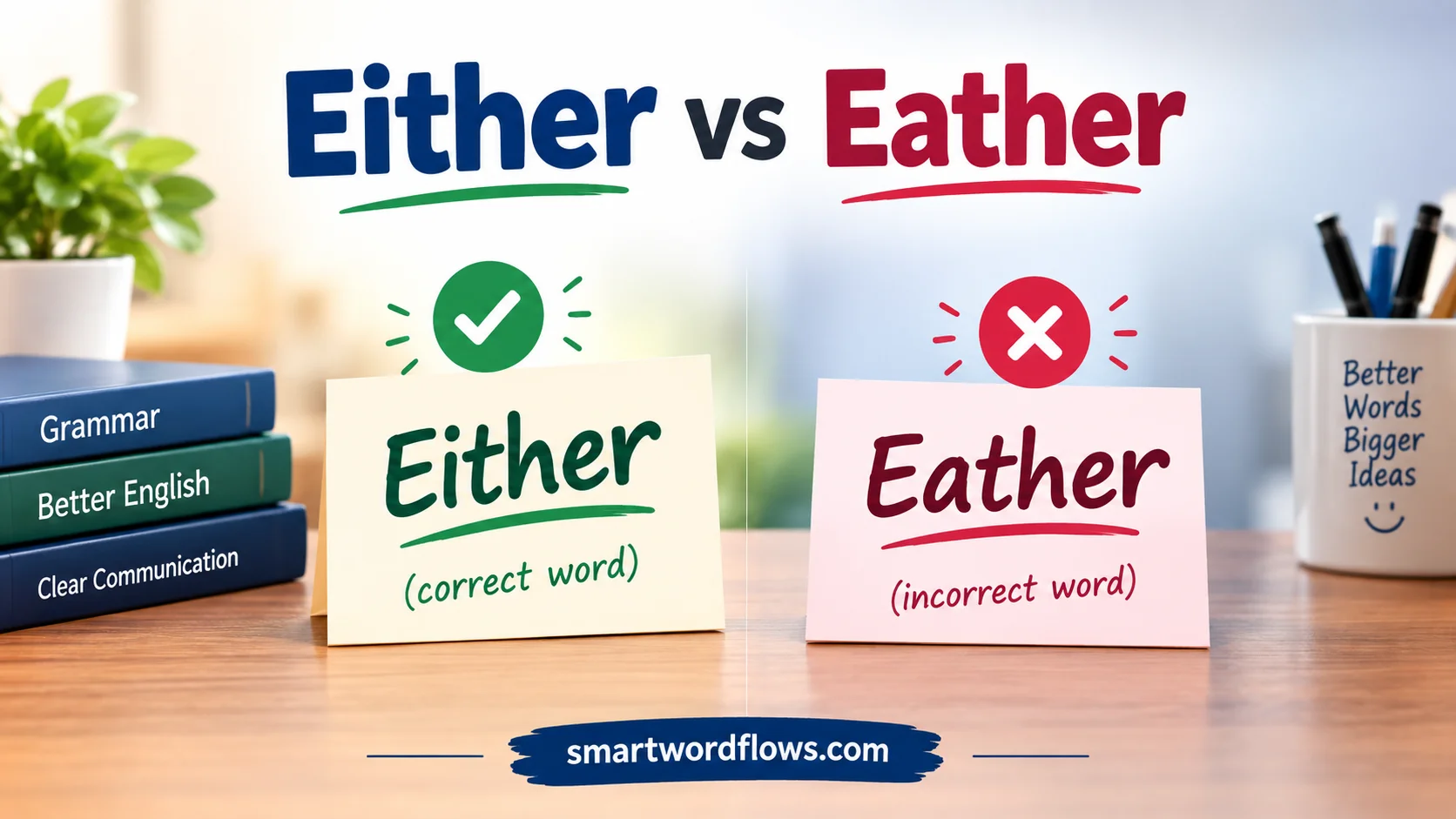

Either vs Eather is a common English spelling confusion that can make English learners unsure about the correct spelling. The correct word is either, while eather is not part of standard English usage. In English writing, either can mean one of two choices, one or the other, or each of two. It often introduces alternatives in the either…or pattern. As a conjunction, determiner, pronoun, or adverb, it follows different grammar rules.
The confusion becomes easier to understand when you hear the word spoken. Either has two accepted pronunciations, EE-ther and EYE-ther, commonly heard in American English and British English. The different sound can lead to common mistakes because learners may spell words according to pronunciation. It is also important to distinguish either from ether, which has different definitions and meanings. Ether can describe the upper sky, air, or a liquid used as an anesthetic.
Quick Answer
Either is the correct spelling.
Eather is not the standard modern spelling of the word meaning “one or the other of two.” If you’re writing an email, essay, article, report, message, or professional document, choose either.
| Word | Correct spelling? | Meaning | Example |
| Either | Yes | One or the other of two choices; also used in negative statements | You can choose either option. |
| Eather | No, in standard modern English | Usually a misspelling of either | ❌ You can choose eather option. |
A useful rule is simple: when you mean a choice between two possibilities, spell the word E-I-T-H-E-R: either.
The major dictionaries treat either as a standard English word with several grammatical functions. Cambridge identifies it as a determiner, pronoun, conjunction, and adverb depending on how it appears in a sentence.
Comparison Overview
The difference between either and eather is mainly a matter of standard spelling rather than meaning.
| Feature | Either | Eather |
| Standard modern spelling | ✅ Yes | ❌ No |
| Refers to one of two choices | ✅ Yes | ❌ No |
| Used in either…or | ✅ Yes | ❌ No |
| Used after negative statements | ✅ Yes | ❌ No |
| Used in professional writing | ✅ Yes | ❌ No |
| Common spelling error | No | Yes |
| Standard dictionary word for this meaning | Yes | No |
| Common pronunciations | EE-ther / EYE-ther | Usually an attempted spelling of either |
There’s one historical wrinkle worth knowing. Eather can appear in historical texts as an obsolete spelling of either. Wiktionary records it as an obsolete form and gives a nineteenth-century literary example. That historical fact doesn’t make eather appropriate in present-day standard English.
So, for modern writing, the practical answer remains clear:
Use “either,” not “eather.”
Main Differences Between Either and Eather
The biggest difference is straightforward: either is the established modern English spelling, while eather is generally encountered as a spelling error.
Either Is the Standard Word
Either has several established meanings and grammatical uses. It can indicate one of two alternatives, refer to each of two things, connect alternatives with or, or add agreement to a negative statement.
For example:
- Either answer could be correct.
- You can choose either color.
- Either call me or send a message.
- I don’t like that restaurant either.
These aren’t separate spellings of the same word. They’re different grammatical uses of the same standard word.
Eather Is Not the Modern Standard Spelling
When someone writes eather in a sentence such as “You can choose eather option,” they almost certainly intend either.
The mistake often develops because the writer hears the pronunciation before learning the written form. English creates plenty of traps like this because spelling doesn’t always map neatly onto pronunciation.
Therefore, if you’re proofreading a document and see eather, check whether the intended word is either.
What Does “Either” Mean?
At its core, either commonly means one or the other of two people or things.
For example:
You can take either route.
This means that two routes exist and either one is acceptable.
Oxford defines either as referring to one or the other of two, while also noting another use in which it refers to each of two things.
Consider these examples:
- Either answer is acceptable.
- You can sit on either side.
- Either candidate could get the position.
- Either road will take you downtown.
- You may choose either option.
Notice the important idea: two possibilities are available.
However, either doesn’t always mean “choose exactly one.” Context matters. In expressions such as on either side, it can mean each of the two sides.
Either as a Determiner
One of the most common grammatical roles for either is as a determiner before a singular countable noun.
For example:
- You can choose either option.
- Either answer could work.
- Take either road.
- Either candidate could win.
- You can use either method.
Cambridge notes that when either functions as a determiner before a noun, the noun normally appears in the singular when the word refers to one of two choices.
So compare these:
Correct:
Either jacket looks good.
Incorrect in this construction:
Either jackets look good.
The second sentence doesn’t follow the standard determiner pattern.
Either of + Plural Noun or Pronoun
When either comes before the, these, those, or a possessive determiner, English uses either of.
Examples include:
- Either of the answers is acceptable.
- Either of these plans could work.
- Either of my brothers can help.
- Either of them can handle the task.
This construction can confuse learners because either takes a singular noun directly but works with a plural noun after of.
Either as a Pronoun
Either can also function as a pronoun when the noun is already understood.
Imagine someone asks:
Would you like tea or coffee?
You could answer:
Either.
That response means one of the two choices is acceptable.
You don’t need to repeat the noun because the context already supplies it.
More examples include:
- Either will work.
- Either is fine with me.
- I don’t want either.
- Either of them can help.
- You can choose either.
Cambridge gives examples of either functioning as a pronoun when speakers respond to two choices.
Either as an Adverb
Another important use appears in negative sentences.
Here, either can mean something similar to also or too, but it normally follows a negative statement.
For example:
I don’t like coffee either.
This means that the speaker also doesn’t like coffee.
Consider the pattern:
I don’t like tea.
Someone might respond:
I don’t like it either.
Cambridge and Oxford both describe this negative use of either.
More Examples
- I don’t understand it either.
- She isn’t coming either.
- We haven’t finished either.
- He doesn’t want pizza either.
- They weren’t invited either.
A common mistake is to use either in a positive sentence where too or also would be more natural.
Incorrect:
I like pizza either.
Correct:
I like pizza too.
Correct:
I also like pizza.
But after a negative statement:
I don’t like pizza either.
That small distinction makes a big difference.
Either as a Conjunction
The familiar structure either…or presents alternatives.
Examples include:
- Either call me or send an email.
- Either we leave now or we’ll miss the train.
- You can either walk or take the bus.
- Either Sarah or Daniel will lead the meeting.
Cambridge explains that either…or connects two choices and can connect words, phrases, or clauses of the same grammatical type.
This makes either…or especially useful when you need to show a clear decision.
Either…Or and Parallel Structure
Good writing doesn’t just use either…or correctly. It also keeps the two sides grammatically balanced.
Compare:
You can either walk to the station or take a taxi.
The two alternatives are verb phrases, so the sentence feels balanced.
Now consider:
You can either walk to the station or a taxi.
That version feels awkward because the two alternatives don’t have matching grammatical structures.
Good Parallel Examples
Two nouns:
We can choose either tea or coffee.
Two verbs:
You can either stay or leave.
Two phrases:
She’ll stay either at home or at her sister’s house.
Two clauses:
Either we start now or we wait until tomorrow.
Using parallel structure makes either…or sentences easier to read and understand. Cambridge specifically recommends using the construction to connect items with the same grammatical type.
Either vs Neither
Either and neither are closely related, but their meanings move in opposite directions.
Either generally presents one of two possibilities.
Neither rejects both possibilities.
| Word | Basic meaning | Example |
| Either | One or the other of two | Either answer could work. |
| Neither | Not one and not the other | Neither answer works. |
Consider this simple comparison:
Either candidate can take the position.
This says one candidate or the other could take it.
Now:
Neither candidate can take the position.
This says both candidates are excluded.
The paired constructions work similarly:
- Either…or
- Neither…nor
For example:
Either John or Maria will attend.
versus:
Neither John nor Maria will attend.
Cambridge identifies neither…nor as the negative counterpart to either…or.
Either vs Both
Another common source of confusion involves either and both.
Generally, either focuses on one of two alternatives, while both refers to the two together.
Compare:
Either student can answer the question.
This means one student or the other can answer.
Now:
Both students can answer the question.
This means the two students can answer.
The distinction becomes particularly important in instructions, policies, and formal writing because changing one word can change the meaning of the entire sentence.
| Word | Meaning | Example |
| Either | One or the other of two | Either route will work. |
| Both | The two together | Both routes are open. |
Oxford describes both as referring to the two members of a pair or the two together.
Either vs Any
Either generally works with a set of two alternatives, while any often works with three or more possibilities or with an unrestricted choice.
For example:
You can choose either shirt.
This naturally suggests two shirts.
Meanwhile:
You can choose any shirt.
This usually suggests a larger selection.
Consider a store with two jackets:
You can buy either jacket.
Now imagine a rack containing twenty jackets:
You can buy any jacket.
The words can overlap in some contexts, especially when the speaker isn’t emphasizing the exact number of choices. Still, either strongly points toward a pair.
Read More: Party’s vs. Parties: Basic Difference and How to Use
Either vs Whether
Don’t confuse either with whether. They look somewhat similar, but they perform different jobs.
Either identifies or introduces alternatives.
Either road will take us there.
Whether introduces uncertainty or a question about alternatives.
I don’t know whether we should leave.
The distinction becomes especially clear in these sentences:
You can choose either option.
I don’t know whether to choose this option.
The first sentence gives a choice. The second expresses uncertainty about the choice.
How to Pronounce “Either”
One reason either vs eather creates confusion involves pronunciation.
The word either has two widely accepted pronunciations:
- EE-ther
- EYE-ther
Cambridge lists both pronunciations for US and UK English.
Neither pronunciation changes the spelling.
That’s important because English spelling often preserves a conventional written form even when speakers pronounce a word differently.
For example, someone who says the word with an initial “ee” sound might naturally imagine a spelling beginning with ea. That can lead to eather. However, the standard spelling remains either.
Does American English Spell It Differently?
No.
American English and British English use the same spelling:
either
The pronunciation may vary between speakers and regions, but the spelling doesn’t change.
Oxford’s American dictionary also lists both major pronunciation patterns.
Why Do People Spell Either as Eather?
The mistake usually comes from the complicated relationship between English spelling and pronunciation.
English isn’t a language where every sound has one predictable spelling. Several different letter combinations can represent similar sounds, while the same letter combination can produce different sounds in different words.
The EE-ther pronunciation makes eather look plausible at first glance.
Words such as these may also reinforce the visual pattern:
- weather
- feather
- leather
- together
Someone familiar with those words may unconsciously expect a similar -eather spelling.
There’s another issue, too. People often learn spoken vocabulary before they encounter the written form. If you’ve heard either hundreds of times but haven’t seen it written frequently, your brain may build an approximate spelling from the sound.
That’s a normal language-learning process. The solution is simply to memorize the established spelling.
Is “Eather” a Real Word?
For modern standard English, eather isn’t the correct spelling for the common word either.
However, saying that it has never existed in any form would be too absolute.
Historical English contains obsolete spellings that differ from modern conventions. Wiktionary records eather as an obsolete spelling of either, including a nineteenth-century example.
That historical detail matters because language changes over time. A form that appeared in older writing doesn’t automatically remain acceptable today.
For modern communication, the distinction is simple:
Modern standard English:
✅ either
Common modern misspelling:
❌ eather
Therefore, don’t use the historical form in ordinary contemporary writing.
Common Mistakes With Either
Writing “Eather” Instead of “Either”
This is the central spelling error.
❌ Eather option will work.
✅ Either option will work.
The correction requires changing ea to ei.
Using Either Instead of Too
Remember that either can mean “also,” but this happens in negative contexts.
❌ I enjoyed the movie either.
✅ I enjoyed the movie too.
But:
✅ I didn’t enjoy the movie either.
Using a Plural Noun Directly After Either
When either acts as a determiner in the usual two-choice construction, use a singular countable noun.
❌ Either choices are acceptable.
✅ Either choice is acceptable.
If you want a plural noun, use either of:
✅ Either of the choices is acceptable.
Cambridge specifically highlights this distinction in its grammar guidance.
Confusing Either With Neither
❌ Neither answer is acceptable when you actually mean one answer will work.
✅ Either answer is acceptable.
The first sentence rejects both answers. The second accepts either one.
Breaking Parallel Structure
❌ You can either drive to work or the train.
✅ You can either drive to work or take the train.
The corrected sentence gives the two alternatives matching grammatical forms.
Either in Everyday English
You probably use either more often than you realize.
Choosing Food
You can order either pizza or pasta.
Choosing a Seat
You can sit in either chair.
Making Plans
We can either leave now or wait.
Choosing a Date
Either Monday or Tuesday works for me.
Agreeing With a Negative Statement
I don’t want to go either.
These examples show why learning either is more useful than simply memorizing its spelling. The word appears in everyday decisions, conversations, instructions, and written communication.
Either in Professional and Academic Writing
Either works perfectly well in professional, academic, and formal writing.
For example:
The applicant may submit either a digital copy or a printed version.
A business policy might say:
Either party may terminate the agreement with written notice.
An academic paper might state:
The result can be explained by either mechanism.
In each case, either clearly establishes alternatives.
The word itself isn’t informal. What matters is how you construct the sentence around it.
Professional Examples
- Please contact us using either method listed below.
- Either department can provide additional information.
- The applicant may select either option.
- Either explanation could account for the observed result.
- You may submit either document before the deadline.
These sentences demonstrate that either fits naturally into formal communication.
Either and Subject-Verb Agreement
Subject-verb agreement can become slightly tricky when either appears in a larger construction.
With either + singular noun, use a singular verb:
Either candidate is qualified.
With either of + plural noun, formal writing generally favors a singular verb:
Either of the candidates is qualified.
Oxford notes that plural verbs can occur informally with either of constructions, while singular agreement remains the formal choice.
The pattern becomes more complicated with either…or because the subjects may have different numbers.
For example:
Either the manager or the assistants are responsible.
The verb commonly agrees with the subject closest to it, although style and grammar guides can vary in more complex constructions.
For polished formal writing, restructuring the sentence can sometimes make the agreement clearer.
Correct and Incorrect Examples
| Incorrect | Correct |
| Eather option is fine. | Either option is fine. |
| You can eather stay or leave. | You can either stay or leave. |
| I don’t like it eather. | I don’t like it either. |
| Eather answer could be correct. | Either answer could be correct. |
| I like this one either. | I like this one too. |
| Either choices are acceptable. | Either choice is acceptable. |
| Eather John or Maria will come. | Either John or Maria will come. |
These examples reveal an important point: eather doesn’t represent a different grammatical choice. In ordinary modern usage, it simply needs correction to either.
Case Study: Why “Eather” Looks Correct at First
Imagine a student hears a teacher say:
“You can choose either answer.”
The student already knows the pronunciation but hasn’t memorized the spelling. Because the first syllable sounds like “ee,” the student writes:
“You can choose eather answer.”
The sentence sounds perfectly understandable when spoken aloud. That’s exactly why the mistake can survive proofreading.
Now compare the written forms:
Eather
Either
The letters are visually close enough to create hesitation, especially for someone learning English.
A useful learning strategy is to connect the spelling to a familiar pair:
either — neither
Both words contain ei.
That association can make the correct spelling easier to recall.
A Simple Memory Trick for Either
If you frequently confuse either and eather, remember this:
Either Has “I” in It
Think:
EI = either
Then connect it with neither:
either
neither
Both contain ei.
Another helpful memory sentence is:
Either this or that.
The phrase either…or is extremely common, so remembering the complete structure can reinforce the spelling.
When you see eather, stop and ask:
“Am I talking about one of two choices?”
If the answer is yes, you almost certainly want either.
Either vs Eather in Real Sentences
Here are several natural examples covering the major uses of either.
Choice Between Two Options
You can choose either color.
Either…Or Construction
We can either drive or take the train.
Pronoun Use
Which dessert do you want? Either is fine.
Negative Agreement
I don’t want to go either.
Either of Construction
Either of these solutions could work.
Meaning “Both” in a Specific Construction
There are doors on either side of the hallway.
In the last example, either side means each of the two sides. Cambridge and Oxford both recognize this use.
Is “Either” Professional and Polite?
Yes. Either is completely appropriate in professional, academic, business, and everyday English.
There’s nothing informal or careless about the word itself.
For example:
Please select either option A or option B.
That’s perfectly suitable for a professional document.
Likewise:
Either solution would meet the project requirements.
The sentence sounds neutral, precise, and professional.
What you should avoid is the misspelling eather, particularly in resumes, academic assignments, business emails, reports, applications, and published content.
Is “Eather” Ever Correct?
In ordinary modern English, eather isn’t the spelling you should use for either.
There is a historical exception worth remembering. Older texts sometimes used eather as an obsolete spelling of either.
That doesn’t make it a suitable modern alternative.
Think of it like an old spelling found in a historical document. It may be interesting from a language-history perspective, but it isn’t the form you’d normally use today.
If your sentence means one or the other, use:
either
Not:
eather
Quick Reference: Common Either Patterns
| Pattern | Meaning | Example |
| either + singular noun | One of two | Either answer works. |
| either of + plural noun | One of two | Either of the answers works. |
| either…or | Two alternatives | Either call or email me. |
| either as a pronoun | One of two | Either is fine. |
| negative + either | Also/too in a negative statement | I don’t know either. |
| either side/end | Each of two sides or ends | Doors stood at either end. |
Learning these patterns gives you a much stronger command of either than simply remembering its spelling.
FAQs:
1. Is “either” the correct spelling?
Yes. Either is the correct spelling in standard English. Eather is not the standard spelling of this word.
2. What does “either” mean?
Either usually means one of two choices, one or the other, or each of two. It is commonly used in the either…or structure.
3. How do you pronounce “either”?
Either has two accepted pronunciations: EE-ther and EYE-ther. Both are widely used in American English and British English.
4. Is “eather” an English word?
Eather is not the standard modern spelling of either. If you mean one of two choices or alternatives, use either.
5. What is the difference between “either” and “ether”?
Either refers to two choices or possibilities. Ether is a different word that can refer to a substance, a liquid used as an anesthetic or solvent, or the upper sky in older usage.
Conclusion:
The correct spelling is either, not eather. Remember that either can describe two choices and commonly appears with or. Its two accepted pronunciations can cause spelling confusion, but the spelling remains either. Also, don’t confuse either with ether, because they have completely different meanings and uses. Learning these simple differences can help you avoid common spelling mistakes and write with greater confidence.