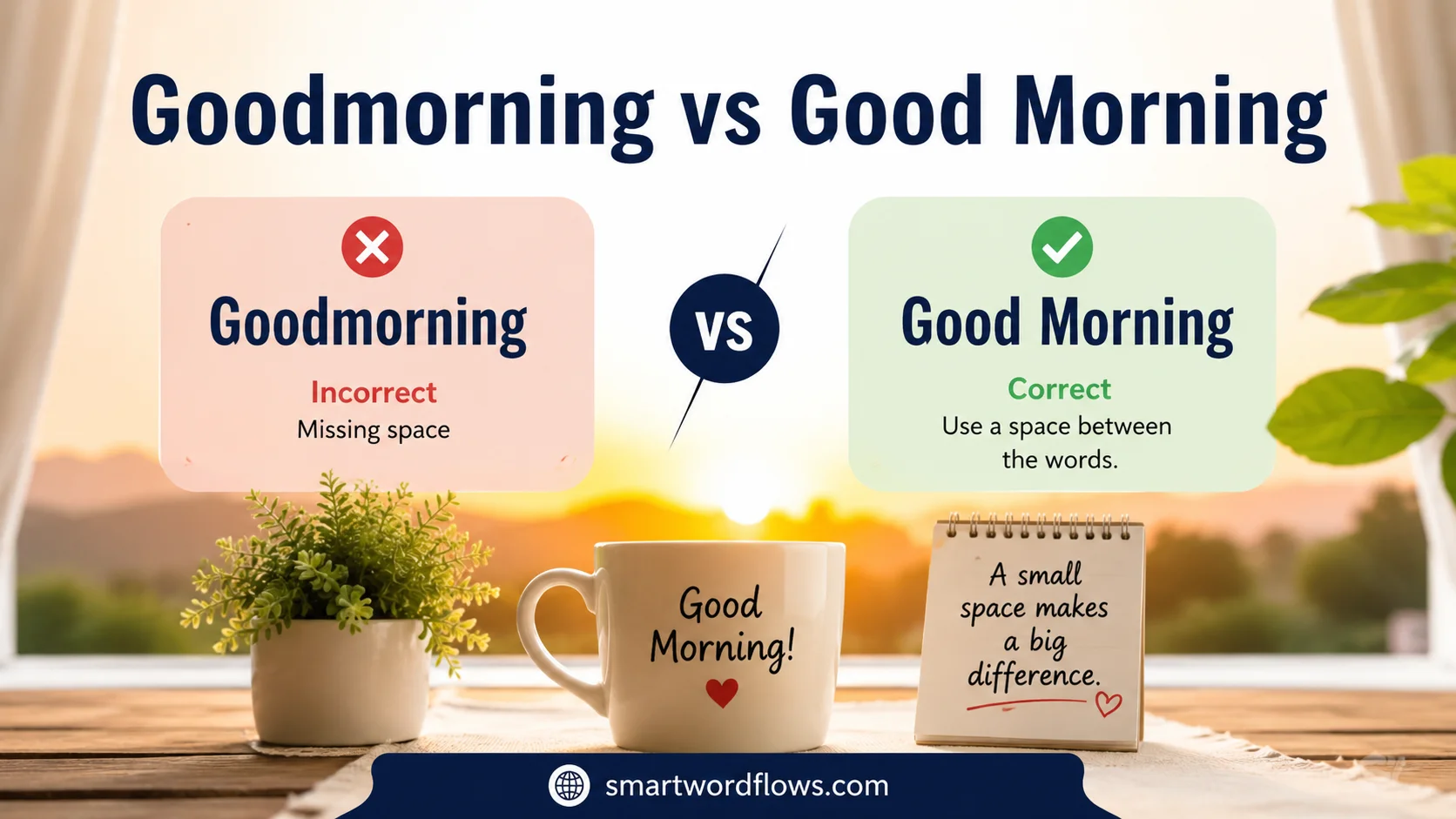

Goodmorning vs Good Morning is a common spelling question among English learners, students, writers, and professionals. Both forms may appear in texts, emails, and social media, but only good morning is the correct standard form. Understanding this small difference helps you write clearly and avoid common grammar mistakes in everyday communication.
The greeting good morning combines two separate words and is widely used in casual and professional communication. You’ll often see it in emails, messages, conversations, and greeting cards. In contrast, goodmorning is generally considered an incorrect spelling. Learning the simple spelling rule behind this phrase can improve your writing, clarity, and confidence when communicating in English.
Quick Answer
“Good morning” is correct when you use the expression as a greeting.
Write it as two words:
- Good morning!
- Good morning, everyone.
- Good morning, Sarah.
- Good morning. How are you today?
The form “goodmorning” isn’t the standard modern spelling for this greeting. Although dictionaries may record goodmorning as an alternative form in particular noun or verb uses, ordinary English writing overwhelmingly uses good morning as two words.
The simplest rule is easy to remember:
Greeting someone in the morning? Write “good morning.”
Comparison Overview
The difference becomes much easier when you place both forms side by side.
| Form | Standard spelling for a greeting? | Number of words | Common use |
| Good morning | Yes | 2 | Standard greeting |
| Goodmorning | No, not normally | 1 | Rare, informal, stylistic, or specialized use |
| Good-morning | Not normally | Hyphenated | Historical or specialized noun/verb usage |
Cambridge defines good morning as an expression used to greet someone politely when you meet them in the morning. Its American English entry gives the same basic function.
Merriam-Webster likewise lists good morning as an interjection meaning a way to say hello to someone in the morning.
Oxford also identifies good morning as an exclamation used to say hello politely when people first see each other in the morning. It notes that “morning” can serve as an informal shortened greeting.
Main Differences Between Goodmorning vs Good Morning
The biggest difference is word spacing. The standard greeting consists of two words: good + morning.
There’s also a difference in grammatical function and frequency.
“Good Morning” Is the Standard Greeting
When you walk into an office and greet your coworkers, you might say:
“Good morning, everyone.”
When you meet a neighbor early in the day, you could simply say:
“Good morning!”
In both cases, the expression works as a greeting. English dictionaries consistently present this form as good morning, not goodmorning.
“Goodmorning” Is a Closed Form
Goodmorning combines the two words into one. You may occasionally find this form in historical writing or specialized uses.
For example, Wiktionary records goodmorning as an alternative form associated with good morning, including noun and verb uses.
That distinction matters. A form can exist somewhere in the language without being the preferred spelling for everyday modern English.
Think of it like a road with a main lane and a tiny side road. Both might exist, but one is clearly the normal route.
What Does “Good Morning” Mean?
Good morning is a greeting used when people meet during the morning.
The phrase combines the adjective good with the noun morning, creating a conventional greeting rather than a literal description in most conversational situations.
For instance:
“Good morning, John.”
This doesn’t normally mean that John is a “good morning.” Instead, it functions as a friendly acknowledgment of another person.
Cambridge classifies the expression as an exclamation and defines it as something said to greet someone politely in the morning.
Oxford gives essentially the same function and also notes that “good morning” can sometimes be used formally when people leave each other in the morning.
The phrase can therefore carry more than one conversational purpose.
It can:
- Open a conversation
- Acknowledge someone’s arrival
- Show politeness
- Create a friendly tone
- Welcome a group
- Mark the beginning of an interaction
Why Is “Good Morning” Written as Two Words?
The answer comes down to how English normally forms phrases.
Good functions as an adjective, while morning functions as a noun. Together, they form the familiar phrase good morning.
English contains countless adjective-plus-noun combinations that remain separate:
- good idea
- good friend
- good day
- good evening
- good news
- good morning
You don’t normally combine good with these nouns simply because the words frequently appear together.
For example, “good evening” remains two words. Likewise, “good morning” remains two words.
Over time, frequently used expressions can sometimes become compounds. However, that process doesn’t mean every frequently repeated phrase should automatically become one word.
Is “Goodmorning” Correct?
Goodmorning is not the standard spelling of the ordinary greeting in modern American English.
If you’re writing a school assignment, business email, professional message, article, or formal document, use “Good morning.”
There are exceptions worth knowing, though.
Historical sources and dictionaries can contain forms such as goodmorning or good-morning. Wiktionary, for example, records goodmorning as an alternative form and gives historical examples where the closed form functions as a noun or verb.
That evidence doesn’t mean you should replace good morning with goodmorning in everyday writing.
Instead, it shows how English has sometimes experimented with compound forms.
When Should You Avoid “Goodmorning”?
Avoid goodmorning when you simply want to greet someone.
For example:
Incorrect in standard everyday writing:
“Goodmorning, everyone!”
Correct:
“Good morning, everyone!”
The second version follows the standard form recognized by major English dictionaries.
How to Use “Good Morning” Correctly
Using good morning doesn’t require complicated grammar rules. A few basic principles cover most situations.
As a Greeting
The most common use is simply to greet another person.
Examples:
- Good morning! I hope you slept well.
- Good morning, everyone.
- Good morning, Mr. Carter.
- Good morning! How are you doing today?
- Good morning, team. Let’s get started.
The phrase can stand alone as a complete greeting. You don’t need to add another sentence unless you want to continue the conversation.
At the Beginning of a Sentence
When Good morning begins a sentence, capitalize the first word.
For example:
“Good morning, everyone.”
The word morning doesn’t need capitalization simply because it follows Good.
That’s an important distinction. In ordinary sentence-style capitalization, you capitalize the beginning of the sentence, not every word in the phrase.
In the Middle of a Sentence
When the expression appears inside a larger sentence, lowercase may be appropriate.
For example:
“She walked into the room and said good morning to everyone.”
Here, the greeting appears inside a sentence rather than at the beginning.
The capitalization therefore depends on its position and the style being used.
With Someone’s Name
When you directly address someone after good morning, place a comma before the name.
Correct:
“Good morning, Alex.”
Also correct:
“Good morning, everyone.”
The comma helps show that Alex or everyone is being addressed directly.
Compare these:
- Good morning, Maria.
- Good morning, Maria!
- Good morning, everyone.
That tiny comma makes the sentence easier to read and grammatically clearer.
Good Morning in Professional Writing
A simple greeting can set the tone for an entire message.
In professional emails, “Good morning” is polite, clear, and widely appropriate. Oxford specifically describes the expression as a polite greeting and notes its use across settings.
For example:
Good morning, James.
That opening feels professional without sounding excessively formal.
You can also address a group:
Good morning, team.
For a larger audience:
Good morning, everyone.
These greetings work well because they sound natural rather than ceremonial.
Professional Email Examples
Formal:
Good morning, Ms. Williams. I’m writing to confirm our meeting scheduled for Thursday.
Friendly professional:
Good morning, team. I hope everyone had a relaxing weekend.
Group message:
Good morning, everyone. Here are the updates for today’s project.
The key point remains unchanged: write good morning as two words.
Good Morning in Text Messages and Casual Conversation
Texting gives you more freedom with punctuation and tone.
You might write:
- Good morning!
- Good morning 😊
- Good morning! Hope you have a great day.
- Good morning, everyone!
- Morning!
The spelling remains good morning when you use the full expression.
Oxford’s American English entry notes that people often use “Morning” informally as a shortened version.
That’s a useful distinction.
“Morning!” is an informal shortening.
“Goodmorning!” isn’t simply the informal version.
One removes a word. The other incorrectly closes two words together for standard usage.
Good Morning With Punctuation
Punctuation changes the feeling of a greeting without changing its basic spelling.
Good Morning!
An exclamation point gives the greeting a warmer, more energetic feel.
“Good morning!”
This works especially well in casual conversation, classrooms, group messages, and friendly workplace communication.
Good Morning.
A period creates a calmer, more neutral tone.
“Good morning.”
It can sound straightforward and reserved.
Good Morning, [Name].
A comma separates the greeting from the person’s name when you address that person directly.
“Good morning, Daniel.”
The same principle applies to groups:
“Good morning, everyone.”
Good Morning?
A question mark can appear when someone uses the phrase as part of a question or expresses uncertainty.
For example:
“Good morning? Is anyone there?”
That’s less common as a basic greeting. The punctuation changes the conversational meaning.
Is “Good Morning” Hyphenated?
As a normal greeting, good morning is not hyphenated.
Write:
“Good morning!”
Not:
“Good-morning!”
Not:
“Goodmorning!”
However, English sometimes uses good-morning as a specialized compound form, especially when the expression functions as a noun or verb in historical or literary usage. Wiktionary records good-morning as an alternative form and provides examples of such usage.
This is an important language detail because punctuation and word formation can vary when a phrase changes grammatical function.
Standard Greeting
“She said good morning to her teacher.”
Specialized Compound Noun
Historical or literary writing may use a compound such as good-morning in a noun-like construction.
That specialized form doesn’t replace the ordinary greeting.
For modern everyday American English, remember:
Greeting = good morning
Read More: In Line vs Inline: Which One Is Correct and Usage
Can “Good Morning” Be Used as a Noun?
Yes, the expression can appear in noun-like constructions, although this usage is less common than its use as a greeting.
For example:
“We exchanged good mornings before the meeting.”
Here, good mornings refers to the greetings themselves.
Wiktionary records good morning as a noun meaning a greeting consisting of the interjection.
There is another interesting meaning in specialized vocabulary: good morning can refer to a strength-training exercise involving bending forward at the waist while supporting resistance across the shoulders.
That meaning has nothing to do with saying hello.
Context does the heavy lifting.
Good Morning as a Greeting vs. Description
One of the most useful distinctions involves whether good morning acts as a greeting or describes a morning.
Consider these sentences:
“Good morning, Lisa.”
This is a greeting.
Now compare:
“We had a good morning at the park.”
Here, good directly describes the quality of the morning.
The two sentences look similar, but they perform different grammatical jobs.
| Sentence | Function |
| Good morning, Lisa. | Greeting |
| We had a good morning. | Description |
| It was a good morning for a walk. | Description |
| Good morning, everyone! | Greeting |
This distinction explains why good morning can appear in different grammatical contexts without changing its basic two-word spelling.
Common Mistakes With “Good Morning”
A few mistakes appear again and again.
Writing “Goodmorning”
This is the most obvious error when you’re using the phrase as a greeting.
Wrong: Goodmorning!
Right: Good morning!
Adding an Unnecessary Hyphen
Wrong: Good-morning, everyone!
Right: Good morning, everyone!
The hyphenated form can appear in specialized or historical contexts, but it isn’t the standard greeting.
Capitalizing Every Word
Some people write:
“Good Morning, Everyone!”
This can appear in titles or decorative designs, but ordinary sentence capitalization doesn’t require every word to start with a capital letter.
For standard prose:
“Good morning, everyone!”
Forgetting the Comma Before a Name
When directly addressing someone, use a comma:
“Good morning, Emma.”
The comma separates the greeting from the person’s name.
Treating “Morning” and “Goodmorning” as Equivalent
They’re not equivalent forms.
“Morning!” is a recognized informal shortening of “Good morning.” Oxford explicitly notes this informal usage.
“Goodmorning!” is a nonstandard closed spelling for the ordinary greeting.
Examples of “Good Morning” in Everyday English
The phrase works in almost any setting where a morning greeting makes sense.
- Good morning! It’s nice to see you.
- Good morning, everyone. Please take your seats.
- Good morning, Mom. How did you sleep?
- Good morning, Professor Lee. I have a question about the assignment.
- Good morning, team. Here’s today’s schedule.
- Good morning! I hope your day gets off to a smooth start.
- She smiled and said good morning as she entered the office.
- I always say good morning to my neighbors when I see them early.
- Good morning, Mr. Brown. Thank you for coming in.
- The receptionist greeted each visitor with a cheerful good morning.
Notice how the phrase stays separated even when it appears in different grammatical positions.
Examples of “Goodmorning” and the Correct Form
Seeing the error beside the correction makes the rule easier to remember.
| Nonstandard form | Standard form |
| Goodmorning, everyone! | Good morning, everyone! |
| I wanted to say goodmorning. | I wanted to say good morning. |
| Goodmorning, Sarah. | Good morning, Sarah. |
| She smiled and said goodmorning. | She smiled and said good morning. |
| Goodmorning, team! | Good morning, team! |
The important lesson isn’t that goodmorning never appears anywhere. Historical and specialized examples exist. The practical lesson is that standard modern writing uses “good morning” for the greeting.
Good Morning in Emails: Correct Examples
Email greetings deserve a little attention because the opening line often establishes the relationship between writer and reader.
Formal Email
Good morning, Dr. Harris.
Thank you for taking the time to review the proposal.
This sounds respectful without becoming overly ceremonial.
Friendly Work Email
Good morning, team!
Here are the updates we discussed yesterday.
The exclamation point makes the message warmer while keeping the language professional.
Group Email
Good morning, everyone.
I wanted to share the latest information before today’s meeting.
This works when you’re addressing several people at once.
Email With a Name
Good morning, Michael.
I’m following up regarding our conversation from yesterday.
The comma after morning is appropriate because Michael receives the direct address.
Is “Good Morning” Professional and Polite?
Yes. “Good morning” is both polite and professional in a wide range of situations.
It works especially well when you want to sound courteous without sounding stiff.
For example, compare these openings:
- Good morning, Mr. Adams.
- Good morning, everyone.
- Hi, Sarah.
- Hey, guys.
All can be appropriate. The best choice depends on your relationship, workplace culture, and the level of formality you need.
Good morning sits comfortably in the middle. It’s more formal than a bare “Hey” while still sounding natural.
Cambridge and Oxford both describe the expression as a polite greeting.
“Good Morning” vs. “Morning”
The shortened greeting “Morning” is common in informal English.
Oxford specifically identifies morning as an informal short form of good morning.
Compare the tone:
| Greeting | Typical tone |
| Good morning. | Polite and neutral |
| Morning! | Informal and relaxed |
| Hello. | Neutral and versatile |
| Hey! | Casual and friendly |
Neither “Good morning” nor “Morning” is inherently better.
They simply create different impressions.
If you’re emailing a manager you’ve never met, “Good morning” may feel more appropriate. If you’re walking past a familiar coworker, “Morning!” may sound perfectly natural.
“Good Morning” vs. “Good Day”
These greetings overlap slightly, but they aren’t identical.
Good morning specifically refers to a greeting used during the morning.
Good day is broader and can function as a general daytime greeting or a formal expression of goodwill.
For example:
“Good morning, everyone.”
This clearly identifies the morning.
Meanwhile:
“Good day, sir.”
has a more formal or old-fashioned flavor in many modern American contexts.
The distinction matters because good morning is the much more natural choice when you’re specifically greeting someone in the morning.
“Good Morning” in American English
In American English, the standard form is good morning, with a space between the two words.
The American entries from Cambridge and Oxford both recognize the expression as a morning greeting.
The spelling doesn’t change because the phrase appears in:
- American emails
- Text messages
- Business documents
- School writing
- News broadcasts
- Speeches
- Personal conversations
- Social media posts
Capitalization can change according to sentence position and style, but the basic spelling remains two words.
Quick Grammar Guide for “Good Morning”
If you want one compact reference, keep these rules nearby.
| Grammar point | Correct form |
| Standard spelling | good morning |
| Number of words | Two |
| Normal greeting | Good morning! |
| Direct address | Good morning, Sarah. |
| Group address | Good morning, everyone. |
| Informal shortening | Morning! |
| Normal hyphenation | None |
| Closed spelling for ordinary greeting | Avoid “goodmorning” |
The rule is wonderfully simple once you separate standard usage from rare historical or specialized forms.
A Small Case Study: Choosing the Right Form
Imagine that three people are writing the same morning greeting.
Person A writes:
Goodmorning, team!
Person B writes:
Good-morning, team!
Person C writes:
Good morning, team!
For standard modern English, Person C has the best form.
Person A has closed the phrase into one word.
Person B has added a hyphen that the ordinary greeting doesn’t need.
Person C follows the conventional dictionary form.
This tiny example shows why spelling questions matter. A single space can separate standard usage from a form that looks unusual or distracting.
Why Do People Write “Goodmorning”?
The error is easy to understand.
English contains many familiar closed compounds:
- goodbye
- goodnight in some noun-like or informal uses
- afternoon
- everyday
- sometimes
That pattern can make goodmorning feel plausible.
However, familiarity doesn’t automatically determine spelling.
English spelling developed through centuries of usage, convention, borrowing, and grammatical change. Some expressions become compounds while others remain open phrases.
Good morning remains the standard open form for the greeting in modern English dictionaries.
Is “Goodmorning” Ever Acceptable?
There are limited contexts where you might encounter goodmorning, especially outside ordinary greeting usage.
Historical texts provide examples of closed or hyphenated forms. Wiktionary records goodmorning as an alternative form and documents examples where it functions as a noun or verb.
You might also encounter unusual closed spellings in:
- Usernames
- Brand names
- Creative writing
- Song or artwork titles
- Informal internet language
- Historical quotations
Those contexts follow their own conventions.
If a person intentionally creates a username called Goodmorning, that doesn’t change the standard spelling of the English greeting.
Names and stylistic choices can bend ordinary spelling rules.
Good Morning vs. Goodmorning: Which Should You Use?
The answer depends on what you’re trying to write.
If you’re greeting someone, use:
Good morning.
If you’re discussing a rare historical or specialized form, you may encounter:
goodmorning or good-morning.
If you’re using a proper name, username, or brand, preserve the official spelling chosen by its owner.
That gives you a practical rule without pretending that unusual forms never exist.
Best Choice for Standard English
Use “good morning” for:
- Professional emails
- Academic writing
- Messages
- Letters
- Workplace communication
- Everyday conversation
- Social media posts
- Speeches
- Customer communication
Common Questions About Goodmorning vs Good Morning
Is “Goodmorning” one word?
Goodmorning is a closed form that appears in some historical and specialized sources. However, it isn’t the standard spelling for the everyday greeting. Use “good morning” in normal modern English.
Should “Good morning” be capitalized?
Capitalize Good when the greeting begins a sentence.
For example:
“Good morning, everyone.”
If the expression appears in the middle of a sentence, lowercase may be appropriate:
“She stopped to say good morning.”
Do you put a comma after “Good morning”?
Use a comma when you directly address someone.
“Good morning, David.”
The same rule applies to groups:
“Good morning, everyone.”
Is “Good morning” professional in an email?
Yes. Good morning is a polite and widely appropriate professional greeting.
Your relationship with the recipient determines whether you should use a name, title, or more formal opening.
Is “Goodmorning” ever acceptable?
It can appear as an alternative or stylistic form in certain contexts. Historical and specialized examples exist, but “Good morning” remains the standard choice for the ordinary greeting.
Here are 5 clear FAQs and a concise conclusion for your Goodmorning vs Good Morning article.
FAQs :
1. Is “good morning” one word or two?
Good morning is always written as two separate words. It’s the standard and grammatically correct form used in both casual and formal communication.
2. Is “goodmorning” correct English?
No, goodmorning is not the standard spelling. You should write good morning as two words when using it as a greeting.
3. Can I use “good morning” in a formal email?
Yes. Good morning is polite and appropriate for professional emails, letters, workplace messages, and other formal communication.
4. Why do people write “goodmorning”?
People often write goodmorning because the phrase sounds like one unit when spoken. However, pronunciation doesn’t change the standard written form.
5. Should “Good Morning” be capitalized?
At the beginning of a sentence or greeting, write Good morning with a capital G. In the middle of a sentence, lowercase is usually appropriate unless a specific style requires capitalization.
Conclusion :
The correct form is good morning, not goodmorning. Although both versions may appear online, standard English treats the greeting as two separate words. Whether you’re writing an email, text, social media post, or professional message, choosing good morning keeps your writing clear, polished, and grammatically correct.