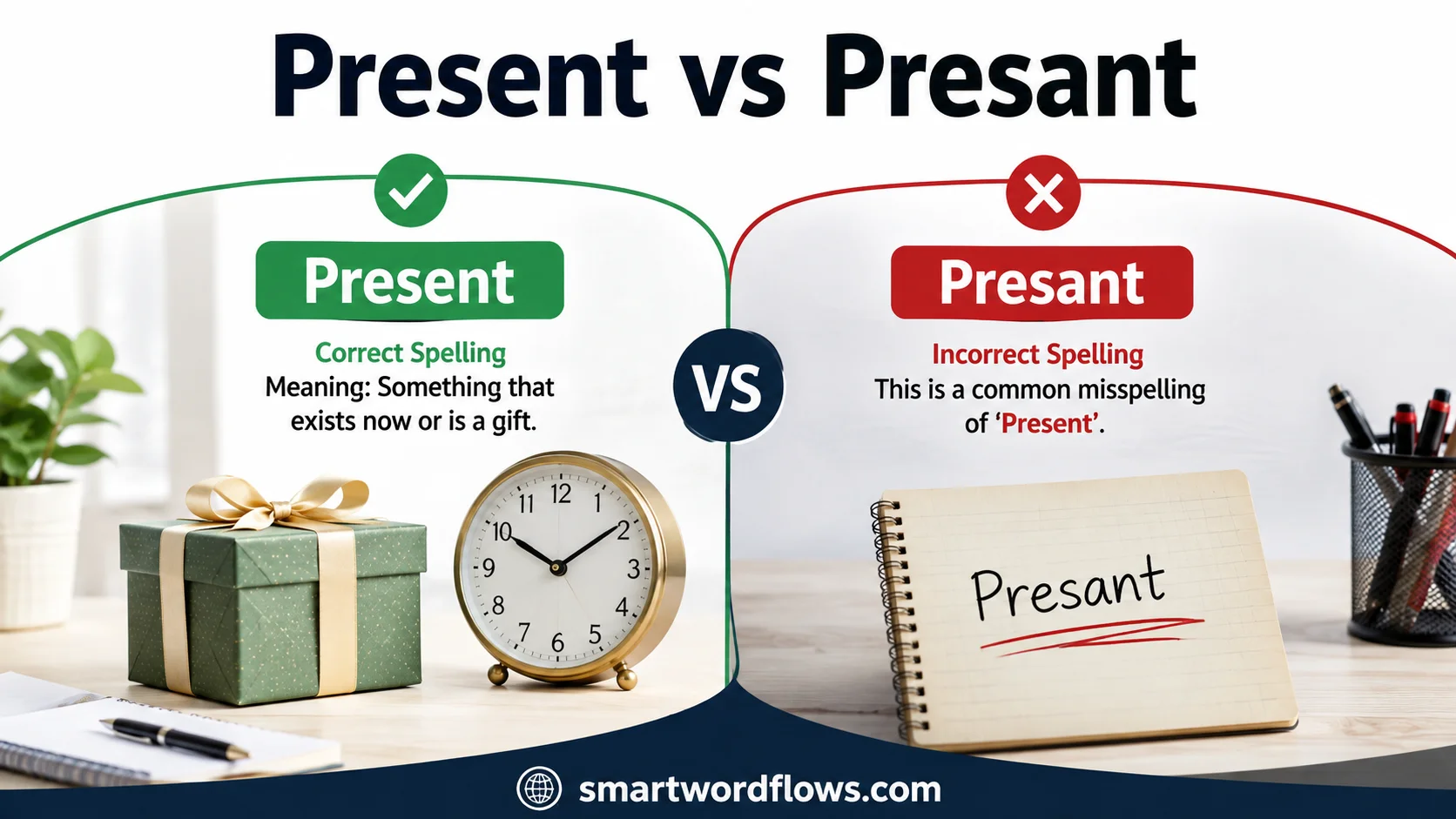

Present vs Presant: Differences and Correct Usage can help learners understand the difference between these two forms. Present is the correct spelling, while Presant is a common misspelling. The words may look identical when written quickly and can sound similar in everyday speech. This confusion often causes spelling mistakes in emails, assignments, business documents, and everyday writing. Learning the correct form improves English spelling, confidence, and accuracy, while helping writers avoid common mistakes and write clearer messages.
Present becomes easier to understand when learners study its correct usage and meanings. English has many homophones, including presence and presents, which are pronounced the same but have completely different meanings. These words can be confusing for beginning writers and new English learners. A simple understanding of spelling rules, pronunciation, and context can prevent unnecessary mistakes. Careful writing also reduces typing errors and improves professional communication, academic writing, and overall communication in real-world settings.
Quick answer
The correct spelling is present. The spelling presant is wrong in standard English.
Present can mean a gift, the current time, something that is here or included, or the act of showing or introducing something. Presant is a common spelling mistake and should not be used in formal or standard writing.
Comparison overview
| Word | Correct spelling | Standard meaning | Example |
| present | Yes | gift, now, here, show, introduce | She gave him a present. |
| presant | No | no standard meaning in English | This is a misspelling. |
The difference is simple, but the usage can be tricky because present changes meaning based on context. That is where many learners get confused.
Main differences between present vs presant
The biggest difference is that present is a real English word and presant is not.
Present is correct
Present is used in standard English every day. It appears in writing, speech, exams, books, business communication, and formal documents.
Presant is incorrect
Presant is not the accepted spelling in standard English. It is usually just a typing error or a spelling mistake caused by sound confusion.
Present has multiple meanings
This is another reason it matters. Present can work as a noun, adjective, or verb. The same spelling stays the same, but the meaning changes depending on how you use it.
Presant has no standard meaning
You will not use presant in correct academic or professional writing. If you see it, it usually needs correction.
What does present mean?
The word present is versatile. That is why it shows up in so many different sentences.
It can mean a gift.
It can mean the current moment.
It can mean being somewhere.
It can also mean to show, introduce, or offer something.
That range makes it useful, but it also makes it easy to misuse.
Present as a noun
The most familiar meaning of present is a gift.
When someone gives you a birthday present, they are giving you something without expecting payment.
Examples
- I bought my sister a present for her birthday.
- The child opened the present with excitement.
- They exchanged presents during the holiday season.
Useful note
In this meaning, present is usually countable. You can say one present, two presents, or many presents.
Common phrases
- birthday present
- Christmas present
- wedding present
- surprise present
These phrases are common in everyday English and sound natural in both speech and writing.
Present as a noun meaning the current time
Present can also refer to the time happening right now.
This meaning often appears in phrases like at present or in the present.
Examples
- At present, the company is hiring.
- The present is the only moment you can fully control.
- She is focused on the present instead of worrying about the past.
Why this matters
Many learners know “present” as a gift but forget that it also means now. This meaning is common in writing about life, planning, history, and personal growth.
Present as an adjective
As an adjective, present means something that is here, existing, or taking place now.
Examples
- All students were present in class.
- There were no signs of danger present at the scene.
- The present situation is difficult.
Simple distinction
Here, present does not mean a gift. It means something is available, visible, included, or happening.
Common phrases
- present situation
- present condition
- present members
- present time
This use is very common in schools, business, and formal English.
Present as a verb
As a verb, present means to show, give, offer, or introduce something.
Examples
- She will present her project tomorrow.
- The teacher presented the topic clearly.
- The manager presented the final report to the team.
Common contexts
You will often see this verb in:
- business meetings
- classroom presentations
- award ceremonies
- academic reports
- news coverage
Important pronunciation note
When present is a verb, the stress usually changes. That can confuse learners, because the spelling stays the same but the sound shifts.
Why people write presant by mistake
The spelling error presant happens for a few natural reasons.
Sound and spelling do not always match
English spelling is famous for being inconsistent. A word can sound one way and still be spelled another. That creates confusion.
The vowel sound can mislead writers
When people hear the word quickly, they may think the middle sound looks like a. That leads to presant instead of present.
Learners write what they hear
This is common in language learning. If a word is learned through speech before reading, the spelling may feel uncertain.
Similar sounding words create pressure
Words like present, pleasant, and peasant can mix in the mind. Even though they are different words, their sounds can blur for beginners.
Present pronunciation and stress
One reason learners struggle with present vs presant is pronunciation.
The spelling is present in every case, but the pronunciation can change based on grammar.
As a noun or adjective
- PREZ-uhnt
Examples:
- a birthday present
- present in class
As a verb
- pri-ZENT
Examples:
- to present an idea
- to present a plan
Why this matters
The pronunciation changes, but the spelling does not. That is the key point many people miss.
Simple memory tip
Think of it like a shirt that fits differently depending on how you wear it. The shirt is the same. The style changes. In the same way, the spelling stays the same while the stress shifts.
Comparison table with real usage
| Use | Correct form | Meaning | Example sentence |
| Gift | present | something given | He gave her a present. |
| Now | present | current time | Stay in the present. |
| Here / available | present | being in a place | Everyone was present. |
| Show / introduce | present | to display or offer | She will present the results. |
This table helps because it shows that one spelling works across several meanings.
Common mistakes with present
Let’s look at the mistakes people make most often.
Mistake: using presant instead of present
Wrong:
- I got you a presant.
Correct:
- I got you a present.
Mistake: mixing up present and presence
These two words are related, but they are not the same.
- Present can mean a gift, now, here, or to show.
- Presence means the state of being there.
Examples:
- His present was thoughtful.
- Her presence made the room calmer.
Mistake: confusing present with past
Some people use present when they really mean past.
Examples:
- Present: I work every day.
- Past: I worked yesterday.
That sounds basic, but it is one of the most common grammar mix-ups in beginner writing.
Read More: Maintained vs Maintenanced: Differences Explained
How to remember the correct spelling
You do not need a long rule to remember this. A few small memory tricks work better.
Use the word “sent” inside present
One easy trick is to spot sent inside present.
A gift is often something that has been “sent” to you.
That mental link can help the spelling stick.
Connect it to related words
Look at these related words:
- presentation
- presenter
- presenting
They all use the present spelling. That pattern is useful.
Say a short sentence in your head
Try this:
- “A present is a gift.”
- “I will present my idea.”
Short sentences are easier to remember than long grammar rules.
Write it in context
Spelling improves faster when you use the word in a full sentence instead of memorizing it alone.
Examples:
- She wrapped the present carefully.
- They will present the report tomorrow.
Real-world examples of present in different contexts
The best way to understand a word is to see it in action.
Everyday conversation
- Did you buy a present for Dad?
- Please stay present during the meeting.
- I want to live in the present.
School and college writing
- The teacher asked each student to present a short speech.
- The present tense is used for current actions.
- The present study examines reading habits.
Work and business writing
- The team will present the final proposal next week.
- At present, the market is unstable.
- Several risks are present in the current plan.
Formal and academic writing
- The author presents evidence to support the claim.
- The present findings suggest a strong connection.
- The panel was present during the discussion.
A simple case study
Let’s make this practical.
Case study: a student email
A student wrote this sentence in an email to a teacher:
- I will presant my project tomorrow.
The teacher understood the meaning, but the spelling looked careless.
The corrected version:
- I will present my project tomorrow.
Why the correction matters:
- It uses the standard spelling.
- It sounds professional.
- It gives the reader confidence in the writer.
This is a small change, but small mistakes can leave a big impression.
Another case study
Case study: social media caption
A small business posted:
- A special presant for our loyal customers.
That was meant to advertise a free item or bonus gift. But the spelling made the post look unpolished.
Better version:
- A special present for our loyal customers.
Or, even more natural:
- A special gift for our loyal customers.
This is a good example of how the right word choice can improve clarity and style at the same time.
Quick quote to remember
Correct spelling is a small detail that builds trust.
That idea matters because readers notice details, even when they do not say so out loud.
Synonyms and related words for present
Since present has several meanings, its synonyms depend on context.
When present means gift
- gift
- token
- offering
- surprise
- keepsake
When present means now
- current
- existing
- modern
- immediate
- today’s
When present means show or introduce
- display
- introduce
- demonstrate
- deliver
- offer
When present means being there
- available
- in attendance
- there
- here
- on site
Using the right synonym helps you avoid awkward repetition.
Why context matters so much
The word present is useful, but context decides its meaning.
That is why a sentence can look simple and still carry different ideas.
Compare these:
- She opened her present.
Here, present means a gift. - The present situation is difficult.
Here, present means current. - Please present your findings.
Here, present means to show or explain. - All staff were present.
Here, present means here or in attendance.
Without context, the word can feel confusing. With context, it becomes easy.
Tips for using present correctly in writing
Check the meaning first
Before you write the word, ask yourself what you mean.
Are you talking about a gift, time, attendance, or showing something?
Read the sentence out loud
Hearing the sentence can help you catch spelling or meaning mistakes.
Keep the spelling fixed
No matter how it sounds, the standard spelling stays present.
Use a dictionary when unsure
If you ever hesitate, a dictionary can confirm the correct spelling and meaning quickly.
Proofread slowly
Many spelling errors happen because people move too fast. Slowing down helps.
FAQs:
1. Is Present or Presant correct?
Present is the correct spelling in English. Presant is a common misspelling and should not be used in standard writing.
2. Why do people confuse Present and Presant?
People often get confused because both forms sound similar in everyday speech. However, English pronunciation does not always match spelling.
3. Is Presant an English word?
No. Presant is generally a spelling mistake rather than an accepted standard English word. The correct form is Present.
4. What is the difference between Present and Presence?
Present can have several meanings depending on context, while Presence refers to the state of being present or being in a particular place.
5. How can I avoid this spelling mistake?
Remember the correct spelling of Present, check your writing, and use spelling tools when needed. Regular practice can improve confidence and accuracy.
Conclusion:
Understanding Present vs Presant is simple once you remember that Present is the correct spelling, while Presant is a common spelling error. Although they may sound similar, correct English spelling depends on the written form, not only pronunciation. Using Present correctly can help learners avoid unnecessary spelling mistakes and make their writing clearer, more professional, and accurate.