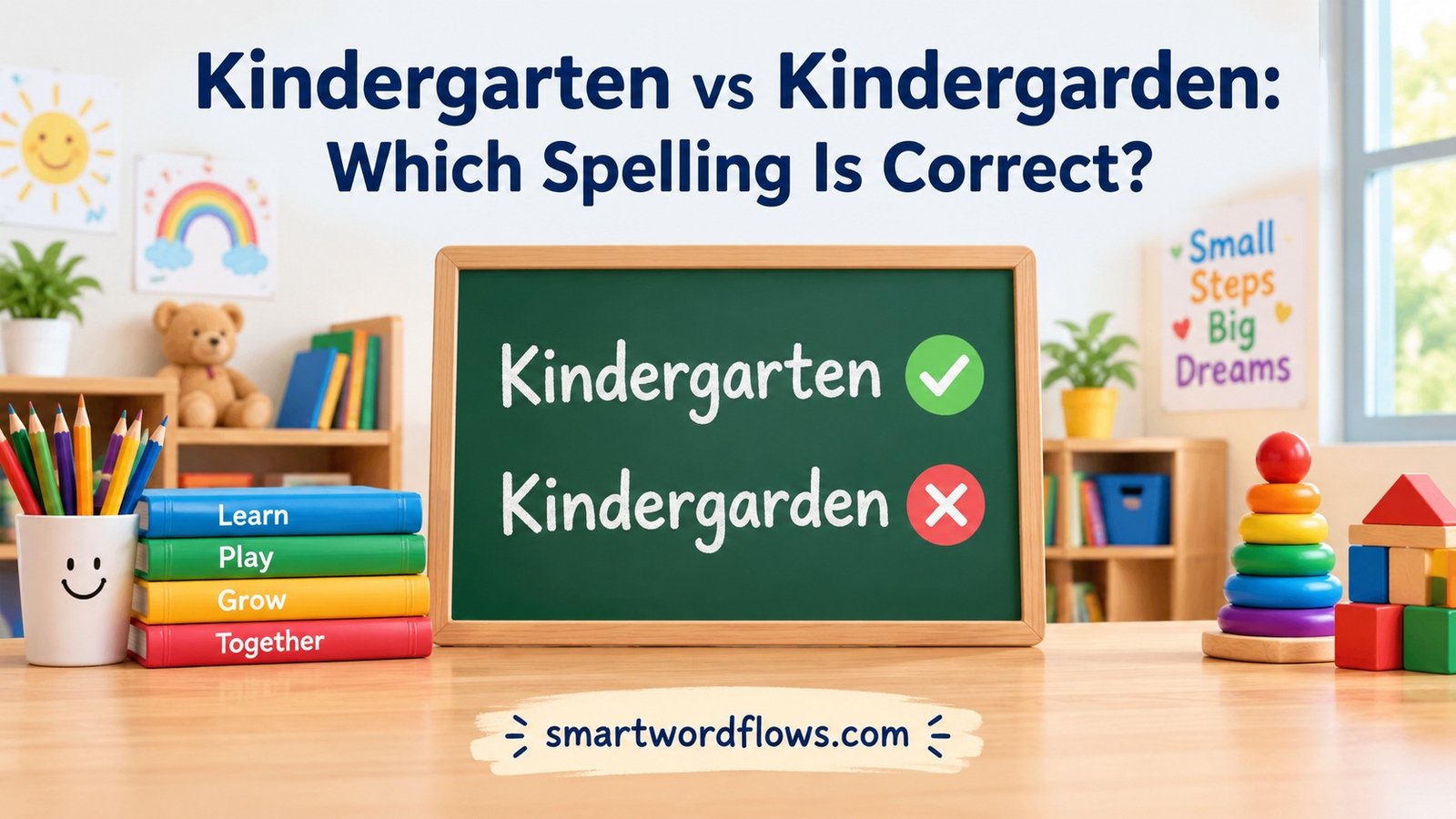

If you’ve ever typed Kindergarden and wondered if it’s right, you’re not alone; Kindergarten vs Kindergarden: Which Spelling Is Correct? explains this common misspelling clearly and shows why the two spellings can cause confusion when they look almost identical and have the same pronunciation when you say them out loud.
The correct spelling is Kindergarten, while Kindergarden is incorrect, often caused by typing errors, spelling mistakes, or an understandable mix-up between sound and spelling. The word comes from the German language, so its form may seem unusual to English learners, but dictionaries, schools, and educational organizations recognize Kindergarten as the correct form in standard writing. The difference becomes easier to remember in real situations: in the fall, parents complete school forms, while a teacher, student, or writer may use the word in emails, assignments, articles, academic writing, or professional writing. Its meaning and origin provide useful clues, while Autocorrect can flag the wrong spelling and remove some doubt by offering clarification.
The common error also appears in everyday conversations, everyday messages, and other forms of communication, so careful usage can strengthen writing skills, professional communication, and accurate English. An easy guide is to remember garten, not garden, when you spell Kindergarten. This simple method works as an easy tip for learners, writers, teachers, and students who want to avoid spelling errors and common grammar mistakes. The comparison answers the question directly: use the proper spelling, Kindergarten, and avoid the common mistake of writing Kindergarden. With regular learning, education, and practice, you can build confidence in modern English and use the word correctly as a parent or professional.
Quick Answer: Kindergarten or Kindergarden?
Kindergarten is the correct spelling.
Kindergarden is a misspelling of kindergarten in standard English when the word refers to the educational level or program.
The easiest way to remember the difference is to look at the final part of the word:
Kinder + Garten = Kindergarten
The word comes from German. Kinder means “children,” while Garten means “garden.” Friedrich Froebel, the German educator who developed the kindergarten concept, chose the name to describe an educational environment where children could grow much like plants in a garden.
Correct Example
My son will start kindergarten this fall.
Incorrect Example
My son will start kindergarden this fall.
The second sentence uses a familiar English word, garden, but that doesn’t make the spelling correct.
For standard American English, the correct form is kindergarten.
Comparison Overview
| Feature | Kindergarten | Kindergarden |
| Standard spelling | Correct | Incorrect |
| Meaning | An early level of formal education for young children | Intended as a spelling of kindergarten |
| Origin | German | Misspelling influenced by English “garden” |
| German elements | Kinder + Garten | Kinder + incorrect English substitution |
| Standard American English | Yes | No |
| Used in school documents | Yes | No |
| Used in formal writing | Yes | No |
| Common spelling error | No | Yes |
The distinction is straightforward. Kindergarten is the established English word. Kindergarden usually appears because writers unconsciously replace the unfamiliar German-looking ending -garten with the familiar English word garden.
That small spelling change creates an incorrect form.
Main Differences Between Kindergarten vs Kindergarden
The biggest difference between kindergarten vs kindergarden isn’t meaning. In most cases, someone who writes kindergarden intends exactly the same thing as someone who writes kindergarten.
The difference lies in standard spelling.
Kindergarten Is the Correct Word
Kindergarten is the standard spelling used in English dictionaries, educational writing, school documents, and everyday American English.
For example:
- Kindergarten teacher
- Kindergarten classroom
- Kindergarten student
- Kindergarten curriculum
- Kindergarten readiness
- Kindergarten enrollment
- Kindergarten school year
These expressions all use kindergarten.
Kindergarden Is a Spelling Mistake
Kindergarden isn’t the standard spelling for the educational term.
The mistake often happens because English speakers already know the word garden. When they hear kindergarten, the final sound can encourage them to connect the word with garden.
It’s an understandable mistake. Still, understandable doesn’t mean correct.
In formal writing, use kindergarten.
What Does Kindergarten Mean?
Kindergarten refers to an early level of schooling for young children. In the United States, it commonly comes before first grade and follows preschool or prekindergarten.
The exact organization of kindergarten varies by state, school district, and educational system. In many US schools, children enter kindergarten at around age five, although enrollment rules differ.
Kindergarten isn’t simply a place where children spend time before “real school” begins. It introduces important academic and social foundations.
Children may develop skills involving:
- Early reading and phonics
- Letter recognition
- Basic writing
- Counting and early mathematics
- Listening and communication
- Classroom routines
- Cooperation
- Problem-solving
- Fine-motor skills
- Social interaction
- Following instructions
- Independent classroom behavior
The balance between academic instruction and play-based learning varies from one educational setting to another.
Kindergarten in American English
In American English, kindergarten commonly refers to the first formal school year of elementary education.
For example:
Maya learned how to read simple words in kindergarten.
Another example:
The kindergarten teacher organized a science activity about plants.
The word can refer to the school level, the class, or the broader educational program depending on context.
What Does Kindergarden Mean?
Kindergarden is generally a misspelling of kindergarten.
A person who writes kindergarden usually understands the intended meaning. The problem is simply the spelling.
The error becomes particularly easy to make because the word garden is familiar to English speakers.
Compare these forms:
- kindergarten — correct
- kindergarden — incorrect
- garden — correct English word, but not the ending used in kindergarten
This distinction matters because kindergarten is a borrowed word. English doesn’t automatically change every foreign word to match familiar English spelling patterns.
Why Does Kindergarden Look So Natural?
The human brain often fills unfamiliar patterns with familiar ones.
Consider the word:
kindergarten
The ending -garten may look unusual to an English speaker. Meanwhile, garden is an extremely familiar word.
That creates an easy mental substitution:
-garten → -garden
Unfortunately, the substitution produces the wrong spelling.
It’s similar to learning other borrowed words whose spellings don’t follow the patterns you expect. Once you know the origin, the unusual spelling becomes much easier to remember.
Why Is Kindergarten Spelled With “-garten”?
The spelling becomes much clearer when you look at the word’s German origin.
Kindergarten comes from German:
- Kinder = children
- Garten = garden
Together, Kindergarten literally means “children’s garden.”
That phrase reflects the educational philosophy behind the original concept. Friedrich Froebel believed children needed an environment in which they could develop naturally through activities, play, creativity, and guided learning.
The word wasn’t created from the English words kind and garden. That’s an important point.
Instead, it came from German Kindergarten.
So the correct spelling preserves the German element Garten.
Kinder + Garten = Kindergarten
Think of the word as two pieces:
Kinder + Garten
Not:
Kinder + garden
That one distinction solves most spelling confusion.
If you remember that the original word uses German Garten, you’ll have a reliable way to avoid the kindergarden mistake.
Kindergarten Word Origin and History
The modern concept of kindergarten is closely associated with Friedrich Froebel, a German educator born in 1782.
Froebel developed an educational approach that emphasized children’s development through activity, play, creativity, nature, and hands-on learning. In 1837, he established an educational institution in Bad Blankenburg in the German state of Thuringia.
He later used the term Kindergarten, meaning “children’s garden,” to describe his educational concept.
The metaphor was deliberate. Froebel viewed children as developing beings who needed care and suitable conditions for growth, much like plants in a garden.
His approach influenced early childhood education far beyond Germany.
The word kindergarten eventually entered English and became firmly established in American educational vocabulary.
From German Concept to American School Term
The kindergarten idea spread internationally during the nineteenth century.
In the United States, early kindergarten programs appeared during the 1850s. Elizabeth Peabody became an important advocate for kindergarten education in the US, helping introduce and promote the approach.
Over time, kindergarten became integrated into the American school system.
Today, the word has a much more specific everyday meaning in the United States. Most Americans immediately associate kindergarten with a formal educational year for young children.
The original “children’s garden” metaphor remains visible in the spelling.
Kindergarten Pronunciation
The American English pronunciation of kindergarten is commonly represented as:
KIN-der-gar-ten
The pronunciation can vary somewhat among speakers, particularly in how strongly each syllable is pronounced.
The spelling sometimes causes confusion because English speakers may hear the ending and associate it with the familiar word garden. That association can contribute to the incorrect spelling kindergarden.
However, pronunciation shouldn’t determine spelling.
English contains many words whose pronunciation doesn’t provide a perfect guide to their written form. The safest approach here is to remember the word’s established spelling:
kindergarten
A Simple Pronunciation Practice
Break it into parts:
kin + der + gar + ten
Then say the complete word naturally:
kindergarten
You don’t need to pronounce the German word exactly as a German speaker would. In American English, the word has its own established pronunciation.
Why Do People Spell Kindergarten as Kindergarden?
Several factors can explain the common spelling mistake.
The Word Garden Is Familiar
The biggest reason is probably the familiar English word garden.
When people see or hear kindergarten, they may unconsciously connect it with a garden.
That connection isn’t completely random. The original German word really does mean “children’s garden.”
Ironically, understanding the meaning can sometimes contribute to the spelling mistake if someone translates the German ending directly into English.
The German Ending Looks Unfamiliar
The sequence -garten isn’t common in ordinary English vocabulary.
When a word contains an unfamiliar pattern, writers often replace it with something they already recognize.
That’s exactly what happens when -garten becomes -garden.
Pronunciation Can Contribute
The pronunciation doesn’t always make the spelling obvious.
Someone who has heard the word many times but rarely seen it written might reasonably reconstruct the ending as garden.
This is especially common when people learn words through conversation before encountering them in writing.
Repetition Can Reinforce the Error
Once someone repeatedly writes kindergarden, the incorrect form can begin to look normal.
That happens with many spelling mistakes. Familiarity isn’t proof of correctness.
A useful habit is to pause whenever a word looks familiar but contains an unusual spelling pattern. Checking a reliable dictionary can prevent the mistake from becoming a habit.
Read More:Receive vs Recieve: Which Spelling Is Correct?
Common Mistakes With Kindergarten
The spelling problem isn’t limited to the word itself. Related expressions can also cause confusion.
Kindergarten Class
Kindergarten class is the standard expression.
Example:
The kindergarten class visited the school library.
Avoid changing kindergarten to kindergarden.
Kindergarten Teacher
The correct phrase is:
She works as a kindergarten teacher.
This refers to a teacher who works with kindergarten students.
Kindergarten Student
A child enrolled in kindergarten can be called a kindergarten student.
Example:
Every kindergarten student received a folder.
Kindergartener
Kindergartener is a common American English word for a child who attends kindergarten.
Example:
Her five-year-old is a kindergartener.
The word contains kindergarten as its base:
kindergarten + -er = kindergartener
It doesn’t become kindergardener.
Kindergarten vs Preschool
Although people sometimes use the terms loosely, preschool and kindergarten aren’t necessarily the same thing.
Preschool generally refers to educational programs for children before they enter kindergarten or another formal school level.
Kindergarten, in the US, is commonly part of elementary education.
| Feature | Preschool | Kindergarten |
| Typical position | Before kindergarten | Usually before first grade |
| Typical age | Often ages 3–4, depending on program | Often around age 5 |
| School status | Varies by program | Commonly part of elementary school |
| Main focus | Early development and preparation | Academic and social foundations |
| Structure | Varies considerably | Usually follows a school-year structure |
These age ranges aren’t universal. State laws, school districts, private programs, and individual enrollment policies can differ.
The key point is that kindergarten has a specific educational role in the US school system.
Kindergarten vs Pre-K
Pre-K, short for prekindergarten, generally describes an educational program that prepares children for kindergarten.
That makes the distinction useful:
Preschool → Pre-K → Kindergarten → First Grade
However, not every child follows this exact sequence. Some children attend preschool without pre-K, while others enter kindergarten through different early-childhood arrangements.
Pre-K and kindergarten can also share teaching methods and learning goals. Both may emphasize early literacy, numeracy, social development, and classroom routines.
The important difference is their position within the educational sequence.
Kindergarten vs Kindergarden in a Sentence
Seeing the words in context makes the difference easier to remember.
Correct Examples
My daughter starts kindergarten next month.
The kindergarten teacher read a story to the class.
He made new friends during his first week of kindergarten.
The school offers a full-day kindergarten program.
Parents attended a kindergarten orientation before the school year began.
She is a kindergartener this year.
Incorrect Examples
My daughter starts kindergarden next month.
Correction: My daughter starts kindergarten next month.
The kindergarden teacher welcomed the children.
Correction: The kindergarten teacher welcomed the children.
He is excited about kindergarden.
Correction: He is excited about kindergarten.
The meaning remains obvious in the incorrect examples. Nevertheless, standard writing requires kindergarten.
Is Kindergarden Ever Correct?
When referring to the educational level, kindergarden isn’t the standard spelling.
There is one useful distinction, though. A business, organization, product, website, username, or other proper name could deliberately use an unusual spelling.
For example, someone could create a company called “Kindergarden Academy.” The name itself might legally use that spelling.
That doesn’t make kindergarden the standard spelling of the educational term.
A proper name can have an unusual spelling. Standard vocabulary follows established spelling conventions.
Kindergarten Spelling Trick: How to Remember It
The simplest memory trick comes from the word’s German origin.
Remember:
Kinder + Garten = Kindergarten
Think of Garten as the key.
If you replace Garten with the English word garden, you get the common mistake:
Kinder + garden = kindergarden ❌
Keep the original ending:
Kinder + Garten = kindergarten ✅
Another useful memory sentence is:
Children grow in a Kindergarten, not a Kindergarden.
The sentence connects the word’s meaning with its original spelling.
A Fast Spelling Test
Whenever you’re unsure, ask yourself:
Does kindergarten end in “garden”?
No.
It ends in:
-garten
So the correct spelling is:
K-I-N-D-E-R-G-A-R-T-E-N
Not:
K-I-N-D-E-R-G-A-R-D-E-N
That one letter can make the difference between standard spelling and a common typo.
Case Study: Why the Wrong Spelling Feels Right
Imagine a parent hears a teacher say:
“Your child will begin kindergarten in September.”
The parent has heard the word dozens of times but hasn’t seen it written often.
Later, while writing an email, the parent types:
“My daughter is excited to start kindergarden.”
Why did the mistake happen?
The parent likely connected the final sound with the familiar English word garden. The spelling feels logical because the original German meaning actually involves a garden.
Now imagine the parent learns that Kindergarten comes from German Kinder + Garten.
Suddenly, the unusual spelling makes sense.
The lesson isn’t simply “memorize the spelling.” Understanding the word’s structure gives you a stronger memory hook.
Why Correct Spelling Matters
A single spelling mistake usually doesn’t prevent readers from understanding your meaning. Still, correct spelling matters in situations where accuracy and professionalism count.
Use kindergarten when writing:
- School applications
- Teacher communications
- Resumes
- Educational reports
- Academic assignments
- News articles
- Website content
- Business documents
- Parent-teacher correspondence
- Official forms
In casual texting, a reader may understand kindergarden immediately. In formal writing, there’s little reason to use the incorrect form when the correct spelling is easy to remember.
Kindergarten in Everyday American English
The word appears in many common expressions.
Common Kindergarten Phrases
- kindergarten teacher
- kindergarten student
- kindergarten classroom
- kindergarten curriculum
- kindergarten readiness
- kindergarten enrollment
- kindergarten program
- kindergarten graduation
- kindergarten teacher assistant
- kindergarten activities
- kindergarten learning
- kindergarten school year
Notice the same spelling in every expression.
Once you remember kindergarten, you don’t need a separate spelling rule for each phrase.
Facts About Kindergarten
Here are several useful facts that put the word into context:
- The term kindergarten comes from German.
- Kinder means “children” in German.
- Garten means “garden” in German.
- The word is commonly translated literally as “children’s garden.”
- The kindergarten concept is strongly associated with German educator Friedrich Froebel.
- Froebel established an early kindergarten institution in 1837 in Bad Blankenburg.
- Kindergarten became an established part of American education over time.
- In the US, kindergarten commonly comes before first grade.
- Many children enter kindergarten at approximately five years old, although enrollment rules vary.
- Kindergarden is a common misspelling rather than the standard name of the educational level.
For historical background, the Encyclopaedia Britannica entry on Friedrich Froebel provides additional information about the educator and his educational ideas.
Kindergarten and the “Children’s Garden” Metaphor
The word’s metaphor is worth understanding because it explains why the spelling looks unusual.
Froebel didn’t simply choose a random German compound. The “garden” idea represented his view of childhood development.
A garden requires suitable conditions. Plants need space, care, sunlight, water, and time to grow. Froebel’s educational philosophy similarly emphasized giving children opportunities to develop through meaningful activities and guided experiences.
That doesn’t mean kindergarten literally refers to a garden.
It refers to an educational environment for children.
The metaphor survived in the word even as kindergarten became a formal part of school systems.
FAQs
Is “Kindergarten” or “Kindergarden” correct?
Kindergarten is the correct standard spelling. Kindergarden is a common spelling mistake and isn’t the standard English form.
What does kindergarten mean?
Kindergarten refers to a school or educational program for young children, usually before they begin formal primary or elementary school.
Why do people spell kindergarten as kindergarden?
People often write kindergarden because “garden” is a familiar English word, while kindergarten comes from German. The similar pronunciation can also cause confusion.
Is kindergarten used in American and British English?
Yes. Kindergarten is used in both American and British English, although the age range and educational system associated with the term can vary by country.
How can I remember the correct spelling of kindergarten?
Remember that the correct word contains “garten”, not “garden.” Think of the original German word Kindergarten, meaning “children’s garden.”
Conclusion
Kindergarten is the correct spelling, while kindergarden is a common misspelling. Although the two forms look and sound similar, only kindergarten is the standard word used in English. Understanding this difference can help you avoid spelling mistakes in school assignments, professional writing, emails, and everyday communication.
If you’re unsure, simply remember the ending “-garten” rather than “-garden.” Learning the correct spelling becomes easier when you connect the word with its German origin and meaning. Whether you’re a student, parent, teacher, or English learner, using kindergarten consistently will make your writing clearer and more accurate.




1 thought on “Kindergarten vs Kindergarden: Which Spelling Is Correct?”