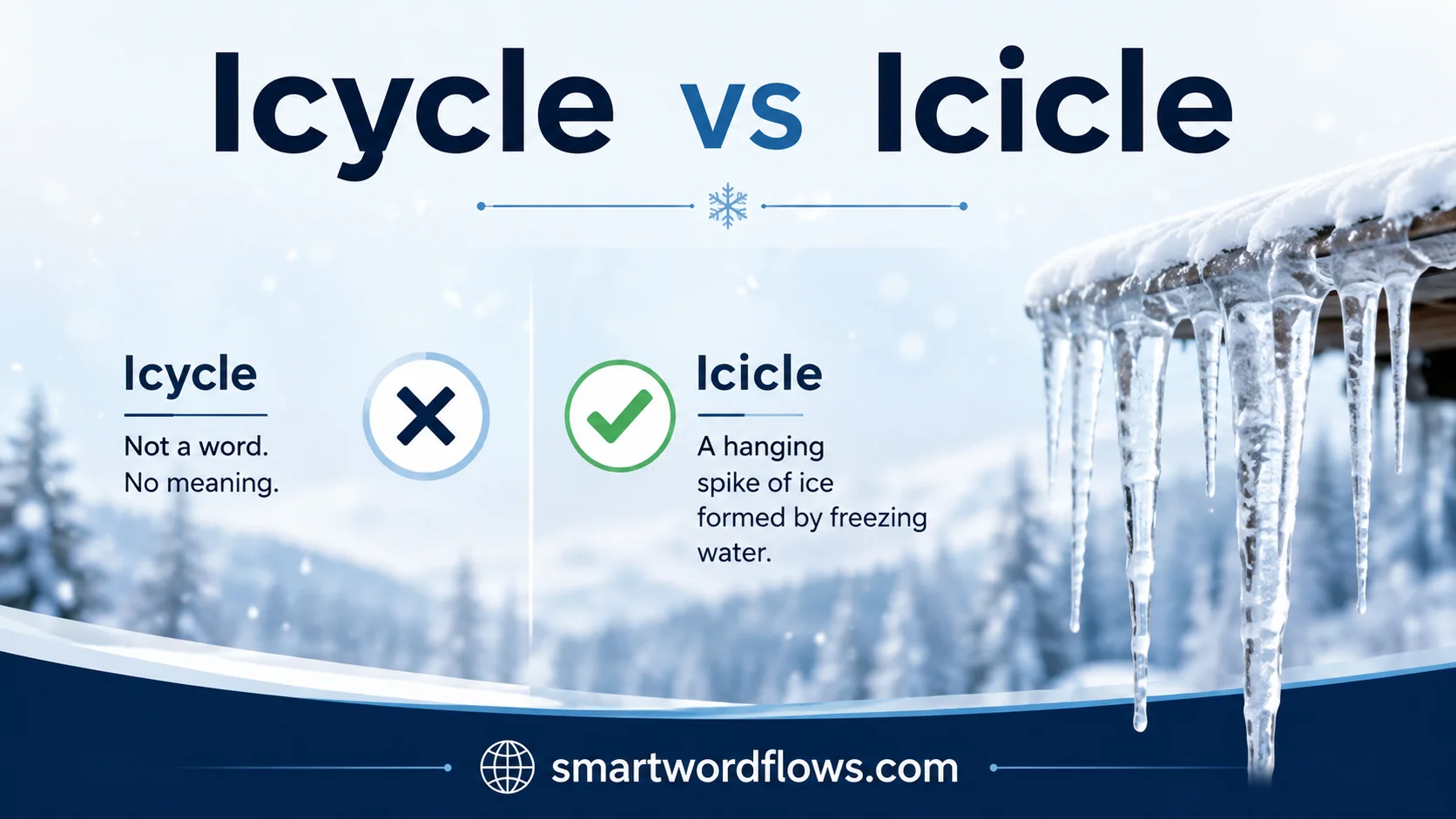

Icycle vs Icicle Differences and Correct Usage explains why icicle is the correct spelling and icycle is a common misspelling. Have you ever seen someone write icycle and wondered if it was the correct English word? The confusion often comes from pronunciation, typing habits, or assumptions about spelling. Although both forms may look plausible, only icicle is accepted in standard English. Understanding this difference helps learners improve accuracy, clarity, and confidence when using the word in everyday writing.
An icicle is a pointed piece of ice formed when melting water freezes again. Its scientific formation is simple, but its spelling can cause confusion. Using the correct form is important in a school assignment, email, blog post, or other professional writing. A useful trick is to remember that icicle starts with Ic, not Icycle. Dictionaries, real-world examples, and regular practice can help you discover the mistake and confidently remember the right spelling.
Quick Answer
Icicle is the correct spelling. Icycle is not the standard English word for a hanging piece of ice.
A simple way to remember it is this:
- Icicle = a frozen point of ice hanging down
- Icycle = usually a misspelling, typo, or a creative name
Here is the shortest possible rule:
If you mean frozen ice hanging from a roof, branch, or ledge, use icicle.
Comparison Overview
Here is a clean side-by-side look at the Icycle vs Icicle Differences and Correct Usage:
| Feature | Icicle | Icycle |
| Standard spelling | Yes | No |
| Dictionary word | Yes | Not as the frozen object |
| Meaning | A hanging piece of ice | Usually a misspelling |
| Part of speech | Noun | Not standard in this meaning |
| Correct in formal writing | Yes | No |
| Example sentence | An icicle hung from the roof. | The form should be avoided. |
A few quick facts help make the difference clearer:
| Fact | Icicle |
| Number of letters | 7 |
| Syllables | 3 |
| Pronunciation | /ˈaɪ.sɪ.kəl/ |
| Common part of speech | Noun |
| Main use | Describes frozen hanging ice |
Main Differences Between Icycle vs Icicle Differences and Correct Usage
The biggest difference is simple: one is correct and one is not in standard English. But the confusion goes deeper than spelling alone. Let’s break it down in a way that actually helps you use the word correctly.
Spelling
Icicle is spelled with ice at the front and -cle at the end.
Icycle swaps the middle letters and looks like it should be connected to “cycle.” That is why many people make the mistake. The brain sees a familiar pattern and fills in the rest.
The correct form is:
- i-c-i-c-l-e
The incorrect form is:
- i-c-y-c-l-e
That one small change changes the whole word.
Meaning
Icicle has a real meaning in English. It refers to a pointed piece of ice hanging from a surface.
Icycle does not have that same accepted meaning in standard English. If you use it in place of icicle, most readers will see it as an error.
Pronunciation
The pronunciation also adds to the confusion.
- Icicle sounds like EYE-si-kul
- Some people read icycle as if it should sound like eye-cycle
That is where the mistake grows. The word may look like “cycle,” but it is not built from that root in this context.
Correct usage
Use icicle in:
- essays
- articles
- reports
- captions
- signs
- schoolwork
- professional writing
Avoid icycle unless you are using it as a name, brand, or creative label that is unrelated to the frozen object.
What Icicle Means
An icicle is a long or pointed piece of ice that hangs down from a surface. You often see them under roofs, on tree branches, on gutters, or along cliffs after freezing weather.
It usually forms when water drips slowly and freezes layer by layer. Over time, the frozen water grows into a hanging shape. In winter, icicles can look beautiful. They can also be dangerous if they become heavy and fall.
How Icicles Form
The process is easy to understand:
- Snow or ice begins to melt slightly
- Water drips downward
- The air is cold enough to freeze the water again
- More drops freeze on top of the old layer
- A hanging shape slowly builds
That is why icicles often appear after a freeze-thaw cycle. A warm patch or a little sunlight starts the drip. Then cold air turns it back into ice.
Everyday facts about icicles
| Detail | Description |
| Common location | Roof edges, tree branches, gutters |
| Main season | Winter |
| Formation method | Repeated freezing of dripping water |
| Shape | Thin, pointed, hanging |
| Risk | Can fall and cause injury |
A simple example
If water drips from a roof all night and temperatures stay below freezing, an icicle can form by morning. That is why you often see them after a cold, wet night.
Why People Write Icycle
People usually do not confuse these words because they are careless. They confuse them because the spelling is unusual.
The word looks familiar
Many English words end in -cycle:
- bicycle
- tricycle
- cycle
So when people hear icicle, their mind may push it toward the more familiar pattern. That is a natural mistake.
The pronunciation is not obvious
The spoken form does not match the visual pattern neatly. A reader may hear the word and assume it should follow the logic of “cycle.” English does that a lot. It sets traps for the eye and ear.
Typing errors happen fast
A lot of misspellings come from speed, not ignorance. Someone types quickly and writes icycle by accident. Auto-correct may not always catch it, especially if the word appears in a title, username, or unusual phrase.
Creative naming can blur the line
Sometimes people use icycle as a brand name, product name, or username. That does not make it the standard word for frozen hanging ice. It only means the word is being used creatively in a different context.
Correct Usage of Icicle in Sentences
Using the right word is easy once you know the pattern. Here are clear examples in simple, natural English.
Everyday examples
- A long icicle hung from the edge of the roof.
- She pointed at the icicle and smiled.
- The cold morning air made the icicles sparkle.
Formal examples
- The storm created dangerous icicles along the building’s exterior.
- Heavy icicles can fall without warning during a thaw.
- Maintenance crews removed the icicles before the walkway reopened.
Descriptive examples
- The icicle looked like glass.
- Thin icicles lined the fence after the snowfall.
- One sharp icicle broke loose and hit the ground.
Wrong vs correct usage
| Incorrect | Correct |
| The roof had many icycles. | The roof had many icicles. |
| An icycle hung from the tree. | An icicle hung from the tree. |
| The window was covered with icycles. | The window was covered with icicles. |
A good habit is to pause for one second before you write it. Ask yourself, “Am I talking about frozen hanging ice?” If yes, icicle is the word you want.
A Small Case Study on Correct Usage
Here is a practical example that shows why this matters.
A student wrote a winter paragraph for class and used icycle three times. The meaning was obvious, so the teacher understood the sentence. Still, the spelling was marked wrong. Why? Because in English, correct spelling matters even when the reader can guess the meaning.
After the correction, the student rewrote the paragraph like this:
- Original: The icycles on the roof looked dangerous.
- Corrected: The icicles on the roof looked dangerous.
That small change made the writing look cleaner and more credible.
This happens in everyday life too. A job application, article draft, product description, or social media post can all lose polish because of one wrong word. It is not about perfection. It is about showing care.
Why the Correct Spelling Matters
Some people think spelling details are minor. In reality, they do more work than most readers realize.
It improves clarity
The right spelling removes hesitation. A reader does not stop to wonder whether the word is real.
It builds trust
Clean writing makes your message feel more reliable. That matters in school, business, publishing, and online writing.
It makes your writing look polished
A correct word is like a clean shirt before a meeting. It may not be the whole outfit, but it changes the impression.
It reduces distraction
When a reader notices a misspelling, attention shifts away from your message. The point gets less space. The word starts stealing the show.
Here is a quote that sums it up well:
Correct spelling is not decoration. It is part of clear thinking.
Read This: Present vs Presant: Differences and Correct Usage
How to Remember the Correct Spelling
If icicle keeps slipping away from memory, use a simple trick.
Think of “ice” first
The word begins with ice because it is made of ice. That is the easiest anchor.
Break it into parts
Say it like this:
- ice
- icle
That helps you remember the shape and meaning together.
Spot the false pattern
If you catch yourself writing cycle, stop. Ask whether you are talking about a hanging frozen object or a rotating process. If it is the frozen object, the word is icicle, not icycle.
Use a memory sentence
Try this:
- Ice hangs. Icicle stays.
- Ice is the root. Icicle is the word.
Short memory lines often work better than long explanations.
Related Words and Helpful Context
Understanding icicle gets easier when you compare it with nearby words.
| Word | Meaning | Connection |
| Ice | Frozen water | Base word |
| Frost | Thin layer of frozen moisture | Related cold condition |
| Snow | Frozen precipitation | Winter weather |
| Freeze | To turn into ice | Formation process |
| Thaw | To melt | Opposite process |
| Glacier | Large mass of ice | Larger frozen structure |
These words all belong to the same cold-weather family. Icicle sits in the middle of that family. It is smaller than a glacier and more specific than ice. It names one visible shape that forms naturally in winter.
Common Mistakes to Avoid
Even when people know the correct spelling, they still slip up in a few predictable ways.
Mistake: assuming cycle must be part of the word
That assumption is wrong here. The word is not built from “cycle.”
Mistake: using the wrong plural
The plural is icicles, not icycles.
Mistake: overthinking the spelling
Sometimes people know the word is related to ice, but they keep changing the middle letters. That only makes the mistake more likely.
Mistake: trusting autocorrect too much
Autocorrect helps, but it does not replace knowing the correct word yourself.
Icicle in Real Writing
You will see icicle in many kinds of writing.
In weather reports
Weather writing often uses icicle when describing winter hazards or frozen buildup.
In fiction
Writers use icicle to create a cold, sharp, or quiet mood.
In educational writing
Teachers and textbooks use it when explaining winter weather or frozen water.
In casual conversation
People use it in everyday speech without thinking much about the spelling. That is usually where the spelling mistake starts.
A Deeper Look at Style and Usage
The difference between icycle and icicle is not just about correctness. It is also about style.
A polished writer does not leave small errors hanging around. Readers notice them. Even if they do not say anything, they feel the difference.
When you choose icicle, you show that you know the standard form. That matters in:
- blog posts
- articles
- essays
- email drafts
- captions
- product descriptions
- study materials
One correct word can strengthen the whole piece.
FAQs:
1. Is “icycle” the correct spelling?
No. Icicle is the correct English spelling. Icycle is a common spelling mistake.
2. Why do people write “icycle”?
The mistake often happens because of pronunciation, typing habits, or confusion about how the word is spelled.
3. What does “icicle” mean?
An icicle is a pointed piece of ice that forms when melting water freezes.
4. Is “icycle” accepted in standard English?
No. Icicle is the accepted form in standard English dictionaries and normal writing.
5. How can I remember the correct spelling?
Remember that the word begins with “ic” and is spelled icicle, not icycle.
Conclusion
Icicle is the correct spelling, while icycle is a common misspelling. Understanding the pronunciation, spelling, and meaning can help you avoid this mistake. Whether you use the word in an email, school assignment, blog post, or everyday writing, choosing icicle will make your writing more accurate, clear, and professional.