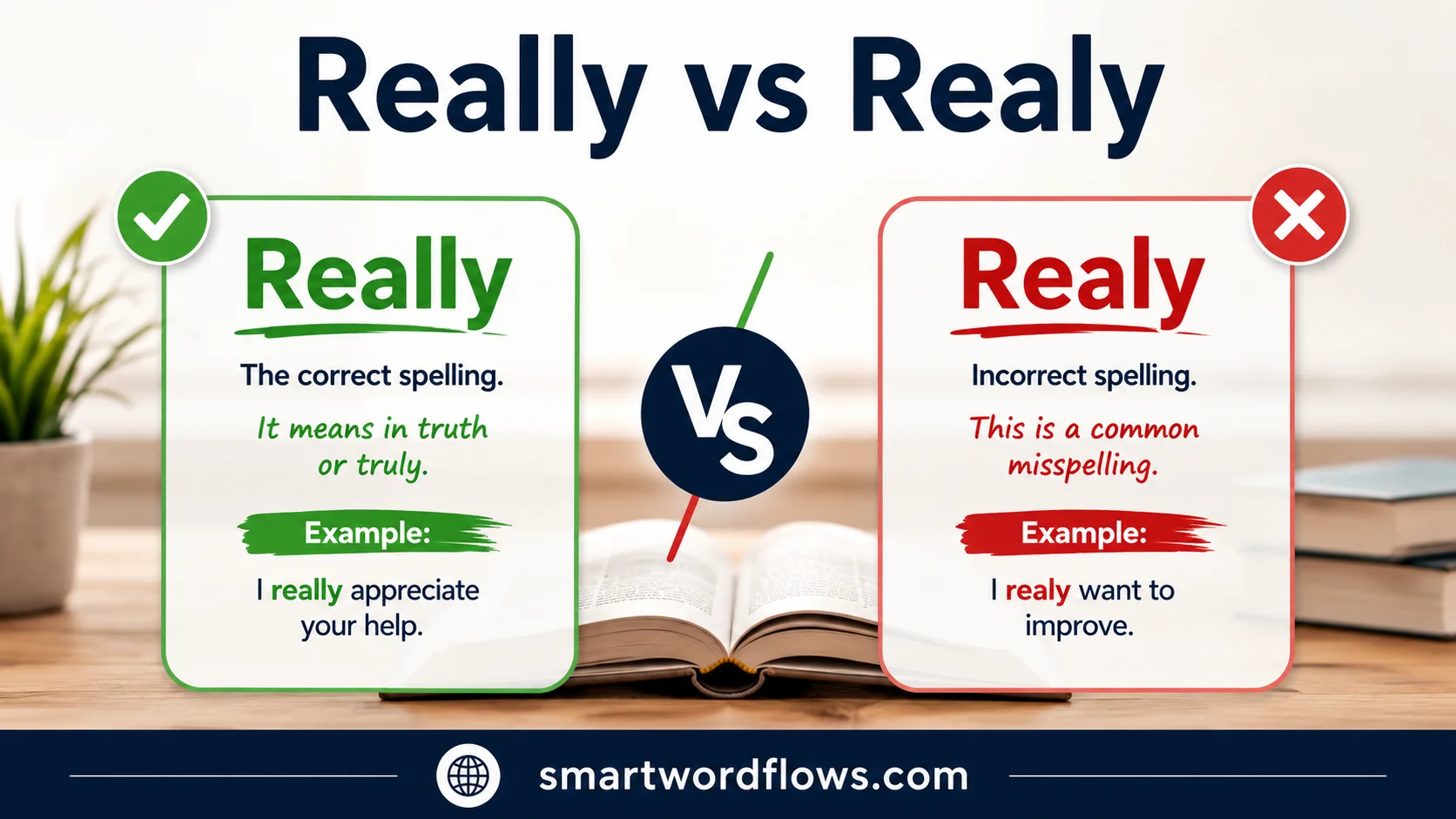

Really vs Realy is a common spelling confusion in English writing. The correct word is really, while realy is an incorrect spelling. The main difference is one letter, because realy has a missing l. This small mistake can affect clarity and credibility in emails, essays, and professional writing. Both English learners and native speakers may misspell this word during fast typing or when typing quickly.
Really is an adverb used to emphasize the truth, extent, or sincerity of something. In standard English, really follows normal English spelling and grammar rules. If you wonder which is correct, realy or really, remember that really has two l letters. This simple pattern can help people understand the correct spelling and avoid the spelling error. Practical tips, such as checking real-world examples, can help eliminate this mistake in the future.
Quick Answer
Really is the correct spelling. Realy is incorrect in standard English.
| Spelling | Correct? | Meaning | Example |
| really | Yes | Actually, truly, very, or very much | “I really enjoyed the movie.” |
| realy | No | Misspelling of “really” | “I realy enjoyed the movie.” |
The easiest way to remember it is:
real + ly = really
So if you’re writing the adverb, keep both ls:
R-E-A-L-L-Y
Merriam-Webster lists really as an adverb and gives meanings including “in reality,” “actually,” “truly,” and “very.” Cambridge likewise defines really as an adverb that can express truth, certainty, emphasis, or a high degree of something.
Comparison Overview
The difference between really vs realy is straightforward because only one form is standard English.
| Feature | Really | Realy |
| Standard English spelling | Yes | No |
| Dictionary word | Yes | No as the standard spelling |
| Part of speech | Adverb | Not a standard English word |
| Common meaning | Actually, truly, very, very much | None in standard English |
| Used in formal writing | Yes | No |
| Used in casual writing | Yes | No |
| Example | “She is really happy.” | “She is realy happy.” |
There is no meaningful difference in definition between the two forms because realy isn’t a standard alternative to really. When you see realy in ordinary English text, it is generally an accidental omission of the second l.
That distinction matters. A spelling mistake doesn’t become correct simply because readers understand what the writer meant.
Main Differences Between Really and Realy
The main difference is correct spelling.
Really Is the Correct Word
Really is a standard English adverb. You can use it to strengthen an adjective, emphasize a verb, express truth, or react to something surprising.
For example:
- “The food is really good.”
- “I really appreciate your help.”
- “Did that really happen?”
- “Really? You finished already?”
These are all normal uses of the word.
Realy Is a Spelling Error
Realy drops one l from the standard spelling.
For example:
- “I realy like this book.”
- “I really like this book.”
The first sentence is understandable, but the spelling is incorrect.
This is similar to accidentally writing definately instead of definitely or seperate instead of separate. The intended word remains obvious, but the written form doesn’t meet standard spelling conventions.
The Difference Is Not a Difference in Meaning
You shouldn’t treat realy and really as two words with different meanings.
They aren’t.
The standard word is really. The other form is a misspelling.
What Does “Really” Mean?
Really has several closely related uses. Its meaning depends on the sentence around it.
According to Merriam-Webster, the word can mean “in reality,” “actually,” “truly,” or “very.” Cambridge also identifies uses connected with truth, certainty, emphasis, and surprise.
Really Meaning “Actually”
Sometimes really tells the reader that something is true in reality.
For example:
- “What really happened?”
- “She didn’t really understand the question.”
- “He isn’t really angry.”
- “I don’t really know the answer.”
Here, really points toward the actual situation rather than an appearance or assumption.
Consider this example:
“He looks angry, but he isn’t really upset.”
The word helps distinguish appearance from reality.
Really Meaning “Very”
In everyday English, really frequently works as an intensifier.
For example:
- “That was really difficult.”
- “She’s really talented.”
- “The coffee is really hot.”
- “This book is really interesting.”
In these sentences, really increases the strength of the adjective.
“The coffee is hot” gives basic information.
“The coffee is really hot” gives stronger emphasis.
Cambridge specifically identifies this use of really as meaning very or very much.
Really Meaning “Truly”
Really can also express sincerity or truth.
For example:
- “I really mean it.”
- “She really cares about her students.”
- “He really wanted to help.”
- “I really enjoyed the experience.”
The word tells the reader that the feeling, intention, or statement is genuine.
Why Is “Realy” Incorrect?
Realy is incorrect because standard English spells this adverb really.
The problem usually comes from removing one l.
Think of the word as:
real + ly → really
Once the suffix -ly attaches to real, the standard spelling becomes really, not realy.
So these sentences should always contain two ls:
- “I really need your help.”
- “She really enjoyed the concert.”
- “Are you really leaving?”
- “That was really unexpected.”
The mistake is easy to make because the eye can move quickly over a familiar word. Typing quickly makes it even easier to skip a repeated letter.
Why Does “Really” Have Two Ls?
The spelling becomes easier to remember when you connect it to the base word real.
Start with:
real
Then add:
-ly
The resulting adverb is:
really
Notice the two ls:
r-e-a-l-l-y
A useful memory trick is to avoid thinking of really as an unrelated six-letter shape. Instead, remember:
REAL + LY = REALLY
That gives you a logical reason for the spelling.
A Simple Spelling Breakdown
| Part | Letters |
| Base adjective | real |
| Adverb ending | -ly |
| Correct adverb | really |
| Incorrect shortcut | realy |
This method can help when you’re writing quickly. Rather than wondering whether you need one or two ls, mentally return to real + ly.
How to Use “Really” in a Sentence
Really is an adverb, so it commonly modifies a verb, adjective, or another adverb.
Its exact position can change depending on what you want to emphasize.
Really Before an Adjective
This is one of the most common patterns.
- “The movie was really funny.”
- “Your idea is really interesting.”
- “That restaurant is really popular.”
- “The test was really hard.”
Here, really strengthens the adjective.
Really Before a Verb
You can also use really to emphasize an action or feeling.
- “I really like this song.”
- “She really wants the job.”
- “They really enjoyed the trip.”
- “We really appreciate your support.”
Compare:
“I like your idea.”
with:
“I really like your idea.”
The second sentence communicates stronger feeling.
Really Before an Adverb
Really can also modify another adverb.
- “She speaks really clearly.”
- “He drives really carefully.”
- “The children ran really quickly.”
- “They worked really efficiently.”
Here, really strengthens the adverb that follows it.
Really as an Intensifier
One of the most useful functions of really is intensification.
An intensifier adds emphasis to another word without changing the basic grammatical structure.
Consider these examples:
- “The room is warm.”
- “The room is really warm.”
Or:
- “She is kind.”
- “She is really kind.”
The basic meaning remains. The second sentence simply gives the adjective more force.
Common Combinations With Really
You’ll often see really with words such as:
- really good
- really bad
- really important
- really useful
- really difficult
- really easy
- really interesting
- really beautiful
- really fast
- really slowly
This use is especially common in everyday American English.
However, don’t assume that adding really automatically improves a sentence. In polished formal writing, a more precise adjective can sometimes communicate the idea more effectively.
For example:
“The results were really good.”
could become:
“The results were excellent.”
The second version is more specific.
Really vs Very
Really and very often overlap, especially when they intensify adjectives.
Compare:
- “The movie was very good.”
- “The movie was really good.”
Both sentences are grammatically correct.
The difference is mostly one of tone and emphasis. Really often feels more conversational, while very is also common in neutral and formal contexts.
| Sentence | General effect |
| “The room is very cold.” | Neutral emphasis |
| “The room is really cold.” | Conversational emphasis |
| “She is very talented.” | Strong but neutral |
| “She is really talented.” | Strong and conversational |
Neither word is automatically better.
The right choice depends on the context.
Really vs Actually
Really and actually can sometimes appear in similar sentences, but they don’t always mean exactly the same thing.
Really
Really can emphasize truth or intensity.
“What really happened?”
Actually
Actually often introduces a correction or contrasts reality with an assumption.
“I thought she lived in Boston, but she actually lives in Chicago.”
Both words can point toward truth, but actually often carries a stronger sense of correction.
Compare:
“Do you really believe that?”
This asks whether the belief is genuine.
“She actually believed that.”
This emphasizes the surprising fact that she did believe it.
Understanding that distinction helps prevent repetitive writing.
Really vs Real
Another common confusion involves really and real.
The two words are related, but they usually serve different grammatical functions.
Real is generally an adjective.
Really is an adverb.
Compare:
- “That is a real problem.”
- “That problem is really serious.”
In the first sentence, real describes the noun problem.
In the second, really modifies the adjective serious.
Quick Comparison
| Word | Typical role | Example |
| real | Adjective | “This is a real opportunity.” |
| really | Adverb | “This is really important.” |
A simple rule helps:
If you’re describing a noun, you may need real. If you’re emphasizing a verb, adjective, or adverb, you may need really.
There are exceptions in informal English, but this rule works well for standard writing.
Read More: Atleast or At Least? Which One Is Correct?
Really in Questions and Conversation
Really becomes especially expressive in questions.
Consider:
“Really?”
That single word can communicate several things depending on context and tone.
It might mean:
- “Is that true?”
- “Are you serious?”
- “That’s surprising.”
- “I didn’t know that.”
- “I find that hard to believe.”
Cambridge specifically lists really? as an expression used for interest or surprise.
For example:
Person A: “I’m moving to California next month.”
Person B: “Really? That’s exciting!”
Here, really expresses genuine surprise or interest.
It can also express doubt:
“You finished the entire project in one hour?”
“Really?”
The word stays the same. The context and tone do the heavy lifting.
Common Mistakes With Really
The most obvious mistake is realy, but several other errors can occur when writers use really.
Mistake: Dropping the Second L
“I realy enjoyed the book.”
“I really enjoyed the book.”
Mistake: Confusing Really With Real
“She is real talented.”
“She is really talented.”
In informal speech, you may hear real used as an intensifier in some varieties of English. However, really is the standard choice when you’re writing a sentence such as this in general-purpose standard English.
Mistake: Overusing Really
Consider:
“The movie was really good and the actors were really talented. The story was really interesting and the ending was really surprising.”
The grammar isn’t wrong. The writing simply becomes repetitive.
A stronger version might be:
“The movie was excellent. The actors were talented, the story was engaging, and the ending was genuinely surprising.”
The goal isn’t to eliminate really. It’s to use it when it adds something.
Really in Formal and Informal Writing
You can use really in both casual and formal English. However, the surrounding sentence matters.
Casual Writing
Really sounds completely natural in:
- Text messages
- Personal emails
- Conversations
- Social media posts
- Informal articles
Examples:
“I really enjoyed your message.”
“That was really helpful.”
Professional Writing
You can also use really in workplace communication.
“We really appreciate your patience.”
However, if you’re writing a formal report, you may sometimes prefer a more exact word:
“We greatly appreciate your patience.”
or:
“We appreciate your continued patience.”
Academic Writing
Academic writing often benefits from precision rather than repeated intensifiers.
Instead of:
“The results were really important.”
you might write:
“The results were significant.”
Instead of:
“The difference was really large.”
you might write:
“The difference was substantial.”
This doesn’t mean really is grammatically wrong in academic writing. It simply means precise vocabulary can often carry more information.
Pronunciation of Really
The standard US pronunciation of really is commonly represented in the International Phonetic Alphabet as /ˈriː.ə.li/. Merriam-Webster gives a related pronunciation representation as /ˈrē-(ə-)lē/.
In ordinary speech, pronunciation can become shorter or less distinct. That’s one reason learners sometimes assume the spelling might be realy.
But pronunciation doesn’t determine the spelling.
For example, people often reduce sounds or syllables in fast speech. Written English still follows its established spelling conventions.
So remember:
Pronunciation may vary. Spelling doesn’t change with the speaker’s speed.
Examples of Really in Different Contexts
Seeing the word in different situations makes its function easier to understand.
Expressing Strong Feeling
“I really love this song.”
Here, really strengthens the speaker’s feeling.
Showing Truth
“What really happened?”
Here, really asks about the actual facts.
Expressing Surprise
“Really? You met her yesterday?”
Here, really expresses surprise or interest.
Emphasizing an Adjective
“The weather is really hot today.”
Here, really intensifies hot.
Emphasizing an Adverb
“He explained the problem really clearly.”
Here, really strengthens clearly.
Emphasizing a Statement
“You really should call her.”
Here, really adds emphasis to the recommendation.
Merriam-Webster specifically notes this emphasis function, including uses where really strengthens an assertion.
Case Study: How One Letter Changes the Quality of a Sentence
Consider this short workplace message:
“Thank you for your help. I realy appreciate your time.”
The intended meaning is perfectly clear. Still, realy makes the message look unfinished or careless.
Now correct it:
“Thank you for your help. I really appreciate your time.”
Nothing else changed. One letter did.
This small example shows why spelling matters even when the reader can understand the sentence. In professional communication, readers often notice spelling errors before they think about the message itself.
The same principle applies to applications, schoolwork, websites, reports, and published articles.
How to Remember the Correct Spelling of Really
The simplest memory trick is:
Think “Real + Ly”
Don’t memorize the spelling as a random sequence of letters.
Instead:
REAL + LY = REALLY
The base word already ends with l. The -ly ending begins with another l.
That produces:
r-e-a-l-l-y
Another quick trick is to remember:
Really has two Ls because real meets -ly.
When you write realy, something is missing. The second l has disappeared.
Really vs Realy: Correct and Incorrect Examples
| Incorrect | Correct |
| “I realy like it.” | “I really like it.” |
| “She is realy happy.” | “She is really happy.” |
| “That was realy difficult.” | “That was really difficult.” |
| “Do you realy believe me?” | “Do you really believe me?” |
| “He realy wants the job.” | “He really wants the job.” |
| “The food was realy good.” | “The food was really good.” |
| “I realy appreciate it.” | “I really appreciate it.” |
| “What realy happened?” | “What really happened?” |
The pattern is consistent. Whenever you mean the standard English adverb, use really.
When Should You Use Really?
Use really when you want to:
- State or emphasize what is true.
- Strengthen an adjective.
- Strengthen an adverb.
- Emphasize a verb or statement.
- Express genuine feeling.
- Show surprise or interest in conversation.
- Add emphasis to advice or an assertion.
Examples:
“I really want to learn.”
“This is really useful.”
“What really happened?”
“You really should see that movie.”
“Really? I had no idea.”
These uses are well established in standard English.
When Should You Avoid Overusing Really?
There’s no grammatical rule saying you can’t use really often. The issue is style.
If every sentence contains really, the word can lose its impact.
For example:
“The restaurant was really nice. The staff was really friendly. The food was really tasty. The service was really fast.”
A more varied version could be:
“The restaurant was charming. The staff was friendly, the food was excellent, and the service was remarkably fast.”
The second version gives each detail its own weight.
Better Alternatives to Really
Depending on the meaning, you could use:
| Instead of “really” | Possible alternative |
| really good | excellent |
| really bad | terrible |
| really important | essential |
| really large | enormous |
| really small | tiny |
| really tired | exhausted |
| really angry | furious |
| really happy | delighted |
| really difficult | challenging |
| really fast | rapid |
These aren’t perfect replacements in every sentence. Context matters. The point is to choose a word that expresses the exact strength or meaning you want.
Is “Realy” Ever Correct?
In ordinary English spelling, realy is not the correct spelling of the adverb really.
There can be unusual cases where a string of letters appears as part of a proper name, brand, username, title, acronym, or technical label. Those cases don’t make realy a standard spelling of the English adverb.
For normal writing, the rule is simple:
Use really.
Don’t write realy when you mean really.
Is Really a Formal Word?
Yes. Really is a standard English word and isn’t restricted to casual conversation.
It appears in everyday speech as well as professional and general written English.
However, formal writing often benefits from more precise vocabulary when really is being used only as a vague intensifier.
For example:
“The findings are really important.”
could become:
“The findings are significant.”
The second sentence gives the reader a more specific description.
Still, there’s nothing inherently incorrect about the first sentence.
Can Really Mean Very?
Yes.
Really can mean very or very much, especially in everyday English. Cambridge explicitly identifies this use.
Examples include:
- “It’s really cold.”
- “She’s really smart.”
- “That was really interesting.”
- “I really enjoyed the show.”
In each case, really increases the strength of the statement.
Can Really Mean Actually?
Yes.
Really can mean actually or refer to what is true in reality.
For example:
“What really happened?”
means:
“What actually happened?”
Another example:
“He doesn’t really understand the problem.”
This suggests that although he may appear to understand it, the actual situation is different.
Merriam-Webster lists actually and in reality among the core meanings of really.
FAQs:
1. Is “realy” a correct spelling?
No. Realy is an incorrect spelling. The correct spelling is really, with two l letters.
2. What does “really” mean?
Really is an adverb used to emphasize the truth, extent, or sincerity of something.
3. Why do people write “realy”?
People often make this spelling mistake because of fast typing, habit, or confusion about English spelling.
4. Which is correct, realy or really?
Really is the correct word in standard English. Realy is an incorrect spelling and should be avoided.
5. How can I avoid spelling “really” incorrectly?
Remember that really contains two l letters. Checking your writing before submitting it can also help prevent this spelling error.
Conclusion
The main difference between really and realy is simple: really is the correct spelling, while realy is incorrect. Remembering the two l letters makes this common English spelling mistake easy to avoid. With regular practice and careful writing, you can use really confidently in everyday and professional writing.