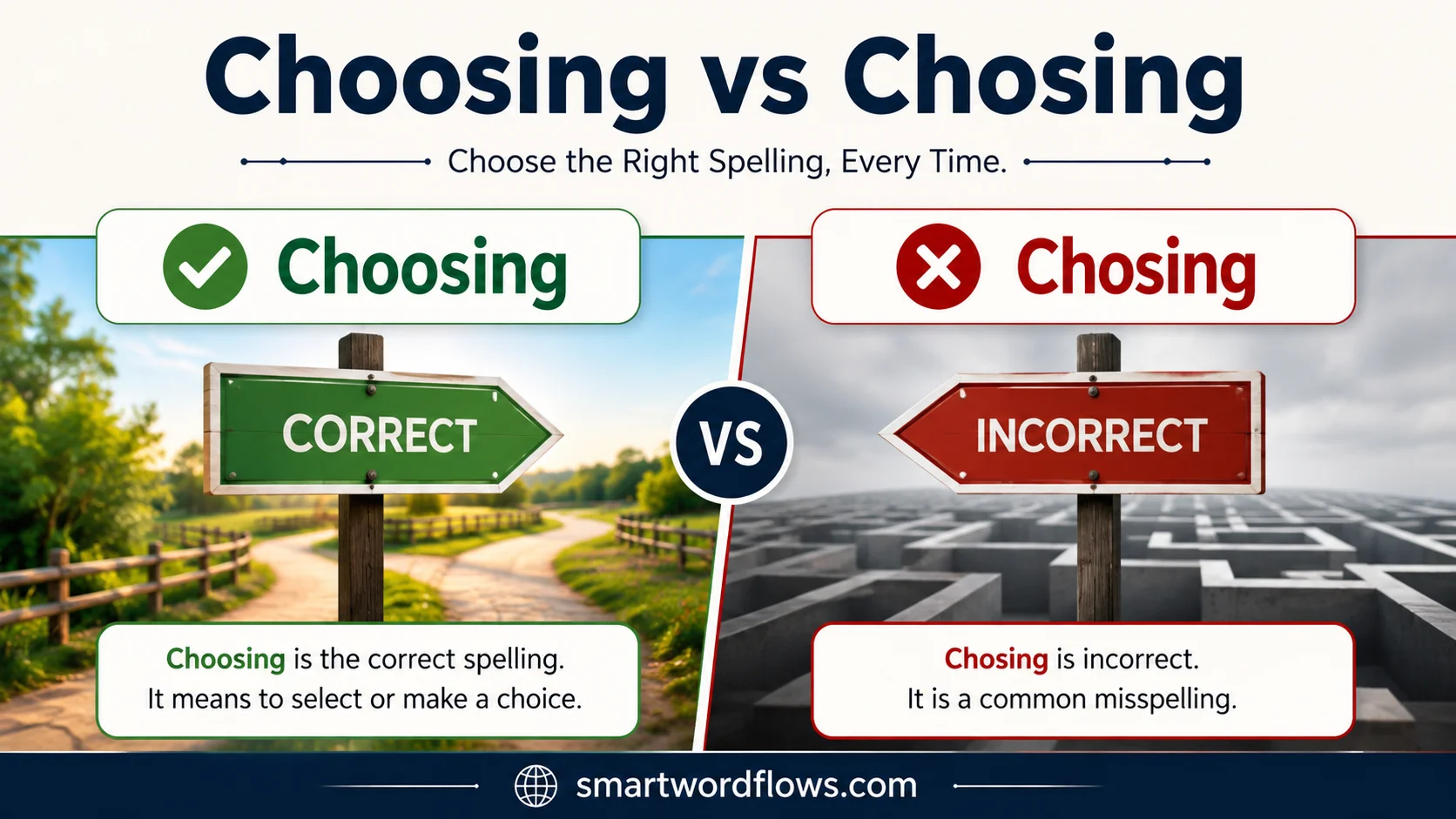

Choosing vs Chosing creates confusion because both words look similar and sound similar. However, choosing is the correct and proper word in standard English, while chosing is an incorrect spelling and common misspelling. This difference is important for learners who want clear English writing. The verb choose changes to choosing, not chosing. Remembering this spelling change can build confidence and help you use the right form in formal sentences and everyday writing.
Choosing means the act of making a decision or selecting something from a set of options. You might be picking a restaurant, movie, or career path. Using the right word correctly keeps your message clear and prevents spelling mistakes that can make writing look unprofessional or unclear. If you feel confused, check the forms carefully. These simple tips help you avoid errors in the future, recognize common mistakes, and improve your understanding of correct English spelling.
Quick Answer
Choosing is the correct spelling.
Chosing is incorrect.
The base verb is choose. When you add -ing, the final silent e drops away, which gives you choosing.
Comparison Overview
Here is a clear side-by-side view of the two spellings.
| Word | Correct? | Meaning | Example |
| Choosing | Yes | Picking or selecting from options | She is choosing a dress for the party. |
| Chosing | No | Not a standard English spelling | He is chosing a college. |
This is a small spelling issue, but it matters. In writing, details shape how polished and trustworthy your work looks. A single letter can change the entire impression.
Main Differences Between Choosing vs Chosing
The main difference is straightforward:
- Choosing is the proper present participle form of the verb choose.
- Chosing leaves out one of the two o’s from the root word.
- Choosing follows standard English spelling rules.
- Chosing does not.
That may sound like a tiny difference. In practice, it is not. Readers notice spelling errors fast. If you use chosing in an email, assignment, or article, it can distract from your message.
What Does Choosing Mean?
The word choosing means making a selection. You use it when one option is picked from several possible options.
It appears in everyday life all the time:
- Choosing a job
- Choosing a restaurant
- Choosing a school
- Choosing between two ideas
- Choosing a solution to a problem
The word carries the idea of decision-making. It is about judgment, preference, and selection.
For example:
- I am choosing a topic for my essay.
- She is choosing the best path for her career.
- They are choosing a paint color for the room.
In each case, a decision is being made.
Why Do People Spell Choosing as Chosing?
This mistake happens for a few simple reasons. English spelling can be tricky, and pronunciation does not always make the rule obvious.
The vowel sound hides the double “o”
When people say the word out loud, the double o in choose can blend into the sound. That makes it easy to forget one letter when writing.
People rely too much on sound
Many spelling mistakes happen because English does not always spell words exactly how they sound. Someone hears choosing and writes chosing because that version feels closer to speech.
The mind tries to simplify the word
When a word looks long or unusual, people often trim it without realizing it. That is how a word like choosing turns into chosing.
English spelling has silent letters
Silent letters often confuse writers. The e in choose disappears before -ing, but the two o’s stay. That rule is easy to mix up if you have not seen it often.
A good spelling habit is built on pattern recognition, not guesswork.
The Spelling Rule Behind Choosing
The spelling rule is simple once you see it clearly.
When a verb ends in a silent e, you usually drop the e before adding -ing.
Here are a few examples:
- make → making
- write → writing
- hope → hoping
- use → using
- choose → choosing
So choose becomes choosing, not chooseing and not chosing.
That pattern helps you spell many English verbs correctly. Once you learn it, you can use it again and again.
Choosing vs Chose vs Choose
These three forms belong to the same verb, but each one has a different job.
| Form | Use | Example |
| Choose | Present tense | I choose the red one. |
| Chose | Past tense | I chose the red one yesterday. |
| Choosing | Ongoing action | I am choosing the red one now. |
Choose
Use choose when the action is happening in the present or when you speak generally.
- I choose healthy meals when I can.
- You choose how to spend your time.
Chose
Use chose for the past.
- She chose the window seat.
- They chose a new manager last month.
Choosing
Use choosing for an action that is happening right now or continuing.
- I am choosing a book for the weekend.
- He is choosing between two offers.
This is one of the easiest ways to avoid confusion. Once you know the tense, the spelling becomes much easier.
Common Mistakes With Choosing
People often make a few repeat mistakes with this word.
Mistake 1: Dropping one “o”
This creates chosing, which is incorrect.
- Incorrect: She is chosing a gift.
- Correct: She is choosing a gift.
Mistake 2: Keeping the silent “e”
Some people write chooseing, but that is also wrong.
- Incorrect: He is chooseing a school.
- Correct: He is choosing a school.
Mistake 3: Mixing up verb forms
Writers sometimes use choose, chose, and choosing in the wrong tense.
- Incorrect: I chose a new job right now.
- Correct: I am choosing a new job right now.
Mistake 4: Trusting spellcheck too much
Spellcheck helps, but it is not a teacher. If you do not know the rule, you may miss the error in drafts, posts, or messages.
How to Remember the Correct Spelling of Choosing
Memory tricks make spelling easier.
Try this pattern
Think of the root word:
- choose
- choosing
The double o stays. The e drops.
Use a short reminder
You can remember:
“I choose, so I am choosing.”
That phrase keeps both forms connected in your mind.
Break the word apart
Look at it in two parts:
- choose
- ing
When you add -ing, remove the silent e.
Read it slowly
If you pause for a second and think about the root word, you are less likely to make the error.
Choosing in Real Sentences
Here are practical examples that show the word in action.
Everyday life
- I am choosing between tea and coffee.
- She is choosing a phone case online.
- We are choosing a gift for our teacher.
School and study
- Students are choosing their research topics.
- He is choosing the best answer on the test.
- They are choosing courses for next semester.
Work and career
- The manager is choosing a candidate for the role.
- I am choosing the strongest example for my report.
- The company is choosing a new software system.
Personal decisions
- She is choosing to save money this year.
- They are choosing kindness in a difficult situation.
- He is choosing a healthier routine.
These examples show how flexible the word is. It works in casual speech, formal writing, and everything in between.
A Simple Case Study: When One Letter Changes the Tone
A student once sent a scholarship email that said, “I am chosing the right program for my future.”
The meaning was clear, but the spelling mistake made the line feel less polished. In a competitive setting, that matters. A reviewer may not reject someone because of one typo alone, but small errors can weaken the overall impression.
After correcting it to “I am choosing the right program for my future,” the sentence looked professional and confident.
That is the real lesson here. Spelling does not just show correctness. It also shows care.
Is Chosing Ever Correct?
In standard English, no. Chosing is not the correct spelling of the word.
You might still see it in a few places:
- casual social media posts
- quick text messages
- drafts with typos
- usernames or handles
But in clean, formal, or professional writing, it should not appear.
If you are writing for school, work, or publication, use choosing every time.
Choosing vs Chosing in Professional Writing
Professional writing leaves very little room for avoidable mistakes. A spelling error in a resume, cover letter, business email, or article can stand out more than you expect.
Compare these two lines:
- I am chosing the best option for the team.
- I am choosing the best option for the team.
The second version looks polished. The first looks rushed.
That difference is small on the page but large in the reader’s mind.
Read More: Offered vs Offerred: The Complete Guide to Correct Spelling
What Makes This Mistake So Common?
This is a good example of how English spelling can trip people up.
English often breaks sound-based logic
You cannot always spell English words by ear. The written form often keeps older patterns that pronunciation has softened.
Writers sometimes write too fast
When you type quickly, your brain fills in the word before your fingers do. That is how letters disappear.
The brain expects symmetry
Because chose and choose are closely related, some writers unconsciously strip away letters while spelling the continuous form.
That is why habits matter. A small pause before writing can save you from repeated mistakes.
Synonyms for Choosing
Different situations call for different words. Here are some close alternatives to choosing.
- selecting
- picking
- deciding
- opting
- settling on
- electing
- preferring
- determining
How they differ
- Selecting sounds a little more formal.
- Picking is casual and simple.
- Deciding focuses on the mental process.
- Opting often implies a choice among options.
- Settling on suggests final agreement after thought.
- Electing is often used in formal or political settings.
- Preferring highlights a favorite choice.
- Determining can sound more analytical.
Example:
- She is selecting a dress.
- She is picking a dress.
- She is settling on a dress.
All three work, but each has a slightly different feel.
Choosing vs Chosing: Fast Facts
Here are a few quick facts worth remembering:
- Choosing is the correct form.
- Chosing is a misspelling.
- The root word is choose.
- The silent e drops before -ing.
- The double o stays in the spelling.
- The word choosing is used in present continuous forms.
- Good spelling improves clarity and credibility.
More Examples You Can Model
Use these sentences as quick references.
- He is choosing the best route home.
- I am choosing a topic that fits the assignment.
- They are choosing between two strong candidates.
- She is choosing her words carefully.
- We are choosing what matters most.
- You are choosing a better path for your future.
If you keep seeing the word in context, the spelling becomes easier to remember.
Helpful Quote
Correct spelling does more than fix a word. It protects your message.
That is especially true for a word like choosing, where one missing letter changes the whole appearance of the word.
FAQs:
1. Is choosing or chosing correct?
Choosing is the correct spelling. Chosing is a common spelling mistake and should be avoided in standard English.
2. Why is chosing incorrect?
The verb choose changes to choosing when adding “-ing.” The correct spelling keeps the extra “o” before “sing.”
3. What does choosing mean?
Choosing means selecting something from different options or making a decision between possible choices.
4. How can I remember the correct spelling?
Remember choose → choosing. Keeping the “oo” can help you avoid the common mistake of writing chosing.
5. Can I use choosing in formal writing?
Yes. Choosing is correct for formal and informal English, including articles, emails, academic writing, and everyday sentences.
Conclusion
Choosing is the correct spelling, while chosing is an incorrect and common misspelling. Remembering the connection between choose and choosing makes this spelling easier to use correctly. When writing about making a decision or selecting between options, always use choosing to keep your English clear, accurate, and professional.