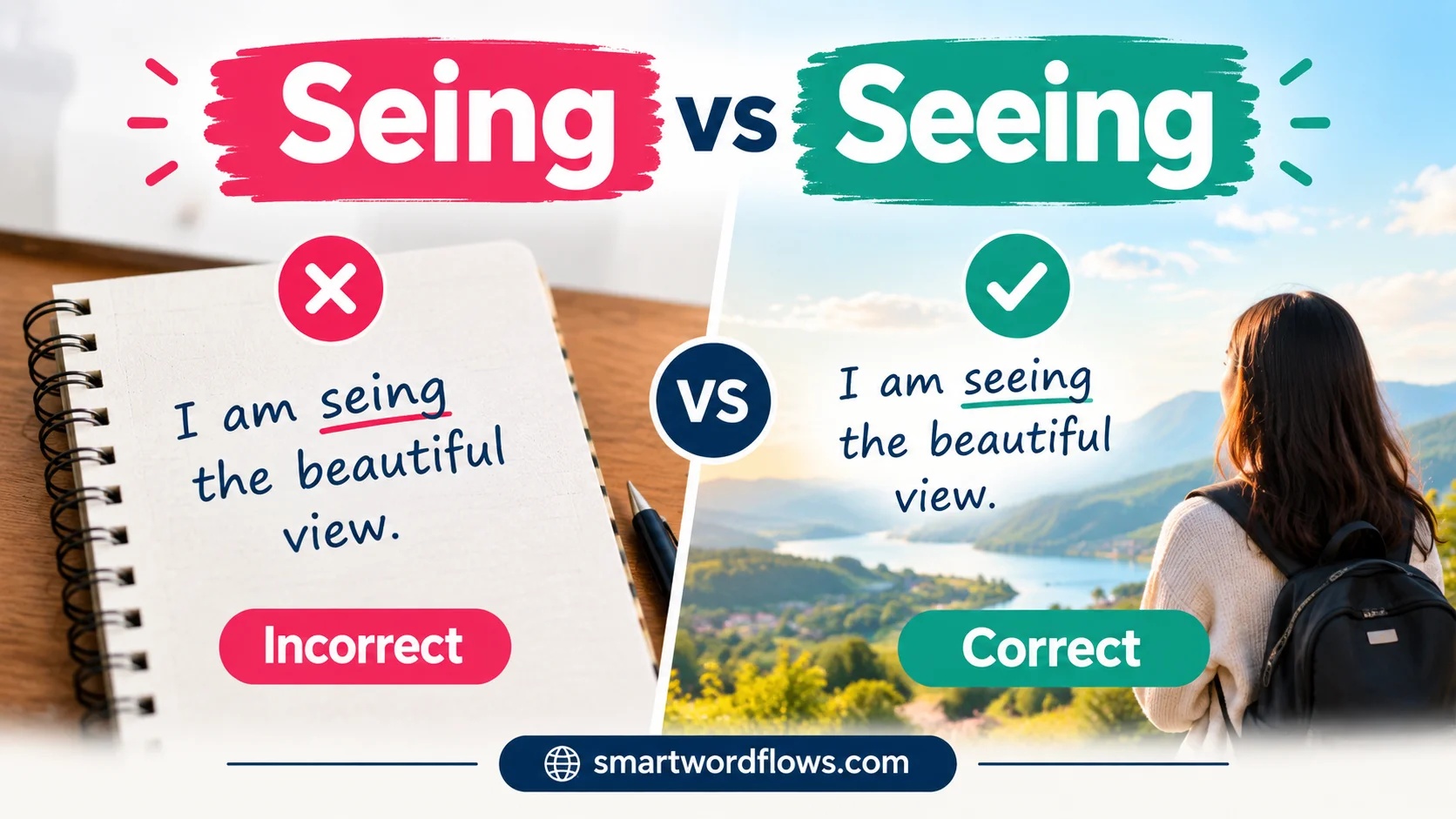

When it comes to Seing vs Seeing, many English learners struggle to choose the correct spelling. The word seeing is the correct form in standard English, while seing is simply a common spelling mistake. This error usually happens because people accidentally remove one “e” when writing quickly. Understanding the correct grammar, meaning, pronunciation, and usage of seeing can help you improve your writing skills and communicate more clearly in emails, assignments, blogs, and everyday conversations.
Learning the difference between seing or seeing is simple once you understand how the word is formed. Seeing comes from the verb “see” and commonly describes the act of noticing, viewing, or experiencing something. Using the correct spelling makes your writing look more professional and trustworthy. In this guide, you’ll find useful sentence examples, common phrases, synonyms, grammar tips, and an easy memory trick to help you avoid this mistake and confidently use seeing in both formal and informal English.
Quick Answer
Seeing is the correct spelling.
Seing is a misspelling when you intend to write the -ing form of see. It isn’t the standard spelling used in modern English.
The basic spelling rule is simple:
see + ing = seeing
The two e’s in see remain when you add -ing.
| Spelling | Correct? | Explanation |
| Seeing | ✅ Yes | Correct -ing form of see |
| Seing | ❌ No | Common misspelling of seeing |
| See | ✅ Yes | Base form of the verb |
| Saw | ✅ Yes | Simple past form of see |
| Seen | ✅ Yes | Past participle of see |
For example:
- Correct: “I’m seeing my doctor tomorrow.”
- Incorrect: “I’m seing my doctor tomorrow.”
The easiest way to remember the spelling is to keep the original word visible in your mind:
SEE + ING = SEEING
Comparison Overview
The difference between seing vs seeing isn’t really a difference in meaning. Instead, it is primarily a matter of correct spelling.
Seeing is a standard English word with several grammatical and contextual uses. Seing, on the other hand, usually appears because someone accidentally removes one of the two e’s from see before adding -ing.
| Feature | Seeing | Seing |
| Standard English spelling | Yes | No |
| Comes from see | Yes | Intended to, but incorrectly formed |
| Present participle | Yes | No |
| Gerund | Yes | No |
| Used in standard writing | Yes | No |
| Appropriate in formal writing | Yes | No |
| Example | “I am seeing my friend.” | “I am seing my friend.” ❌ |
The Key Difference
The key difference is straightforward:
Seeing is the correct word. Seing is normally a spelling error.
This isn’t like color and colour, where both spellings have legitimate regional uses. Nor is it like traveling and travelling, where spelling conventions differ between American and British English.
With seeing, standard English keeps both e’s.
Main Differences Between Seing vs Seeing
Although the two forms differ by only one letter, their status in English is quite different.
Seeing Is the Correct Spelling
Seeing is the present participle and gerund form of the irregular verb see.
It can describe visual perception:
“I’m seeing a bright light through the window.”
It can also describe an appointment or meeting:
“She’s seeing her dentist on Friday.”
In another context, it can describe a romantic relationship:
“He’s seeing someone new.”
The same spelling therefore carries several meanings depending on the sentence.
Seing Is a Misspelling
Seing isn’t the standard -ing form of see. Writers sometimes create it by assuming that one e should disappear before -ing.
That assumption works with some English verbs, but it doesn’t work with see.
For example:
- make → making
- take → taking
- write → writing
These verbs typically drop their final silent e before -ing.
However, see doesn’t follow that pattern:
- see → seeing
- flee → fleeing
- agree → agreeing
That distinction explains much of the confusion.
What Does Seeing Mean?
Seeing has several meanings because see itself has several meanings.
At its most basic level, seeing means using your eyes to perceive something. Yet English speakers also use the word for meeting people, understanding ideas, experiencing events, and dating someone.
Seeing as Perceiving Something Visually
The most literal meaning involves visual perception.
For example:
- “I’m seeing a bird in the backyard.”
- “Are you seeing that sign?”
- “She was seeing the mountains from her hotel room.”
Here, seeing relates directly to vision.
However, native speakers don’t always use the progressive form when describing simple visual perception. The choice depends on the meaning and context.
For instance:
“I see a car outside.”
sounds natural when simply reporting what your eyes perceive.
By contrast:
“I’m seeing a doctor tomorrow.”
uses seeing differently. It means meeting or visiting, not merely looking at someone.
Seeing as Meeting Someone
English frequently uses see to mean meet, visit, or have an appointment with someone.
Consider these examples:
- “I’m seeing my dentist tomorrow.”
- “She’s seeing her parents this weekend.”
- “We’re seeing our manager after lunch.”
In these sentences, nobody means that the speaker will simply look at another person. The word describes a planned meeting or visit.
Seeing as Understanding
The verb see can also mean understand or recognize an idea.
For example:
“Now I’m seeing why you were concerned.”
Here, seeing doesn’t refer to eyesight. It refers to gaining understanding.
The expression “I see” often means “I understand.”
For example:
“Oh, I see what you mean now.”
That meaning comes from a figurative use of see.
Seeing as Dating Someone
In informal English, seeing someone can mean dating or having a romantic relationship with that person.
For example:
“She’s been seeing someone for several months.”
This doesn’t mean she’s physically looking at that person for several months. Instead, it means she’s romantically involved with them.
Context does the heavy lifting here.
Why Is Seeing Spelled With Two E’s?
The spelling becomes much easier when you start with the base verb.
The word seeing comes from:
see + ing
The base verb see already contains two e’s. Those letters remain when -ing is added.
Therefore:
SEE + ING → SEEING
Not:
SEE + ING → SEING
This pattern is worth memorizing because it prevents a common spelling mistake.
Why Doesn’t See Become Seing?
English has a general spelling pattern in which some verbs ending in a silent e drop that e before -ing.
For example:
- hope → hoping
- bake → baking
- drive → driving
- smile → smiling
But see doesn’t end with a silent e in the same way. The two e’s work together to represent the vowel sound in the base word.
That’s why English keeps both letters:
- see → seeing
- agree → agreeing
- free → freeing
- flee → fleeing
This is an important spelling distinction.
Why Is “Seing” Incorrect?
Seing is incorrect because it doesn’t follow the standard spelling of the present participle or gerund of see.
A person might reason like this:
see + ing → seing
That looks logical at first glance. After all, many verbs lose a final e before adding -ing.
However, English spelling doesn’t apply that rule mechanically to every verb ending in an e.
The correct form is:
see → seeing
The same principle appears in other words ending in two e’s.
| Base word | Correct -ing form |
| see | seeing |
| agree | agreeing |
| flee | fleeing |
| free | freeing |
So, when you write seing, the problem isn’t pronunciation or meaning. It’s simply the spelling.
Seeing as the Present Participle of See
Seeing functions as the present participle of see.
A present participle often appears with a form of be to create a progressive construction.
Consider these examples:
- “I am seeing my doctor tomorrow.”
- “She is seeing the results for the first time.”
- “They were seeing a movie when I called.”
- “We are seeing more customers this month.”
The exact meaning depends on the context.
One important detail deserves attention: see can behave differently depending on what it means. When see describes a state of perception or knowledge, English often prefers the simple form.
For example:
“I see what you mean.”
That sounds more natural than:
“I am seeing what you mean.”
However, seeing becomes perfectly natural when see describes an activity, appointment, meeting, or developing experience.
“I’m seeing my doctor tomorrow.”
The distinction isn’t merely about spelling. Grammar and meaning influence the choice.
Seeing as a Gerund
Seeing can also function as a gerund. A gerund is an -ing form that functions like a noun.
For example:
“Seeing is believing.”
Here, seeing acts as the subject of the sentence.
Another example is:
“I enjoy seeing new places.”
In this sentence, seeing functions as the object of enjoy.
More examples include:
- “Seeing the finished project made her proud.”
- “He loves seeing old friends.”
- “Seeing the ocean for the first time was unforgettable.”
A useful test is to ask whether the -ing form acts like an activity or thing within the sentence. If it does, you’re often dealing with a gerund.
Common Uses of Seeing in English
The word seeing appears in several common constructions.
Seeing Something
This usually refers to observing or perceiving something.
“I’m seeing a strange light in the distance.”
Seeing Someone
This can mean meeting or visiting someone.
“I’m seeing my sister this evening.”
Seeing That
Seeing that can introduce a reason or observation.
“Seeing that everyone had arrived, we started the meeting.”
It can roughly mean “considering the fact that.”
Seeing As
Seeing as often introduces a reason, particularly in conversational English.
“Seeing as you’re already here, you might as well stay.”
It means something close to “since” or “considering that.”
Seeing How
Seeing how can introduce a circumstance or reason.
“Seeing how busy she is, we decided not to call.”
Seeing If
This construction often means trying to discover whether something is true.
“I’m seeing if the store still has the item.”
Seeing Whether
Seeing whether has a similar function.
“We’re seeing whether the plan will work.”
Seeing Someone Romantically
This informal expression means dating someone.
“Are you seeing anyone right now?”
Seeing Something Happen
This means witnessing an event.
“I remember seeing the accident happen.”
Seeing Something Clearly
This can have either a literal or figurative meaning.
“I can’t see clearly without my glasses.”
Or:
“After our conversation, I started seeing the situation more clearly.”
Read This: Channel vs Chanel: Difference and Usage
Seeing vs See in a Sentence
The difference between see and seeing involves grammar as well as meaning.
See is the base form. Seeing is the present participle or gerund form.
| Form | Example | Typical meaning |
| See | “I see the problem.” | Perception or understanding |
| Seeing | “I’m seeing my doctor.” | Meeting or visiting |
| Saw | “I saw him yesterday.” | Past perception or experience |
| Seen | “I’ve seen that movie.” | Past participle |
Why “I See” Often Sounds Better Than “I Am Seeing”
When see means understand or perceive something, the simple form usually sounds more natural.
“I see what you mean.”
When see describes an appointment or planned meeting, the progressive form works naturally:
“I’m seeing my dentist tomorrow.”
That distinction helps you choose between see and seeing without relying on spelling alone.
Seeing vs Seing: Examples in Sentences
The easiest way to recognize the correct spelling is to compare real sentences.
Correct Examples
- “I’m seeing my doctor tomorrow morning.”
- “She enjoys seeing new places when she travels.”
- “We were seeing the sights downtown.”
- “I’m finally seeing what you meant.”
- “He’s seeing someone from his office.”
- “They spent the afternoon seeing the local attractions.”
- “I remember seeing that painting years ago.”
- “Are you seeing the same problem on your screen?”
- “She’s seeing her family this weekend.”
- “Seeing the finished result made everyone smile.”
Incorrect Examples
The following sentences contain the common spelling error:
- “I’m seing my doctor tomorrow.”
- “She enjoys seing new places.”
- “We were seing the sights downtown.”
- “I’m finally seing what you meant.”
- “He’s seing someone from his office.”
Each should use seeing instead.
Common Mistakes With Seeing
Spelling seing instead of seeing is the most obvious mistake. Still, several other errors can cause confusion.
Writing Seing Instead of Seeing
This happens when writers incorrectly drop one of the e’s.
Incorrect: “I am seing my friend.”
Correct: “I am seeing my friend.”
Remember that see keeps both e’s when you add -ing.
Confusing Seeing With Scene
Seeing and scene look and sound different, but learners sometimes confuse them.
Seeing relates to the verb see.
“I enjoy seeing live performances.”
Scene is a noun referring to a place, situation, or part of a movie, play, or story.
“The final scene was unforgettable.”
Confusing Seeing With Sea
Sea refers to a large body of salt water.
“We walked beside the sea.”
Seeing relates to see.
“We spent the afternoon seeing the sights.”
They may sound somewhat similar in fast speech, but their meanings and spellings are completely different.
Misusing “I Am Seeing”
Not every use of see naturally takes the progressive form.
For example:
“I see what you mean.”
sounds natural.
The sentence:
“I am seeing what you mean.”
can sound unusual if you’re simply saying that you understand someone.
However, “I’m seeing my doctor tomorrow” sounds completely natural because seeing means visiting or having an appointment with the doctor.
Seeing vs Scene: What’s the Difference?
The words seeing and scene serve completely different grammatical roles.
| Word | Part of speech | Meaning | Example |
| Seeing | Verb form/Gerund | Observing, meeting, understanding, or experiencing | “I’m seeing my friend tonight.” |
| Scene | Noun | A place, situation, or part of a movie or play | “The opening scene was dramatic.” |
A simple memory trick helps:
Seeing contains see, which tells you it relates to the verb see.
Scene describes something you can identify as a setting, event, or part of a performance.
Seeing vs Seing Pronunciation
The correct word seeing is generally pronounced like “SEE-ing.”
The first part sounds like the word see, followed by the -ing sound.
Because the pronunciation doesn’t clearly reveal both written e’s, some learners accidentally write seing after hearing the word.
That’s why spelling it from the sound alone can be tricky.
A useful strategy is to remember the word visually:
SEE + ING = SEEING
When spelling the word, think of the base verb first. That small habit can prevent the missing-e mistake.
Is Seing a Word?
In standard modern English, seing isn’t the correct spelling of the -ing form of see.
If you encounter seing in an email, article, social media post, or message, it will generally be a spelling error.
For standard writing, replace it with seeing.
This applies across common forms of communication, including:
- Academic assignments
- Professional emails
- Business documents
- Resumes
- Online articles
- Social media posts
- Personal messages
- Formal correspondence
There isn’t a standard American English spelling distinction that makes seing acceptable while seeing is correct somewhere else.
Is Seeing a Word?
Yes. Seeing is a standard English word.
It can function as:
- A present participle of see
- A gerund
- Part of a progressive verb phrase
- Part of common expressions such as seeing that and seeing as
Its meaning changes with context.
For example:
“I’m seeing a doctor.”
Here, seeing means visiting or consulting.
“I’m seeing a bird.”
Here, seeing relates to visual perception.
“I enjoy seeing new places.”
Here, seeing functions as a gerund referring to an activity.
How to Remember the Correct Spelling of Seeing
The best spelling trick is also the simplest:
See keeps both e’s before -ing.
Think of the word in two parts:
SEE + ING
That produces:
SEEING
A Few Helpful Memory Tricks
- See has two e’s. Keep both.
- Think SEE + ING, rather than trying to spell the sound.
- Remember that see → seeing, not seing.
- Compare it with flee → fleeing and agree → agreeing.
- If you see seing, stop and check the base verb.
Quick Memory Rule
Never remove an e from “see” when adding “-ing.”
This one-line rule handles the entire spelling problem.
Seeing in Different Tenses and Structures
Understanding the complete verb family makes the spelling easier to remember.
| Grammatical form | Word | Example |
| Base form | see | “I see the building.” |
| Third-person singular | sees | “She sees the building.” |
| Present participle | seeing | “They are seeing the building.” |
| Simple past | saw | “We saw the building yesterday.” |
| Past participle | seen | “I have seen the building before.” |
The verb see is irregular because its past forms don’t follow the ordinary -ed pattern.
You don’t say:
“I seed the movie.”
Instead, you say:
“I saw the movie.”
And with a perfect construction:
“I have seen the movie.”
The -ing form, however, is straightforward:
see → seeing
See, Seeing, Saw, and Seen: Complete Word Forms
The four major forms of see are worth learning together.
See
See is the base form.
“I see a problem with this plan.”
It can describe visual perception, understanding, recognition, or many other meanings.
Seeing
Seeing is the present participle and gerund form.
“I’m seeing my friend tonight.”
It can also function as a noun-like gerund:
“Seeing new places broadens your perspective.”
Saw
Saw is the simple past form.
“I saw him yesterday.”
Seen
Seen is the past participle.
It usually appears with an auxiliary verb such as have, has, had, or be.
“I have seen that movie before.”
A useful four-word sequence is:
see → seeing → saw → seen
Learning this sequence helps prevent several common errors.
Seing vs Seeing in Formal and Informal Writing
The correct choice doesn’t change depending on how formal your writing is.
Seeing works in both casual and formal English.
For example, an informal message might say:
“I’m seeing Jake tonight.”
A professional email might say:
“I’m seeing the client tomorrow afternoon.”
An academic sentence might say:
“Seeing the results in this context provides a clearer understanding of the issue.”
In all three cases, seeing is the correct spelling.
By contrast, seing shouldn’t replace it in standard writing.
Why Proofreading Still Matters
Spell-checking software can catch many obvious errors. However, proofreading remains useful because a spelling error can sometimes survive automated checking, particularly when the incorrect form resembles another recognized word or appears in unusual contexts.
A quick visual check can catch this one easily:
seing ❌
seeing ✅
How to Correct Seing in Your Writing
If you’ve already written seing, correcting it usually takes only a few seconds.
Follow These Steps
- Find “seing” in your document.
- Replace it with “seeing” when you mean the -ing form of see.
- Read the complete sentence to make sure the grammar fits.
- Check whether see, seeing, saw, or seen actually expresses the intended tense.
- Read the sentence aloud if the construction still feels awkward.
For example:
Original:
“I was seing my dentist every six months.”
Corrected:
“I was seeing my dentist every six months.”
The spelling correction is simple. The grammatical context remains the same.
A Practical Case Study: Why the Extra E Matters
Consider a learner writing an appointment reminder:
“I’m seing my doctor tomorrow.”
At first glance, the sentence looks understandable. The reader can probably infer the intended meaning. Still, the spelling is incorrect.
Changing one letter fixes it:
“I’m seeing my doctor tomorrow.”
Now compare that with another sentence:
“I see my doctor every six months.”
Both sentences are correct, yet they use different grammatical forms.
The first emphasizes a particular appointment:
I’m seeing my doctor tomorrow.
The second describes a regular or general fact:
I see my doctor every six months.
This small comparison shows why learning seeing isn’t only about memorizing spelling. It also helps you understand how English speakers use different forms of see.
FAQs :
1. Is “seing” a correct English word?
No, seing is not the correct standard English spelling. It is a common spelling mistake. The correct form is seeing.
2. Which is correct: seing or seeing?
Seeing is correct. It is the present participle of the verb see, meaning to notice, view, or observe something.
3. Why do people spell seeing as “seing”?
People often write seing because they accidentally remove one “e” from seeing, especially when typing quickly or writing from memory.
4. What does “seeing” mean?
Seeing generally means using your eyes to notice or view something. It can also mean understanding or experiencing something, depending on the context.
5. How can I remember the correct spelling of seeing?
A simple trick is to remember that see already contains two “e” letters. When adding -ing, keep both: see + ing = seeing.
Conclusion :
The difference between Seing vs Seeing is easy to understand once you remember the correct spelling. Seeing is the only standard English form, while seing is an incorrect spelling. By remembering that see + ing = seeing, you can avoid this common mistake and make your grammar, spelling, and writing more accurate.