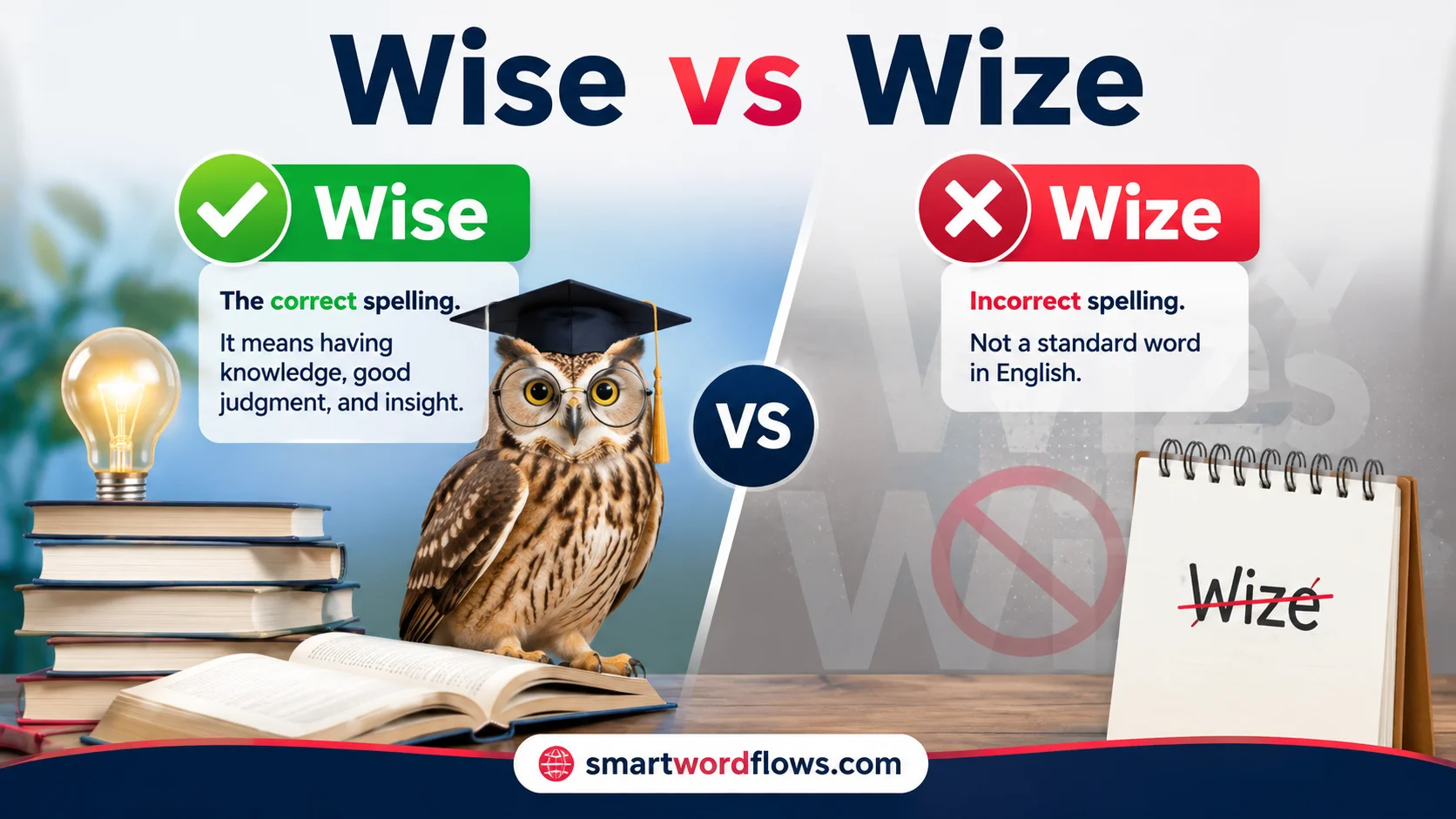

Wise vs Wize is a common spelling question, but Wise is the correct word and standard spelling in modern English. It is a dictionary word that describes someone with knowledge, good judgment, experience, wisdom, and insight. Both American English and British English accept Wise in formal writing. Wize is usually a misspelling, although it may appear as a brand name, company name, or creative spelling.
The difference mainly comes from pronunciation, because Wise and Wize sound alike. The final s in wise produces a /z/ sound, which can confuse writers. However, pronunciation does not always determine spelling. Wise is the proper spelling for standard writing, while Wize should generally be avoided. Learning this distinction improves grammar, spelling accuracy, and English vocabulary, especially when writing emails, essays, messages, or other professional communication.
Quick Answer
Wise is the correct standard spelling in modern English when you mean having good judgment, knowledge, experience, or practical sense.
Wize is not the standard modern spelling of that word. It may appear as a typo, an intentional creative spelling, a name or brand, or an obsolete historical spelling.
The simple rule
If you mean “showing good judgment,” use wise — W-I-S-E.
For example:
- Correct: She made a wise decision.
- Correct: He gave me wise advice.
- Correct: It would be wise to wait.
- Not standard: She made a wize decision.
- Not standard: He gave me wize advice.
So, if you’re unsure, choose wise.
Comparison Overview
The difference between wise vs wize becomes clearer when you compare their spelling, meaning, pronunciation, and modern usage.
| Feature | Wise | Wize |
| Standard modern spelling | Yes | No |
| Common pronunciation | /waɪz/ | Usually intended to sound like wise |
| Main modern meaning | Showing good judgment or experience | Not a standard modern spelling of wise |
| Formal writing | Appropriate | Avoid |
| Academic writing | Appropriate | Avoid |
| Business writing | Appropriate | Avoid |
| Informal writing | Appropriate | May appear intentionally |
| Historical usage | Long-established | Obsolete variant |
| Use as a normal English adjective | Yes | No |
| Recommended for modern writing | Wise | Generally no |
The important distinction is that wise has an established grammatical and lexical role in modern English, while wize does not normally function as its standard spelling replacement.
Main Differences Between Wise vs Wize
The wise vs wize difference isn’t simply about one letter. Several factors explain why one form belongs in ordinary modern writing while the other usually doesn’t.
Wise is the standard spelling
When you describe a person as sensible, experienced, thoughtful, or capable of making sound decisions, use wise.
For example:
She is a wise woman who thinks carefully before making important decisions.
The adjective doesn’t necessarily mean someone is highly intelligent. Instead, it often suggests that the person knows how to use knowledge and experience well.
That’s an important distinction.
Someone may know an enormous amount of information but still make foolish choices. Another person may have less formal knowledge yet understand people, risks, and consequences extremely well. The second person may be described as wise.
Wize isn’t the standard modern spelling
If you write:
He made a wize decision.
Most readers will probably understand what you mean. However, they’ll also likely notice the spelling.
In ordinary modern English, wize doesn’t replace wise.
That makes the issue similar to other spelling mistakes caused by pronunciation. A word can sound as though it contains one letter while its accepted spelling uses another.
They may sound identical
This is the heart of the confusion.
Wise is pronounced approximately like “wyze.”
The final s produces a /z/ sound. Therefore:
wise → /waɪz/
When people hear the word rather than see it written, they may naturally imagine wize.
But pronunciation doesn’t change the established spelling.
Wise has several meanings and uses
The word wise isn’t limited to one narrow definition.
It can describe:
- A person with good judgment
- A sensible decision
- Useful advice
- Practical behavior
- Someone who understands a situation
- Someone who is informed about something
- Someone who is sometimes shrewd or crafty
For example:
She was wise to his plan.
Here, wise to means aware of or informed about something.
That is different from the more familiar:
She is a wise person.
The surrounding words determine the exact sense.
What Does Wise Mean?
Wise generally describes someone or something connected with good judgment, sound thinking, experience, or practical understanding.
Consider these examples:
He gave me some wise advice.
Buying the house after reviewing the finances was a wise decision.
Her grandmother was known for being wise.
It would be wise to check the details first.
Each sentence involves judgment rather than simple intelligence.
Wise person
A wise person typically understands that actions have consequences.
They don’t necessarily rush to an answer. Instead, they consider the situation from several angles.
For example, imagine someone receives a tempting job offer. The salary looks excellent, but the position requires a long commute and offers little stability.
A purely financial approach might focus on the larger paycheck. A wise approach considers the whole picture.
That’s why wise often carries a sense of maturity.
Wise decision
A wise decision is a decision that makes good sense based on the available information.
For example:
Taking an umbrella when rain is forecast was a wise decision.
The decision isn’t necessarily brilliant or complicated. It’s simply sensible.
Wise advice
Wise advice usually goes beyond basic information.
Someone might tell you, “Save money.”
That’s useful advice.
A wiser piece of advice might explain why an emergency fund matters, how much to save, and how to build the habit gradually.
Wisdom often combines knowledge + experience + judgment.
Wise Does Not Simply Mean Intelligent
One of the most useful distinctions is between wise and intelligent.
These words overlap, but they aren’t interchangeable.
| Word | Main idea |
| Wise | Uses knowledge and experience with good judgment |
| Intelligent | Has strong mental ability |
| Knowledgeable | Knows a lot about a subject |
| Sensible | Makes practical choices |
| Clever | Thinks quickly or creatively |
| Prudent | Acts carefully, especially around risk |
| Insightful | Understands deeper meaning or patterns |
Imagine a brilliant mathematician who makes reckless financial decisions. That person may be intelligent but not particularly wise in financial matters.
Now imagine a retired business owner who isn’t a mathematician but understands when to take a risk, when to wait, and when to walk away. You might call that person wise.
The distinction gives the word more depth than a simple synonym like “smart.”
How to Use Wise in a Sentence
The most common grammatical role of wise is an adjective.
Describing a person
She is a wise teacher.
My grandfather was a wise man.
Describing an action
It wasn’t wise to ignore the warning.
Describing a decision
Waiting for more information was a wise choice.
Describing advice
She offered some wise advice.
Describing a strategy
The company took a wise approach to the problem.
Using “wise to”
The phrase wise to has a different meaning.
The manager was wise to the scam.
Here, wise to means aware of or knowledgeable about something, often something that someone is trying to hide.
That usage can confuse learners because the meaning isn’t simply “smart.”
Wise vs Wisely vs Wisdom
These related words are easy to confuse because they belong to the same word family.
| Word | Function | Example |
| Wise | Adjective | She made a wise choice. |
| Wisely | Adverb | She spent her money wisely. |
| Wisdom | Noun | His wisdom helped the team. |
Wise
Use wise to describe a person, decision, action, or idea.
That was a wise decision.
Wisely
Use wisely to describe how someone performs an action.
He invested his money wisely.
The question you can ask is:
How did he invest?
He invested wisely.
Wisdom
Use wisdom for the quality or understanding itself.
Years of experience gave her great wisdom.
A useful pattern is:
wise → wisely → wisdom
Remembering this family can also help prevent accidental spellings such as wize.
Why Do People Write Wize Instead of Wise?
The most obvious reason is phonetic confusion.
When someone hears wise, the final sound resembles a z. If they rely on sound rather than memorized spelling, they may write wize.
The pronunciation trap
The word looks like this:
W-I-S-E
But it sounds approximately like:
W-Y-Z
That mismatch can cause trouble for children learning to spell, language learners, fast typists, and anyone writing from memory.
English has plenty of words where pronunciation doesn’t provide a perfect spelling guide. That’s why hearing a word isn’t always enough to determine how it should appear on the page.
Another reason: visual familiarity
The letter z often represents the /z/ sound clearly in English.
Because of that, wize can look strangely convincing.
It has the same basic visual structure as wise. Only one letter changes.
Unfortunately, being logical from a sound-based perspective doesn’t make it the standard spelling.
Is Wize a Real Word?
This question deserves a careful answer.
In modern standard English
Wize is not the standard modern spelling of wise.
If you’re writing normal English and mean “having good judgment,” use wise.
In historical English
The story changes slightly.
Wize has been documented as an obsolete spelling of wise. Older English spelling was less standardized than modern English, so alternative spellings appeared in historical texts.
That means saying “wize has never existed” would be inaccurate.
At the same time, historical existence doesn’t make the spelling appropriate for modern standard writing.
Think of it this way:
Historical spelling: Wize can appear.
Modern standard spelling: Use wise.
In names and branding
A stylized spelling can also be intentional.
A company, product, website, username, or fictional character might use Wize as part of its official name.
In that situation, the spelling is a proper name rather than an attempt to spell the ordinary adjective wise.
For example, if a company deliberately chooses “Wize” as its brand name, changing it to “Wise” would actually alter the name.
Context matters.
Wise vs Wize in Formal Writing
When you’re writing formally, the answer is especially straightforward:
Use wise.
That applies to:
- School assignments
- Academic papers
- Business reports
- Professional emails
- Applications
- Articles
- Presentations
- Official documents
- Resumes and cover letters
Academic example
Correct:
Researchers made a wise decision to examine the long-term effects.
Incorrect in standard modern English:
Researchers made a wize decision to examine the long-term effects.
Professional example
Correct:
It would be wise to review the contract carefully.
Incorrect:
It would be wize to review the contract carefully.
A small spelling error can make polished writing look less reliable. That’s why using the established form matters.
Read This: Blankie vs Blanky: Spelling, and Usage Explained
Wise vs Wize in Casual Writing
Casual writing gives you more freedom, but the standard spelling remains wise.
You may see wize in:
- Usernames
- Memes
- Brand names
- Song or character names
- Creative writing
- Informal online communities
- Intentional slang
However, seeing a spelling online doesn’t automatically make it standard English.
People intentionally bend spelling all the time. A word can look distinctive without becoming part of standard vocabulary.
Example
Someone might create a username such as:
WizeGuy2026
That doesn’t mean wize has replaced wise in English. It simply means the person chose a stylized spelling.
Common Wise vs Wize Mistakes
Mistake: Spelling wise according to pronunciation
Wrong:
He is a wize leader.
Correct:
He is a wise leader.
The pronunciation may contain a /z/ sound, but the spelling remains wise.
Mistake: Assuming every S sounds like /s/
English uses s for several sounds.
In wise, the final s sounds like /z/.
That’s why:
wise → /waɪz/
The sound doesn’t tell you that the written form needs a z.
Mistake: Treating wise and wize as interchangeable
They’re not interchangeable in standard modern English.
If you’re writing a sentence about good judgment, use wise.
Mistake: Calling every appearance of Wize a spelling error
That’s too broad.
If Wize is a company name, username, product name, or historical spelling, it may be intentional.
Always look at context before judging an unusual spelling.
Mistake: Confusing wise with wisdom
These words aren’t grammatically interchangeable.
Correct:
She is wise.
Correct:
She has great wisdom.
The first describes the person. The second names the quality.
Wise vs Wize Example Sentences
The examples below show how the standard spelling works in everyday English.
| Sentence | Correct? |
| She made a wise choice. | ✅ |
| He gave me wise advice. | ✅ |
| It would be wise to wait. | ✅ |
| She handled the situation wisely. | ✅ |
| His wisdom helped everyone. | ✅ |
| She made a wize choice. | ❌ Standard English |
| He gave me wize advice. | ❌ Standard English |
| It would be wize to wait. | ❌ Standard English |
More natural examples
A wise person learns from mistakes.
It wasn’t wise to spend all the money at once.
She wisely decided to ask for more information.
His years of experience gave him considerable wisdom.
The detective was wise to the suspect’s plan.
Each sentence uses the word family naturally.
Wise vs Wize: Historical Spelling Explained
The history of wise stretches back many centuries.
The modern adjective comes through Middle English from Old English wīs, carrying the basic idea of having knowledge or good judgment.
Merriam-Webster records the word’s first known use as before the 12th century.
That’s significant because it shows that wise isn’t a recently standardized spelling. The word has deep roots in English.
Historical English spelling, however, didn’t operate under today’s level of standardization. Writers used different spellings for many words, especially before dictionaries, printing conventions, education systems, and standardized usage became more influential.
That’s where forms such as wize fit into the historical picture.
Historical does not mean modern
This distinction is crucial.
A spelling can be historically documented without being acceptable as the normal spelling today.
For example:
- Historical form: wize
- Modern standard form: wise
So, if you encounter wize in an old document, don’t automatically assume the writer made a mistake. The spelling may reflect the conventions of that period.
Wise vs Wize and the Letter S
The letter S causes much of the confusion.
In English, s can represent more than one sound.
Compare:
- see — /s/
- sip — /s/
- wise — /z/
- music — /z/ in the middle
- rose — /z/
The exact pronunciation depends on the word and its surrounding sounds.
That’s why replacing the s in wise with z based only on pronunciation creates a spelling error.
English spelling often preserves historical patterns rather than providing a perfect sound-by-sound transcription.
A Simple Memory Trick for Wise
If you regularly confuse wise and wize, use this short memory trick:
Wise people use S.
Remember:
WISE = W-I-S-E
You can also connect it to related words:
- wise
- wisely
- wisdom
All three forms keep the wis- spelling.
Another memory sentence
A wise person makes sensible choices.
The phrase reinforces the standard spelling every time you see it.
A visual memory trick can work too:
WISE = good judgment
WIZE = don’t use it for ordinary modern English
It’s simple, but simple rules are often the ones that stick.
Wise vs Wize: Case Study
Consider two versions of the same sentence:
“It would be wise to wait.”
“It would be wize to wait.”
When spoken aloud, they can sound almost identical.
When written, however, the first sentence looks natural and standard. The second immediately stands out to most experienced English readers.
Now change the context:
“Wize” is the official name of a fictional company.
Suddenly, the spelling may be completely appropriate.
This demonstrates an important language principle:
Standard spelling depends on meaning and context, while proper names can intentionally use unusual spellings.
The unusual spelling itself isn’t enough to determine whether something is correct. You have to ask what the writer is trying to represent.
Wise Synonyms and When to Use Them
If you’re using wise repeatedly, choosing a more precise synonym can strengthen your writing.
Sensible
Use sensible for practical judgment.
It was sensible to bring extra water.
Prudent
Use prudent when caution and risk management matter.
It would be prudent to save some money for emergencies.
Judicious
Use judicious when someone carefully evaluates options.
She made a judicious investment.
Insightful
Use insightful when someone understands something deeply.
His comments were surprisingly insightful.
Sage
Use sage when you want a stronger sense of deep experience or traditional wisdom.
The mentor offered sage advice.
Intelligent
Use intelligent when you’re emphasizing mental ability rather than judgment.
She is an intelligent researcher.
Choosing the right synonym prevents repetitive writing while preserving the exact shade of meaning you want.
Practice: Wise or Wize?
Try completing each sentence before checking the answers.
Choose the correct spelling
It was a ___ decision to wait.
Answer: wise
She gave him some ___ advice.
Answer: wise
He is known as a ___ leader.
Answer: wise
It would be ___ to check the figures again.
Answer: wise
She spent her money ___.
Answer: wisely
His years of experience gave him great ___.
Answer: wisdom
What have you learned?
The pattern is consistent:
- Person or decision → wise
- Manner of acting → wisely
- Quality of judgment → wisdom
And when you’re tempted to write wize, stop and remember:
The standard spelling is wise.
FAQs:
1. Is Wise the correct spelling?
Yes. Wise is the correct and standard spelling in modern English. It describes someone who has good judgment, knowledge, experience, or wisdom.
2. Is Wize a correct English word?
Generally, no. Wize is considered a misspelling of wise in standard English, although it may be used creatively as a brand name or company name.
3. Do Wise and Wize sound the same?
Yes. Wise and Wize are usually pronounced the same because the final s in wise has a /z/ sound.
4. Should I use Wise or Wize in formal writing?
You should use Wise in formal writing, including emails, essays, reports, and professional communication. Avoid Wize unless it is part of a specific name or brand.
5. What does Wise mean?
Wise means having knowledge, experience, good judgment, and wisdom. For example: “She gave me some wise advice.”
Conclusion:
Wise is the correct spelling for standard English, while Wize is generally a misspelling or a creative spelling used in names and brands. Although both forms can sound identical, their spelling and usage are different. Remember to use Wise when you mean someone or something showing wisdom, knowledge, or good judgment. Using the correct spelling will make your English writing clearer, more accurate, and more professional.