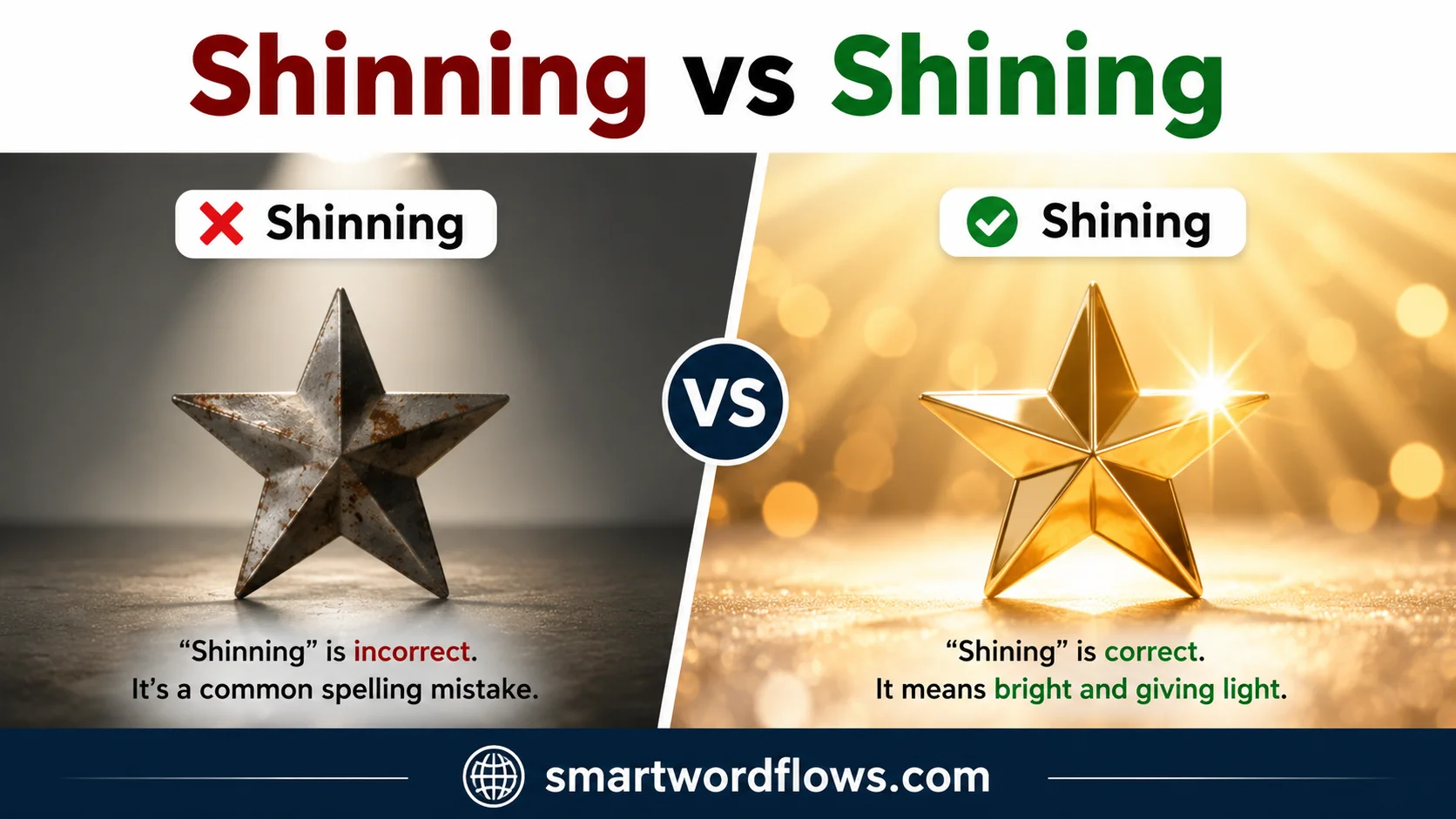

Shinning vs Shining can confuse writers because the words look nearly identical. However, shining is the correct spelling when you mean giving off or reflecting light, looking bright, or showing excellence. It is the present participle of shine and appears frequently in everyday English, school assignments, emails, blogs, and professional writing. For example, “The sun is shining brightly.”
Shinning is also a real English word, but it has a completely different meaning. It refers to climbing something by gripping it with your hands and legs, often using your shins, such as shinning up a tree or pole. Knowing this difference helps you avoid common spelling mistakes and use each word correctly. When discussing sunlight, stars, smiles, polished objects, or outstanding performance, always choose shining.
Quick Answer
Shining is the correct spelling when you mean giving off light, reflecting light, looking bright, or performing exceptionally well.
Shinning is also a correct word, but it has a different meaning. It is the -ing form of “shin,” a verb that means to climb something by using your hands, legs, or feet for support.
Consider these two sentences:
- The sun is shining brightly.
- The boy is shinning up the pole.
The first sentence talks about light. The second describes climbing.
The easiest way to remember it
Shine → shining = light or excellence
Shin → shinning = climbing
So, if you’re trying to write “The stars are shining,” don’t write “The stars are shinning.” The extra n changes the word’s origin and meaning.
Comparison Overview
The difference between shinning vs shining becomes clearer when you compare their base verbs.
| Feature | Shining | Shinning |
| Base verb | Shine | Shin |
| Basic meaning | Giving off or reflecting light | Climbing using the body for support |
| Common usage | Very common | Relatively uncommon |
| Pronunciation | /ˈʃaɪnɪŋ/ | /ˈʃɪnɪŋ/ |
| Spelling formation | shine + ing → shining | shin + ing → shinning |
| Example | The moon is shining. | He was shinning up the pole. |
| Related meaning | Brightness, success, excellence | Physical climbing |
| Typical context | Nature, appearance, achievement | Climbing, outdoor activities, physical movement |
The most important point is that the extra “n” isn’t a random spelling variation. It reflects a different base word.
When you write shining, you’re using the verb shine.
When you write shinning, you’re using the verb shin.
Main Differences Between Shinning vs Shining
The biggest difference between shinning vs shining comes down to meaning and word origin.
Shining Comes From “Shine”
The word shining comes from shine, which means to emit light, reflect light, or appear bright.
For example:
- The sun is shining through the clouds.
- Her diamond ring was shining under the lights.
- The stars were shining above the mountains.
The word can also have a figurative meaning. You might say someone is shining when they’re doing something particularly well.
For example:
Maria is shining in her new leadership role.
Maria isn’t literally producing light. Instead, shining means she’s performing impressively and standing out.
Shinning Comes From “Shin”
Shinning comes from the verb shin. In this context, shin means to climb something by pressing your body against it and using your hands and legs to move upward.
For example:
- The child was shinning up the tree.
- He started shinning up the narrow pole.
- The workers practiced shinning up ropes during training.
This meaning is much less common in everyday conversation. That’s one reason people often assume shinning must simply be a misspelling of shining.
It isn’t.
Shinning is a legitimate word when it describes the physical action of climbing in this particular way.
The Spelling Comes From Two Different Rules
The spelling difference becomes logical when you look at the verbs separately:
shine + -ing = shining
The final e in shine disappears before -ing.
Meanwhile:
shin + -ing = shinning
The final n doubles before the -ing ending.
That pattern isn’t unique to these words.
Compare:
- run → running
- sit → sitting
- swim → swimming
- shine → shining
- make → making
Understanding the base word makes the spelling much easier than memorizing the finished forms individually.
What Does “Shining” Mean?
Shining is the present participle of shine. It commonly describes something that produces light, reflects light, or appears bright.
The word also works as an adjective in many sentences.
For example:
- The shining sun warmed the garden.
- She polished the shining silverware.
- He gave a shining performance.
Depending on the sentence, shining can describe physical brightness or figurative excellence.
Literal Meaning of Shining
In its most direct sense, shining relates to light.
The source might produce its own light, such as the sun or a lamp. Alternatively, an object might appear bright because it reflects light.
Examples include:
- The sun is shining over the valley.
- The stars were shining above the quiet town.
- A bright lamp was shining through the doorway.
- The polished floor was shining in the afternoon light.
- Her silver bracelet was shining under the restaurant lights.
Notice how every example connects shining with brightness or reflected light.
Figurative Meaning of Shining
English speakers also use shining to describe someone who performs extremely well.
A student might be shining in mathematics. An athlete might have a shining performance. A new employee might be shining in their position.
Here, the word doesn’t involve physical light.
Instead, it suggests that someone’s ability, success, character, or performance stands out.
For example:
After months of practice, Daniel is finally shining on the debate team.
That sentence means Daniel is doing exceptionally well. It doesn’t suggest that Daniel is glowing like a lamp.
What Does “Shinning” Mean?
Shinning is the present participle of shin when shin means to climb using the hands and legs against a surface.
This word is perfectly valid, although you’ll encounter it far less often than shining.
For example:
- The boy was shinning up the tree.
- The climber began shinning up the narrow pole.
- He practiced shinning up the rope during training.
- The children watched him shinning up the tall trunk.
- She was shinning up the post when the coach called her back.
The physical action provides the clue.
If someone is moving upward by gripping a pole, tree, rope, or similar surface, shinning may be the appropriate word.
Why “Shinning” Looks Strange
Many readers rarely encounter the verb shin in this sense. They know the noun shin as the front part of the lower leg.
That’s why shinning can look like an obvious typo.
However, English contains many words whose less-common meanings aren’t immediately familiar. Shinning is one of them.
The important distinction is simple:
Shinning is not the normal spelling of shining. It is the -ing form of a different verb.
Why Is It “Shining” Instead of “Shinning”?
This is one of the most useful spelling questions in the shinning vs shining debate.
The answer begins with the base word.
The verb is shine, not shin.
When English adds -ing to a verb ending in a silent e, the final e commonly disappears.
Therefore:
shine + ing → shining
You can see the same pattern in several familiar words:
| Base Verb | -ing Form |
| make | making |
| write | writing |
| drive | driving |
| take | taking |
| use | using |
| shine | shining |
So shinning can’t be used when the base verb is shine.
The spelling shinning tells you that the base verb is shin.
Why Is It “Shinning” Instead of “Shining”?
The reverse question is equally important.
When you start with shin, the word already ends in a consonant after a short vowel:
s-h-i-n
Adding -ing gives:
shin + ing → shinning
The n doubles.
You see similar spelling patterns in words such as:
- run → running
- sit → sitting
- plan → planning
- stop → stopping
- swim → swimming
This helps explain why shinning has two n’s.
It isn’t an accidental extra letter. The spelling reflects the verb shin.
When Should You Use “Shining”?
Use shining whenever your sentence comes from the verb shine.
Here are the most common situations.
When Something Gives Off Light
Use shining for natural or artificial sources of light.
- The sun is shining.
- The moon is shining brightly.
- The flashlight was shining into the cave.
When Something Reflects Light
Objects can also appear shining because they reflect light.
- Her shoes were shining after polishing.
- The freshly cleaned windows were shining.
- The metal surface was shining in the sunlight.
When Someone Performs Exceptionally Well
Use shining figuratively when someone stands out because of their performance or qualities.
- She is shining in her new position.
- He has been shining throughout the competition.
- The young player is shining this season.
When Describing Something Excellent
The adjective shining can suggest something especially good, impressive, or admirable.
Common expressions include:
- a shining example
- a shining star
- a shining achievement
- a shining performance
- shining qualities
These expressions use shining, never shinning.
When Should You Use “Shinning”?
Use shinning when the sentence comes from shin in the climbing sense.
The context usually involves a person moving upward along a narrow or vertical surface.
For example:
The firefighter practiced shinning up the pole.
Here, the person is physically climbing.
Another example:
The child was shinning up the tree before his parents stopped him.
Again, the action involves climbing.
Because this meaning is relatively uncommon, many modern writers would choose climbing instead when they want maximum clarity.
For example:
- He was climbing the pole.
- She was climbing the tree.
These alternatives sound more natural in many everyday contexts.
Shining or Shinning: Which Is Correct?
The answer depends entirely on what you mean.
If you’re talking about light, brightness, reflection, success, or excellence, use shining.
If you’re talking about climbing by using your hands and legs against a surface, use shinning.
Correct Examples
| Intended Meaning | Correct Sentence |
| Light | The sun is shining. |
| Reflection | Her shoes are shining. |
| Excellence | She is shining in class. |
| Climbing | He was shinning up the pole. |
| Climbing | The boy was shinning up the tree. |
A useful rule of thumb is:
If there’s light involved, think “shining.” If there’s climbing involved, think “shinning.”
That one distinction will solve most spelling questions.
Common Mistakes With Shinning and Shining
Because the words look almost identical, spelling mistakes happen frequently.
Mistake: “The Sun Is Shinning”
Incorrect: The sun is shinning brightly.
Correct: The sun is shining brightly.
The sentence refers to shine, which means producing or giving off light.
Mistake: “She Is Shinning at Work”
Incorrect: She is shinning in her new job.
Correct: She is shining in her new job.
Here, shining means performing extremely well.
Mistake: “He Was Shining Up the Pole”
Incorrect: He was shining up the pole.
Better: He was shinning up the pole.
However, He was climbing up the pole sounds more natural for most readers.
The context involves physical climbing rather than brightness.
Mistake: Assuming “Shinning” Is Always Wrong
This is another common misunderstanding.
Shinning isn’t automatically incorrect. It has a legitimate dictionary meaning connected to the verb shin.
The mistake occurs when someone uses it as the -ing form of shine.
Shining vs Shinning in Different Sentences
Looking at contrasting sentences makes the difference easier to recognize.
Example Pair One: Sunlight
The sun is shining through the window.
The verb shining describes light.
The sun is shinning through the window.
This is incorrect if the intended meaning is that the sun is producing or sending light.
Example Pair Two: Climbing
The boy was shinning up the pole.
This can be correct because shinning describes the physical climbing action.
The boy was shining up the pole.
This doesn’t communicate the intended climbing meaning.
Example Pair Three: Performance
Our youngest player is shining this season.
The player is performing exceptionally well.
Our youngest player is shinning this season.
This is incorrect because there is no climbing meaning.
Example Pair Four: Stars
The stars were shining above the lake.
The stars appeared bright.
The stars were shinning above the lake.
This is incorrect because the intended verb is shine.
Shining in Different Contexts
The flexibility of shining makes it much more common than shinning.
Literal Light
Shining can describe sunlight, moonlight, stars, lamps, candles, and other sources or reflections of light.
The morning sun was shining across the fields.
Reflection
A polished surface can look shining because it reflects light.
The newly polished table was shining under the chandelier.
Personal Achievement
You can use shining to praise someone who performs well.
Aisha is shining in her science classes this year.
Character or Qualities
The word can also describe admirable qualities.
His kindness is one of his shining qualities.
This figurative use connects brightness with something noticeably positive.
Shinning in Different Contexts
The word shinning has a much narrower meaning.
It generally describes climbing or scrambling upward by using the body against a surface.
You may encounter it in:
- Descriptions of tree climbing
- Accounts involving poles or posts
- Descriptions of rope climbing
- Outdoor or physical activities
- Older or more literary writing
For modern everyday writing, climbing often provides a clearer alternative.
That’s especially useful when your readers might not know the less-common verb shin.
Read More: Carrer vs Career: The Correct Spelling and Difference
Shining vs Shinning: Pronunciation
The words are not pronounced exactly the same.
Shining is generally pronounced approximately like:
SHY-ning
Its first syllable uses the long i sound found in shine.
Shinning is generally pronounced approximately like:
SHIN-ing
Its first syllable uses the short i sound found in shin.
This pronunciation difference reflects their different roots:
- shine → shining
- shin → shinning
For many speakers, hearing the vowel clearly can help identify which word they need.
Is “Shinning” a Misspelling of “Shining”?
Sometimes, yes. But not always.
If someone writes:
The moon is shinning.
They almost certainly intended shining and simply used the wrong spelling.
However, consider:
The athlete was shinning up the pole.
In that sentence, shinning can be completely correct.
This is an important distinction because spelling correction tools may not always understand the intended context perfectly. A word can look unusual without being wrong.
A Simple Context Test
Ask yourself:
Does the sentence involve light or exceptional performance?
If yes, choose shining.
Does the sentence describe a person climbing something using their body for support?
If yes, shinning may be correct.
If neither meaning fits, check the base verb before choosing the spelling.
Easy Trick to Remember the Difference
Here’s the simplest memory trick:
SHINE = LIGHT = SHINING
Think about:
- sunlight
- stars
- polished objects
- success
- excellence
All of these can use shining.
SHIN = CLIMB = SHINNING
Think about:
- trees
- poles
- posts
- physical climbing
These can use shinning.
The extra n belongs to shin, not shine.
A Closer Look at the Grammar
Both shining and shinning use the -ing suffix. However, their grammatical foundations differ because their base verbs differ.
Shine
Shine can function as a verb meaning to emit or reflect light.
Its present participle is:
shine → shining
Example:
The stars are shining tonight.
The word shining appears after the auxiliary verb are, forming the present progressive construction.
Shin
Shin can also function as a verb.
Its present participle is:
shin → shinning
Example:
The climber was shinning up the pole.
Here, shinning follows was to describe an action in progress.
Understanding the grammar reinforces the spelling because each -ing form belongs to a different verb.
Quick Case Studies: Choosing the Right Word
Case Study: A Weather Report
Suppose you’re describing a bright summer afternoon.
The sun is shining brightly over the city.
Shining is correct because the sentence describes sunlight.
Using shinning would incorrectly suggest the climbing-related verb.
Case Study: A School Report
Imagine a teacher praising a student’s performance.
Emma is shining in her English class.
Here, shining means Emma is doing particularly well.
The sentence uses the figurative sense of shine.
Case Study: An Outdoor Adventure
Now imagine someone climbing a narrow pole.
The climber was shinning up the pole.
In this context, shinning can be correct because the action comes from shin.
Still, climbing up the pole would usually sound more natural to a modern general audience.
Common Expressions With “Shining”
You’ll often see shining in established phrases.
Shining Star
A shining star can literally describe a bright star. Figuratively, it can describe someone who stands out because of their talent or success.
Shining Example
A shining example means an especially good example of something.
She is a shining example of dedication and patience.
Shining Armor
Shining armor literally describes bright or polished armor. The expression also appears in the familiar phrase “knight in shining armor.”
Shining Moment
A shining moment refers to a particularly memorable or successful moment.
Winning the final match was his shining moment.
None of these expressions uses shinning.
Shining vs Shinning: At-a-Glance Guide
| If you mean… | Use… | Example |
| Producing light | Shining | The lamp is shining brightly. |
| Reflecting light | Shining | The glass was shining in the sun. |
| Doing exceptionally well | Shining | She is shining at work. |
| Standing out positively | Shining | He delivered a shining performance. |
| Climbing a pole | Shinning | He was shinning up the pole. |
| Climbing a tree using hands and legs | Shinning | The boy was shinning up the tree. |
Useful Facts About Shining and Shinning
A few facts make this spelling difference easier to remember:
- Shining comes from the verb shine.
- Shinning comes from the verb shin.
- Shining is vastly more common in ordinary modern writing.
- Shinning has a specific physical meaning related to climbing.
- The final e in shine disappears before -ing.
- The final n in shin doubles before -ing.
- Shining can have both literal and figurative meanings.
- Shinning generally has a much narrower, physical meaning.
- Climbing is often a clearer modern alternative to shinning.
- The two words have different vowel sounds in pronunciation.
Frequently Asked Questions
Is “shining” the correct spelling?
Yes. Shining is the correct spelling when you’re using the verb shine to describe producing or reflecting light or performing exceptionally well.
Is “shinning” a real word?
Yes. Shinning is a real English word. It comes from shin and describes a particular type of climbing that uses the hands and legs for support.
Why isn’t “shine” spelled “shinning” when adding “-ing”?
Because shine follows the spelling pattern in which its final silent e drops before -ing.
Therefore:
shine + ing = shining
Why does “shin” become “shinning”?
The verb shin follows a consonant-doubling pattern when forming its -ing form.
Therefore:
shin + ing = shinning
Should you write “the sun is shining” or “the sun is shinning”?
You should write:
The sun is shining.
The sentence refers to shine, meaning that the sun is producing or appearing to give light.
Is “shinning” commonly used?
Shinning is much less common than shining in everyday English. Many modern writers use climbing instead because it communicates the physical action more directly.
FAQs :
1. Is “shining” or “shinning” correct?
Shining is correct when you mean giving off or reflecting light, appearing bright, or performing exceptionally well.
2. Is “shinning” a real word?
Yes, shinning is a real English word. It means climbing something by gripping it with your hands and legs.
3. What is the difference between shining and shinning?
Shining comes from the verb shine and relates to light or excellence. Shinning relates to climbing using the shins.
4. Which spelling should I use in professional writing?
Use shining when referring to brightness, light, beauty, or excellent performance. It’s the standard spelling in professional English.
5. How can I remember shining vs shinning?
Remember that shining comes from shine. Use shinning only when describing the action of climbing with your shins.
Conclusion :
Understanding Shinning vs Shining is easy once you know their meanings. Shining is the correct choice for light, brightness, beauty, or excellence, while shinning refers to climbing with the help of your shins. Using the right spelling will make your writing clearer and more accurate.