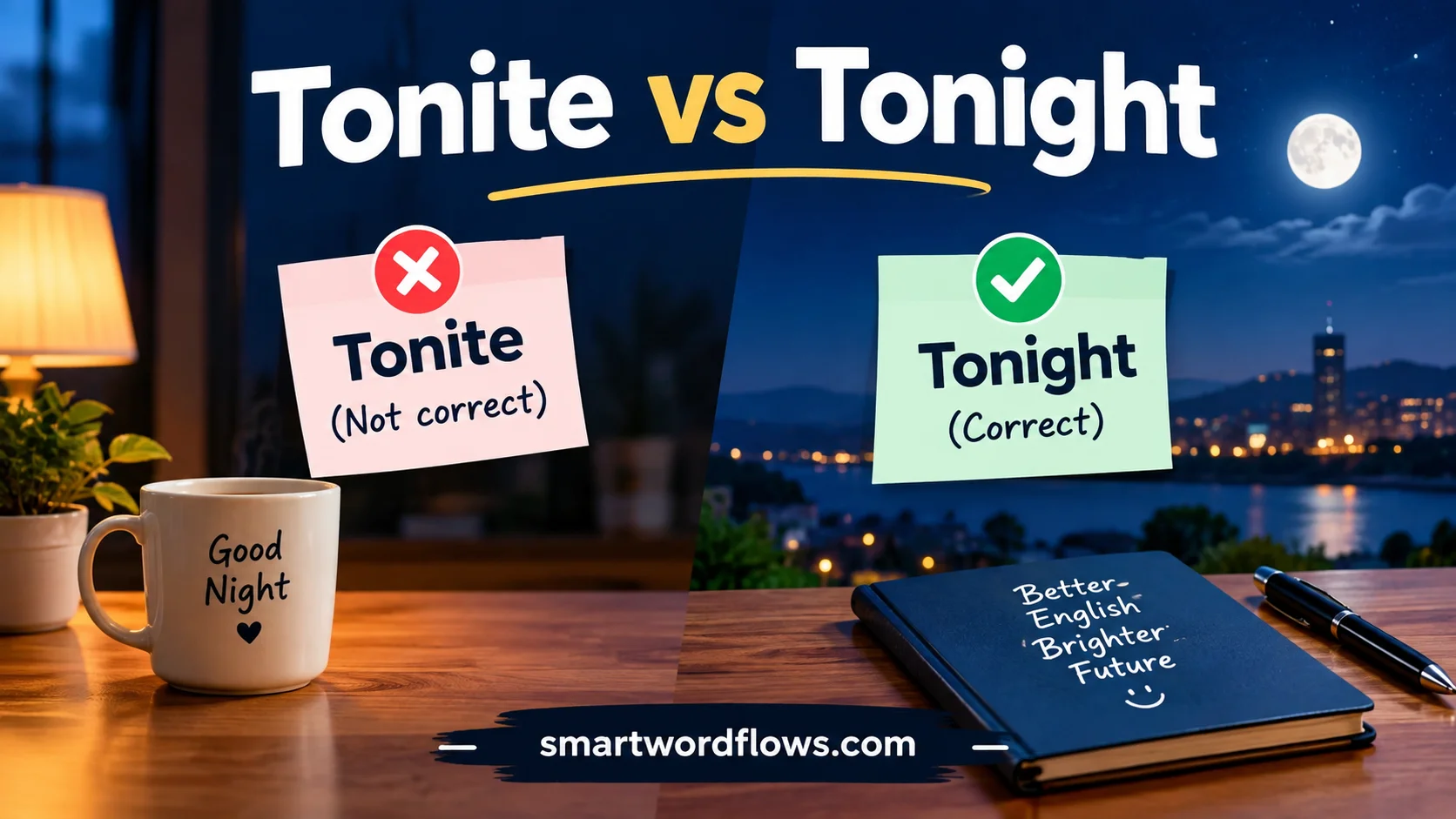

Tonite vs Tonight is a common spelling confusion because both forms have the same pronunciation. Tonight is the standard and correct spelling used in dictionaries, formal writing, academic work, professional communication, and everyday English. Tonite is an informal variation that may appear in texting, social media, advertisements, song titles, or creative contexts. Knowing this difference helps writers choose the appropriate word and avoid unnecessary spelling mistakes.
Although Tonite can be understood easily, it is generally less suitable for formal contexts and polished writing. Tonight should be your preferred choice in essays, emails, articles, school assignments, business documents, and professional messages. Learning their meaning, usage, context, and key differences can improve your writing skills and make your communication clearer. Once you understand when each form appears, choosing the right spelling becomes simple.
Quick Answer: Tonite vs Tonight
Tonight is the standard spelling and the form you should normally use in English writing.
Tonite has the same basic meaning as tonight, but it is generally treated as an informal or nonstandard spelling. You may see it in text messages, advertisements, posters, social media posts, event promotions, song titles, or branding.
The simple rule
- Tonight → standard English spelling
- Tonite → informal or stylized variant
- Formal writing → use tonight
- Casual writing → tonite may appear, depending on the intended style
Examples
We’re meeting tonight. ✅
We’re meeting tonite. ⚠️ Informal/stylized
The meaning doesn’t change. The register and spelling do.
Comparison Overview
| Feature | Tonight | Tonite |
| Standard spelling | Yes | No |
| Meaning | This evening or night | This evening or night |
| Common in formal writing | Yes | No |
| Common in casual writing | Yes | Yes |
| Common in texting | Yes | Yes |
| Used in advertising | Yes | Sometimes |
| Used in professional writing | Yes | Generally avoid |
| Pronunciation | Same basic pronunciation | Same basic pronunciation |
| Recommended for general writing | Yes | No |
| Tone | Neutral | Informal/stylized |
The important point is that tonite isn’t a different word with a different definition. It represents the same time expression in a less standard spelling.
Main Differences Between Tonite vs Tonight
Although tonite and tonight communicate the same basic idea, their use isn’t interchangeable in every situation. The biggest difference involves standard spelling, formality, audience, and writing purpose.
Tonight Is the Standard Spelling
Tonight is the established standard form in contemporary English.
It refers to the current evening or night. For example:
- I’ll call you tonight.
- Are you working tonight?
- The game starts tonight.
- We’re having dinner tonight.
- She plans to study tonight.
Because tonight is the standard spelling, you can use it almost anywhere.
It works in casual conversation, professional communication, academic writing, journalism, business documents, websites, and everyday messages.
Tonite Is an Informal Variant
Tonite is a shortened spelling of tonight. It generally appears when a writer wants to create a casual, compact, playful, or promotional tone.
For example:
- Party tonite!
- Live music tonite.
- See you tonite!
- Special offer tonite only.
These examples are easy to understand. However, the informal spelling doesn’t make it the preferred choice for standard written English.
Think of tonite as a stylistic shortcut rather than the spelling you should automatically choose.
The Meaning Doesn’t Change
One of the easiest mistakes is assuming that tonite and tonight have different meanings.
They don’t.
Both refer to the evening or night of the current day.
Compare:
We’ll watch the movie tonight.
and:
We’ll watch the movie tonite.
The basic message remains the same. What changes is the writing style.
The first sentence uses standard spelling. The second gives the sentence a more casual or deliberately informal appearance.
The Difference Is Mainly About Register
In English, register describes the level or style of language used in a particular situation.
For example, you might speak differently to your best friend than you would in a formal business letter. The same principle applies to spelling.
Tonight has a neutral register. It doesn’t draw attention to itself.
Tonite has a noticeably informal register. It can make writing feel shorter, more casual, or more promotional.
That difference becomes important when your audience expects standard English.
What Does Tonight Mean?
Tonight refers to the evening or night occurring on the current day.
It commonly answers the question “When?”
For example:
When will you arrive?
I’ll arrive tonight.
It can describe an action, event, plan, or condition connected with the current evening or night.
Tonight as an Adverb
The most common use of tonight is as an adverb.
An adverb can provide information about when an action happens. In this role, tonight tells the reader that something happens during the current evening or night.
Examples include:
- We’re going out tonight.
- He’ll finish the work tonight.
- They’re playing football tonight.
- I need to sleep early tonight.
- Will you be home tonight?
Notice how naturally the word fits into each sentence.
It can appear at the end of a sentence, which is extremely common:
I’m studying tonight.
It can also appear at the beginning:
Tonight, we’re having dinner at home.
This flexibility makes tonight useful in everyday communication.
Tonight as a Noun
Tonight can also function as a noun in certain constructions.
For example:
Tonight was unforgettable.
Here, tonight refers to the particular evening itself rather than simply describing when an action happened.
Another example is:
Tonight is the night we’ve been waiting for.
This construction treats tonight as the subject of the sentence.
However, its adverbial use is much more common in everyday English.
Tonight in Questions
You’ll frequently see tonight in questions about plans and schedules.
Examples:
- What are you doing tonight?
- Are you free tonight?
- Where are you going tonight?
- What time does the show start tonight?
- Will you call me tonight?
These sentences sound natural because tonight clearly identifies the relevant time.
What Does Tonite Mean?
Tonite generally means the same thing as tonight.
The major difference lies in spelling and style.
Writers sometimes use tonite because it looks shorter and more casual. It has appeared in informal communication and promotional language for many years.
You might encounter it in:
- Text messages
- Social media posts
- Posters
- Event advertisements
- Store promotions
- Informal announcements
- Song or event titles
- Branding
- Casual notes
For example:
Concert tonite!
A reader immediately understands the intended meaning. The spelling creates a casual promotional feel.
Is Tonite a Real Word?
Tonite is a recognizable English variant, but that doesn’t mean it is the preferred spelling in standard English.
This distinction matters.
A word can appear frequently in real-world communication without becoming the standard form recommended for formal writing.
English contains many informal spellings and shortened forms. Some become widely accepted over time while others remain strongly associated with casual usage.
Tonite generally belongs to the latter category.
Therefore, recognizing tonite doesn’t mean you should automatically use it in every piece of writing.
Is Tonite Correct or Is Tonight Correct?
If the question is asking for the standard spelling, choose tonight.
That’s the clearest answer.
Standard English
I’ll see you tonight. ✅
Informal Usage
I’ll see you tonite. ⚠️
The second version isn’t confusing. Most readers will understand it immediately. However, it doesn’t follow the standard spelling used in formal English.
This is why grammar and spelling questions often require more than a simple “right or wrong” distinction.
A spelling can be understandable and widely recognized while still being inappropriate for formal writing.
When Should You Use Tonight?
In most situations, tonight is the best choice because it works across different writing styles.
Use tonight when you’re writing:
- School assignments
- College papers
- Business emails
- Professional documents
- Blog posts
- News articles
- Reports
- Resumes
- Formal invitations
- Customer communications
- Website content
- General correspondence
Professional Example
The team will review the proposal tonight.
This sentence looks neutral and professional.
Using tonite would introduce an unnecessary casual element:
The team will review the proposal tonite.
The meaning remains clear. However, the spelling doesn’t match the professional tone as well.
Academic Example
The researchers will analyze the remaining samples tonight.
For academic writing, standard spelling is especially important. There’s rarely a reason to replace tonight with an informal variant.
When Might You See Tonite?
Although tonight should be your default choice, tonite has a legitimate place in certain informal contexts.
It may be used when the writer intentionally wants a casual or attention-grabbing style.
Advertising
Advertisements sometimes favor shorter wording because space and visual impact matter.
For example:
LIVE MUSIC TONITE!
The spelling helps create a relaxed promotional style.
Social Media
A casual social post might say:
Who’s coming out tonite?
The writer isn’t necessarily making a spelling mistake. They may simply be using an informal style.
Text Messages
A friend might write:
See you tonite.
In a private message, standard spelling isn’t always the main concern. Speed, tone, and informality can matter more.
Posters and Promotions
Event organizers may choose tonite because it looks compact or fits a particular design.
For example:
ONE NIGHT ONLY — LIVE SHOW TONITE!
In this context, the unusual spelling can be a deliberate stylistic choice.
Read This: Cubical vs Cubicle: Meaning, Differences, Examples, and Correct Usage
Tonite vs Tonight in Texting and Social Media
Digital communication has changed how people approach spelling.
When people text friends or post casually online, they often shorten words, omit punctuation, or use informal spellings. These choices can signal familiarity and speed.
Examples include:
- tonite instead of tonight
- gonna instead of going to
- wanna instead of want to
- tho instead of though
However, not every shortened form belongs in every situation.
A text to a close friend and an email to a hiring manager serve very different purposes.
Casual Message
Are you coming tonite?
This can sound relaxed and conversational.
Professional Message
Are you available tonight?
The second version is more appropriate for workplace communication.
The lesson isn’t that informal writing is always wrong. Instead, match your language to your audience and purpose.
Tonite vs Tonight in Formal Writing
For formal writing, tonight is the clear choice.
This includes professional and academic environments where readers expect conventional spelling.
Consider these examples:
| Context | Better Choice | Example |
| Academic paper | Tonight | The observation will continue tonight. |
| Business email | Tonight | The meeting will begin tonight. |
| Blog article | Tonight | The event takes place tonight. |
| Text message | Either, depending on style | See you tonight/tonite. |
| Social media | Either, depending on style | Party tonight/tonite! |
| Formal invitation | Tonight | Dinner will begin tonight. |
| Advertisement | Either, depending on branding | Special event tonight/tonite. |
The central issue is context.
If there’s no particular reason to use an informal spelling, tonight is the safer option.
Tonite vs Tonight: Examples in Sentences
Seeing the two forms side by side makes the distinction easier to understand.
Standard Examples With Tonight
- I’ll finish the assignment tonight.
- Are you going to the concert tonight?
- We’re meeting at eight tonight.
- She plans to cook dinner tonight.
- The store closes early tonight.
- They’re traveling home tonight.
- The match begins tonight.
- Please call me tonight.
Informal Examples With Tonite
- See you tonite!
- Party tonite!
- Who’s going out tonite?
- Movie tonite?
- Live show tonite!
- Dinner tonite?
The meaning stays almost identical. The spelling changes the tone.
Common Mistakes With Tonite and Tonight
Understanding the difference is simple once you know what to watch for.
Mistake: Using Tonite in Formal Writing
One of the most common problems occurs when someone uses tonite in a professional or academic document.
For example:
Please attend the meeting tonite.
A better standard-English version is:
Please attend the meeting tonight.
There’s no need for the informal spelling in this context.
Mistake: Assuming Tonite Has a Different Meaning
Another mistake is treating tonite as a separate time expression.
It doesn’t normally indicate a different part of the evening. Both forms point to the current evening or night.
Mistake: Thinking Shorter Means Better
Shorter isn’t automatically better.
Although tonite removes two letters from the conventional spelling, those letters don’t create a problem for readers.
In standard writing, clarity and convention usually matter more than saving a couple of characters.
Mistake: Replacing Tonight Everywhere
The opposite mistake also happens.
Some writers assume that because tonite is informal, it should never appear anywhere.
That’s too broad.
Informal spelling can be intentional in advertising, branding, dialogue, social posts, and creative contexts. The important question is whether the style fits the purpose.
Why Do People Spell Tonight as Tonite?
The spelling tonite is easy to understand because it reflects a simplified spelling pattern.
English speakers often shorten words in informal communication. Digital communication has made this habit even more visible.
There are several reasons a writer might choose tonite:
- It looks shorter.
- It feels informal.
- It can suit advertising language.
- It may fit a sign or graphic better.
- It can create a conversational tone.
- It may be part of a brand or event name.
- The writer may simply prefer the informal spelling.
However, popularity in casual communication doesn’t automatically make a spelling the standard form.
Tonite vs Tonight: A Practical Case Study
Imagine two businesses promoting events.
Business A: Professional Conference
The announcement says:
Annual Business Conference — Tonight at 7:00 PM
This wording feels clear and professional. The standard spelling fits the event and audience.
Business B: Local Music Event
The poster says:
LIVE BAND TONITE!
Here, the informal spelling may be deliberate. The goal is to create an energetic, casual promotional style.
Neither example creates a different meaning.
The difference lies in branding and tone.
This illustrates an important writing principle: standard English and intentional informal English can coexist.
Tonite vs Tonight in Different Types of Writing
| Type of Writing | Recommended Form | Reason |
| Academic paper | Tonight | Standard spelling |
| Professional email | Tonight | Clear and conventional |
| Website article | Tonight | Standard English |
| News article | Tonight | Formal editorial style |
| Personal text | Tonight or tonite | Depends on personal style |
| Social media | Tonight or tonite | Informal style may be intentional |
| Advertisement | Depends on branding | Informal spelling may create impact |
| Event poster | Depends on design | Either can work stylistically |
| Formal invitation | Tonight | Conventional wording |
| Creative dialogue | Context-dependent | Character voice may matter |
Tonight vs Tonite: Which One Should You Use?
If you’re unsure, choose tonight.
It’s the standard spelling. It works in practically every situation. You won’t need to worry about sounding too informal or appearing to make a spelling mistake.
Use tonite only when the informal spelling serves a clear purpose.
Quick Decision Guide
Choose “tonight” when:
- You’re writing professionally.
- You’re completing schoolwork.
- You’re publishing an article.
- You’re writing an email.
- You’re preparing a report.
- You’re communicating with an unfamiliar audience.
- You want standard English.
“Tonite” may fit when:
- You’re texting a friend.
- You’re writing casual social media content.
- You’re creating an informal advertisement.
- You’re designing a promotional poster.
- You’re using a stylized title or brand name.
- You intentionally want a casual tone.
Is Tonite a Misspelling?
The answer depends on context.
In standard formal writing, tonite would normally be treated as an incorrect or nonstandard spelling of tonight.
In a casual or promotional context, however, the writer may use it intentionally.
That’s why simply calling every occurrence of tonite a typo can miss the bigger picture.
For example:
See you tonite!
A friend may deliberately write it that way.
But:
The report must be submitted tonite.
in a formal workplace document would be better written as:
The report must be submitted tonight.
Context changes how the spelling should be interpreted.
Tonight and Tonite: Meaning, Grammar, and Usage Facts
Here are the most useful facts to remember:
- Tonight is the standard spelling.
- Tonite has the same basic meaning.
- Tonight can function as an adverb and can also appear in noun constructions.
- Tonite is primarily associated with informal or stylized writing.
- Both forms generally refer to the current evening or night.
- Standard English favors tonight.
- Informal writing can use tonite when the style is intentional.
- The pronunciation generally remains the same despite the different spelling.
- The spelling choice can affect the tone without changing the basic meaning.
FAQs :
1. Is Tonite or Tonight correct?
Tonight is the standard and correct spelling in English. It is appropriate for formal, academic, professional, and everyday writing. Tonite is an informal variation commonly found in texting, social media, advertisements, and creative contexts.
2. Is Tonite a real word?
Yes, Tonite is used as an informal spelling of Tonight, but it is not the preferred form in standard English writing. You should generally use Tonight when writing an essay, email, article, or professional message.
3. Can I use Tonite in a text message?
Yes. Tonite can be used in casual text messages, social media posts, or other informal communication. Since these settings often allow shortened or stylistic spellings, the informal form may be acceptable depending on the context.
4. Why do people spell Tonight as Tonite?
People often write Tonite because it represents the word’s pronunciation in a shorter, more casual-looking form. It has also appeared in advertising, song titles, branding, and informal communication. However, Tonight remains the standard spelling.
5. Which spelling should I use in formal writing?
Use Tonight in formal writing. It is the safer choice for school assignments, essays, business emails, professional documents, articles, and academic writing. Using the standard spelling keeps your writing clear and polished.
Conclusion :
Tonight is the standard spelling you should use in most situations, especially in formal, academic, and professional writing. Tonite is an informal variation that can appear in texting, social media, advertising, and creative contexts. Although both forms are pronounced the same, they differ in their level of standard usage. When you’re unsure which one to choose, Tonight is the reliable choice.