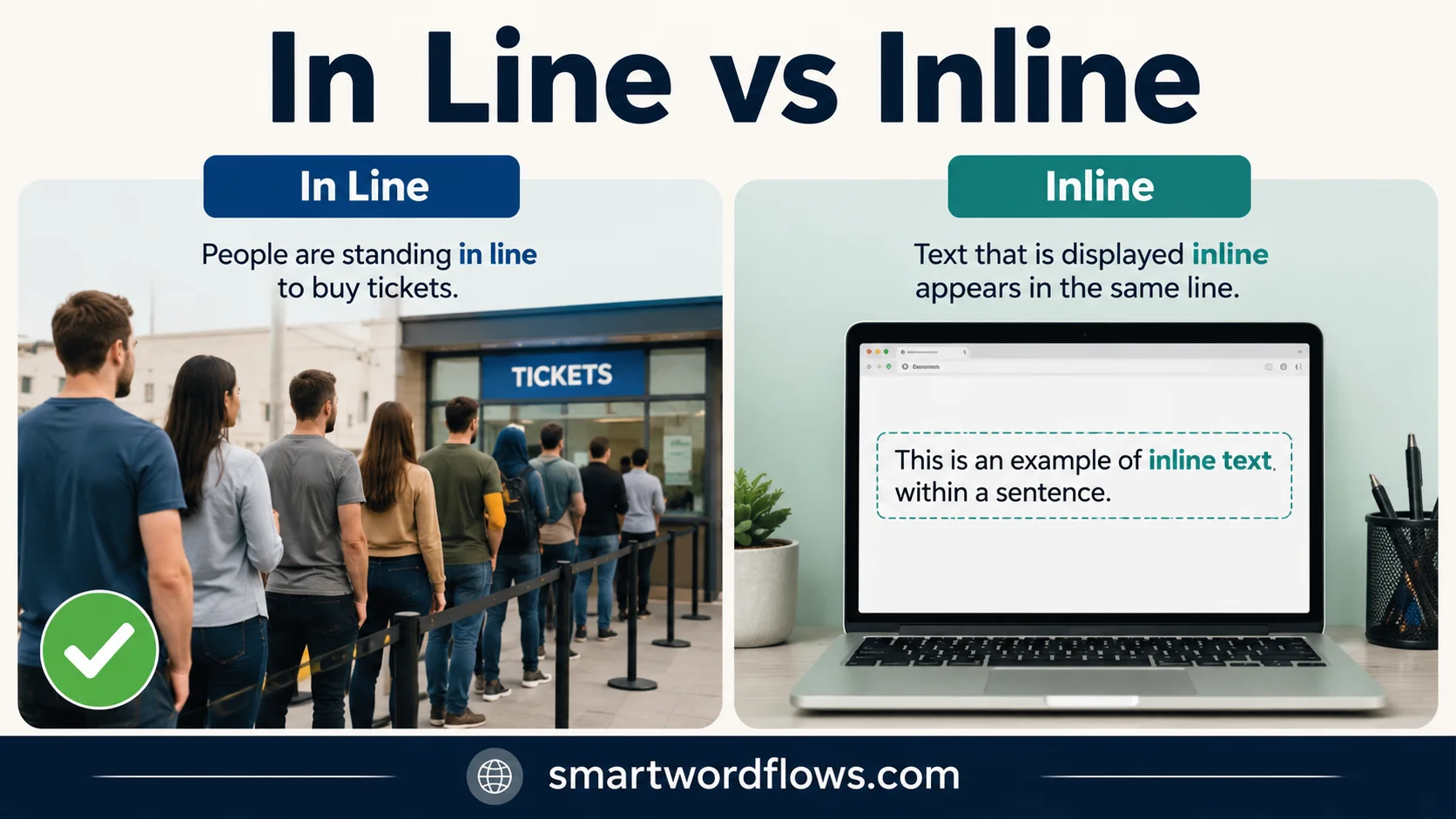

When comparing In Line vs Inline, the difference may seem small, but spacing and context can completely change how each term works. In line usually refers to people or things arranged in a row, such as waiting in line or keeping text in line. Inline, however, commonly describes something positioned within another element or existing content. You’ll often see inline in programming, CSS, computing, and web design, where it has a specific technical meaning. Knowing these distinctions can help you choose the correct form confidently.
The confusion becomes greater when you encounter in-line, the hyphenated form. Although it can appear in some writing, modern usage often prefers either in line or inline, depending on the meaning and context. In manufacturing or mechanical descriptions, in-line may still appear in terms such as an in-line engine or in-line production. Meanwhile, inline can also work as an adjective or noun in technical language. Understanding these patterns makes your writing clearer and helps you avoid common grammar and spelling mistakes.
Quick Answer
Use in line as two words when you mean in a row, in a queue, aligned, or consistent with something.
Use inline as one word when it acts as an established adjective or adverb describing something incorporated into a larger flow, positioned within something, or forming a particular technical or compound term.
Quick examples
- “The customers are waiting in line.” — Correct because the phrase describes a queue.
- “The chairs are in line along the wall.” — Correct because it describes physical arrangement.
- “The proposal is in line with our goals.” — Correct because it means consistent with the goals.
- “The developer added inline code.” — Correct because inline is a technical compound.
- “The application supports inline editing.” — Correct because the editing occurs directly within the existing interface or content.
- “The car has an inline-four engine.” — Correct because inline forms part of an established technical term.
The easiest rule is simple: don’t automatically replace “in line” with “inline.” First determine what the sentence actually means.
Comparison Overview
| Form | Main function | Common meaning | Example |
| In line | Phrase | In a row, queue, sequence, or agreement | “Please wait in line.” |
| Inline | Adjective/adverb or compound element | Incorporated into or arranged within something | “The page contains inline images.” |
| In line with | Phrase | Consistent with or aligned with | “The decision is in line with company policy.” |
| Inline code | Technical term | Code placed within surrounding text or code | “Use inline code for short commands.” |
| Inline editing | Technical term | Editing directly within the displayed content | “The app allows inline editing.” |
The key difference isn’t simply two words versus one word. Grammar and meaning matter more than spelling alone.
In line usually describes a relationship or position using a prepositional phrase. Inline, meanwhile, often modifies a noun or describes how something exists within another structure.
That distinction becomes especially useful when a sentence could look correct at first glance.
Main Differences Between In Line and Inline
The most important difference between in line vs inline is how each form functions and what relationship it expresses.
In Line
In line generally describes something that exists in a row, sequence, queue, or state of agreement.
Consider these examples:
- “The children stood in line outside the classroom.”
- “The cars moved in line through the checkpoint.”
- “Her actions were in line with the agreement.”
- “The shelves are in line with one another.”
Here, in line acts as a phrase rather than a single compound adjective.
Inline
Inline commonly describes something that exists within the flow or structure of something else.
For example:
- “The article contains inline links.”
- “The editor supports inline formatting.”
- “The application provides inline editing.”
- “The webpage displays inline images.”
In these examples, inline works naturally as part of a compound expression.
The important distinction
Think of the two forms this way:
In line usually tells you where something is or whether something agrees with another thing.
Inline usually tells you that something has been incorporated into an existing flow, structure, or system.
This isn’t an absolute rule for every specialized use. English contains established compounds whose spelling depends on convention and field-specific usage.
What Does “In Line” Mean?
In line is a two-word phrase with several common meanings in everyday US English.
Its most familiar meaning is standing or being arranged in a row. You might stand in line at a store, wait in line at an airport, or put several objects in line.
The phrase can also describe agreement, consistency, or conformity, especially in the construction “in line with.”
“In Line” for a Physical Position
When people or objects form a row, in line is the natural choice.
For example:
- The students waited in line before entering the auditorium.
- Several cars were parked in line beside the building.
- The children stood in line for their turn.
- The chairs were arranged in line along the corridor.
- Everyone remained in line until the doors opened.
The phrase can describe either a literal queue or a physical arrangement.
“In Line” for Agreement or Conformity
Another major use appears in “in line with.” Here, the phrase doesn’t involve a physical line at all.
Instead, it means consistent with, compatible with, or aligned with something.
For example:
- “The new policy is in line with federal requirements.”
- “Her recommendation is in line with the company’s long-term strategy.”
- “The results are in line with earlier research.”
This meaning appears frequently in business, education, journalism, finance, and professional communication.
“In Line” in Everyday Expressions
You’ll also see the phrase in expressions such as:
- in line for — likely to receive or obtain something
- in line with — consistent with something
- keep in line — maintain order or obedience
- get in line — join a queue or, figuratively, follow an established order
For example, “She is in line for a promotion” doesn’t mean she is physically standing in a queue. It means she is considered a likely candidate for the promotion.
What Does “Inline” Mean?
Inline is a one-word form used in several established contexts.
Its broad idea involves something being within, incorporated into, or directly part of an existing line, flow, structure, or system.
The exact meaning depends on the field.
In digital publishing, for instance, an inline image appears within the surrounding content rather than functioning as a separate block. In programming, inline code can refer to code placed directly within surrounding text or an inline function or expansion, depending on the programming language and context.
“Inline” in Technology and Computing
Technology uses inline extensively.
Common expressions include:
- inline code
- inline element
- inline editing
- inline image
- inline style
- inline function
- inline comment
The term generally indicates that something exists directly within an existing structure rather than separately from it.
For example, a technical guide might say:
“Use inline code when referring to a short command within a paragraph.”
The word inline tells the reader that the code appears as part of the surrounding text.
“Inline” in Web Development
Web development provides one of the clearest examples of specialized inline usage.
CSS and HTML terminology commonly uses the word inline to describe elements, formatting, and styles that participate in the flow of surrounding content.
For example:
- inline element
- inline style
- inline-block
- inline formatting
These are established technical terms. Writing them as in line would generally change or obscure the intended technical meaning.
“Inline” in Editing and Software
Many modern applications use inline editing.
With inline editing, you don’t necessarily open a separate editing screen. Instead, you modify content directly where it appears.
For example, a project-management application might let you click a task title and change it immediately. That’s commonly described as inline editing.
This usage has become especially common in software interfaces, content-management systems, spreadsheets, and web applications.
“Inline” in Sports and Equipment
Inline also appears in established compound terms outside computing.
Examples include:
- inline skates
- inline skating
- inline engine
- inline-four engine
An inline engine, for example, places its cylinders in a single row. The compound spelling has a specific technical meaning.
Similarly, inline skates have wheels arranged in a single line rather than using the two-by-two arrangement associated with traditional roller skates.
In Line With vs Inline With
This is one of the most common points of confusion.
When you mean consistent with, compatible with, or aligned with, the standard phrase is usually “in line with.”
For example:
- “The plan is in line with our objectives.”
- “The price is in line with current market conditions.”
- “The decision was in line with the company’s policy.”
- “The findings are in line with previous studies.”
Writing “inline with” in these sentences is generally inappropriate in standard US English.
However, inline can appear before a noun in technical or descriptive contexts.
For example:
- inline processing
- inline editing
- inline formatting
- inline documentation
The grammatical position helps you identify the correct form.
Also Read This: Half Day vs Half-Day: Which Is Correct and How to Use Each?
In Line or Inline for Alignment?
The word alignment can make this distinction tricky because both expressions can relate to things being aligned.
If you’re talking about a physical row or arrangement, use in line.
“The desks are in line with the windows.”
If you’re using a specialized compound that describes something incorporated into an existing system or flow, inline may be appropriate.
“The application displays the image inline with the article.”
There’s an important nuance here. English usage can vary in specialized contexts. Technical writers often use inline when describing content embedded within a document or interface.
Meanwhile, in line with remains the normal choice when the meaning is consistent with or aligned with a standard, plan, expectation, or rule.
Common Examples of “In Line”
Here are practical examples showing how in line works in everyday and professional English.
- The customers waited in line for nearly twenty minutes before entering the store.
- Please keep the boxes in line with the markings on the floor.
- Her proposal is in line with the department’s annual goals.
- The children stood in line while their teacher counted everyone.
- The company’s spending remains in line with its approved budget.
- Several buildings sit in line along the narrow coastal road.
- His explanation wasn’t in line with the evidence presented earlier.
- The players waited in line before taking their turn.
Notice how these examples involve queues, physical arrangement, or agreement.
Those meanings strongly favor the two-word form.
Common Examples of “Inline”
The following examples show common contexts where inline appears as a single word.
- The website displays inline images throughout the article.
- The editor lets users make inline changes without opening another page.
- Developers often use inline code when documenting short commands.
- The application supports inline formatting for selected text.
- The vehicle uses an inline-six engine.
- The webpage contains an inline style on the heading.
- The software provides inline comments during collaborative editing.
- The documentation includes inline examples beside the relevant instructions.
Here, inline forms established descriptive or technical expressions.
Common Mistakes With “In Line” and “Inline”
Because the forms look so similar, writers often treat them as interchangeable. That shortcut causes several recurring errors.
Using “inline” for every meaning of “in line”
A sentence such as:
“The customers stood inline.”
doesn’t follow the usual standard form for describing a queue in American English.
The natural sentence is:
“The customers stood in line.”
The physical queue calls for the two-word phrase.
Writing “inline with” to mean “consistent with”
This mistake appears frequently in workplace writing.
Incorrect:
“The recommendation is inline with our strategy.”
Standard:
“The recommendation is in line with our strategy.”
The phrase in line with has its own established meaning.
Splitting established technical compounds
The reverse mistake can happen in technical writing.
For example, established expressions such as inline editing, inline code, and inline element normally appear as one word.
Writing “in line editing” can make the phrase look like ordinary positional language rather than a technical term.
Choosing based on pronunciation
Both forms can sound nearly identical when spoken.
That’s why listening for the difference won’t always help. Instead, look at the function and meaning of the word in the sentence.
How to Remember the Difference
A useful memory trick is to focus on the idea behind the expression.
In line = a position or relationship.
Think:
- in a queue
- in a row
- in sequence
- in line with a rule
- in line with expectations
Inline = incorporated into a structure or flow.
Think:
- inline code
- inline editing
- inline images
- inline formatting
- inline elements
A simple mental test can help:
Could you naturally replace the phrase with “in a row” or “consistent with”?
If yes, in line is probably the right choice.
If you’re describing a recognized technical or compound term involving something being integrated into an existing flow, inline may be correct.
In Line vs Inline in Professional Writing
Professional writing makes the distinction especially important because unclear word choices can make otherwise polished documents look careless.
Use in line for statements about policies, expectations, plans, standards, goals, budgets, and physical arrangement.
For example:
“The revised procedure is in line with the company’s safety standards.”
Use inline when you’re discussing software, web design, programming, document formatting, or established technical terminology.
For example:
“The content management system provides inline editing.”
This distinction also helps writers avoid unnecessary jargon. If you’re simply describing a group of people standing in a queue, in line is clearer than trying to force a technical-sounding construction into the sentence.
In Line vs Inline in Technical Writing
Technical language sometimes gives familiar words specialized meanings.
The word inline is particularly common in technology because developers and designers need a concise way to describe content or operations that occur directly within another structure.
For example, inline styles are styles applied directly to an HTML element. An inline element participates in the flow of text rather than behaving like a block-level element.
Programming languages also use inline as part of technical terminology. The exact meaning can vary by language and compiler, especially with terms such as inline function.
This is why technical writing should follow the terminology used by the relevant technology rather than applying a general English spelling rule mechanically.
Case Study: A Workplace Policy
Consider a company preparing a new employee handbook.
The writer wants to say that the new vacation policy agrees with existing company goals.
The correct sentence is:
“The new vacation policy is in line with the company’s broader employee-support goals.”
Why? The phrase means consistent with.
Now imagine the same handbook contains a software tutorial that explains how employees can edit their profile information directly on the page.
The sentence might read:
“Employees can use inline editing to update their profile information.”
Here, inline describes a specific interface feature.
The two sentences may appear in the same document, yet each spelling performs a different job.
Case Study: Web Content
Imagine an online article containing a short command within a paragraph.
A writer might say:
“Enter the reset command in the terminal.”
In technical documentation, that command can be described as inline code because it appears directly within the surrounding prose.
Now consider a separate sentence:
“The navigation links should remain in line with the site’s design standards.”
Here, in line with means consistent with something.
The subject matter may overlap, but the grammar tells you which form belongs.
Facts About “In Line” and “Inline”
Several useful facts make the distinction easier to remember:
- In line consists of two separate words.
- Inline is an established one-word form used in many specialized compounds.
- In line with commonly means consistent with or aligned with.
- Inline frequently appears in computing, web development, editing, formatting, and engineering.
- In line commonly describes queues, rows, physical positioning, and conformity.
- The two forms aren’t universal substitutes for each other.
- Context matters more than pronunciation because the two forms often sound alike.
- Specialized fields may have their own established terminology involving inline.
In Line vs Inline: A Practical Decision Guide
When you’re unsure, work through these questions.
| Question | Likely choice |
| Are people waiting in a queue? | in line |
| Are objects arranged in a row? | in line |
| Does the phrase mean consistent with something? | in line with |
| Is it an established technical compound? | inline |
| Does it describe editing directly within displayed content? | inline |
| Does it describe code placed within surrounding text? | inline |
| Does it describe a recognized engine configuration? | inline |
| Does it describe a web or formatting concept? | inline |
When a sentence falls into a specialized area, check the terminology used by reputable documentation or a current dictionary.
Is “In Line” or “Inline” More Correct?
Neither form is universally more correct.
The correct choice depends on the meaning and grammatical construction.
In line is the appropriate choice when you’re using the ordinary phrase for a queue, row, position, or agreement.
Inline is appropriate when you’re using the established single-word form in contexts such as technical terminology, formatting, computing, or certain compound nouns.
So the question isn’t really “Which spelling wins?” It’s “What does the sentence mean?”
That shift in thinking solves most cases immediately.
In Line vs Inline: Common Sentence Corrections
| Less appropriate | Better choice | Reason |
| “We stood inline at the checkout.” | “We stood in line at the checkout.” | A queue requires the two-word phrase. |
| “The plan is inline with expectations.” | “The plan is in line with expectations.” | The phrase means consistent with. |
| “The developer inserted in line code.” | “The developer inserted inline code.” | This is established technical terminology. |
| “The software offers in line editing.” | “The software offers inline editing.” | Inline editing is a standard technical expression. |
| “The desks were inline across the room.” | “The desks were in line across the room.” | Ordinary physical arrangement calls for the phrase. |
These corrections demonstrate why context beats spelling intuition.
FAQs:
1. What is the difference between in line and inline?
In line usually means arranged in a row, aligned, or waiting in a queue. Inline generally means placed within something else, especially in computing, CSS, and programming.
2. Is inline one word or two words?
Inline is commonly written as one word when it functions as an adjective or relates to technical contexts. For example, “inline code” or “inline element.”
3. Is in line grammatically correct?
Yes. In line is correct when you’re talking about alignment, position, or a queue. For example, “We stood in line for tickets.”
4. Is in-line still correct?
Yes, in-line can still appear in certain contexts, particularly technical, mechanical, or manufacturing terms. However, modern usage often favors inline when the word functions as a single adjective.
5. Should I use inline or in line?
Choose inline when something is incorporated into existing content or appears within a technical structure. Use in line when referring to a row, queue, or alignment.
Conclusion:
Understanding in line vs inline is easier when you focus on meaning and context. Use in line for queues and alignment, while inline is common in technology, programming, CSS, and web design. The hyphenated in-line remains appropriate in some specialized expressions. Choosing the correct form will make your writing more accurate, clear, and professional.