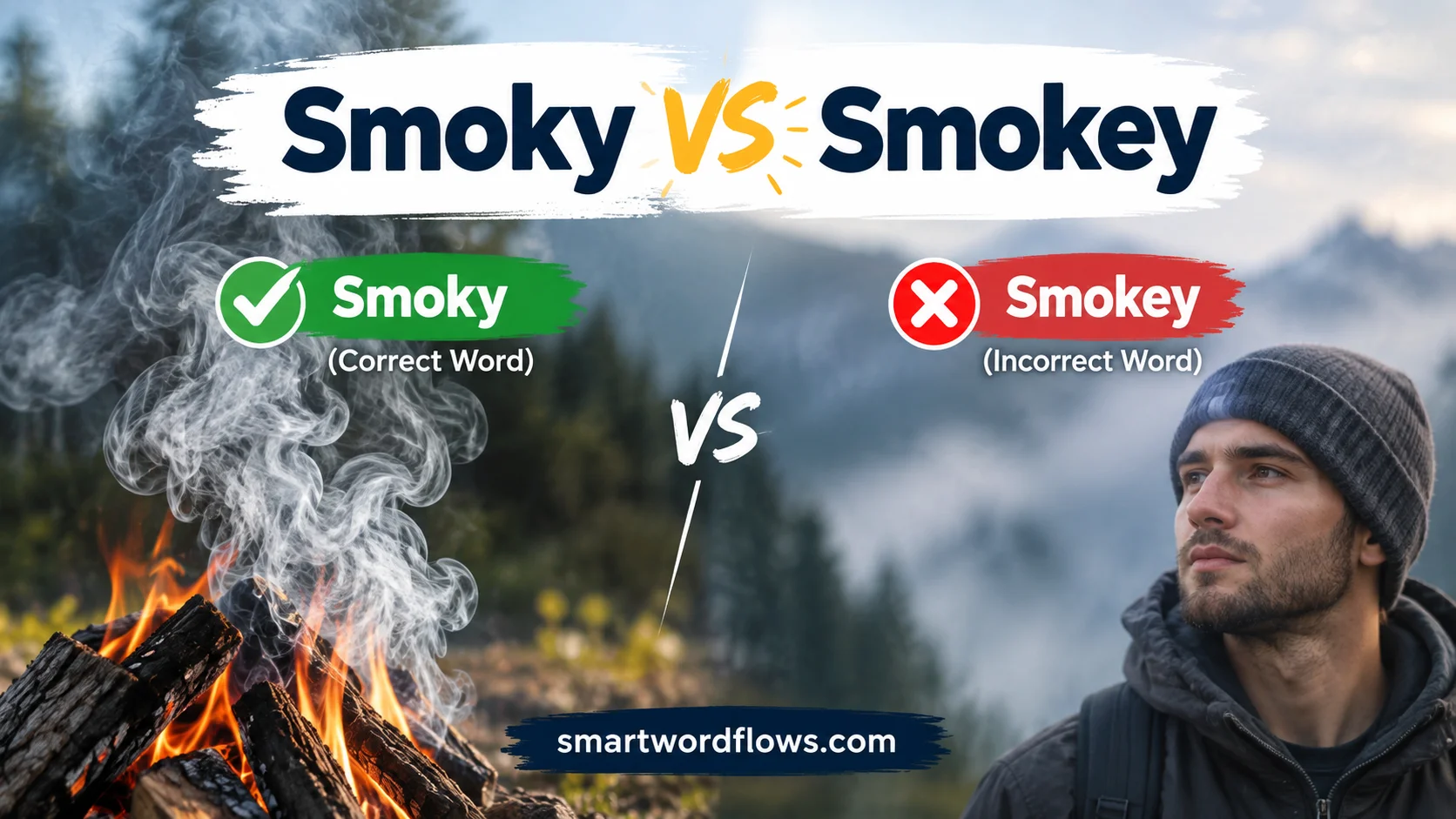

Have you ever wondered whether Smoky vs Smokey is the correct spelling? You’ll often see both forms in writing, menus, descriptions, and names. Although they look almost identical, they don’t always serve the same purpose. Smoky is the standard spelling used to describe something filled with smoke or having a smoky taste or smell. Smokey, however, appears in certain names and established uses, which makes this spelling confusing for many readers and writers.
Understanding the difference between smoky and smokey can help you choose the right word in everyday and formal writing. In most situations, smoky is the form you should use when describing flavor, smell, air, or appearance. Meanwhile, Smokey is commonly found in proper names, such as Smokey Bear, a well-known American wildfire-prevention mascot. Learning these simple usage rules makes the distinction much easier to remember.
Quick Answer: Smoky or Smokey?
Smoky is the standard spelling you should normally use when the adjective describes something filled with smoke or having the qualities of smoke.
For example:
- The kitchen became smoky after the food burned.
- The ribs had a rich, smoky flavor.
- She chose a smoky gray shade for the walls.
- The smoky air made it difficult to see clearly.
However, smokey isn’t simply a misspelling in every situation. Cambridge Dictionary lists smokey as a variant of smoky.
The spelling Smokey also appears in established proper names. The best-known example is Smokey Bear, the American wildfire-prevention mascot.
The simple rule
Use “smoky” for ordinary descriptive writing.
Use “Smokey” when the established name or source specifically uses that spelling.
| Spelling | Typical use | Example |
| smoky | Standard descriptive adjective | a smoky room |
| smoky | Food, smell, appearance, atmosphere | smoky barbecue |
| smokey | Recognized variant | smokey as an alternative spelling |
| Smokey | Proper name | Smokey Bear |
The important point is context. Smoky and smokey overlap in meaning, but they don’t always have the same practical use.
Comparison Overview
Before getting into the finer details, here’s a quick comparison of smoky vs smokey.
| Feature | Smoky | Smokey |
| Word type | Adjective | Adjective variant or proper name |
| Basic meaning | Relating to or resembling smoke | Can carry the same descriptive meaning |
| Standard descriptive spelling | Yes | Variant |
| Common in general writing | Yes | Less common |
| Used in food descriptions | Yes | Possible but less standard |
| Used for colors and appearance | Yes | Possible as a variant |
| Used in proper names | Sometimes | Yes, notably Smokey Bear |
| Comparative | smokier | Less commonly encountered |
| Superlative | smokiest | Less commonly encountered |
| Safest choice for ordinary US English | Smoky | Usually not |
One detail stands out: smokey has legitimate uses. That means a spelling checker shouldn’t automatically convince you that every occurrence of smokey represents an error.
Cambridge Dictionary records smokey as an alternative spelling, while smoky serves as the main dictionary form.
Main Differences Between Smoky vs Smokey
The biggest difference isn’t really pronunciation. It’s usage and spelling preference.
When you’re writing an ordinary sentence, smoky is the natural choice:
The restaurant had a warm, smoky atmosphere.
When you’re dealing with an established name, however, you should preserve the original spelling:
Smokey Bear teaches people about wildfire prevention.
There’s also a broader spelling lesson here. English often creates adjectives by adding -y, but the base word doesn’t always keep its final e. That’s why smoke becomes smoky, rather than smokey, in the standard form.
Smoky is the standard everyday form
If you’re describing smoke, smoke-like qualities, or something that tastes or smells like smoke, smoky is generally the form to reach for.
Examples include:
- smoky air
- smoky room
- smoky smell
- smoky flavor
- smoky barbecue
- smoky cheese
- smoky eyes
- smoky gray
- smoky atmosphere
It’s concise, familiar, and widely used.
Smokey has specific legitimate uses
Smokey can function as a variant spelling of the adjective. It can also appear as part of a proper name.
That second use is especially important. Proper names don’t follow ordinary spelling preferences in the same way common adjectives do. If a person, organization, character, product, or mascot officially uses Smokey, changing it to Smoky can produce the wrong name.
Pronunciation usually doesn’t solve the problem
Another reason this pair causes confusion is that the spelling doesn’t provide an obvious pronunciation distinction.
In ordinary use, smoky and smokey are generally pronounced alike. The difference sits on the page rather than in the sound.
That means you can’t rely on hearing the word to decide which spelling belongs in your sentence. You need to consider the context.
What Does Smoky Mean?
The adjective smoky describes something that contains smoke, resembles smoke, or has qualities associated with smoke.
It’s a flexible word. You can use it for physical environments, flavors, smells, colors, visual effects, and even moods or atmospheres.
Smoky Meaning “Filled With Smoke”
The most direct meaning involves actual smoke.
Imagine walking into a kitchen after someone accidentally leaves oil heating on the stove. The air might become smoky.
For example:
- The bedroom became smoky after the candle tipped over.
- The firefighters entered a smoky building.
- Smoke filled the hallway, leaving it dark and smoky.
In these sentences, smoky describes an environment where smoke is present.
It’s closely connected to the noun smoke, but the adjective gives you a convenient way to describe the condition of something.
Smoky Meaning “Like Smoke”
The word also works when something doesn’t literally contain smoke.
A color can look smoky. A scent can smell smoky. A flavor can taste smoky.
For example:
- The designer selected a smoky gray color.
- The tea had a subtle smoky aroma.
- The cheese developed a smoky taste.
Here, the word describes a quality rather than necessarily indicating actual smoke.
That’s one reason smoky appears so often in food, fashion, makeup, interior design, and photography.
Smoky in Food and Drinks
Food writers use smoky constantly because smoke can create a distinctive flavor profile.
A steak cooked over wood, for instance, may develop a smoky flavor. Barbecue cooked over charcoal can also have a noticeable smoky character.
You might see descriptions such as:
- smoky barbecue sauce
- smoky grilled chicken
- smoky cheddar
- smoky salsa
- smoky coffee
- smoky whiskey
- smoky roasted vegetables
The word doesn’t necessarily mean someone poured smoke into the food. Instead, it describes a flavor or aroma associated with smoke.
That distinction helps explain why smoky can describe both something physical and something sensory.
What Does Smokey Mean?
Smokey has two important uses worth understanding.
First, dictionaries can recognize it as a variant spelling of smoky. Cambridge Dictionary specifically lists smokey as a variant.
Second, Smokey appears in proper names.
This creates an important difference between dictionary spelling and real-world naming.
Smokey as a Variant Spelling
If you encounter smokey in a text, it isn’t automatically proof that the writer doesn’t know how to spell the word.
Some dictionaries recognize the form as an alternative. That means the spelling exists in English usage.
Still, recognizing a variant doesn’t mean you should automatically choose it.
For everyday US English, smoky remains the straightforward choice.
Think of it this way:
Recognized variant ≠ preferred choice in every context.
A dictionary can document a form without recommending it as the first option for every piece of writing.
Smokey in Proper Names
Proper names are a different story.
One famous example is Smokey Bear, the wildfire-prevention mascot associated with the US Forest Service. The name intentionally uses Smokey.
If you’re writing about that mascot, you shouldn’t “correct” the name to Smoky Bear. The established name takes priority.
This is similar to how you preserve unusual spellings in people’s names. If someone’s name is spelled differently from the common form, changing it because another spelling looks more familiar would be incorrect.
Why “Smokey” Looks So Natural
There’s a simple reason this spelling feels intuitive.
The base word is smoke:
SMOKE → ?
When people add -y, they may naturally think:
SMOKE + Y = SMOKEY
That visual pattern feels logical.
However, standard English spelling gives us:
SMOKE → SMOKY
The final e disappears.
That’s why smoky can look slightly unusual when you first encounter it, even though it’s the standard spelling.
Why Is Smoky Spelled Without an E?
The spelling comes from the way English handles a final silent e when forming certain words.
The base noun is:
smoke
The adjective is:
smoky
So the spelling changes like this:
smoke → smoky
The same kind of spelling adjustment appears in other English words.
For example:
- noise → noisy
- ice → icy
- spice → spicy
- shine → shiny
- taste → tasty
These examples aren’t identical in every grammatical detail, but they demonstrate a useful spelling pattern.
The key thing to remember is that smoky has become an established standard form. You don’t need to reconstruct the spelling every time you use it.
A Useful Memory Trick
Think of the word as:
SMOKE → SMOKY
Not:
SMOKE → SMOKEY
Once that pattern becomes familiar, the spelling becomes much easier to remember.
Smoky vs Smokey in American English
In American English, smoky is the normal choice for ordinary descriptive writing.
You’ll commonly see it in:
- newspapers
- magazines
- recipes
- product descriptions
- school assignments
- professional writing
- fiction
- everyday conversation
Examples:
The smoky scent of the campfire drifted through the trees.
She ordered ribs with a smoky barbecue glaze.
The artist used smoky shades of gray and blue.
Meanwhile, Smokey can appear because of a proper name or because a writer chooses the recognized variant.
The distinction isn’t comparable to obvious regional pairs such as color/colour. The issue here is more about standard form, variant spelling, and proper names.
Smoky vs Smokey in British English
British English also uses smoky as the main adjective.
The broader spelling issue remains similar: smokey can appear as an alternative form.
That means you shouldn’t assume that smokey is exclusively an American spelling or that smoky belongs only to British English. The distinction doesn’t work that way.
If you’re writing general English and want the clearest conventional form, smoky is the practical choice.
Smoky vs Smokey in Common Phrases
Some expressions appear so often that knowing the standard spelling becomes useful.
Smoky Room
A smoky room contains smoke or has an atmosphere strongly affected by smoke.
The old fireplace left the room smoky.
Here, smoky is the natural spelling.
Smoky Eyes
Smoky eyes refers to a makeup style in which darker shades are blended around the eyes to create a soft, hazy appearance.
The phrase is established in beauty and fashion writing.
She created a dramatic smoky-eye look for the evening.
Notice that the word still uses smoky even though no literal smoke exists.
Smoky Flavor
A smoky flavor tastes or smells like smoke.
The grilled peppers added a smoky flavor to the sauce.
This is especially common in recipes and restaurant descriptions.
Smoky Smell
A smoky smell suggests the odor of smoke.
A smoky smell lingered in the kitchen.
The meaning is straightforward, and smoky is the usual spelling.
Smoky Gray
Smoky gray describes a gray shade with a soft, hazy, smoke-like quality.
The walls were painted a muted smoky gray.
This usage shows how the adjective can move beyond literal smoke.
Smoky Atmosphere
A smoky atmosphere can describe actual smoke-filled air.
It can also create a descriptive image in creative writing.
The smoky atmosphere gave the small jazz club an old-fashioned feel.
The word works because it connects the scene with the visual and sensory qualities of smoke.
Also Read This: Treet vs Treat: Which Spelling Is Correct?
Smoky vs Smokey Examples in Sentences
The easiest way to understand this difference is to see it in action.
| Word | Example sentence | Explanation |
| Smoky | The room became smoky after the fire. | Smoke filled the room. |
| Smoky | The chicken had a delicious smoky flavor. | The food tasted like smoke. |
| Smoky | She wore smoky gray clothing. | The color resembled a hazy gray tone. |
| Smoky | A smoky smell came from the kitchen. | The smell resembled smoke. |
| Smoky | The restaurant served smoky grilled vegetables. | The vegetables had a smoke-related flavor. |
| Smokey | Smokey Bear is a well-known mascot. | Smokey is part of the established proper name. |
| Smokey | Some dictionaries list smokey as a variant. | The spelling exists as an alternative form. |
More Examples With Smoky
Literal:
The chimney produced a smoky plume.
Sensory:
The sauce had a deep smoky aroma.
Visual:
A smoky haze covered the distant hills.
Figurative:
The singer’s smoky voice suited the slow jazz song.
That final example is especially useful. A voice cannot literally contain smoke, yet smoky can describe its husky, soft, or evocative quality.
Grammar and Word Forms of Smoky
Understanding related forms can make the spelling easier to remember.
Smoky
Smoky is an adjective.
The cabin was smoky.
Smokier
The comparative form is smokier.
The second batch had a smokier flavor.
Notice the spelling:
smoky → smokier
The y changes to i before the comparative ending.
Smokiest
The superlative form is smokiest.
This sauce has the smokiest flavor of the three.
Again, the spelling changes:
smoky → smokiest
Smokiness
The noun form is smokiness.
It describes the quality or degree of being smoky.
The smokiness of the grilled peppers was noticeable.
The family of words looks like this:
smoke → smoky → smokier → smokiest → smokiness
That word family provides another useful reminder that smoky is the standard base adjective.
Common Mistakes With Smoky and Smokey
Even though this is a small spelling difference, several mistakes appear repeatedly.
Treating Smokey as Always Wrong
This is probably the biggest mistake.
It’s tempting to say:
“Smoky is correct. Smokey is wrong.”
That’s too absolute.
Smoky is the standard descriptive form, but dictionaries recognize smokey as a variant.
Proper names create another exception.
A better explanation is:
Smoky is the standard form for ordinary descriptive writing, while smokey can appear as a variant or in established names.
That’s both more accurate and more useful.
Changing a Proper Name
Suppose you’re writing about Smokey Bear.
Changing the name to Smoky Bear would create an incorrect version of the established name.
Proper names deserve special treatment because spelling is part of the identity.
Assuming the Extra E Changes the Pronunciation
The spelling difference doesn’t necessarily give you a different spoken word.
In ordinary usage, smoky and smokey generally have the same pronunciation.
Therefore, listening to someone say the word won’t always tell you which spelling they intended.
Using Smokey Automatically in Formal Writing
Because smoke contains an e, writers sometimes carry that letter into the adjective.
For general formal writing, smoky is the cleaner and more conventional choice.
If you’re writing a report, article, school assignment, recipe, or business description, smoky will usually serve you well.
When Should You Use Smoky Instead of Smokey?
Here’s the practical decision guide.
Use smoky when you’re:
- describing a smoke-filled room
- describing smoky air
- talking about a smoky smell
- describing a smoke-like color
- discussing smoky food
- describing a smoky flavor
- writing about smoky makeup
- describing a smoky voice
- writing formal or general English
Use Smokey when:
- it’s part of an established proper name
- you’re reproducing a source’s intentional spelling
- you’re using the recognized variant in a context where that form is appropriate
This gives you a simple rule without pretending that English has no exceptions.
Smoky vs Smokey: A Simple Decision Guide
When you’re unsure, ask one question:
Am I using the word as an ordinary adjective?
If the answer is yes, choose:
smoky
If the word belongs to an established name, preserve the official spelling.
For example:
The room was smoky.
Ordinary adjective → smoky
The sauce had a smoky taste.
Ordinary adjective → smoky
Smokey Bear appeared in the campaign.
Proper name → Smokey
Smokey is listed as a variant spelling.
Dictionary/variant context → smokey
This approach is far more useful than memorizing a blanket “right versus wrong” rule.
Is Smokey a Misspelling of Smoky?
Not necessarily.
For ordinary descriptive writing, smoky is the standard spelling and the form most writers should choose.
However, smokey has legitimate documented uses. Cambridge Dictionary lists it as a variant of smoky.
There’s also the proper name Smokey Bear, where the spelling with e is intentional.
So the most accurate answer is:
“Smoky” is the standard descriptive spelling, while “smokey” is a recognized variant and also appears in proper names.
That distinction prevents two opposite errors. You don’t want to call every smokey occurrence wrong, yet you also don’t want to use smokey automatically when ordinary descriptive English calls for smoky.
Is Smoky or Smokey More Common?
Smoky is the more useful standard form for everyday descriptive writing.
You’ll encounter it naturally in descriptions of:
- food
- smoke
- colors
- aromas
- makeup
- voices
- landscapes
- atmospheres
Smokey appears in narrower contexts, including variant usage and proper names.
Search-engine frequency alone isn’t a reliable way to answer this question because proper names, brand names, historical references, and unrelated documents can distort raw results. For a spelling guide, dictionary status and actual grammatical function provide a much better basis for deciding which form to use.
A Real-World Case: Smokey Bear
The name Smokey Bear is a useful example because it demonstrates why context matters.
If someone sees Smokey, they might assume the writer accidentally added an e. In this case, that assumption would be wrong.
Smokey Bear is the established name of the wildfire-prevention mascot.
That creates an important writing principle:
Don’t “correct” a proper name into the spelling you personally expect.
The same principle applies far beyond this word pair. Names, titles, brands, organizations, and characters can intentionally use spellings that differ from ordinary dictionary forms.
How to Remember the Correct Spelling
If you frequently confuse smoky and smokey, use one simple memory trick:
Think “smoke becomes smoky”
SMOKE → SMOKY
The final e drops away.
You can also remember the related forms:
smoke → smoky → smokier → smokiest
That pattern makes the spelling easier to recognize.
When you see smokey, pause for a second. Ask whether it’s:
- A proper name
- A quoted or intentional variant
- An ordinary adjective
If it’s an ordinary adjective, smoky is usually the answer.
FAQs :
1. Is “smoky” or “smokey” correct?
Smoky is the standard spelling in most English writing. Use it when describing something that contains smoke or has a smoky taste, smell, or appearance.
2. Is “smokey” an incorrect spelling?
Not always. Smokey is an accepted spelling in certain proper names and established terms. For example, Smokey Bear uses this spelling.
3. What does “smoky” mean?
Smoky describes something that contains, resembles, or smells like smoke. You can also use it for foods and drinks with a distinct smoke-like flavor.
4. Can I use “smokey” to describe food?
Usually, smoky is the preferred spelling when describing food. For example, “The barbecue has a smoky flavor” is standard English.
5. What is the difference between smoky and Smokey?
Smoky is the standard adjective, while Smokey is mainly used in specific names and established expressions. The context determines which spelling is appropriate.
Conclusion :
The difference between smoky and smokey is simple once you know the rule. Use smoky when describing smoke, flavor, smell, or appearance. Use Smokey when it forms part of a recognized name, such as Smokey Bear. Remembering this distinction will help you choose the correct spelling confidently in both everyday and formal writing.